Your writer just quit, leadership wants to know your AI search strategy, and you have thirty topic gaps you cannot execute on. If that feels like a lot, that's normal. Almost every content lead is in the same spot right now.
Here's the good news. Picking from the best GEO tools for content teams is not a six-month project. It's one decision about where your real bottleneck sits.
Generative engine optimization is the practice of structuring content so AI engines like ChatGPT, Perplexity, Gemini, Claude, and Google AI Mode can find it, understand it, and cite it inside their answers. The prize isn't a blue link at position one. It's being named in the answer itself.
Most tools in this space do one of two jobs. They measure where you show up in AI answers, or they help you produce content for those answers. A few do both. Once you know which job you actually need, your shortlist gets small fast.
That's the whole trick, by the way. The generative engine optimization content teams can actually sustain isn't a new discipline bolted onto your week. It's your existing editorial process, pointed at a different target and measured differently.
This guide compares four tools built for editorial work: DeepSmith, Frase, AirOps, and MarketMuse. We'll be honest about where each one wins, including where a competitor beats our own pick.
How we picked these tools
Roundups are only useful when you know the scoring. So here's ours, weighted in this order.
- Editorial workflow fit. Does it produce a publish-ready draft in your voice, or does it hand you a brief and a scorecard? You're buying a system, not another dashboard.
- AI-visibility coverage by tier. Which engines does it track at the entry price, and how many prompts does the cheapest plan include? Entry-tier ceilings matter more than the sticker price.
- Distribution built in. Does repurposing into LinkedIn, X, and newsletter happen inside the tool, or does it become another hour per piece?
- Brand-voice enforcement that works. A style guide PDF your writers ignore isn't enforcement. Structured voice context that shapes every draft is.
- Operational economics. Per-seat fees, per-task fees, generation caps, overage rates. The fine print is where budgets break.
- Time to first useful output. Days or weeks? You need to publish this month, not after a workshop.
- Refresh and decay signals. Does it flag pages losing AI citations before your traffic drops?
We scoped this to editorial production and optimization. Pure executive dashboards and share-of-voice trackers are out, because they report on content without helping you make any.
One thing worth saying plainly: no vendor here publishes verified third-party head-to-head benchmarks. Everything below rests on documented features and public pricing, not invented performance numbers.
Why this list looks different from a tracker roundup
You'll notice we're not ranking dashboards. That's deliberate.
The shift toward AI-led discovery is what put this on your roadmap, and the research suggests it's still early enough to move. A tracker tells you that a competitor owns the answer to a question your buyers ask. Useful. Then what? You still have to write the piece, get it in your voice, link it, publish it, and check back in six weeks. The reporting was never the hard part.
So GEO content workflow tools get judged here on whether they move you from a gap to a published page. If you want the wider category view, we cover the full GEO tool landscape separately. A tool that only measures is not a workflow tool, no matter how good the charts look.
That's also why content optimization for AI answers can't sit in a separate tab from production. If your optimization step happens after the draft exists, you're paying for rework every single time.
What good looks like in an editorial GEO workflow
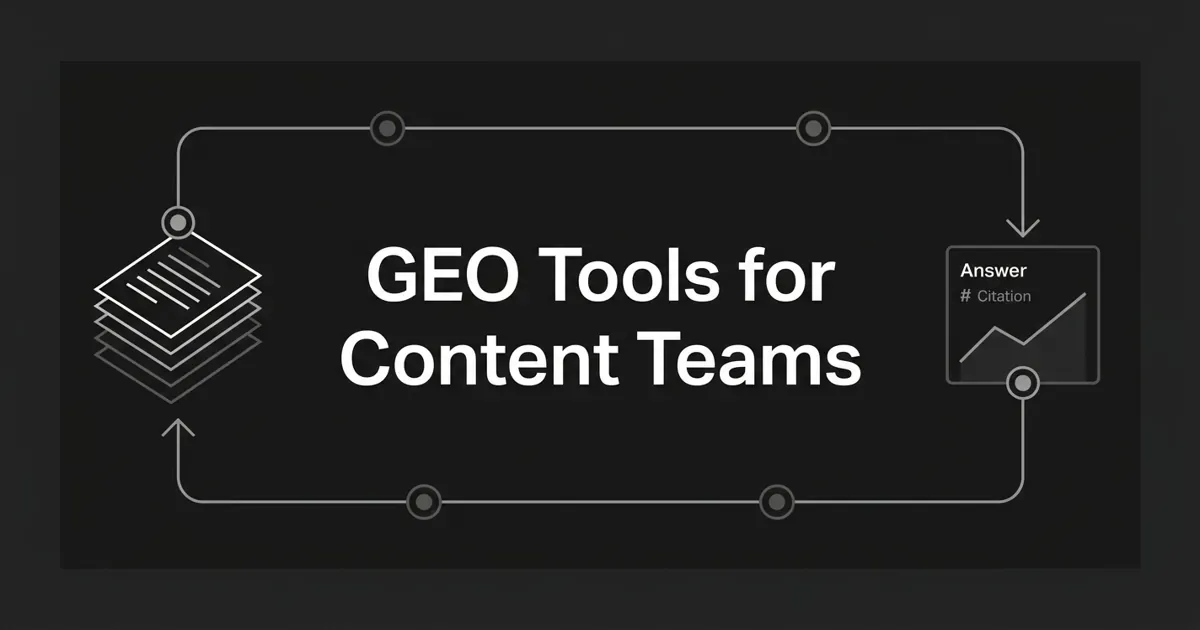
Before you compare vendors, get clear on the loop you're trying to build. It has four steps, and most teams are missing the same two.
Find the gap. Which questions do your buyers ask AI, and who gets cited instead of you? This is prompt tracking, and it's where most teams start.
Produce the answer. Turn that gap into a real article in your voice, with answer-ready structure. Most teams stall here, because this is the expensive step.
Ship and distribute. Publish it, then turn it into the LinkedIn post and the newsletter section. Distribution is the step that quietly falls off every month.
Watch and refresh. Check whether citations moved, and catch pages that start decaying.
Steps one and four are measurement. Steps two and three are production. The trade press has been untangling GEO and AEO as labels for a while now, but the loop is what actually matters. The tools below sit at different points on it, and that's really the only distinction worth weighing when you're choosing.
The best GEO tools for content teams at a glance
| Rank | Tool | Primary job | Entry price | Entry-tier engines tracked | Publish-ready drafts | Distribution built in |
|---|---|---|---|---|---|---|
| 1 | DeepSmith | AI search analytics plus on-brand production | $99/mo Pro ($80 annual) | ChatGPT | Yes, Writer plus Autowrite | Yes, Apps Library |
| 2 | Frase | SEO plus GEO bundle with on-site assistant | $49/mo Starter ($39 annual) | ChatGPT, Google AI (50 prompts) | Yes, AI Article Wizard | Frase Answers widget |
| 3 | AirOps | Workflow builder for bulk production and refresh | Free Insights, then $200/mo Solo | ChatGPT (Solo) | Yes, needs human review | Limited |
| 4 | MarketMuse | Content intelligence, planning, and briefs | Free, then $99/mo Optimize | None | No, briefs only | None native |
1. DeepSmith: best for the produce-and-track loop

Most teams end up with a split. A tracker tells you you're invisible in ChatGPT, then you open a separate writing tool and start from scratch. The measuring and the fixing never touch each other.
DeepSmith closes that loop. It's an AI search analytics and content production platform in one, and it's a production engine rather than a writing assistant. Output is a finished, on-brand article, not a first draft you rescue.
You set it up once from your website. Then seven modules work off that same shared context.
The AEO module tracks mention rate (how often AI names you), citation rate (how often AI links to your pages), and share of voice against competitors across ten engines, from ChatGPT, Gemini, Perplexity, and Claude to Google AI Overviews, AI Mode, Copilot, Grok, Meta AI, and DeepSeek, with per-platform breakdowns and a competitor leaderboard. The Prompts screen shows per-question mention and citation rates with full answer history. Not sure which questions to track? Discover Prompts builds a starter set from your product, persona, and buyer-stage context, so you're not staring at an empty tracker on day one. The Pages view shows which of your pages get cited and which prompts drive them.

Content Map turns your site and your competitors' sites into one topic map, so coverage is a measurement instead of a hunch. It surfaces coverage gaps where a rival publishes more than you and untapped topics where you have nothing at all, re-checked every 24 hours. Opportunity Agents then read that data and hand back content ideas with the data point that justifies each one attached.
Then Content Studio moves ideas from New Ideas to Planned Content to Produced. The Writer turns one planned idea into a finished, brand-grounded article: researched, internally and externally linked, with a cover image and publish-ready metadata. Autowrite goes further. Configure an article at planning time and it writes itself on its scheduled date, with nobody in the app. Produced Content is where you review, revise, regenerate the cover, and publish straight to WordPress, Webflow, Strapi, Sanity, Contentful, or your own webhooks.

That's the part that matters for the produce-and-track loop. The gap you spot in the tracker becomes an article on a calendar, and the article publishes itself.
Distribution is built into the article instead of being a separate chore. Every finished piece arrives with social posts already written. The Apps Library spins one article into platform-native versions for LinkedIn, X, Medium, Substack, newsletter and nurture email, Reddit, and more, each tuned to that channel's tone and length.
Underneath everything sits Deep IQ, the brand context layer: your positioning, products, personas, brand voice, visual guidelines, and content types stored as structured data. That's what keeps drafts accurate without re-briefing every article. Content Map classifies every page you have published, which is what powers internal linking automatically. Keyword coverage, heading structure, schema markup, internal linking, and metadata are part of the writing pipeline, not bolted on after.
Pricing. Pro is $99/mo ($80 annual) for 20 articles, 50 tracked prompts, 5 seats, tracking ChatGPT. Grow is $199/mo ($160 annual) for 40 articles, 100 prompts, 7 seats, adding Perplexity. Scale is $399/mo ($299 annual) for 90 articles, 200 prompts, 10 seats, adding Gemini. Enterprise is custom and covers all ten engines, with 1:1 onboarding and a dedicated account manager. There's a 7-day free trial with real data and real drafts, and no long-term contracts.
Best for: content and marketing teams, in-house or agency, that want one system to show where they appear in AI answers, close the gaps with on-brand articles, and ship them, with citation-ready formatting native.
Honest limitation: engine coverage is tier-gated, so a team that needs Claude and Google AI Mode on day one is on Enterprise, not Pro. That said, ChatGPT has the largest user base of the ten, so Pro covers where most teams need to start, and you add Perplexity, Gemini, and the rest as you scale into Grow and beyond. DeepSmith tracks mention and citation; it doesn't control or guarantee rankings, citations, or traffic, and no tool in this roundup can. And if you want a model that talks you through a draft paragraph by paragraph, this isn't that workflow, because DeepSmith hands you a finished piece rather than coaching you through one.
2. Frase: best SEO and GEO bundle for tens of articles a month

Frase started as an SEO content workflow and has grown a full GEO layer on top. If you want one subscription instead of four, start here.
The stack covers the whole editorial arc. Research gives you topic clusters and SERP-driven content briefs. Write is an AI Article Wizard with brand voice controls and SEO plus GEO scoring inside the editor. Optimize adds a site audit and an AI visibility score. Publish runs through FraseCMS or integrations with WordPress, Webflow, Sanity, and Wix.
Two features stand out. Content Guard flags pages that are losing AI citations or decaying in rankings, so you can refresh before traffic slides. Frase Answers is a conversational on-site widget that pulls answers from your own content and captures what visitors are actually asking. That second one is unusual in this group, and it's genuinely useful intent data.
Frase's engine coverage scales cleanly with the tier, which makes it easy to reason about. Starter tracks ChatGPT and Google AI with 50 prompts. Professional adds Perplexity at 200 prompts. Scale adds Claude and Gemini at 500 prompts.
Pricing. Starter is $39/mo annual ($49 monthly) for 10 articles, 25 AI generations, 1 seat, 1 site. Professional is $103/mo annual ($129 monthly) for 40 articles, 100 generations, 3 seats, 5 sites. Scale is $239/mo annual ($299 monthly) for 100 articles, 350 generations, 5 seats, 10 sites. Enterprise is custom. There's a 7-day trial.
Best for: content teams that want SEO, GEO, an on-site AI assistant, and decay monitoring on one bill, publishing tens of articles a month rather than hundreds.
Honest limitation: the AI generation caps are tight at every tier, from 25 on Starter to 350 on Scale, so heavy publishers hit the ceiling. If those caps are your sticking point, we compare the Frase alternatives in more depth elsewhere. Starter's 50 prompts across two engines is too narrow for real competitive benchmarking. Extra seats run $29/month on Professional and Scale, which adds up. Site Audit and Content Guard sit behind higher tiers.
3. AirOps: best for bulk production and refresh at scale

AirOps is the power tool here. It pairs an AI search visibility layer with a no-code workflow builder, and it's aimed at operations producing or refreshing content by the hundred.
The Workflow Builder lets you chain models, data, and steps into repeatable jobs. Brand Kits inject voice and positioning guardrails into those workflows. The Knowledge Base curates the sources your workflows draw from. Grid view is the standout: bulk operations across hundreds of rows at once, which is exactly what you want when you're refreshing a library, not writing one post. It publishes directly to WordPress, Webflow, and Shopify.
If your team has ops or engineering capacity and wants to compose its own pipelines rather than accept someone else's, this flexibility is the whole point.
Be honest with yourself about the cost of that flexibility, though. Most reviewers report two to three weeks before they're productive. Brand Kits need iteration before output is publish-ready, and human review stays in the loop. Teams that stall on that ramp often end up scanning the AirOps alternatives for something lighter.
Pricing. Insights is free, with 1,000 to 10,000 tasks and one seat. Solo is $200/mo for 20,000 tasks and one seat, with ChatGPT visibility insights. Pro is $2,000/mo for 75,000 tasks, unlimited seats, and multi-engine coverage. Enterprise is custom, and a separate Pages product handles programmatic landing pages. Overage typically runs $0.025 per task.
Best for: large content operations shipping or refreshing hundreds of pieces a month, with the engineering capacity to build and maintain workflows.
Honest limitation: the jump from Solo at $200 to Pro at $2,000 is the largest mid-tier gap in this comparison, and there's nothing in between. Multi-engine tracking only arrives at that $2,000 tier. Task-based billing makes monthly cost hard to predict, and grid performance can lag past roughly 100 rows.
4. MarketMuse: best for planning and briefs

MarketMuse answers a different question than the rest. It's not trying to write your article. It's trying to tell you which article to write and how to brief it properly.
Topic Authority scores how completely your domain covers a topic against competitors, and the underlying topic modeling is genuinely hard to replicate with a general SEO tool. Content Inventory audits every page on your site, classified by topic, type, angle, and buyer stage. It's the deepest audit in this group. Personalized Difficulty scores keywords against the actual quality of pages already ranking, not just backlink counts, which is a more realistic read than most difficulty scores. Compete handles SERP and content-gap analysis. The Heatmap overlays topic coverage in the editor and shows missing subtopics.
The briefs are the real draw. They're semantically rich outlines with related terms, structure guidance, and link suggestions, thorough enough to cut re-briefing cycles with freelancers.
MarketMuse was acquired by Siteimprove in 2024, which is worth knowing when you plan a multi-year stack.
Pricing. Free covers 1 user and 10 queries. Optimize is $99/mo for 1 user, 100 queries, 100 tracked topics, and 5 briefs. Research is $249/mo for 3 users with unlimited queries and 10 briefs. Strategy is $499/mo for 5 users, 10,000 tracked topics, and 20 strategy docs. Premium is custom.
Best for: strategy-led content teams whose bottleneck is deciding what to write and briefing it well, and who are willing to pair it with separate production and visibility tools.
Honest limitation: the workflow stops at research and briefs, with no native draft-to-publish pipeline and no repurposing or distribution. If that's a dealbreaker, the MarketMuse alternatives worth weighing are mostly production-first tools. It's also the only tool of the four with no first-party AI citation or mention-rate tracking, so it can't tell you whether AI engines are citing you. Strategy is $499/mo with a five-seat cap, and the heatmap and inventory outputs take practice to read.
How to choose
Forget the feature lists for a second. Name your actual bottleneck, then match it.
Choose DeepSmith if you want one platform that shows where you appear in AI answers, produces on-brand articles with AEO formatting, internal linking, and metadata baked in, runs hands-off on a calendar through Autowrite, and turns each piece into LinkedIn, X, and newsletter assets in the same voice. This is the pick when your problem is that measuring and producing live in different tools.
Choose Frase if you'd rather have SEO, GEO, an on-site assistant, and decay alerts on one subscription, and you publish tens of articles a month. Its per-tier engine coverage is the cleanest in this group. Just watch those generation caps.
Choose AirOps if you're operating at very high volume with ops or engineering support and want to build your own pipelines. Nothing else here handles bulk refresh as well. Budget for the Solo to Pro cliff.
Choose MarketMuse if your problem isn't production at all. If you have writers but keep pointing them at the wrong topics, MarketMuse's audit and briefs will fix more than a drafting tool would. Plan to pair it with something that tracks citations.
Notice that three of these four can be the right answer. The question is never which tool is best in the abstract. It's which bottleneck is yours this quarter.
One more filter before you commit. Run the entry tier against your real numbers, not the plan you imagine buying later. How many articles do you actually publish a month? How many prompts do you need tracked to see whether you're winning? How many seats? Generative engine optimization content teams abandon usually died on one of those three lines, not on features. A plan that covers one engine and 50 prompts will look fine in a demo and thin by month two.
And give yourself a trial that produces something real. A tool you can't get output from in week one is a tool your team won't open in month two. That's the failure mode worth avoiding, because a stalled rollout costs you more than the subscription did.
If your answer is "we can see the gaps but we can't produce fast enough to close them," that's the loop DeepSmith was built for. Start a 7-day free trial and you'll have real data and real drafts before you pay for anything.
You don't need a bigger team. You need a smaller first step.