You wrote something genuinely good. It ranks. It reads well. And ChatGPT still cites a competitor instead of you. That stings, and it is more common than you think.
Here is the good news: the fix is almost never the writing. It is the order. AI engines do not read your article the way a person does. They scan each section for one short, self-contained sentence that answers the question, then they quote that sentence and link to you. If your answer is buried in paragraph three, it is invisible to them, no matter how strong paragraph three is.
This guide shows you how to get cited by AI by leading every section with its answer. That pattern has a name: answer-first content. By the end, you will be able to take any article you already have and rewrite it so an engine can lift a clean sentence and quote you. You want to write content AI can quote, and the skill is smaller than it looks.
Let's start with what the pattern actually is, then walk it step by step.
What answer-first content actually is
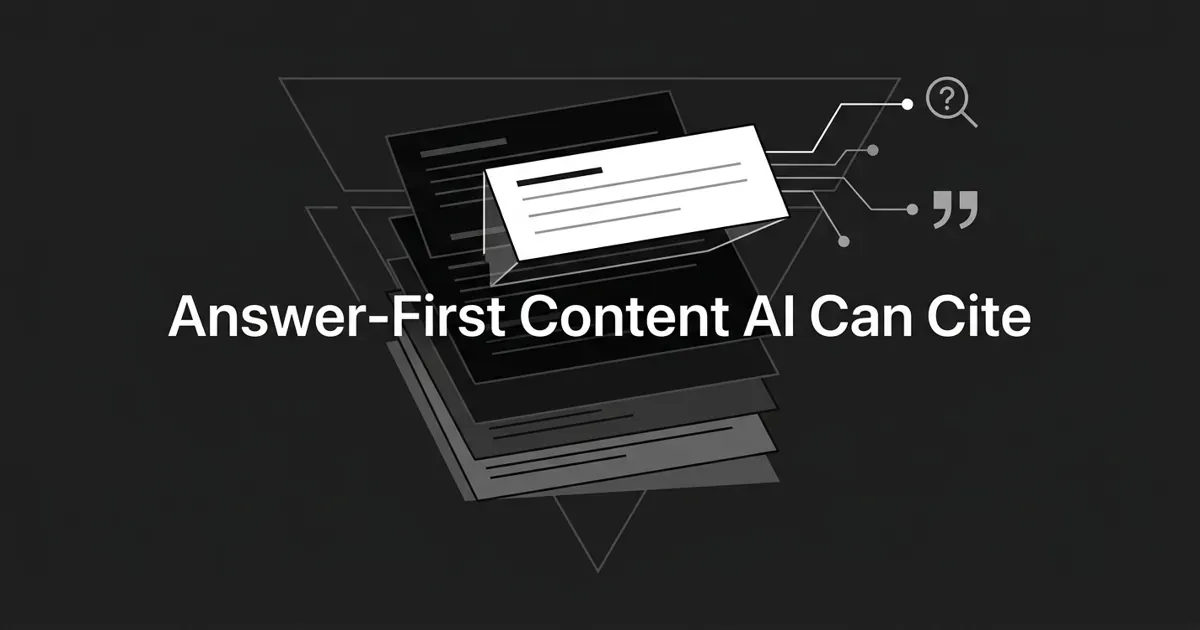
Answer-first content is writing where every major section opens with a direct, complete answer, then expands with context, examples, and caveats. The claim comes first. The support comes next. The nuance comes last. That is the whole shape.
You already know this shape by another name. Journalists call it the inverted pyramid: most important information first, supporting detail next, background and exceptions at the bottom. It goes back to the 1840s and the telegraph, and it became standard during the American Civil War, when a wire could cut off mid-story. Whatever came first had to be the most important, because nobody could count on the rest arriving.
Sound familiar? That is the exact constraint AI retrieval puts on you now. There is no guarantee anyone, human or model, reads past your first sentence. So the inverted pyramid AI search quietly runs on is the same one reporters have used for 180 years.
Here is how the journalism structure maps onto your article sections.
| Journalism layer | Answer-first counterpart |
|---|---|
| Headline | H2 or section question |
| Lede | Answer (first one to two sentences) |
| Nut graf | Main fact or supporting evidence |
| Body | Secondary facts, examples, citations |
| Tail | Caveats, exceptions, background |
The working rule for every section is short enough to tape to your monitor: direct claim first, support next, nuance last.
- The direct claim is one declarative sentence that resolves the section's question. It stands alone. It is quotable. It stays true out of context.
- The support is two to four sentences of evidence: named entities, numbers, examples, or citations that back the claim.
- The nuance is a short closing paragraph that names the limits, exceptions, or trade-offs, so the claim does not mislead when a model lifts it.
That is the content structure for AEO you are building toward. Everything below is how to build it on purpose.
Why AI engines reward the answer-first shape
AI engines cite answer-first sections because passage-level extraction is the core operation in modern AI search. Google AI Overviews and similar systems rank individual passages for relevance, not whole pages. A page that buries its answer behind a long intro loses that race even when the deeper content is excellent.
The mechanism underneath is retrieval-augmented generation. ChatGPT, Perplexity, Gemini, Claude, and Google AI Mode all retrieve candidate passages, rank them by how directly they resolve the question, and stitch the winners into one answer. A passage that reads as a complete statement lifts cleanly. A passage that reads as half an argument does not.
The engines disagree on plenty, but they agree on opening-sentence clarity. ChatGPT pulls text-heavy passages with explicit claims and rewards declarative sentences plus named entities. Perplexity weights source trust, recency, format, and semantic clarity. Google AI Mode and AI Overviews pull from structured Q-and-A blocks and reward pages that already look like answers.
Perplexity's four source-selection criteria make a clean sanity check for anything you write:
- Credibility: publisher authority and demonstrated expertise.
- Recency: how current the page is.
- Relevance: topical match to the query.
- Extraction quality: whether the page can be accurately quoted from.
Notice that last one. Extraction quality is the only criterion fully in your control this afternoon. You cannot manufacture authority overnight, but you can rewrite a first sentence so it quotes cleanly.
The data backs the shift, and some of it will surprise you. In one study of cited blog posts, 72.4% included an identifiable "answer capsule," a concise, self-contained statement of the answer. The pages without one tended to have longer intros and vaguer first sentences. Structure, not luck, separated them.
And ranking is not the safety net you might hope. Only 38% of AI Overview citations come from pages in the traditional top 10; the rest come from pages ranked 11 to 100 and beyond. A year earlier that figure was 76%. Citation is becoming its own game, and the average cited page is around 500 days old, so freshness is not the lever either. The lever is shape. That shape is the inverted pyramid AI search keeps rewarding: the answer, placed first.
One more number to make it urgent: ChatGPT skips web search entirely on roughly 65% of queries. When the model already holds the answer, nothing you publish this week changes it. So the structured answer you write today has to count, because for many queries there is no second chance to revise it.
Ready to build it? Here are the seven steps.
Step 1: Turn every H2 into a question a buyer would ask
Start by writing the one question your whole article answers, then one question per section. Use the questions your buyers would actually type into ChatGPT or Perplexity, in their words, not yours.
What to do: for each H2, ask "would someone type this into an AI engine?" "What is answer-first content?" works. "Definition and background" does not.
How you know it's done: every H2 reads as a real query. Read your outline as a list of questions. If any heading is a label instead of a question, it is not ready.
Where people go wrong: treating H2s as filing labels ("Overview," "Background," "Context"). Labels produce label-shaped sections with nothing to extract. A question forces an answer, and an answer is what gets cited.
This is the cheapest step and the highest leverage. Fix your headings first, and the rest of the rewrite almost tells you what to do.
Step 2: Write the claim sentence first, before anything else
For every section, draft the single sentence that answers that section's question, and write it before you write anything else in the section. Treat it as the section's real headline, even when it is not literally the H2.
What to do: make that sentence declarative, standalone, and true out of context. No throat-clearing, no "it depends," no windup. Just the answer.
How you know it's done: read the sentence aloud to someone who has not read the section. If they can repeat the answer back to you, it passes. If they say "wait, what?", it needs another pass.
Where people go wrong: writing all the support first and trying to surface the claim afterward. Reverse-order drafting almost always leaves you with a claim too soft to lift. Write the answer first, then earn it below.
If this feels backward, that's normal. Most of us were trained to build up to the point. Here, you lead with it. Give it a week and it feels natural, and it is most of what it takes to write content AI can quote.
Step 3: Order each section as claim, support, nuance
Put the claim sentence first, follow it with two to four sentences of evidence, and close with one short paragraph of nuance. Same order, every section, no exceptions.
What to do: lead with the claim. Back it with named entities, numbers, examples, or citations. Then name the limits or trade-offs in a closing paragraph that is shorter than the claim.
How you know it's done: highlight the first sentence and read it alone. It should answer the section's question by itself.
Where people go wrong: letting the nuance paragraph outgrow the claim. If your caveat is longer than your answer, the section reads as caveat-first, and retrieval may quote the caveat instead of your point.
Here is what that reordering looks like in practice. Take a section on choosing a content platform for AI search.
Before:
Choosing the right content marketing platform for AI search can feel like a tall order, especially with so many options on the market. In this guide, we'll walk through some of the things to consider, the categories of tools available, and the tradeoffs between them, so you can make a confident decision for your team.
That fails on every count. The first sentence has no claim; it just promises a walk-through. The actual answer does not arrive until the third sentence, and even then it is vague ("the things to consider"). There are no named entities, no numbers, no definition. There is nothing for a model to lift.
After:
A content marketing platform for AI search is a tool that tracks how AI engines cite your brand and produces the on-brand articles that close your citation gaps. To choose one, score each candidate on four dimensions: which AI engines it tracks, whether it produces finish-ready drafts or only first drafts, whether it covers engines beyond ChatGPT, and whether it tracks competitor pages alongside your own. Trade-offs to weigh include per-prompt cost, depth of brand-voice grounding, and whether distribution to channels like LinkedIn and Substack comes bundled.
See the difference? Sentence one is a standalone definition. Sentence two is a list of four dimensions a model can quote in order. The last sentence carries the nuance. A reader who stops after sentence one already has the answer. A reader who continues gets the depth. The rewrite is not longer. It is ordered.
Step 4: Match the opener to the section's intent
Pick one of three opener patterns for each section, based on what the section is for. Definition-first, list-first, or key-fact-first. One per section, chosen on purpose.
What to do:
- Definition-first: open with "X is Y." Best for what-is sections and any place a concept has to be defined before the rest makes sense.
- List-first: open with a numbered or bulleted list. Best for how-to sections and anything whose value is a structured set of items. Models quote lists in order.
- Key-fact-first: open with the single most decision-changing number in the section. Best for reasoning sections where the reader wants the headline figure before the explanation.
How you know it's done: the first sentence clearly matches one pattern. A definition looks like "X is Y." A list opener looks like "Three things matter: A, B, C." A key-fact opener leads with the number.
Where people go wrong: blending patterns so the opener is neither a definition, nor a list, nor a fact. A fuzzy opener reads as none of the three, and it lifts as nothing.
Pro tip: cap any list at nine items. Models start to degrade when they lift from lists longer than about seven to nine items. If you have more, break them into named groups.
Step 5: Cut the throat-clearing from your intro
Rewrite your first 120 words so they answer the article's main question directly, with no windup. This is where most articles quietly lose the citation before the reader even scrolls.
What to do: cut "in today's digital landscape," "let's dive in," and any sentence that sets mood instead of delivering information. Make those opening 120 words a standalone answer to the article's core question.
How you know it's done: you can lift the first 120 words on their own and they read as a real answer. Every surviving sentence moves the claim forward.
Where people go wrong: treating the intro as the place for brand tone. Intros over 120 words consistently underperform short ones on citations. Your tone belongs in the words you choose for the answer, not in a separate warm-up paragraph.
Common mistake worth naming: hedging language. "It could be argued that" and "many believe" cannot be quoted as facts, because a model cannot lift a hedge. Replace them with claims you are willing to stand behind. If you believe it, say it plainly.
Step 6: Test each section as a standalone extract
Verify each section by pulling its first sentence out and reading it alone, then checking whether an engine surfaces a version of it. This is the audit that tells you whether the rewrite actually worked.
What to do: copy each section's opening sentence into a blank document and read it with no context. Then paste it into ChatGPT or Perplexity alongside the section's question and see whether the engine returns something like it. The sections whose first sentence never shows up are your rewrite targets.
How you know it's done: aim for at least 80% of your section openers quoting cleanly on their own. Rewrite the other 20% before you publish.
Where people go wrong: testing the whole article at once. A quoted passage almost always comes from one section's opening line, so test section by section. Only the section that fails needs the fix.
Doing this by hand across a full backlog gets heavy fast, and this is where knowing which pages actually earn citations saves you hours. This is the work DeepSmith's AI Search Visibility does for you. It tracks Citation Rate and Mention Rate across ChatGPT, Gemini, Perplexity, Claude, and Google AI Mode, and its Pages view shows exactly which of your pages AI cites and which prompts drive those citations. Instead of guessing which sections to rewrite, you see the ones that already win and the ones that never surface. You still write the answer; the platform tells you where to point that effort.
Step 7: Add numbers, names, and lists as evidence
Give every major section at least one of the three things AI engines cite most: an explicit number, a named entity, or a list. Claims backed by evidence get quoted; bare assertions get skipped.
What to do: scan each section. If it has no number, no named entity (a product, company, or study), and no list structure, add at least one. Co-locate the number with the claim it supports.
How you know it's done: every major section carries a number, a named entity where you make a claim, or a list, and the article overall uses at least one list.
Where people go wrong: burying the number mid-paragraph. "82% of cited pages lead with an answer" beats "cited pages often lead with an answer." Lift the figure into the first or second sentence of its section so it travels with the claim.
Pro tip: named entities pull their weight too. "Perplexity's criteria are credibility, recency, relevance, and extraction quality" lifts far better than "AI engines use several criteria." Specific nouns win retrievals.
Where the answer-first pattern fits your bigger AEO plan
Answer-first structure is the ordering layer of your content structure for AEO, and it works best sitting inside the rest of your AEO habits, not instead of them. Question-shaped headings, self-contained passages, and a clean summary block are siblings to this pattern; each one makes your page a little easier to extract. Think of this guide as one piece of that structure, the piece that decides what your reader, and the model, sees first in every section. Get that ordering right and you have the core of how to get cited by AI.
Here is the honest gap in most tool stacks. AI-visibility trackers are great at telling you what to write about: which prompts you miss, which competitor pages win, where your coverage is thin. They do not write the answer-first structure into the draft for you. That gap is exactly the one DeepSmith closes. Its writing pipeline builds citation-ready formatting during creation, so crisp answers near the top of sections and clean structure are native to the draft, not something you retrofit after. As Pallav A., an SEO Specialist at Tahshop AI, put it: "Drafts come out close to final because the system has context it needs."
You do not have to adopt any of that to use this guide. The pattern is free, and it is yours the moment you rewrite one section.
What to do next
Every section of your article is an independent candidate for an AI engine to quote. The only thing that decides whether a section gets cited is whether its first sentence can stand alone as the answer to the section's question. Lead each section with that sentence. Support it in the next two to four. Close with the nuance. Repeat for every section. That is the entire pattern.
So here is your smaller first step. Open your best-performing article, the one you wish AI would cite, and write the claim sentence at the top of a single section. Just one. See how it reads. Then do the next one tomorrow. Momentum matters more than a perfect rewrite in one sitting.
When you want the structure built in from the first draft instead of bolted on after, you can start a free DeepSmith trial and see real drafts on your own topics before you decide. You've already learned the hard part. Now you just have to lead with it.