Pages that match AI citation-heavy formats (think SaaS listicles, technical articles, and some product pages) gain the most from content refreshes. But format alone isn’t enough. Those pages also need to fall inside an ~8–13 week freshness window to catch the recency signals AI engines love. Get both right, and a single refresh can take your brand from being invisible to being cited across a whole cluster of your buyers' prompts.
Let’s be real for a second. You’re probably a content lead looking at a backlog of 80, 150, maybe 250 URLs. You have a two-person team (if you're lucky), and your boss keeps asking why competitors are all over ChatGPT and you’re not. The old logic of "this post is two years old, let's update it" made sense for SEO, but it doesn't really work for AI citation. And the pressure to do something about AI visibility without a clear system makes every refresh decision feel like a total shot in the dark.
That gap between "we know we need to refresh" and "we know what to refresh and why it will work" is exactly what I want to help you close with this playbook.
Here’s what you'll get: a ranked view of which page types earn AI citations most often, a scoring model to pick the highest-leverage pages, a tiered cadence based on business value, the specific changes that actually move the needle, and a lightweight measurement loop that works across all the major AI platforms.
What Does "Gain the Most" Mean for an AI Content Refresh?
The biggest gains from an AI content refresh show up as new AI citations first. Organic traffic and pipeline will follow, but they’re secondary effects. If you lump all three outcomes together without picking a primary goal, your refresh program will feel like it's failing even when it's working.
I learned this the hard way. The first time we got a big citation win, our traffic didn't budge, and I almost wrote the whole project off as a failure. Then a sales rep mentioned that a huge prospect referenced the answer from that exact page on a demo call. That's when it clicked.
There are three distinct outcomes worth tracking:
- AI visibility lift: Your brand gets more mentions and citations when buyers use AI platforms. This is the main goal for AI-focused refreshes.
- Organic lift: Better rankings, click-through rates, and traffic in traditional search. This still matters because a page Google trusts is more likely to earn AI citations, too.
- Business lift: Pipeline assists like demo requests and trial signups, plus internal sales usage when a refreshed page becomes a credible resource your reps actually want to share.
The ROI from AI refreshes often shows up in these unexpected ways. A refreshed page might earn more citations without a traffic spike because the AI engine just surfaces your answer directly. Or you might see a rank improvement before the citations show up. What you’re really after is "share shift," where you start showing up in answers where a competitor used to be.
That’s a real win, even if your Google Analytics dashboard stays flat.
My practical rule: every refreshed page gets one primary KPI and one secondary KPI. Don't try to track four different metrics you'll check inconsistently; you’ll just drive yourself crazy. For a blog post targeting informational queries, the primary KPI is citation rate, and the secondary is organic traffic. For a product page, the primary KPI might be conversion rate, with the secondary being citation frequency on transactional prompts.
One honest caveat here: attribution is messy. AI citation tracking is brand new, models change constantly, and a single week of data means almost nothing. Get in the habit of re-checking every 4–6 weeks and looking for directional patterns, not single-point readings.
What's Different About an "AI Refresh" vs. a Traditional SEO Refresh?
A traditional SEO refresh is all about keyword coverage and ranking signals. An AI refresh optimizes for extractability. The key question is: can an AI engine pull a discrete, trustworthy answer block from this page?
That means starting your H2s with a direct answer instead of throat-clearing context, writing short paragraphs with one claim each, and updating facts and examples to feel current. An SEO refresh often focuses on keyword density, but an AI refresh demands a tight structure and directness that a language model can confidently attribute.
Which SaaS Page Types Are Most Likely to Gain AI Citations from Refreshes?
In SaaS, your refresh ROI is concentrated in listicles and informational articles first. Product and category pages are next, but only when their content matches how buyers actually ask questions. Everything else is a lower priority.
Here's the ranking by expected AI citation lift after a refresh:
-
Listicles (especially comparison and review style). These match the "best X for Y" and "top tools for Z" prompts that buyers use all the time. AI engines see well-structured comparison content as authoritative. Refresh impact is high.
-
Informational articles and technical guides. "How to" content, process explainers, and concept definitions are the workhorses of AI citation. They naturally align with informational queries, and AI engines favor their directness. Refresh impact is high.
-
Product pages (for transactional intent). When a product page clearly defines what the product does and who it's for, it can earn citations on prompts like "what's the best tool for X." Refresh impact is medium-high, especially when you're repositioning the page.
-
Category pages / solution hubs. These are useful when they group related content and orient a reader within a topic. AI engines cite them when a buyer's query is broad, like "what software handles X." Refresh impact is medium.
-
Help docs and support blog posts. These are frequently cited for narrow "how-to" and troubleshooting queries. Teams often overlook them, but they're high-value because the prompts are so specific and easy to answer. Refresh impact is medium.
-
Pricing pages. These are rarely cited by AI engines. They are for human buyers ready to convert, not for informational extraction. Don't put pricing pages at the top of your AI refresh list. Refresh impact is low for citations.
Here's the nuance most teams miss: self-promotional listicles get ignored by AI. We made this mistake, by the way. Our first "best tools" post was basically an ad for our own product, ranked #1 with no real criteria. It got zero traction. We had to learn the hard way that neutral, genuinely helpful listicles with transparent criteria and clear trade-offs are what earn trust from both humans and AI. Promotional ones get skipped.
In practice, a "Best Project Management Tools" post updated with 2026 evaluation criteria, a comparison table, and honest "who shouldn't use this" notes will crush a post that just exists to feature your product.
Quick Cheat Sheet: Page Type × Intent × What to Refresh
- Listicle refresh = update your comparisons with current market data, add or revise your evaluation criteria, rebuild the comparison table, and expand on "best for" segments.
- Guide refresh = update process steps for current tools, add edge cases or common failure modes, define terms that have evolved, and add a "common mistakes" section to help your reader more completely.
- Product page refresh = rewrite the page to match how buyers talk, tighten the FAQ to handle specific objections, and sharpen benefit statements to be about outcomes, not just features.
The page type and content quality matter way more than small tweaks. If the page type doesn't fit the prompt, no amount of formatting will fix it.
Page Type × Intent × Refresh Depth Reference
| Page Type | Likely AI Prompt Intent | What Makes It Citable | Refresh Depth | Common Mistake |
|---|---|---|---|---|
| Listicle (comparison/review) | Commercial investigation: "best X for Y" | Transparent criteria, structured comparisons, "best for" segments | Medium–Heavy | Self-promotional framing; no criteria or trade-offs |
| Informational/technical guide | Informational: "how to do X" | Direct answer first, step-by-step clarity, updated examples | Medium | Outdated steps, vague intros, no failure modes covered |
| Product page | Transactional: "tool for doing X" | Clear positioning, specific use cases, tight FAQ | Medium | Feature-list focus with no outcome framing or prompt alignment |
| Category/solution hub | Broad informational: "software for X" | Aggregates related content; provides topic orientation | Light–Medium | Too thin to cite; just a link list with no substantive content |
| Help docs / support posts | Narrow how-to: "how do I fix X" | Specific, scannable, one clear answer per article | Light | Outdated UI steps, missing error variants |
| Pricing page | Transactional: "how much does X cost" | Clear pricing tiers, comparison to alternatives | Light | Rarely cited; don't prioritize for AI refresh |
How Fresh Is "Fresh Enough" for AI Engines, and What Refresh Cadence Should SaaS Teams Actually Run?
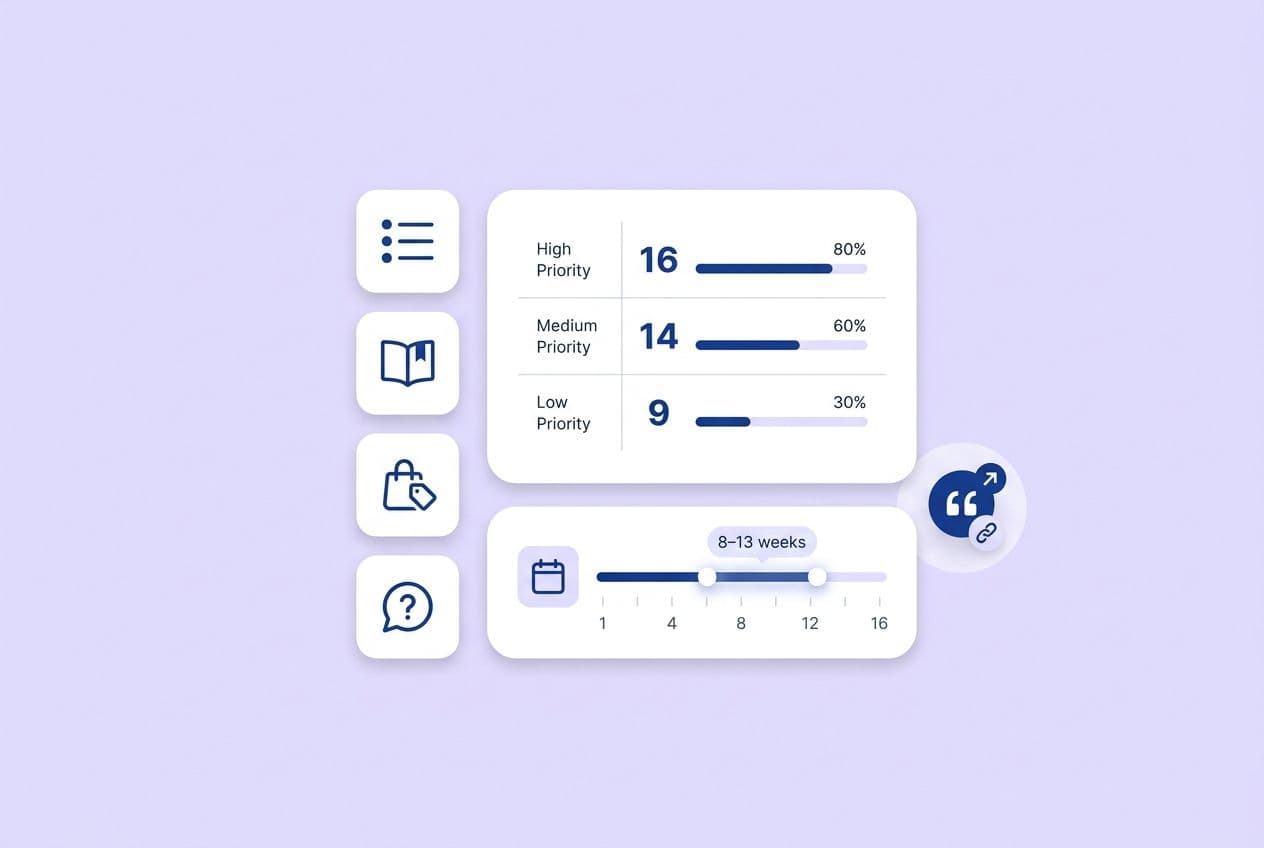
You should assume an ~8–13 week citation decay risk window for pages in competitive topics. Then, build a tiered cadence so your most valuable pages get refreshed before they slip, not after.
AI systems rely on live indexes and care about recency. A page that earned citations 4 months ago is now competing against pages that were refreshed last month. Freshness doesn't guarantee a citation, but staleness reliably loses it, especially in fast-moving SaaS categories where the entire tool landscape can change every quarter.
After a lot of trial and error, we landed on this three-tier cadence model. It’s saved our team from burnout more than once.
- Tier 1 — Revenue-driving pages and high-stakes prompts: Refresh every 8–12 weeks. These are your top listicles, product comparisons, and any content tied directly to demos or trials. A citation slip here costs you pipeline.
- Tier 2 — Traffic-driving informational assets: Refresh every 12–16 weeks. Your "how-to" guides, technical explainers, and category-level content fall here. They generate volume and support your other content.
- Tier 3 — Authority and evergreen concept pages: Refresh every ~6 months. Foundational concept posts don't decay as fast, but they still need a periodic touch-up to stay competitive.
**What changes the cadence:"
- Fast-moving markets (like AI tools, security, or fintech) mean you need to compress these windows. An 8-week rhythm might need to be 6 weeks.
- Stable topics (like general management concepts) mean longer windows are fine. But "stable" is an assumption you have to re-evaluate, not a label you can set and forget.
And I know what you’re thinking: "How do we do this with our tiny team?" A lean team of two writers and an editor can probably sustain 6–10 medium refreshes a month. The key is to make it a monthly habit, not a quarterly fire drill where everyone panics because traffic dropped.
Avoid refreshing everything on the same schedule. Treating a Tier 3 concept post the same as a Tier 1 comparison list wastes your team's energy on low-risk pages while your high-leverage content quietly slips.
What "Substantive Refresh" Signals Look Like (and What Doesn't Count)
A substantive refresh gives AI engines new, extractable content like updated claims, new sections, and current examples. A cosmetic update gives them nothing.
Counts as substantive:
- Updated statistics and benchmarks with current data
- Replaced or expanded examples that reflect the current tool landscape
- New sections answering questions the original post missed
- Rewritten intro that leads with a direct answer
- Improved internal linking to newer related content
- Rebuilt or updated comparison tables
Doesn't count:
- Changing the publish date without touching the content
- Swapping a few adjectives or tightening sentences for tone
- Minor formatting tweaks with no new information
- Replacing one image without updating its context
If an AI system crawls your refreshed page and can't find a new answer it couldn't have pulled before, the refresh didn't work.
Which Specific Pages Should You Refresh First When You Have Too Many Options?
When you have more pages than your team can possibly refresh, use a scoring model. Weigh business value × decay risk × "almost-there" opportunity × effort. This ensures every hour you spend goes to the highest expected lift.
The real problem is that content triage is rarely systematic. Most teams just pick what "feels important" or what's oldest. I got so tired of this guesswork that I built a simple scoring model. It’s just a way to force a strategic decision instead of relying on gut feel.
The Refresh Priority Score: Rate each page on a 0–3 scale for these factors:
- Business value (0–3): Is this page tied to pipeline? Do reps share it? (3 for direct revenue, 0 for low relevance).
- Visibility decline signals (0–3): Is traffic trending down? Are rankings slipping? (Score higher for steeper declines).
- "Almost there" SEO position (0–3): Is this page hovering in positions 4–12? A refresh can push it into the top 3 much faster than a page ranking 35th. (3 for pages in striking distance).
- AI citation opportunity (0–3): Does the page type match citation-heavy formats? (3 for comparison listicles and technical guides).
- Competitive pressure (0–3): Are competitors publishing fresh content on this topic? (Score higher if a competitor just published something new).
- Effort level (0–3 inverse): How much work is it? (3 for a light refresh, 1 for a heavy rewrite).
Add up the scores. Refresh the highest totals first.
Sample Scoring Table
| Page | Business Value | Visibility Decline | Almost-There SEO | AI Citation Opp. | Competitive Pressure | Effort (inverse) | Total |
|---|---|---|---|---|---|---|---|
| "Best [X] tools for SaaS" listicle | 3 | 2 | 3 | 3 | 3 | 2 | 16 |
| "How to do [Y]" guide | 2 | 2 | 2 | 3 | 2 | 3 | 14 |
| Product/solution page | 3 | 1 | 1 | 2 | 1 | 1 | 9 |
Explicit "refresh first" heuristics:
- Pages that used to perform well but are now declining. They have proven relevance and just need a tune-up.
- Pages created before 2023 that lack structured, extractable sections.
- Pages that already rank in the top 5 but rarely get AI citations. This signals a structure mismatch, not an authority problem.
Pitfalls to avoid:
- Refreshing only by age. An old page that was never strong probably won't become strong after a refresh.
- Defaulting to full rewrites when a light touch-up would work.
- Changing URLs to 'optimize' them. You'll break all the equity you've built up. (Ask me how I know.)
The Fastest Signals That a Page Is Becoming Stale (Before It Fully Drops)
Don't wait for a traffic cliff. The early warning signs are more subtle:
- A MoM traffic decline of 10–15%+ for two consecutive months. This is a directional signal that something is slipping.
- Mid-page rank movement. A page that was ranking 4th and is now 7th is in the danger zone.
- A competitor overtakes you on key queries. If a competitor who wasn't ranking above you six months ago now is, they likely refreshed something.
- Prompt drift. Buyers start asking new versions of your target query that your page doesn't answer. Check forums and Reddit for how people are talking.
- Internal staleness signals. Things like outdated screenshots, tool lists with defunct products, or old benchmarks. These signal to both humans and AI that the page isn't current.
Light vs. Medium vs. Heavy Refresh
| Refresh Type | Time Estimate | What Changes | When to Choose It | Common Failure Mode |
|---|---|---|---|---|
| Light | 1–2 hours | Update stats, fix outdated examples, refresh intro, tighten internal links | Page is structurally strong; just needs current data and examples | Calling it done when the core structure actually needs rework |
| Medium | 3–5 hours | Rewrite or add 2–3 sections, rebuild comparison table, update all examples, improve scannability | Page has good bones but missing coverage or weak extractable structure | Over-scoping into a rewrite; spending 8 hours instead of 4 |
| Heavy | 6–10 hours | Near-rewrite: restructure for answer-first format, replace most content, rebuild from current prompt intent up | Page was created pre-AI era with no structured extraction; competitor has leapfrogged | Changing the URL and losing accumulated equity |
What Changes Actually Increase AI Citations When You Refresh a Page?
AI citation lift comes from making the page more extractable and more current, not from mechanical tweaks. The changes that actually work fall into four categories.
Structure for Extraction
- Open every H2 with a 1–2 sentence direct answer before giving any context.
- Keep paragraphs to 2–4 sentences, with one single claim in each.
- Add decision tables and "if/then" guidance where buyers have to make choices. These are highly parsable.
- Use numbered lists for steps in a process and bullet points for options.
Update What Ages Fastest
- Replace outdated stats and benchmarks with current data.
- Update tool names and screenshots. An article showing a tool's UI from 18 months ago screams "stale."
- Revise competitive positioning to reflect today's market (new tools, acquisitions, etc.).
- Check for any policy or compliance references that have changed.
Expand to Match Prompt Intent
- Add sub-sections that answer the follow-up questions buyers have. If your "how to" guide doesn't cover "what to do when it fails," add that.
- Replace generic overviews with scenario-based guidance. For example, "if you're doing this for the first time, start here."
- Close intent gaps. Look at what AI engines are currently citing for your target prompts and see what those pages cover that yours doesn't.
Improve Navigability
- Add or update internal links to related content you've published since the original post.
- Improve section headers so they read like direct questions a buyer would ask.
- Add a brief summary or key-takeaway box at the top of long guides.
And here's what to skip to keep your refreshes efficient:
- Rewriting everything just for tone. Voice tweaks alone don't earn citations.
- Keyword stuffing. A good, extractable structure is way more important than keyword frequency.
- URL format changes. It's a waste of time. Focus on the content.
One honest reality check: not every page is meant to be cited. Pricing pages and demo request pages are conversion assets. Optimize them for conversion, not extraction. Mixing those goals just creates pages that do neither well.
How to Refresh Listicles Without Turning Them Into Biased "Self-Promotional" Content
The fastest way to kill a listicle's citation potential is to make it obvious you wrote it just to rank yourself first.
What actually earns citations:
- Add transparent evaluation criteria at the top. Tell people, "we evaluated these tools on X, Y, and Z factors."
- Include "best for" segments so each recommendation has context.
- Use side-by-side comparison tables with honest trade-offs.
- Keep your claims testable. "Supports up to X integrations" is better than "the most powerful integrations."
- Avoid framing your own product as #1. AI engines favor utility over promotion.
Neutral, comparison-first listicles earn trust. Promotional ones get skipped.
How to Refresh Guides So They Stay Evergreen in a 3-Month Citation World
The problem with guides is they become these giant, monolithic articles that are hard to update. You can fix that with structure.
- Build guides with modular sections, like "Tools," "Benchmarks," and "Common Mistakes." This lets you update one section without touching the rest.
- Use dated context markers where it makes sense ("as of 2026, the standard benchmark is X"). This helps readers and AI engines assess freshness.
- Add a "last reviewed" note at the top of the page. It’s a small trust signal that compounds over time.
How Do You Track Whether Refreshes Improved AI Visibility Across ChatGPT, Gemini, Perplexity, Claude, and Google AI Experiences?
You need a simple measurement loop that you run on a consistent schedule.
You need a simple measurement loop that you run on a consistent schedule. Traditional SEO metrics won't tell you if you're earning citations.
Tracking this stuff can feel like a mess, I get it. ChatGPT may favor different sources than Gemini. Perplexity loves recency. A refresh that works on one platform might go unnoticed on another. And ranking well on Google doesn't automatically mean you'll be cited everywhere else.
You don't need a crazy expensive tool to get started. Here's a system a small team can manage:
-
Define a prompt set of 10–30 questions that your buyers actually ask AI. Think awareness, consideration, and purchase questions. Revisit this set every quarter.
-
Check your visibility across multiple AI platforms on a schedule. I'd do it weekly for your most important (Tier 1) pages and bi-weekly for the rest.
-
Log four things: Was our brand mentioned? Was a specific page cited? Which one? And which competitor was cited instead?
-
Re-check 4–6 weeks after a refresh. You have to give the systems time to re-crawl and see the changes. Checking the next day is pointless.
Beyond just counting citations, you should monitor:
- Share of voice on your prompt set versus your competitors.
- Which types of pages are earning citations. This tells you if your strategy is working.
- Whether your citations are happening on pages that actually support your pipeline.
A candid limitation: AI models are always changing. A win in week one can be gone by week six. Treat this as an ongoing habit, not a one-time audit.
What to Do When One Model Cites You and Another Doesn't
This is going to happen, and it's normal. When Gemini cites your page but Claude doesn't, it's usually because they prefer different types of sources.
- Diagnose the pattern: Does the non-citing model seem to prefer Reddit or forums over brand websites? Or does it only like big-name domains with lots of backlinks?
- Adjust your strategy: If a model seems to ignore your site, you might need to focus more on getting third-party validation through things like guest posts or community mentions.
- Don't panic: Don't tear up your whole strategy just because one model isn't citing you yet. Focus on building high-quality pages. The platform-specific gaps often close over time as the models evolve.
What's a Realistic Refresh Operating System for a Lean SaaS Team (Without Burning Out)?
A sustainable refresh program isn't a quarterly sprint. It's a monthly habit with small batch audits, a clear queue, and checklists that make it repeatable.
Here's the monthly cadence you can actually sustain:
- Week 1: Pull the candidate list. Run a quick audit to find top decliners, pages due for a refresh, and spots where competitors are moving in. Your output should be a ranked queue of 6–12 pages.
- Week 2–3: Execute the refreshes. Work through your queue. Use standardized checklists so writers know exactly what "done" means without a new brief every single time.
- Week 4: Republish and measure. Push the refreshed pages live, update your internal links, and log the baseline metrics so you can re-check them in 4–6 weeks.
A little governance to keep quality high:
- Use a QA checklist that specifically flags "generic AI rewrite" outcomes. Even human-written refreshes can become bland.
- Review every refreshed page for accuracy. Outdated promises and deprecated features kill brand trust.
- Define "done" concretely. For us, a refresh is done when at least two extractable answer blocks are new or updated.
How to scale without more people:
- Build templates for each refresh tier (light, medium, heavy).
- Create a shared "freshness trigger" document. This is just a living list of stats and tool names that need updating when things change.
- Treat refreshes as a first-class content type on your calendar, not a cleanup task you squeeze in.
I'm telling you, this is not just content housekeeping. It’s competitive visibility defense. It's the difference between holding the ground you've earned and watching competitors slowly take your spot across the prompts your buyers actually use.