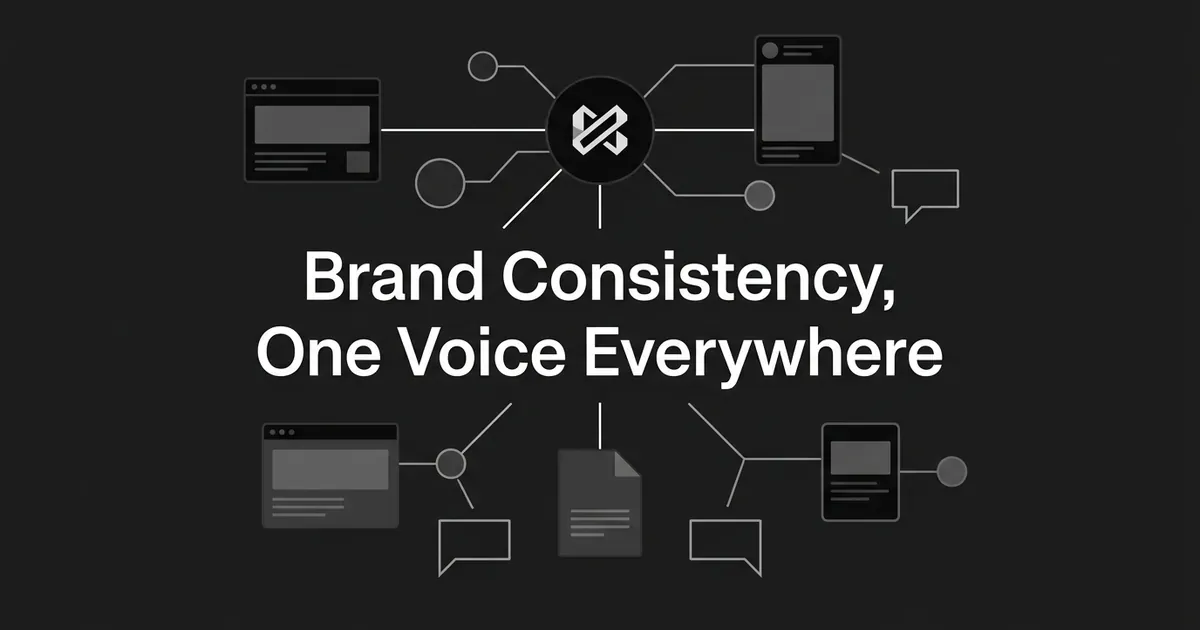
Brand consistency in the age of AI means keeping your brand's identity, approved meaning, and public evidence aligned across your own channels, the third-party sources that write about you, and the AI answers that summarize or recommend you. The goal isn't to make every channel use identical words. It's to make every channel recognizable as the same brand, accurate about what you do, and backed by evidence that agrees with itself. That's what brand consistency AI search adds to the old job of keeping your website and your social posts on-brand: a new audience, made of systems, reading everything you and everyone else publishes about you and compressing it into a short answer.
Here's the part that catches most marketing teams off guard. A perfectly consistent style guide, followed to the letter on every page you own, doesn't fully solve the problem anymore. AI systems don't just read your site. They read reviews, forum threads, competitor comparisons, old press releases, and whatever your support team said on a public forum three years ago, and they blend all of it into one description of who you are. You can control what you say. You can't fully control what gets said about you, or which version an AI system happens to pick up. Brand consistency now covers both, and that's why a consistent brand in LLM answers takes more than a tidy website. It takes agreement between what you say and what the rest of the internet says back.
The three pillars: voice, message, and reputation
Three things make up brand consistency, and they're easy to mix up because they all touch on "how we come across." Keeping them separate is what makes the rest of this piece, and the whole cluster it routes to, useful instead of vague.
Voice: how the brand sounds
Voice is the enduring character of how your brand communicates. Plainspoken or technical, warm or formal, direct or playful, restrained or expressive, the words you reach for and the ones you avoid. Voice is different from tone. Voice stays roughly the same. Tone shifts with the situation: a support reply, an executive announcement, a product page, and a social post can all use different tones while still sounding like the same company.
A useful way to hold the two apart: voice is the personality that should persist no matter where someone meets you. Tone is the adjustment you make for that particular reader and moment. Style is the concrete choices, sentence length, formatting, specific word picks, that make voice and tone visible on the page.
When voice breaks down, it usually looks like this: the website reads restrained and technical, the social account is loud and casual, sales copy uses a different name for the same product than the website does, and anything written by an AI tool without guardrails drifts into generic phrasing that could belong to any company. A reader, human or otherwise, starts to feel like they're dealing with several different brands wearing the same logo.
The fix isn't a long prose document that a freelancer or an AI writer has to interpret from scratch every time. It's turning voice into something structured: attributes, a tone range with channel-specific notes, preferred and avoided terms, examples of writing that sounds right and writing that doesn't, and rules for things like humor, uncertainty, and calls to action. A system, whether that's a person following a checklist or a tool grounded in stored brand voice and AI search context, can apply a short list of concrete rules more consistently than it can infer a personality from forty pages of guidelines. That's not a guarantee an AI engine will recommend you because your voice profile is tidy. It's a guarantee that whatever gets written about you, by you or with AI assistance, sounds like it came from the same place.
Message: what the brand means
Message is the controlled meaning you want people, and AI systems, to associate with you. It's your positioning, your category, who you serve, which problems you solve, what makes you different, and the specific claims you're willing to stand behind. "We're clear, direct, and practical" is voice. "We're an AI search analytics and content production platform for content teams" is message.
AI brand messaging matters to how systems represent you because those systems are trying to reconcile a lot of scattered information into one coherent entity. If your homepage calls you a platform, a partner page calls you an agency, and an old press mention calls you a tool, an AI system has to guess which one is right, or worse, it blends them into something that's technically sourced but practically wrong. A message system should make a short list of facts unambiguous: what you are, what category you belong to, who you're for, which claims are approved, which need a qualifier, and what your product doesn't do. That list should live somewhere as a maintained source of truth, not as a one-time exercise from a rebrand two years ago.
Message failure looks like changing your category description from page to page, using two or three names for the same feature, making claims nobody can back up, and leaving outdated descriptions live on pages nobody remembers to update. Message success looks like saying the same true things everywhere, at whatever length and emphasis the channel calls for.
Good AI brand messaging isn't a tagline exercise. It's closer to a small, boring reference document: what you are, in one sentence that doesn't change; who you serve; the three or four claims you can defend with evidence; and the claims you've decided not to make. Everyone drafting content, briefing a freelancer, or prompting an AI tool should be pulling from that same document instead of reconstructing your positioning from memory each time.
Reputation: what the public record supports
Reputation is the accumulated external perception and evidence tied to your brand: reviews, news coverage, third-party commentary, partner references, complaints, corrections, and whether your claims hold up against what people actually experience. Reputation is different from message because you can declare your message, but you can't declare your reputation. Other people and other sources shape it.
In an AI-mediated market, reputation has a few working parts: is the brand described accurately, is the description positive, neutral, or negative, do credible sources support what's being said, and is the information current. Google has said knowledge panels are generated automatically from information across the web, sometimes pulled together with data from other authoritative sources, which is a useful reminder that your reputation is built from more than your own site. Being mentioned a lot isn't the same as being described well. A brand can show up constantly and still get framed as outdated, overpriced, or wrong for the use case someone's actually asking about.
Reputation breaks down when your own site says one thing, a review site says another, and an old page that should have been retired years ago is still indexed and contradicting the current one. It holds up when your current facts are easy to find, external sources broadly agree with them, your important claims have something behind them, and when something is wrong, there's a real path to correct it and follow up.
How AI engines build brand answers
There's no single, confirmed formula for how an AI engine decides what to say about a brand, and any article that claims otherwise is guessing. What's actually documented is worth understanding, because it explains why consistency helps even without a secret ranking system behind it.
Google has said AI Overviews and AI Mode can use a process it calls query fan-out, where one question triggers several related searches across subtopics before the system puts together an answer. That means your brand might get represented through several different pages rather than one, and a page can be relevant to part of an answer without being the page that actually defines who you are. Google's eligibility rules for these features are, in a sense, reassuringly plain: a page needs to be indexed and eligible to appear in regular search results with a snippet. No special AI markup, no special schema.org tags, no new file you need to create just for AI features. Meeting those requirements doesn't guarantee you'll be crawled, indexed, or served, but there's no separate technical hoop to jump through either.
ChatGPT search works differently under the hood. OpenAI runs separate crawlers for separate jobs: one that surfaces sites in ChatGPT search results, and a different one used for training its models, with settings a publisher can control independently. Blocking one doesn't automatically block the other, and turning one on doesn't guarantee a citation. Perplexity, for its part, presents its answers as sourced and cited, letting a reader check where a claim came from, though a citation just means a source was used somewhere in the answer, not that the interpretation is complete or flattering.
None of these mechanics tell you how to win a specific answer. What they tell you is that these systems are pulling from a wide, uneven set of sources, weighing them in ways that differ engine to engine, and trying to resolve a coherent entity out of whatever they find. A brand that gives them fewer contradictions to reconcile is easier to summarize accurately. That's the practical case for brand consistency AI systems can actually work with: not a guarantee, a reduction in avoidable ambiguity.
It also means the old habit of optimizing one page for one keyword doesn't map cleanly onto this new behavior. A single question can fan out into several related searches, so more than one of your pages might end up feeding a single answer, and none of them individually controls the outcome. Knowledge panels work the same way in miniature: Google has said they're generated automatically from information scattered across the web, sometimes combined with data from other verified sources, and an official representative can claim one and suggest corrections but can't simply overwrite it. The practical takeaway is the same one that runs through this whole piece. You're not writing to one algorithm anymore. You're keeping a public record straight enough that whichever system reads it comes away with the same picture.
Why consistency matters more now
A regular search results page shows a person a list of links they can weigh for themselves. An AI answer compresses that into one description, one comparison, sometimes one recommendation, before the reader has clicked anything. Whatever wording the system lands on becomes the first impression, and that impression can travel further and faster than the original source material it was built from.
That compression is also why a coherent entity matters more than it used to. A consistent name, a clear category, a stable set of product facts gives a system fewer competing signals to untangle. Google's own guidance on organization data frames structured information as a way to help disambiguate an organization, which is entity clarity, not a promise of visibility.
Recommendations also depend heavily on context. The same brand can be the right answer for one use case and the wrong one for another, depending on budget, audience, feature needs, and the exact way someone phrases their question. That means defining not just what you are, but who you're for, which use cases you don't serve well, what you're commonly compared against, and what limitations are worth being upfront about.
None of this adds up to a formula. A well-known research study from Seer Interactive looked at hundreds of thousands of finance and SaaS keywords, generated close to 600,000 related questions, and found that brands ranking on page one of Google showed roughly a 0.65 correlation with being mentioned by an LLM, with backlinks showing a weaker relationship. That's a correlation worth paying attention to, not proof that ranking well causes an AI mention. A separate study from SparkToro ran the same prompts through ChatGPT, Claude, and Google AI dozens of times each and found that the exact same list of brand recommendations, in the same order, showed up in less than one run out of a thousand. Treat any single AI answer as a snapshot, not a stable ranking. Consistency supports recognition. It doesn't guarantee visibility, and a piece that promises otherwise is selling something it can't back up.
This is also why tracking brand consistency across AI answers has to mean more than checking whether ChatGPT said your name once this week. A single favorable answer can be followed by an unfavorable one an hour later, on the same prompt, for reasons that have nothing to do with anything you changed. What holds up under that kind of variability is a repeatable set of questions, checked on a schedule, across more than one engine, so you're looking at a trend instead of a lucky screenshot.
Where brand consistency breaks
The failure patterns repeat across companies, which makes them worth naming plainly. Your brand uses two or three different category labels depending on which page someone lands on. Your product names shift between the website, the app, and your sales deck. Your voice alternates between careful and technical on one page and inflated and hype-driven on another, especially once AI-assisted writing gets involved without real guardrails. Old pages stay indexed and quietly contradict the current version of the truth. You measure only whether you got mentioned, not how you were described or which sources backed it up. You treat one AI answer as if it were a permanent scoreboard. Or worst of all, you try to fix a reputation problem by publishing more promotional copy instead of correcting the actual public record that's causing the confusion.
Good consistency looks almost boring by comparison: one clear category, current terminology, a voice a reader can recognize whether they're reading a formal report or a support reply, claims that are specific instead of inflated, and a habit of checking a fixed set of real questions across engines instead of guessing.
Where to start
You don't need to solve all of this at once, and trying to is usually how these efforts stall out. Start with a handful of moves that cover the most ground.
Build one canonical brand record. One maintained place with your official name and any alternate names, your category description, positioning, audience, product facts, approved claims, claims to avoid, and the date it was last reviewed. This is the source everything else should draw from, your website, your content briefs, anything written with AI assistance, your sales materials, and your profiles on other platforms.
Separate what stays fixed from what can flex. Your identity, category, core promise, product facts, terminology, and claim boundaries should hold steady everywhere. Length, format, technical depth, tone intensity, and examples can and should change by channel. The goal is recognizable adaptation, not copy-pasting the same paragraph into every format.
Define the prompts that reflect real discovery. Build a small, repeatable set of questions that mirror how buyers actually ask AI systems about your category: comparison questions, use-case questions, objection questions, and questions that use your brand name directly. Run them on a schedule, not once, and track wording, date, engine, and how you were framed, not just whether you showed up.
Monitor representation, not just mentions. Mention rate tells you whether you were named. Citation rate tells you whether a page of yours actually got linked. Share of voice tells you how that compares to competitors in the same prompt set. Sentiment tells you whether the framing was fair. None of these are universal scores, but tracked consistently over time, they tell you far more than checking ChatGPT once and calling it done.
Keep an evidence loop running. When an answer is wrong or outdated, write down the exact prompt, the answer, the date, and the sources it cited. Figure out whether the problem traces back to your own stale content, conflicting third-party information, or something else entirely. Fix the most authoritative source you control, update anything else that still contradicts it, and re-run the same prompt later to see whether it stuck. Most consumer AI tools don't give you a direct way to edit what they say about you. You influence the evidence they draw from. You can't usually force an immediate rewrite.
Assign real owners. Brand consistency falls apart fastest when it's everyone's job and nobody's responsibility. Someone owns voice. Someone owns product facts. Someone owns AI visibility monitoring. Someone owns corrections when something's wrong. A short, clear list of who does what beats a long policy document nobody reads.
This is the hub for a wider set of pieces, each going deeper into one part of this system: voice guidelines that AI production can actually apply, canonical fact management, multichannel adaptation without copy-paste, visibility monitoring, citation and mention tracking, reputation monitoring, correcting misinformation once you find it, and content governance for teams producing at volume. Each is worth its own read once this framework makes sense to you.
DeepSmith approaches this from both directions at once. It tracks how AI engines describe and cite your brand across the questions that actually matter to your buyers, so drift shows up as data instead of a bad surprise in a board meeting. And because it holds your product facts, brand voice, and audience context as shared, structured brand context, every article it produces draws from the same canonical record instead of getting re-briefed and reinterpreted each time. That doesn't mean any tool can guarantee a citation or a ranking. It means the gap between "we noticed we're being described wrong" and "we fixed it everywhere it matters" gets a lot shorter.
Consistent brands don't force every channel to sound identical. They make the same identity, the same meaning, and the same supporting evidence available wherever a person, or a system reading on their behalf, happens to encounter them.