You typed your own brand name into ChatGPT last week and got a shrug. Maybe a competitor came back instead. Maybe the answer described you as something you stopped being two years ago.
That stings. It also has a fix, and the fix is more mechanical than you would expect.
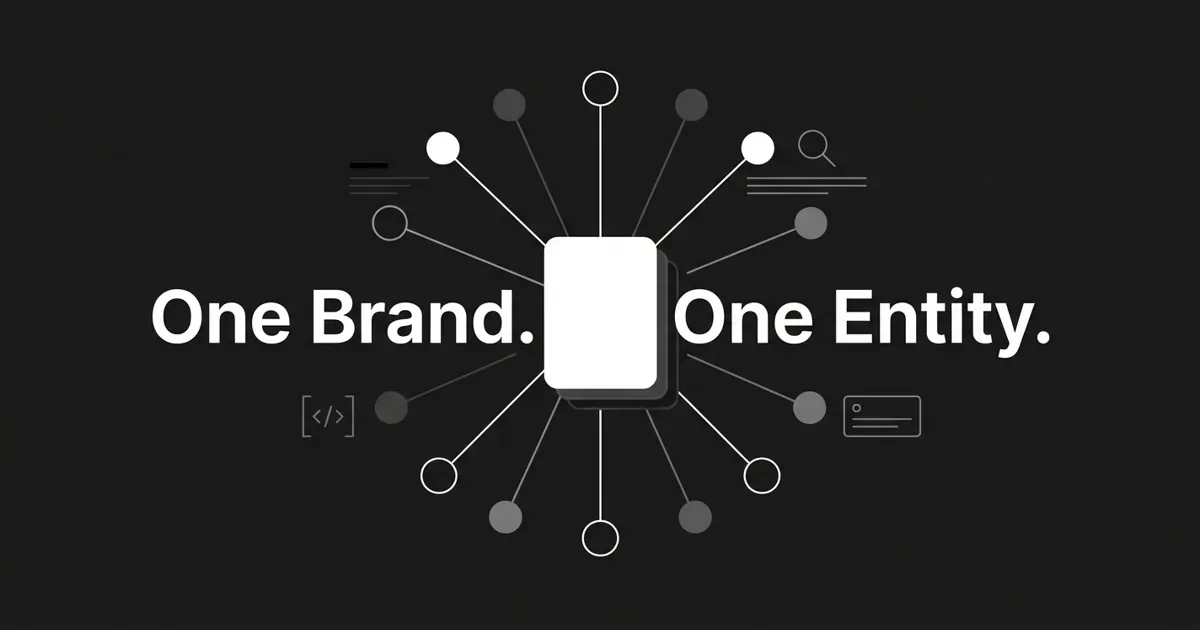
Here is the real question underneath the frustration: how do I make AI recognize my brand as a distinct thing rather than a string of words it has seen somewhere? Answer engines do not guess their way to you. They resolve you first. Before ChatGPT, Perplexity, Gemini, Claude, or Google AI Mode writes a single sentence about your company, something upstream has to decide that your name, your domain, your LinkedIn page, and your Wikidata record all point at one entity. When that resolution fails, you do not get a bad answer about your brand. You get no mention at all.
This guide gives you nine steps to become that resolvable thing. It covers your organization as an entity. Author bios and keeping every published fact current are their own projects, so leave them for another day.
Fair warning on what kind of work this is. Half of it is data engineering, meaning canonical fields, structured markup, and clean records. The other half is public relations, meaning other people saying your name correctly in places engines trust. Neither half works alone, and most of the first half is checklist work you can finish this month.
Step 1: Audit what AI engines already know about you
Do not change anything yet. Look first.
Search your brand name in quotes on Google and Bing, then ask ChatGPT, Perplexity, Gemini, and Claude with search turned on a plain question: what is [your brand]? For each surface, write down whether you appear at all, what description comes back, which logo shows up, and whether you get a knowledge panel, a passing mention, or silence.
You are building a one-page audit sheet. Each row is a surface. Each column is a field: name, description, address, founding year, founders, logo. Mark every blank and every contradiction.
Done when: you can point at the exact fields that are missing or inconsistent, instead of saying "AI does not know us."
Where people go wrong: checking once, on one engine, and calling it data. Engines disagree with each other, and they change. One pass across five surfaces tells you far more than five passes on one.
It helps to know what each engine is looking at while you audit. Google's Knowledge Graph powers knowledge panels and feeds AI Overviews and AI Mode, and it leans heavily on Wikidata and Wikipedia. Gemini draws on that same graph and web index, and it synthesizes across sources more willingly than classic search does. Perplexity runs retrieved pages through named filters that include entity clarity and extractability, so a page about one clearly named company beats a page about everything you do. ChatGPT and Claude retrieve and summarize, and both reward the same clarity. The reassuring part of brand entity AI search is that these are not five different projects. They reward the same signals.
This is also where a tracker earns its keep. Watching whether engines name you, and how often, is exactly what AI visibility tools measure through mention rate and citation rate across ChatGPT, Perplexity, Gemini, Claude, and Google AI Mode. DeepSmith tracks those prompts on a schedule so the audit becomes a trend line instead of a Tuesday afternoon you never repeat.
Step 2: Lock one canonical identity
Everything in brand entity AI search comes back to one idea: one thing, described one way, in enough places that the description stops looking like a coincidence.
So write the canonical document. One page, boring, authoritative. Freeze these values:
- Legal name and brand name, exactly as each should appear
- A one-sentence tagline
- A one-paragraph description, roughly 50 to 90 words, covering industry, headquarters, founding year, who you serve, and what makes you different
- Headquarters address, in one format you will never vary
- Phone, email, contact URL
- Founding year and founders, named, with roles
- The logo file you will use everywhere
- Every authoritative profile URL you own
This document is the source of truth. Every other surface copies from it.
Done when: one person owns this file and everyone else knows to ask them before inventing a new description.
Where people go wrong: letting the description drift. Marketing writes a punchier version for LinkedIn. Sales writes a shorter one for a directory. Now three descriptions exist and none of them agree. Write the paragraph once, then paste it, resisting the urge to improve it each time.
Step 3: Publish your entity home page
Pick one page to be the canonical home of your identity. Convention is /about, and your homepage works if the About page is thin.
Then make it visibly declare everything from Step 2. Visibly means in the rendered text a human reads, not hidden in markup. The brand name, the tagline, the description paragraph, the HQ address in the body copy, the founders named with roles, the logo as a real image with alt text carrying your brand name, and a live link to every profile you listed.
The goal: this becomes the most information-dense page about you on your own domain.
Done when: a stranger could rebuild your canonical document from that page alone.
Where people go wrong: shipping the logo as a CSS background image or a sprite. Crawlers cannot read those. Use an image tag pointing at a real URL that returns a live image, near-square, at least 112 by 112 pixels. Anything smaller or hidden behind a redirect gets ingested unreliably, and you will never see an error message telling you so.
Step 4: Add Organization schema with a sameAs array
Now you translate that page for machines.
Schema.org gives you Organization as the type for companies and institutions. Google's guidance is refreshingly relaxed here: no properties are strictly required, and you should fill in as many relevant ones as you can, because each one helps disambiguate you.
Fill in the ones that carry weight:
name, andurlfor your official sitelogo, as an ImageObject with url, width, and heightsameAs, an array of URLs that unambiguously identify you: Wikidata, Wikipedia if you have it, LinkedIn, Crunchbase, X, YouTube, GitHubcontactPointwith telephone, email, and contact typeaddressas a PostalAddress with the full field breakdownfoundingDatein ISO format, plusfounderidentifierif you have one
The sameAs array is the part that matters most for this project. It is your declaration that all of these records describe the same company. Put the whole thing in a single JSON-LD block in the head of your entity home page. One Organization schema entity block for the site, not one per page with values that quietly disagree.
Then validate. Run the page through Google's Rich Results Test and the Schema Markup Validator, and clear every error before you move on. Typical failures are unglamorous: a logo URL that redirects, address fields swapped, a sameAs link that 404s, a malformed phone number.
Done when: both validators come back clean and every sameAs URL resolves to a live, on-brand profile.
Where people go wrong: treating this as a ranking play, then feeling cheated. The Organization schema entity you publish does not lift rankings by itself. It disambiguates. That is a different job, and it is the job you need done here.
Pro tip: never put a URL in sameAs that you do not control or that does not represent your legal entity. A dead link, a hashtag page, or a competitor profile in that array actively works against the resolution you are trying to earn.
Step 5: Create or clean up your Wikidata item
Wikidata is the open, structured backbone of the knowledge graph for brand identity on the web, and Google has said its Knowledge Graph draws heavily on Wikidata for structure and Wikipedia for semistructured content. That makes this step quietly one of the highest-leverage things on the list.
Good news if you have been dreading it: Wikidata's notability bar is separate from Wikipedia's and considerably more permissive. An item is acceptable if it describes an identifiable entity backed by publicly available reliable references. You do not need a Wikipedia article first.
If no item exists, create one. If one exists, audit it. Either way, populate the core company properties: instance of, inception, headquarters location, country, official website, logo image via a Commons file, legal form, industry, founder, plus legal name and short name for disambiguation.
Done when: the core properties are populated, every statement carries a reference to a reliable source, and your logo lives on Wikimedia Commons under a proper license.
Where people go wrong: adding statements with no references. Unreferenced claims get challenged and removed, and you will not get a notification. Reference every statement, even the obvious ones.
Step 6: Decide honestly about Wikipedia
This is the step where I want you to consider not doing the work.
Wikipedia judges organizations against a specific notability guideline: significant coverage in multiple reliable secondary sources that are genuinely independent of you. Independent rules out press releases, your own blog, controlled media, paid placements, and routine announcements like funding rounds, new hires, and office openings.
Many real, healthy companies do not clear that bar yet. If you are one of them, skip this step. Forcing an article gets it speedily deleted and leaves a public deletion log that is harder to live down than never having had an article.
If you do clear it, two rules are non-negotiable. Editors with a conflict of interest, meaning employees, contractors, and paid PR, are strongly discouraged from creating or editing articles about their own employer. Use the Articles for Creation review process or a neutral editor instead. And any paid editing must be disclosed, on the user page, on talk pages, and in edit summaries. Undisclosed paid editing is sanctionable, and the content gets deleted anyway.
Done when: either a neutral, well-sourced article exists with no COI flags, or you have made a clear-eyed decision to revisit this in a year.
Where people go wrong: writing their own company's article in a marketing voice. That is the single most reliable way to get deleted. Wikipedia is an encyclopedia, and promotional tone is a deletion criterion on its own.
Step 7: Align every external profile to the canonical identity
Back to the audit sheet. Walk every profile you found and make it match Step 2, field by field.
Work down roughly this priority: LinkedIn, Crunchbase, Google Business Profile if press or customers might actually visit your HQ, then X, Facebook, YouTube, GitHub, then the directories that matter in your vertical, like G2, Capterra, and Trustpilot for SaaS, or OpenCorporates and SEC EDGAR for the legal record. Where a platform will not accept a field, match everything it will.
Local SEO has a name for the discipline: NAP+W, for Name, Address, Phone, Website. Same rigor here, with description and logo added.
Done when: a fresh audit shows every profile matching the canonical document on every available field.
Where people go wrong: the small stuff, which is the whole stuff. "St." on one profile and "Street" on another. "Ste 100" versus "Suite 100." A phone number from the old office. Each one is a tiny contradiction, and enough of them dilute the confidence you are trying to build.
Keeping your own published content consistent is the same discipline pointed inward. Deep IQ stores your positioning, your product facts, and your brand voice as structured context, so the articles DeepSmith produces describe your company the same way every time instead of drifting one draft at a time.
Step 8: Earn authoritative third-party mentions
This layer is the slowest, and it is the one that actually convinces an engine you exist.
Everything up to now was you saying who you are. Corroboration is other people saying it. Aim for independent mentions, with your facts stated correctly, in outlets engines treat as authoritative: major business and tech press, your industry's trade press, government and regulatory filings, analyst reports, academic work when you are the subject of it, and reputable review platforms.
Three solid independent mentions is a reasonable first target. Not thirty. Three.
Why does this layer matter so much? Because every independent mention is a separate confirmation that you exist and that your facts are what you say they are. Search engines and answer engines both read authoritative mentions as strong entity confirmation. That is the half of entity establishment AEO nobody can automate for you. The schema is data engineering, and you can finish it in an afternoon. This part is relationships, and it takes quarters.
Done when: searching your brand name surfaces your own site plus multiple independent, authoritative pages that describe you consistently.
Where people go wrong: counting anything with your logo in it. A syndicated press release is not corroboration. Independence is the entire value of this step, and a mention you placed yourself has none of it.
Step 9: Monitor quarterly so your entity does not drift
Entity work is not a launch. It is a standing appointment.
Set alerts on your brand name and your founders' names. Then, once a quarter, re-run the Step 1 audit, check your Wikidata item for unwanted edits, since anyone can edit it and changes are public, check your Wikipedia article if you have one, and re-validate your JSON-LD, especially after any site redesign.
Knowledge panels can be wrong and stale once they exist. A rebrand, a new HQ, or a new phone number means the canonical document changes and every surface needs to follow.
Done when: a quarterly review turns up no drift in your canonical fields and no new contradictions.
Where people go wrong: assuming a redesign is cosmetic. Site rebuilds quietly drop JSON-LD blocks all the time, and nothing tells you. Re-validate after every one.
What to do next
If this feels like a lot, that is normal. It is a stack, and each layer is weak alone. Together they produce a knowledge panel, a Gemini answer that gets you right, a Perplexity citation, a ChatGPT mention.
You do not need all nine steps this month. You need Step 1. Run the audit, see which fields are actually missing, and you will usually find that two or three cheap fixes are blocking everything else.
One honest caveat before you go. Entity establishment AEO is necessary, not sufficient. Perfect entity signals with weak topical authority still will not get you cited, because engines have to want your page for the question. Entity work makes you resolvable. Content makes you worth quoting. You need both.
When you are ready to see whether any of it is landing, start a free DeepSmith trial and watch how often engines name you before and after. Real data beats guessing.