Someone asked ChatGPT about your company last week and the answer was close, but wrong. Old pricing. A founder who left two years ago. A category label you retired in the last rebrand.
That sting is useful. It means you found the problem before your buyer did.
This guide is for marketing leads who own the brand story and just realized AI engines are telling a slightly different one. By the end you will have a repeatable audit that pulls consistent brand facts AI engines can agree on into a single current version of the truth, across your own site, your directory profiles, and the third-party sources you do not control.
Here is the good news: most of the drift lives in a handful of places. You can fix the highest-leverage ones this week.
One boundary before we start. This is about keeping correct facts aligned everywhere, proactively. If an engine is actively stating something false or damaging about you right now, that is a different job with a different playbook, and you want the correction path instead.
Why AI engines get your facts wrong in the first place
Answer engines do not trust your website. Not the way you want them to.
ChatGPT, Perplexity, Gemini, Claude, and Google AI Mode all run a retrieval pipeline. They parse the question, pull candidate passages from across the web, rerank those passages by how well each one fits the question and how cleanly it maps to a single real-world entity, then write an answer from whatever survived. Your homepage is one candidate among many. It competes with your Crunchbase profile, your LinkedIn page, a two-year-old press release, and a Reddit thread.
When those sources agree, the engine answers confidently and cites you. When they disagree, one of two things happens. The engine hedges, or it quietly picks a version. Sometimes the version it picks is the old one.
Here is the part that reorders your priorities: only a small slice of what AI engines cite overlaps with Google's top ten organic results for the same question. Most of what they read lives somewhere your SEO reporting never looks. Review sites. Wikipedia and Wikidata. Community threads. YouTube transcripts. Business directories. If your entire strategy watches blue links, you are watching the minority of the corpus.
Analyses of AI citation behavior keep surfacing the same five factors: whether a page resolves cleanly to one entity, how well it matches the question semantically, how fresh it is, whether it carries credible authority cues, and how many independent places state the same fact. That last one is the whole game here. Every extra source that repeats your fact correctly is another vote. Every source that repeats it wrong is a vote against you.
Which is why NAP consistency AI search engines rely on stopped being a local-SEO-only chore. Your name, address, and phone details were never really about maps. They were always about proving that scattered mentions across the web describe one company, and that job matters more now, not less.
So the goal of brand data consistency web-wide is not tidiness. It is disambiguation. You are making it easy for a machine to be sure.
Step 1: Build one canonical fact sheet
Pick one place where the truth lives. Everything else in this guide is downstream of that decision.
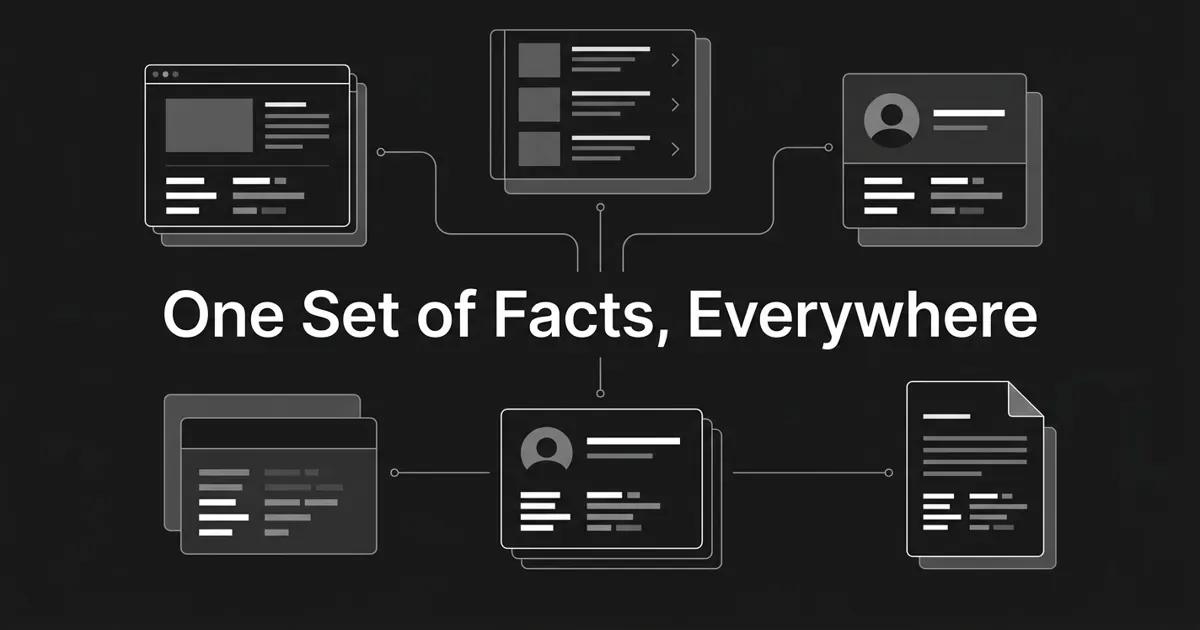
Create a shared doc (Notion, a Sheet, Confluence, it genuinely does not matter which) with one row per load-bearing fact. Each row carries four things: the canonical value, an owner, a last-verified date, and the list of surfaces that carry it.
What belongs on the sheet:
- Legal name, DBA name, and the stylized version you actually use
- Full HQ address including suite, plus the main phone and main URL
- Year founded and founder names, spelled the way you want them spelled
- Current leadership with exact titles
- Product names and pricing tier names
- Tagline, short and long
- Boilerplate paragraph in a 50, 100, and 250 word version
- Social handles per platform, primary categories, certifications, awards
You know it is done when every field has a named owner and a verified-on date, and when changing a value means changing it here first.
Common mistake: letting marketing own this in isolation. The sheet only works if support, sales, legal, and engineering all pull from it. If your support team writes its own version of the company description into a help center article, you just created a new source of drift.
Take a breath. This is a two-hour task, not a quarter-long project. It is also the single thing that makes every later step possible.
Step 2: Inventory every surface that carries your facts
You cannot align what you have not listed. Build the map.
Work in three buckets, because they behave differently:
Owned. Homepage, About page, press or newsroom pages, footer microcopy, legal pages, your structured data, your sitemap, your robots policy. You control these absolutely.
Claimed. Profiles you edit but do not own: Google Business Profile, Bing Places, LinkedIn Company Page, Crunchbase, G2, Capterra, Trustpilot, your GitHub org, app store developer profiles, Glassdoor, and a Wikidata item. You can log in and change these.
Earned. Everything you influence but cannot edit: Wikipedia, press coverage, wire releases, Reddit threads, YouTube transcripts, podcast show notes, regulatory filings, vertical directories. For these, record the URL, the fact version currently visible, and a contact for corrections where one exists.
You know it is done when you have a grid: one row per surface, one column per canonical fact, each cell holding the current value plus the date you observed it.
Common mistake: stopping at your homepage and Google Business Profile. Engines read dozens of places. Every surface you skip is a leak.
This is also where knowing what engines actually read saves you from guessing. DeepSmith's AI visibility module tracks the questions buyers ask across ChatGPT, Perplexity, Gemini, Claude, and Google AI Mode, and reports which sources those engines cite most for your prompts. That turns your inventory from a list of everywhere you could be into a shortlist of what is genuinely being read.
Step 3: Audit each surface against your canonical record
Now compare. Cell by cell, tag every fact: match, drift, missing, or stale.
The drift is rarely dramatic. It hides in details that feel too small to matter and matter anyway:
- Phone formatting, parentheses versus hyphens, a tracking number replacing the real one
- Missing suite numbers, "Street" versus "St.", a wrong ZIP
- Founding year off by one, because someone counted from incorporation and someone else counted from launch
- A founder's name spelled two ways across two profiles
- Pricing tier names that quietly changed when Starter became Growth
- Three slightly different About paragraphs across PR, your site, and your G2 profile
- Product claims with counts in them, the "used by X brands" line that was true in 2024
That last one deserves attention. Any fact with a number in it goes stale on its own, without anyone touching it.
Do not skim the boring rows. The name, address, and phone details feel like local-SEO housekeeping, and they are the exact fields engines use to decide two mentions describe the same company. NAP consistency AI search depends on is won in these unglamorous cells, not in your messaging.
You know it is done when every drift is logged with a severity. High means identity-level facts on high-weight surfaces. Medium means tier names and descriptions. Low means a niche directory nobody reads.
Common mistake: treating every cell as equal. A wrong founding year on Wikidata costs you more than a wrong phone format on a directory from 2011. Weight by surface, then act.
Step 4: Fix the highest-leverage surfaces first
Resist the urge to do this evenly. The distribution is lopsided, so your effort should be too.
Tier one, this week. Organization JSON-LD on your homepage, your About page, Google Business Profile, Bing Places, Apple Maps Connect, Wikidata, Crunchbase, LinkedIn Company Page. These are your identity anchors. They carry disproportionate weight in entity resolution and they are all editable by you today.
Tier two, the next two to three weeks. Wikipedia if you meet the notability bar, Facebook, Yelp, G2 and Capterra and the other review sites in your category, plus the top ten directories that matter in your vertical.
Tier three, ongoing. Remaining directories, secondary social profiles, podcast show notes, the press archive.
One note on directories, because it saves real time. A handful of large US data aggregators feed hundreds of downstream directories, apps, and map providers. Fixing your details at the aggregator level propagates outward. Fixing them on one directory fixes one directory. Upstream is where brand data consistency web listings inherit from you gets cheap, and it is why listing-management vendors exist at all. Handle it there rather than one listing at a time.
You know it is done when tier one reads 100% match, tier two clears within 30 days, and tier three is on a working list.
Common mistake: ignoring the press archive. Wire services cache the original release permanently. If your 2019 announcement said "founded in Palo Alto" and you have since moved, that line outlives every correction you publish afterward. You may not be able to edit it, but you can make sure ten newer, stronger sources say the current thing.
Step 5: Lock the canonical version into your code
Manual consistency decays. Every time. Not because your team is careless, but because copy gets edited by people who are not thinking about structured data.
So take the facts out of human hands where you can.
Add Organization JSON-LD to your homepage template with your name, URL, and logo (Google treats those three as required), plus description, founding date, founder, address, and contact point. Then add sameAs and list every official profile you control: LinkedIn, Crunchbase, Wikidata, your Wikipedia article if you have one, X, YouTube, GitHub, Facebook, Instagram. Each entry is one more identity-confirmation vote. Be generous here.
Add Person markup to every leadership bio, with the job title and links to their professional profiles.
If two companies share your name, add a disambiguatingDescription that says plainly which one you are, and consider an identifier property carrying a registry code like a DUNS number.
The real move is templating. Pin the tagline, founding year, HQ address, and leadership titles as CMS fields that render into the schema block. When a marketer edits page copy, the structured data does not drift, because the structured data is not copy anymore. It is a field.
You know it is done when schema validation runs automatically, and the Rich Results Test and Schema Markup Validator both pass.
Pro tip: mirror your boilerplate in four places at once, in the same words. Your JSON-LD, your About page, your press kit, and your Wikidata item. These four are your identity anchors, and when all four agree, engines stop guessing.
While you are in the code, two smaller files are worth a look. An /llms.txt at your root gives a plain Markdown map of your key pages for tools that want it, though it is a proposed convention rather than a ratified standard, and no major engine treats it as a default crawl target yet. Low cost, modest upside. Your robots.txt matters more. Retrieval bots like ChatGPT-User, OAI-SearchBot, Claude-User, and Perplexity-User are the agents that fetch pages when an engine is answering a live question. Training crawlers like GPTBot, ClaudeBot, Google-Extended, and CCBot ingest content for future models. If your goal is accurate AI brand answers, allow the retrieval bots. Blocking everything to protect your content also blocks the citations you want.
Step 6: Set a refresh cadence that survives busy quarters
You will fix everything. Then it will drift again. That is not failure, that is physics.
Consistent brand facts AI engines can trust are not a one-time achievement. They are a maintained state, like a clean inbox, and the maintenance is lighter than the cleanup.
Two cadences keep it from compounding.
Quarterly, on the calendar. A full sweep of the canonical sheet against the inventory. Aggregator sync cycles run on the order of one to three months, so quarterly is the working minimum. Annual audits let a wrong fact circulate for a year and get repeated by other sources in the meantime, which is how one small error becomes ten.
On events, not just dates. Trigger an out-of-cycle sweep on any of these: a leadership change, a pricing restructure, a rebrand, an HQ move, a product launch that shifts your category language, or an acquisition. These are the moments that make yesterday's canonical value wrong across forty surfaces at once.
You know it is done when a recurring calendar event exists with the audit sheet attached and a named owner, and when your comms process includes "sweep the fact surfaces" as a step in any launch or exec announcement.
Common mistake: assuming a one-time fix is permanent. AI corpora refresh on their own schedules. A fact you corrected can reappear months later from a cached source you never found.
Step 7: Monitor AI answers and close the loop
Everything so far has been input. This step tells you whether it worked.
Track what the engines actually say. Ask about your brand name, your founders, your category, and your flagship products, on a schedule, across the engines your buyers use. You are looking for two things: whether you get mentioned at all, and whether the facts in the answer match your canonical sheet.
When a wrong fact shows up, do not argue with the engine. Trace it. Ask the answer where it got that, find the source URL, and check it against your inventory. Nine times out of ten it is a surface you already listed in Step 2 and deprioritized. Fix the source, then re-check in a few weeks.
You know it is done when you have a running view of prompts by engine by answer, and you notice a stale fact reappearing without someone stumbling onto it by accident.
Doing this by hand across five engines and thirty prompts is where good intentions go to die. It is also exactly the work DeepSmith's AEO module does on a schedule: it tracks your defined prompts across ChatGPT, Perplexity, Gemini, Claude, and Google AI Mode depending on your plan, reports mention rate and citation rate over time, shows which of your pages earn citations, and surfaces the sources those engines lean on most. It will not edit your Crunchbase profile for you. It will tell you that a stale fact is back and point you at the page that is feeding it, which is the part you cannot do manually.
Common mistake: checking once, in one engine, on one day. Answers vary between engines and shift over time. One clean answer in ChatGPT is not a clean bill of health. Accurate AI brand answers hold across engines and across months, so measure them that way.
What to do next
Do not run all seven steps this month. Momentum matters more than completeness here.
Pick the smallest high-leverage move: put Organization JSON-LD on your homepage with a full sameAs list to every official profile you control. It takes an afternoon and it creates the entity anchor everything else hangs from.
Then build the fact sheet. Then inventory your surfaces. Then work down the tiers.
If you want the monitoring loop in Step 7 running without building it yourself, DeepSmith tracks how AI engines answer questions about your brand and shows you which sources they cite, so drift surfaces as a signal instead of a surprise. You can start a free trial and see real data on your own prompts before you pay for anything.
You are closer than this article makes it look. Most companies have never done step one.