Every AI visibility program starts with a list of questions to monitor, and the composition of that list determines what the program can and cannot see. Some teams track only queries that name their brand. Others chase the high-volume category terms and ignore the head-to-head matchups where deals are decided. The distinction between branded vs unbranded prompts, and between both of those and competitor comparisons, is not academic. Each category answers a different business question, earns a different kind of content, and behaves differently on the core visibility metrics. Deciding which prompts to track AI visibility programs should prioritize, and in what proportion, is the first strategic choice a content team makes when it moves from ad hoc checks to a measured program.
This article defines the three prompt categories, sets out what each one measures and misses, and recommends a starting mix. It deliberately excludes funnel-stage mapping mechanics, scoring rubrics, and guidance on how many prompts to run in total. The focus is classification and balance: which types belong in the tracked set, and roughly how much weight each deserves.
The three prompt types at a glance
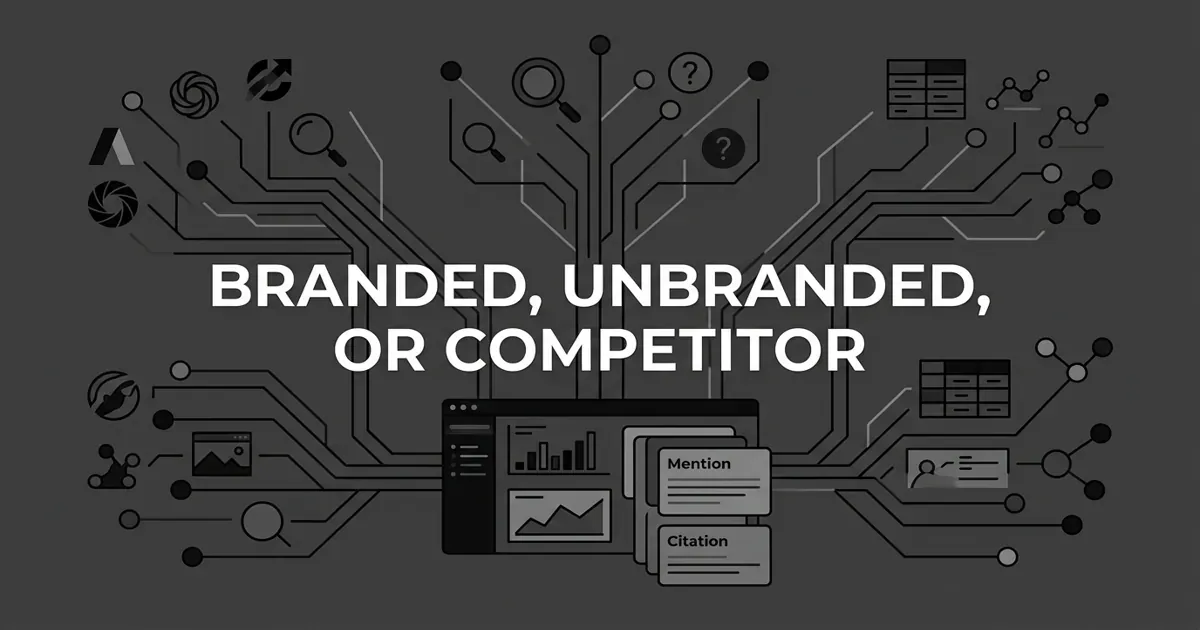
The categories divide by one question: whose name, if anyone's, appears in the query.
- Branded prompts name the brand, the product, or both. The engine is asked to describe, evaluate, or price a known entity.
- Unbranded or category prompts name no brand. The query describes a problem, a use case, or a category, and the engine recommends.
- Competitor comparison prompts name two or more brands, ask for alternatives, or request a direct bake-off. The engine is asked to compare.
The table below summarizes how the three differ across the dimensions that matter when building a tracked set.
| Dimension | Branded | Unbranded / category | Competitor comparison |
|---|---|---|---|
| Brand in query? | Yes (yours) | No | Yes (yours or a rival's) |
| Buyer stage it reveals | Decision, validation | Awareness, consideration | Active shortlisting |
| What the engine is asked to do | Describe or defend you | Recommend for a job | Compare head to head |
| Example queries | "DeepSmith pricing," "is DeepSmith worth it?" | "best AI visibility tool," "how to track ChatGPT mentions" | "DeepSmith vs Profound," "Profound alternatives" |
| Primary metric | Mention rate, sentiment, description accuracy | Inclusion rate, share of voice, source diversity | Win rate against named rivals, citation overlap |
| Content that earns it | Owned site, PR, review profiles, Wikipedia, structured data | Glossary entries, pillar pages, best-of listicles, original research | Comparison pages, third-party reviews, G2 and Capterra |
| Cost of ignoring it | Your AI description drifts and you cannot catch it | You never enter the consideration set | You lose named bake-offs to rivals |
| Typical share of tracked set | About 25 percent | About 50 to 60 percent | About 15 to 25 percent |
The rest of this article takes each type in turn, then addresses the two questions that follow from the table: how to weight the mix, and why mention rate and citation rate must be read as separate signals.
Branded prompts: describing and defending a known entity
Branded prompts are the queries that name the company or its products. Examples include "DeepSmith pricing," "DeepSmith review," and "how does DeepSmith work?" The engine already knows the entity, so the task is to describe it, evaluate it, or answer a specific factual question about it.
What they measure
Branded prompts read brand health inside AI answers. They surface how accurately engines describe the company, what verdict the engines deliver on questions of value or fit, and whether the sentiment is positive or negative. Because the query names the brand, the answer usually carries a readable tone, which makes branded prompts the cleanest sentiment signal of the three types.
Where they fall short
Branded prompts have no leading-indicator value. A brand appears in these answers only after a buyer already knows its name, so growth demand does not originate here. The category also carries a specific failure mode worth naming: description drift. Engines blend a company's own positioning with competitor claims, third-party reviews, and outdated press, and a "what is [brand]?" answer can quietly shift toward a competitor's framing. Branded questions about pricing, integrations, and features are also where engines hallucinate most, and those answers can change week to week.
How brands earn them
The primary sources for branded answers are surfaces the brand largely controls: its own site, its Wikipedia and Wikidata entries, and its profiles on review platforms such as G2, Capterra, and Gartner Peer Insights. Structured data on those surfaces, using Organization, Product, and FAQ schema, helps engines lift clean facts rather than inferring them. A consistent brand-description block repeated across the site, press, and partner pages pushes engines to converge on one version. Periodic audits of the highest-stakes branded answers, such as "[brand] pricing" and "is [brand] worth it?", catch drift before it hardens.
Unbranded and category prompts: the largest opportunity surface
Unbranded prompts, also called category prompts, name no brand at all. They describe a problem or a category and ask the engine to recommend. Examples include "best AI visibility tool," "how to measure AI search performance," and "what is answer engine optimization." For most brands, category prompts AEO programs track carry the largest share of tracked queries, because most buyer sessions begin in problem-aware or solution-aware mode rather than with a brand name in hand.
What they measure
Category prompts measure whether the engine places the brand on the shortlist before any competitor is named. Inclusion in these answers is the leading indicator of future pipeline, since it reflects presence at the moment buyers are still defining what they need. This is also the surface where challengers overtake incumbents: established brands tend to win branded queries by default, but the category tier is contestable, and a strong piece of content can move a newer brand into the answer.
Where they fall short
Attribution is indirect. A brand can appear in a category answer and never receive a direct visit, because the buyer may absorb the recommendation without typing the name. Competition is also heavy, since every vendor in the space targets the same handful of high-volume queries. Engine behavior compounds the difficulty: ChatGPT, Gemini, Perplexity, Claude, and Google AI Mode frequently cite different sources for the same category query, so a gain on one engine does not guarantee a gain on another. Lift tends to scatter across hundreds of prompts rather than concentrate in a few, which makes it real but diffuse and harder to measure.
How brands earn them
Category answers reward depth. Pillar pages carrying original data, clear definitions, and named frameworks give engines the elements they extract most readily. Structure matters as much as substance: a one-sentence answer near the top of a section, question-shaped headings, and explicit summary blocks read cleanly to a model. Topical authority signals, including dense internal linking across a cluster and citations to primary sources, reinforce eligibility. Third-party presence on forums, industry newsletters, and analyst coverage also weighs heavily, because engines over-index on independent mentions for category queries.
Competitor comparison prompts: surviving the bake-off
Competitor comparison prompts name at least two brands, request alternatives, or ask for a direct matchup. Examples include "DeepSmith vs Profound," "Profound alternatives," and "best AI visibility tools compared." The competitor comparison prompts AI engines answer represent the shopping moment: the buyer is comparing named options and is closer to a decision than in either other category.
What they measure
Comparison prompts measure whether a brand survives, and ideally wins, the head-to-head evaluation that tends to precede purchase. Of the three types, this one ties most directly to pipeline and closed-won outcomes. Comparison answers also reveal the competitive narrative the engines have settled on. When an engine frames one vendor as the enterprise leader and another as the affordable option, that framing is the story being told to in-market buyers, and it is worth knowing.
Where they fall short
The sample size is small. Most categories contain only a handful of named competitors, so the pool of comparison prompts is finite and individual answers swing hard from one collection to the next. The category is also the easiest for a rival to attack, since a single new comparison page, sponsored review, or public-relations push can shift an answer quickly. Engines default toward incumbents, leaning on whichever brand carries the most third-party validation, which is usually the market leader. And comparison content cannot manufacture a capability: where a product genuinely lacks a feature, no comparison page repairs the gap.
How brands earn them
Honest, structured comparison pages on the owned site are the foundation. The most effective ones lead with a one-sentence verdict, populate a real comparison table, and treat tradeoffs candidly rather than claiming universal superiority. An "[competitor] alternatives" page that names the rival and lists genuine differences earns the citation by being useful rather than promotional. Third-party reviews and roundups on platforms such as G2 and Capterra carry heavy weight in this tier. One dependency is easy to miss: comparison answers lean on which brand won the underlying category, so winning the category prompts first tends to improve comparison outcomes as a byproduct.
Mention rate versus citation rate: read them separately
The most common measurement error in AI visibility tracking is collapsing two different signals into a single number. The three prompt types behave differently on these metrics, and reading them together hides that.
- Mention rate counts how often an engine names the brand in its answer, with or without a link. It is a presence metric.
- Citation rate counts how often an engine cites one of the brand's URLs as a source. It is a coverage metric.
- Share of voice measures visibility relative to named competitors across the same prompt set. It is a relative metric.
The three types skew in predictable directions. Branded prompts tend toward high mention and high citation together, because engines lean on the brand's own site to answer questions about it. Category prompts tend toward lower mention and lower citation, which is the normal state of a channel where the brand is competing for a slot in someone else's shortlist. Comparison prompts tend toward mention-driven outcomes, where being named at all is the win and citations flow to whichever side carries stronger independent evidence.
Benchmarks help calibrate expectations. An analysis of more than one million AI citations from Peec AI places a healthy citation rate at roughly 1.1 to 1.5 for ChatGPT and Google AI Mode, meaning the engine cites sources slightly more than once per answer on average, and higher at 1.5 to 2.0 for Perplexity, which surfaces more citations per answer. The same analysis found Perplexity has the lowest share of uncited URLs at about 4 percent, while Google AI Mode has the highest at about 64 percent. Separately, Ahrefs reported in mid-2025 that roughly 76 percent of URLs cited in Google's AI Overviews also rank in the traditional top ten organic results, which suggests continuity between classic ranking and AI citation rather than a clean break. The practical conclusion is that a low citation rate on category prompts is not a failure but the natural condition of that surface, and mention, citation, and share of voice should be tracked as three separate numbers.
The recommended prompt mix for AI search
No public, peer-reviewed benchmark establishes an ideal split, and the honest framing is that the ratios below are practitioner conventions rather than measured standards. Guidance from sources including Conductor and SE Ranking converges on a category-heavy default. A workable starting prompt mix for AI search looks approximately like this:
- About 50 to 60 percent unbranded or category. This is the largest opportunity surface and the leading indicator of future demand, so it warrants the most weight.
- About 25 percent branded. Useful for brand health and drift detection, but worth capping, since branded wins are easy and inflate headline scores without revealing growth.
- About 15 to 25 percent competitor comparison. Small but high in intent. The small sample means swings should be treated as signal to investigate rather than as settled truth.
A practical starting set runs roughly 20 to 40 prompts across two to three engines, per SE Ranking guidance, and signal-to-noise tends to degrade beyond about 50 loosely chosen prompts. The right prompt mix for AI search is not fixed, however, and should shift with a brand's position:
- New or low-awareness brands should push toward 60 to 70 percent unbranded, because branded queries will be sparse until awareness builds.
- Established brands under reputation pressure should lift branded weight to 30 to 40 percent and audit those answers more frequently.
- Category leaders are best served by a balanced spread across all three, defending branded, expanding category coverage, and protecting comparison positions.
- Niche business-to-business brands with few named rivals will find comparison prompts scarce and should lean into category queries and problem-framed alternative searches instead.
Where the categories overlap
A few query shapes straddle categories and need a consistent bucketing rule, because inconsistent classification quietly corrupts the mix.
- "X vs Y" that names the brand counts as comparison, not branded, because the engine's task is to compare rather than to describe.
- "X alternatives" without the brand named counts as comparison when the user is shopping for substitutes, and as category when the user is still defining the problem.
- "X pricing" is branded when X is the brand and category when X is a category label, such as "AEO platform pricing."
- "Best X" lists that happen to include the brand count as category, from the user's perspective, even though the brand appears in the answer.
The specific rules matter less than applying one set of them consistently across the whole program.
Common mistakes when choosing prompt types
Several recurring errors distort what a tracked set can reveal, and most trace back to a shallow reading of branded vs unbranded prompts and where comparisons fit:
- Tracking only branded prompts. This inflates headline scores and says nothing about future demand.
- Tracking only category prompts. This maximizes exposure metrics while ignoring reputation and description accuracy.
- Filing comparison prompts as branded. A matchup is a comparison task with a different success metric, and it deserves its own bucket.
- Reusing one prompt set across every engine. Engines cite different sources, so a single set tailored to none of them creates blind spots.
- Chasing citation rate without mention rate. Citation is coverage and mention is presence, and a program needs to read both.
- Leaving the prompt list static. Queries evolve, so the set warrants a monthly review.
- Ignoring intent grouping. Fifty loosely chosen prompts are noise, while ten grouped by intent, such as best-of, how-to, pricing, and alternatives, are signal.
How DeepSmith tracks branded, category, and comparison prompts
DeepSmith is an AI search analytics and content production platform that tracks how engines answer questions about a brand and produces on-brand content to close the gaps it finds, from the same data. Its AI search visibility module is the tracking layer: a team defines the prompts to monitor, the platform runs them on a schedule, and it reports mention rate, citation rate, share of voice, and visibility trend, with a per-platform breakdown and a competitor leaderboard.
The design maps onto the three prompt types directly. The Prompts view holds every tracked question with its per-prompt mention and citation rates and full answer history, and Discover Prompts generates a starter set from a brand's product, persona, and buyer-stage context, which is a practical way to populate the category tier. The Competitor Citations view shows which rivals win citations for a brand's prompts, on which exact pages, and how each performs per engine, which is the data behind the comparison tier. The Pages view shows which of a brand's own URLs engines actually cite and the prompts driving those citations.
Engine coverage rises by tier. The Pro plan at 99 dollars per month tracks ChatGPT; Grow at 199 dollars per month adds Perplexity; Scale at 399 dollars per month adds Gemini; and Enterprise, priced custom, covers all five engines including Claude and Google AI Mode. Annual billing lowers the effective monthly rate to 80, 160, and 299 dollars for the three published tiers, and a 7-day free trial runs real prompts and produces real drafts before any charge. DeepSmith reports mention and citation across the engines a plan covers; it does not control or guarantee rankings, citations, traffic, or revenue, and coverage does not extend past the purchased tier. Every tracked prompt and competitor citation can feed the Idea Bank and the Writer, so a visibility gap surfaced in the data can move into a publish-ready article without leaving the platform.
Which mix should you choose
The right starting point depends on where a brand sits. Challenger and early-stage brands are best served by a category-heavy set, roughly 60 to 70 percent unbranded, because that is the surface where a smaller brand can win before competitors are named and because branded volume will be thin regardless. Established brands managing reputation, or navigating a news cycle, should raise branded weight toward 30 to 40 percent and audit those answers on a shorter loop. Brands in crowded, well-defined categories with several named rivals should protect their comparison tier deliberately, since that is where in-market buyers decide and since the competitor comparison prompts AI engines return at that stage often carry the final word. Brands in niche segments with few named competitors will get more from category and problem-framed alternative queries than from a comparison tier that barely exists.
Settling which prompts to track AI visibility programs measure is finally a question of proportion rather than of finding one perfect query. Whatever the split, the discipline is the same: cover all three types rather than defaulting to the easiest, classify overlapping queries by one consistent rule, and read mention, citation, and share of voice as separate signals rather than a single score. Teams that want to run the three tiers against live engines, see the per-prompt breakdown, and turn the gaps into content can start a DeepSmith free trial and work from real data before committing.