

Byword and Koala both write and publish SEO articles at volume. Byword suits teams that run batch campaigns and programmatic templates and pay per article credit, and Koala suits teams that want an agent to plan from Search Console data and pay by plan size and number of brands. DeepSmith is a strong alternative on one axis, because it tracks AI answers on a schedule and feeds what it finds into Opportunity Agents that decide what to write next. Byword has no native tracking, and Koala's AI visibility checks run on demand for Google AI Overviews only.
If you are weighing Byword vs Koala AI, the first thing to sort out is who decides what gets written. With Byword you mostly bring the keywords, titles or spreadsheet data, and it turns them into single articles or whole sets of pages. With Koala you can let an agent read your Search Console data and propose the plan, then have it write and publish. Both list their prices publicly, but they count different things: articles for one, and words, credits and brands for the other. DeepSmith sits next to both, and its own section comes right after the two briefs.
Byword vs Koala: the short answer
- Choose DeepSmith if you want AI answer tracking and the content that closes the gaps in one platform, with plans from $99 a month that include 20 articles and 50 tracked prompts.
- Choose Byword if you plan to publish programmatic pages from a template and your own data, or run large batch campaigns, and you want to pay per article credit, from $99 a month for 25 articles.
- Choose Koala if you want an SEO agent that plans from your Search Console data, or you manage several brands, with plans from $25 a month for one brand to $2,000 a month for 75.
| Criterion | DeepSmith | Byword | Koala |
|---|---|---|---|
| Entry price (monthly) | $99/mo (Pro) | $99/mo (Starter) | $25/mo (Starter) |
| Annual price (per month) | $80/mo | $83/mo | Not listed |
| Output at entry tier | 20 articles/mo | 25 articles/mo | 45,000 words/mo |
| Free trial or free plan | 7-day free trial | 5 free articles, no card | 5,000 words and 25 credits, no card |
| Brand voice and knowledge grounding | Yes | Yes | Yes |
| SERP-based content scoring | - | Yes, Starter and above | Yes, Professional and above |
| Bulk generation | Yes | Yes | Yes |
| Scheduled publishing | Yes | Yes | Yes, Boost and above |
| CMS publishing | Yes | Yes, Starter and above | Yes |
| Optimizes content for AI answers | Yes | Partial | Yes |
| AI visibility tracking | Yes | Partial | Partial |
| Public API | Yes | Yes, Standard and above | Yes |
| SOC 2 | Yes | Not listed | Not listed |
| Review rating | 4.8/5 on G2 | 3.5/5 on G2 | 4.5/5 on G2 |
Pricing and features as of September 2026, from each vendor's site and public reviews.
Byword

Byword is a self-serve AI article writer for SEO teams, agencies and affiliate or niche publishers who want a lot of search-focused articles and will edit and fact-check them themselves. You give it a keyword, a title or a template plus data, and it researches, drafts, adds internal links and images, and publishes to WordPress, Webflow, Ghost, HubSpot or Medium. Its standout is volume. Campaigns take a list of keywords or titles, and programmatic templates fill variables from a CSV or API feed to build anywhere from 100 to more than 10,000 pages, with over 50 template types such as location, alternatives and integration pages.
Pricing is per article credit, and one credit buys one article. Starter is $99 a month for 25 articles, Standard is $299 for 80, Scale is $999 for 300, and an Unlimited plan is $1,999 a month plus your own model keys. Unused credits roll over. Every account starts with 5 free articles, and the API shows up from Standard.
The real limits are on the tracking and trust side. Byword has no native AI answer tracking, and the site points to a separate product for it. It publishes no security certifications, and independent reviews are few and mixed, with 3.5/5 on G2 from 3 reviews and 2.8/5 on Trustpilot from 7, the latest from June 2025. Capterra Ireland shows 5.0/5 from a single review. Reviewers like the speed of producing drafts and mention repetitive passages and weak link choices. Our full Byword review goes deeper into the product. If neither tool here fits, there is also a list of Byword alternatives.
Koala

Koala AI, from F5 Media, is built for bloggers, affiliate and niche publishers, local businesses and agencies that want planning, writing and publishing in one subscription. Brand DNA builds a knowledge base from your website or Google Maps listing, and the SEO agent reads your Search Console and Analytics data to plan a calendar. KoalaWriter then writes articles in eight types, in more than 100 languages, and publishes to WordPress, Shopify, Webflow or Ghost. A paid plan of any size includes an API and an MCP server with 62 tools.
Pricing runs through nine public tiers, from Starter at $25 a month for 1 brand up to Scale III at $2,000 for 75 brands. Articles draw on a monthly word allowance, and premium writing models use that allowance at two or three times the normal rate. Chat, images, links and agent work share a separate credit pool that expires each month. New accounts get 5,000 words and 25 credits with no card.
Several of the features that matter most start above Starter. The SEO scoring editor, Deep Research and KoalaLinks begin at Professional, which is $49, and the uncapped agent and calendar autopilot begin at Boost, which is $99. Koala's AI search features are on-demand checks of Google AI Overviews, and it publishes no security certifications. Reviews are better than Byword's, at 4.5/5 on Capterra from 70 reviews. G2 shows 4.5/5 for KoalaWriter from 2 reviews, though Trustpilot shows 3/5 from 22 with complaints about support speed, credits and refunds. For other options, see the list of Koala alternatives.
DeepSmith: the alternative that tracks AI answers and decides what to write

Byword and Koala are both good at the writing and publishing half. Byword plans from keyword and SERP data, and Koala plans from your Search Console data and can check whether Google AI Overviews cite your domain. Neither one samples AI answers on a schedule and keeps the history, so neither can tell you week over week which prompts you are winning, which competitor pages are taking the citations, and which article would change that.
DeepSmith does that tracking as part of the same platform that writes. You choose the questions buyers ask, and DeepSmith checks them on a schedule and reports mention rate, citation rate and share of voice, with the pages AI actually cites and the competitors winning citations. Pro tracks ChatGPT, Grow adds Perplexity, Scale adds Gemini, and Enterprise covers all ten engines. The Opportunity Agents read that data, plus your Content Map of your site and your competitors' sites, and return content ideas that each carry the data point behind them. We have a longer comparison of tools that both track and write. A separate guide covers how to turn tracked prompts into a content plan.

From there, production is the Writer inside Content Studio. It turns a planned idea into a researched, brand-grounded article with internal and external links, a cover image and publish-ready metadata, grounded in the brand context you set up once in Deep IQ. With Autowrite, an article writes itself on its scheduled date and lands in Produced Content for review, or you can publish straight to WordPress, Webflow, Strapi, Sanity or Contentful.
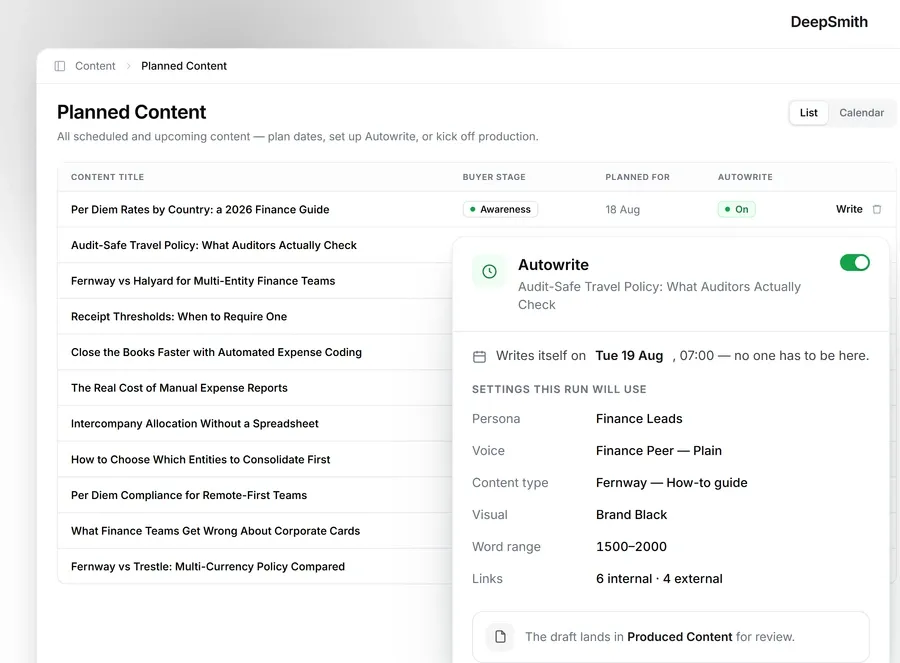
Plans start at $99 a month for Pro with 20 articles, 50 tracked prompts and 5 seats, then $199 for Grow with 40 articles, and $399 for Scale with 90, billed monthly, with a 7-day free trial and no long-term contracts. Annual billing brings those to $80, $160 and $299 a month. DeepSmith is rated 4.8/5 on G2 and is SOC 2, GDPR and ISO certified. For a one-to-one view, read DeepSmith vs Byword. The matching page for the other tool is DeepSmith vs Koala.
Programmatic pages and bulk production
Byword is the stronger tool for programmatic pages, because templates filled from a CSV or API feed are a core part of the product and programmatic is available on every plan, including Free. Koala has bulk writing from a keyword list on all paid plans and article types that cover roundups, service pages and topical clusters, but it does not build pages from a data template.
The limit on both is credits. Byword's volume is capped by article credits, and extra articles cost $3.50 each on Starter down to $2.50 on Scale. Koala's is capped by the word allowance, and bulk runs go faster on Boost and above. Large template runs also raise the risk of thin pages, which is worth reading about before you commit to one, such as how to build a programmatic SEO page template that holds up.
What DeepSmith does: it plans articles individually or in bulk, and Autowrite writes each one on its date. Each article comes out researched, linked and on brand, within a monthly allowance of 20, 40 or 90 articles by plan. That fits teams that want fewer, fuller articles chosen by evidence than thousands of template pages.
Planning and research
In Byword vs Koala AI, Koala wins on planning, because its agent starts from your own site. It reads Search Console and Analytics, finds striking-distance queries and ranking drops, and turns them into a calendar, and it can find topics competitors rank for that you do not cover. Byword's research is also strong, with keyword volume and difficulty, SERP insights, content gaps and topic clusters, but Search Console only comes in for its content refresh tool, which flags pages that have dropped.
On both, keyword data is the base. Byword's comes from a claimed index of more than 2.4 billion keywords, and Koala does not name its data provider. Neither is a reason to choose on its own, since both give you volumes, difficulty and a plan.
What DeepSmith does: Opportunity Agents read your AI visibility data and your Content Map and return ideas with the evidence attached, such as the competitor page winning a citation and the gap on your own site. A marketer can defend that backlog to a boss, because every idea shows why it is there.
Pricing and value
On Byword vs Koala features and pricing, Koala is cheaper to start and Byword is simpler to read. Koala begins at $25 a month against Byword's $99, and Koala scales by brand, with 3 brands at $179 and 75 at $2,000. Byword scales by article, and domains are 5 on Starter and unlimited from Standard at $299.
The catch with Koala is that you cannot turn its words into a number of articles without knowing how long yours run, and premium models use two or three times the allowance. Several tools in the plan, including the SEO editor and the uncapped agent, also begin at $49 and $99. Byword's catch is that team seats and the API only arrive at Standard, which is $299, and Free and Starter are solo.
Annual pricing is listed for Byword at $83, $249 and $833 a month for Starter, Standard and Scale. Koala says annual saves 20% but does not list the totals, so treat any annual figure for it as unconfirmed.
What DeepSmith does: pricing is by plan with a fixed article allowance and tracking included. For $99 a month you get 20 articles and 50 tracked prompts on one plan, and there is no word meter or credit pool to watch.
AI visibility and AEO
In Koala AI vs Byword on this axis, Koala is ahead, because it has documented tools that check whether Google AI Overviews cite a domain, compare competitor citations, and recommend answer-friendly rewrites and schema. Byword only touches the topic through its MCP docs and a link to a separate product, and it documents no method for optimizing to be cited. The record is clear on one limit for Koala, though. Its checks run on demand against Google AI Overviews, with no recurring sampling and no ChatGPT, Perplexity or Gemini answer history.
That distinction matters, since one-off checks can be noisy and trends say more than a single reading. If you want to compare dedicated options, there is a list of Google AI Overviews tracking tools.
What DeepSmith does: it runs your tracked prompts on a schedule, keeps the full answer history, and reports mention rate, citation rate and share of voice by engine. AEO formatting is also built into how the Writer structures every article, with crisp answers near the top and clear headings.
From insight to action
Koala is closer to a full loop than Byword. Its agent reads your data, hands topics to KoalaWriter, and Content Calendar Autopilot writes and publishes an approved calendar, from the Boost plan up. Byword goes from keywords to campaigns to publishing, and its Optimize tool syncs Search Console to catch decaying pages, but the choice of what to write stays with you and your research.
Both stop short of tying the plan to how AI engines answer your buyers' questions. Koala's plan comes from Search Console, and Byword's from keywords.
What DeepSmith does: the tracking and the writing share data. A tracked prompt where a competitor is cited and you are not becomes an Opportunity Agent idea, the idea gets a date, Autowrite produces the article, and the same prompt keeps being tracked afterward. That is the loop from tracking data into fixes, run in one platform.
Which should you choose
- DeepSmith fits marketing leads and content teams who want to know where they show up in AI answers, decide what to write from that evidence, and publish on-brand articles without stitching tools together, from small teams to agencies running several brands in separate workspaces.
- Byword fits SEO teams, agencies and affiliate or niche publishers who want programmatic pages or big batch campaigns, pay per article, and have the time to edit and fact-check what comes out.
- Koala fits bloggers, local businesses and agencies who want an agent to plan from Search Console data and who need many brands under one subscription at a low entry price.
On Byword vs Koala features and pricing, the choice between Byword or Koala AI mostly comes down to whether your volume comes from templates and data or from a plan built around your own site.
Start a free DeepSmith trial and see your AI visibility and your first batch of ideas before you pay.


