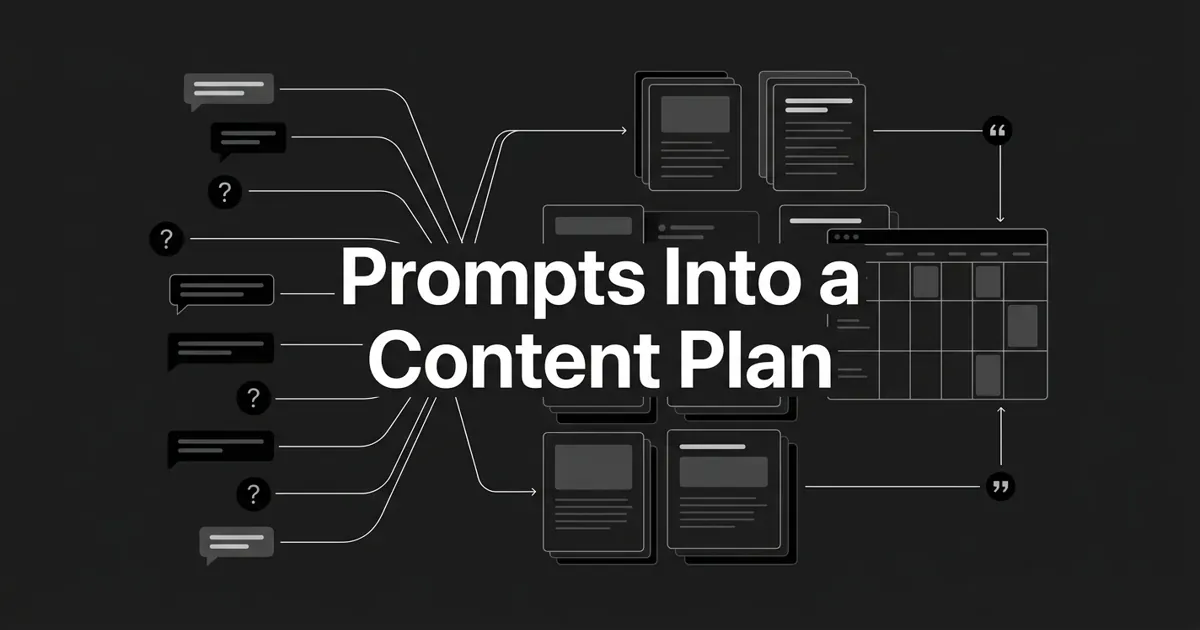
You already did the hard part. You have a list of prompts you want to win, the real questions buyers type into ChatGPT and Perplexity when they are sizing up your category. Now comes the part that stalls most teams: turning that list into an actual plan. If moving from ai prompts to content plan feels like staring at a spreadsheet with no next move, take a breath. This is a solvable, repeatable problem, and you are closer than you think.
Here is what you will have by the end of this guide: a way to tier your prompts, score them, match each one to the format most likely to earn a citation, and route the winners into production. That is the whole job: you turn prompts into content that gets cited by AI, one page, one prompt, one format, in the order you should build them.
Let's do it one step at a time.
First, a quick reset on what you are planning for
Two minutes of vocabulary saves you hours of confusion later, so let's get the words straight.
AEO, or answer engine optimization, is the practice of shaping content so AI assistants cite it. It is the same family as SEO, but the score changes. The old metric was a click. The new metric is a citation.
A tracked prompt is a question you deliberately monitor inside AI engines, logged and re-run on a cadence so you can see whether you show up. Mention rate is how often an engine names your brand. Citation rate is how often it links to your page as a source. Share of voice is your slice of the mentions or citations for your prompt set, measured against competitors.
Why does this matter so much right now? Because buyers are leaving the results page you optimized for. OpenAI reported ChatGPT crossed roughly 900 million weekly users in early 2026, more than double a year earlier. Google says its AI Mode passed about a billion monthly users in its first year, and that close to 60 percent of searches now end without a single click to the open web. A huge share of buyer research now happens inside an answer, not on your site. If your plan still maps keywords to blue links, you are planning for a page people are walking away from. Prompts are the new keywords, and the difference between AEO and classic SEO is exactly this shift from ranking to being cited.
That is what aeo content planning really is: planning around the questions people ask, not the keywords they used to type.
Good news: the workflow below turns that shift into a checklist. Five steps. Let's start.
Step 1: Audit and tier your tracked prompts
Do this first. Pull every prompt you are tracking across the engines that matter to you, and tag each one on two simple axes.
The first axis is buyer intent. Sort each prompt into one of five buckets: branded, comparison, category, problem-aware, or decision. The second axis is funnel stage: top, middle, or bottom. Problem-aware questions sit at the top, comparison and category questions in the middle, branded and decision questions at the bottom.
While you are here, widen your source list. Your prompt tool will not catch everything. Mine your sales calls, support tickets, Reddit threads, and Google Search Console queries for the exact language buyers use. That raw language is gold, and it is where the prompts nobody else is tracking come from.
You will know this step is done when every prompt on your master list carries exactly one intent label and one stage label, and you can answer a plain question: how many branded, comparison, category, problem-aware, and decision prompts do we have?
This is also where a tracker earns its keep. DeepSmith's AI search visibility module checks your prompts across ChatGPT, Perplexity, Gemini, Claude, and Google AI Mode on a schedule, then tells you where you already have visibility, where a competitor owns the citation, and where you are simply invisible. That inventory is the raw input for tiering, and it saves you from guessing. If you want a deeper walkthrough of sorting questions this way, the work of prompt mapping and prioritization deserves its own read.
Where this goes wrong. The most common mistake is treating your prompt list as flat, one long column with no labels. Without intent and stage, you cannot sequence anything. The second trap is under-counting comparison prompts, which are the highest-leverage type you have. The third is scoring branded and non-branded prompts in the same pass. Branded prompts defend a position you already hold. Non-branded prompts go on the attack. The difference between branded and unbranded prompts changes both how you score them and what you build.
Step 2: Score each prompt so you know what to write first
You cannot build everything at once, and you should not try. This step decides the order.
Score every prompt on five factors, each weighted. Volume counts for 25 percent: how often is this actually asked? Business value counts for another 25 percent: does this prompt touch revenue and fit your ideal customer? Current visibility counts for 20 percent, but inverted, so a prompt where you are already cited scores low and a prompt where you are invisible scores high. Win likelihood is 15 percent: given your authority on the topic, can you realistically out-cite the incumbents? Competitive intensity is the last 15 percent, also inverted, so fewer strong competitor pages means a higher score.
Add it up and split the list into three tiers. Tier A is your top 20 percent, and it gets built first. Tier B is the next 30 percent, your second wave. Tier C is the bottom half: backlog it, refresh it later, or let it go.
You will know this step is done when every prompt has a number and a tier, and your Tier A list actually fits your capacity. For a small team, that is often around eight to twelve articles a month. If Tier A is bigger than what you can ship in a quarter, your bar is too low.
This is the other place a platform does real work. The same visibility data, mention rate, citation rate, share of voice, and the trend on each, feeds your score directly, so you are not hand-assembling a spreadsheet from five browser tabs. Comparing your standing against rivals is much faster when share-of-voice data is already sitting next to each prompt.
Where this goes wrong. Teams skip volume and fall in love with a high-intent prompt nobody asks. That is a vanity bet. They also give every Tier A prompt the same treatment, when some want a deep pillar page and others want a lightweight template. And they ignore win likelihood, picking a fight with an entrenched incumbent on a foundational term before they have earned any authority. Pick the fights you can win this quarter.
Step 3: Map each prompt to the format that gets cited
Here is the heart of aeo content planning, and the part that separates content that gets cited by AI from content that just fills a calendar. The format you choose is not a style preference. It is a bet on extractability, and the data on that bet is clear.
An analysis of more than 768,000 AI citations across engines found that formats are not cited equally. Comparison posts pull citation shares in the 45 to 60 percent range. Product reviews land around 50 to 65 percent. How-to guides sit near 25 to 40 percent. Generic blog posts? Roughly 3 to 6 percent. The format is doing a lot of the lifting.
So match each prompt pattern to the format that wins for it:
- A "what is X" question wants a definitional guide that leads with the definition.
- A "how to X" question wants a how-to guide with real steps and troubleshooting.
- A "best X for Y" question wants a verdict-first listicle with ranked, compared options.
- An "X vs Y" question wants a true comparison: a table, a per-criterion breakdown, and a verdict by use case.
- An "X pricing" question wants a pricing page that leads with the number.
- An "X reviews" question wants a scored review roundup with a stated method.
- An "X alternatives" question wants an alternatives page with a switching guide.
- A "why" or "when" question wants an explainer that answers in the first sentence.
Notice the pattern under the pattern: every winning format opens with a direct, extractable answer. Answer first, evidence second, depth third. That inverted pyramid is the single biggest lever you have for getting cited by AI, because engines pull from the top of the page, not the middle. A closer look at which content formats AI cites will help you standardize these choices across your team.
You will know this step is done when every Tier A prompt is matched to one format template, and that template already implies the slug, the heading structure, and the schema you will need.
Pro tip: roughly half of your new production should go to comparison and category prompts. They capture citation share far out of proportion to the number of pages you publish. If you have to choose, choose the "vs" and the "best of."
DeepSmith helps at this exact decision too. Its Pages view shows which of your existing URLs AI already cites for which prompts, so you can spot a format gap, a prompt you should own but do not, before you greenlight a single new article.
Where this goes wrong. The classic error is forcing everything into a listicle. A comparison prompt needs a comparison, not a top-ten. The second is ignoring branded prompts, which want product pages and FAQ blocks, not editorial thought leadership. The third is treating format as a magic trick. The template is a wrapper. Citation still requires substance inside it.
Step 4: Write a citation-ready brief for each prompt
This is where your content plan for ai citations becomes something a writer can actually build from. A brief here is not a creative prompt. It is an engineering spec, and it should be boring in the best way.
For each Tier A prompt, write one page that locks down eight things:
- The exact prompt, word for word, plus five to ten natural variations and the persona who asks them.
- The required format and a pre-filled outline, so nobody re-litigates structure mid-draft.
- The direct-answer lead: a 30 to 50 word paragraph, in plain language, that resolves the prompt and sits at the very top of the page.
- A factual density target: at least one verifiable fact, statistic, or named source per 150 words. Original data earns the highest citation odds of all.
- Named-source attribution for every consequential claim. "According to an Ahrefs study of 1,885 pages" beats "studies show," every time. Vague authority kills extractability.
- A schema plan by format. Comparison pages get ItemList plus Product and FAQPage. How-to guides get HowTo plus FAQPage. Reviews get Review plus FAQPage. Definitional pages get Article plus FAQPage. Choosing the right structured data is easier when you know which schema types actually help AI citations.
- An internal link plan of three to five links: one to a close sibling page, one to a pillar, one to a conversion page. Treat internal linking as a citation lever, not housekeeping. A repeatable internal linking approach keeps this from eating your afternoon.
- A citation-readiness checklist: direct answer in the first 50 words, every H2 phrased as a question or a self-contained claim, a named source behind every major claim, schema validated, page fast, mobile clean.
A good content briefing system makes this the fastest step, not the slowest, because you fill the same template every time.
You will know this step is done when a writer can produce the article without asking you what format to use, what the lead should say, or what schema to add. If they have to ask, the brief is not finished.
Where this goes wrong. People skip the direct-answer lead and open with a story. AI engines extract from the top, so a narrative intro makes the page uncitable no matter how good paragraph six is. They also forget the internal links, or add schema as an afterthought. Build all three into the brief so they are never optional.
Step 5: Sequence production, then check your citations
Publishing is the middle of the job, not the end. This last step is what keeps your citations from quietly rotting.
First, lock a cadence you can actually hold. Weekly or biweekly works for most teams. Schedule Tier A first, then Tier B, then Tier C. Then, after each piece ships, run its target prompt back through your tracked engines on a weekly rhythm and record what you see: present or absent, mention rate, citation rate, sentiment, share of voice.
Re-score everything about every 30 days. A prompt that loses share becomes a refresh candidate, not a reason to write something brand new. And refresh on a schedule that matches the format. Comparison and pricing pages want a look every 60 days, because rivals change prices and features constantly. Priority pages want 90 days. How-to guides can stretch to 120.
This is the fourth place a tracker does the heavy lifting. Re-running your prompts in DeepSmith after publish confirms the page is genuinely being cited and flags regressions before they cost you a position. The measurement loop is the point, and deciding whether to chase citations or mentions first is a real strategic call worth making on purpose.
You will know this step is done when every Tier A page has a tracked mention rate, citation rate, and share of voice, refreshes are happening on cadence, and underperformers are being retired instead of ignored.
Where this goes wrong. The biggest mistake is treating publish as the finish line. Citation position drifts on its own. The second is measuring traffic when your KPI is citation. The third is never refreshing, which quietly bleeds your best pages of the freshness that AI engines reward. Understanding the citation signals that determine whether a page gets picked will tell you what to fix first when a page slips.
What to do next
You do not need a bigger team to start. You need a smaller first step.
Going from ai prompts to content plan is not one giant leap. It is five small, repeatable moves. This week, do one thing: tier every prompt on your list and score the top of it. That alone puts you ahead of most teams, who are still treating their prompt list as a flat column. Next, pick one format template per prompt tier and standardize it, so production becomes repeatable instead of a fresh negotiation every time. Then route your top 20 prompts into the next 60 days of slots, and set a 90-day point to re-score and rebalance toward whatever format is winning citations for you.
That is the whole loop. Audit, score, map, brief, verify, repeat. It is how you turn prompts into content that earns a spot inside the answer, and it is how a good content plan for ai citations stays alive instead of going stale.
If you want the tracking, scoring, and post-publish verification handled in one place, you can try DeepSmith free for 7 days and start on real data. One step at a time. You have got this.