The deepsmith vs koala decision looks like a comparison of two AI writing tools, but it is better understood as a choice between two different jobs. Koala exists to turn a keyword into a long-form SEO blog draft as fast and as cheaply as possible. DeepSmith exists to measure where a brand appears inside AI answers and then produce brand-grounded articles built to earn those mentions and citations. Both are competent at what they do. They simply optimize for different outcomes, and the right pick depends on which outcome a content team is being measured against this quarter.
The short version, for readers who want the answer near the top: for producing articles that are ready to be cited by AI search engines, DeepSmith is the closer fit, because Koala does not track AI citations and does not structure output specifically for citation in AI answers, while DeepSmith measures both and produces citation-ready articles as its default output. Koala wins on raw drafting speed and entry price. The sections below make that trade-off concrete, then close with a recommendation by situation and a short FAQ.
Comparison at a glance
| Dimension | Koala (KoalaWriter) | DeepSmith |
|---|---|---|
| Primary job | One-click long-form SEO blog draft from a keyword | AI search analytics plus brand-grounded article production |
| Category | AI writing tool for SEO blogs | AI search visibility and content production platform |
| Entry price | $9/mo (Essentials, 15,000 words) | $99/mo (Pro, 20 articles/mo) |
| Mid-tier price | $49/mo (Professional, 100,000 words) | $199/mo (Grow, 40 articles/mo) |
| Top self-serve price | $99/mo (Boost, 250,000 words); higher tiers to $2,000/mo | $399/mo (Scale, 90 articles/mo) |
| AI-search tracking | Not a feature | Core feature: mention rate, citation rate, share of voice, sentiment, visibility trend |
| Engines tracked | Not applicable | Ten: ChatGPT, Gemini, Perplexity, Claude, Google AI Overviews, Google AI Mode, Grok, Meta AI, Microsoft Copilot, DeepSeek (mix scales by tier) |
| Brand grounding | Tone presets only | Deep IQ: company, products, personas, voice, visuals, content types, sources |
| Output posture | Draft to edit and publish | Publish-ready article, with hands-off Autowrite option |
| Distribution assets | None beyond the article | Built-in social posts plus an Apps Library of channel formats |
| Volume model | Word credits that scale by tier | Articles per month (20 / 40 / 90, custom above) |
| Best fit | High-volume SEO drafts at low cost per article | Teams building AEO visibility with grounded, distribution-ready articles |
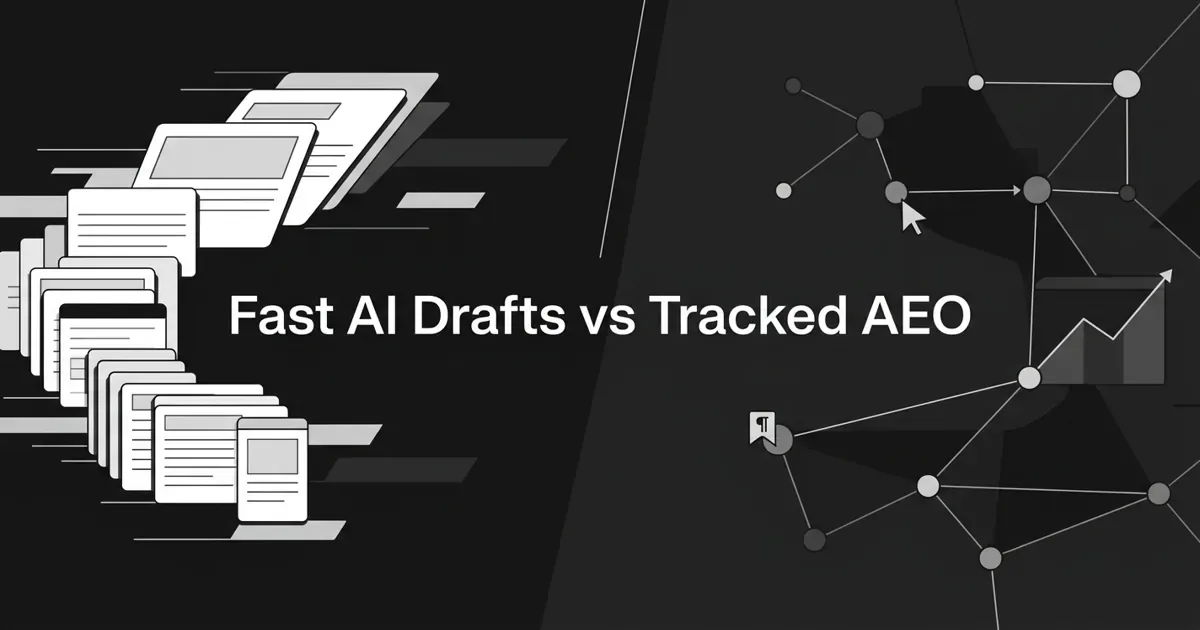
The core distinction: fast AI articles vs AEO
The framing that most clarifies the deepsmith vs koala question is fast ai articles vs aeo, because that phrase captures the actual fork in the road. One path optimizes for the cost and speed of getting words on the page. The other optimizes for whether those words earn a brand its place inside AI-generated answers, and measures that outcome rather than assuming it.
Koala treats the article as the deliverable. A keyword goes in, a formatted, SERP-aware draft comes out, and the workflow is complete once that draft is edited and published. DeepSmith treats the article as one step inside a measured loop. Visibility data shows which questions a brand is invisible for, the platform produces content aimed at those gaps, and the same analytics layer then reports whether the published pages are being mentioned and cited. The distinction matters because the two models respond to different constraints. When the binding constraint is cost per published post, the speed model tends to win. When the binding constraint is share of AI answers in a competitive space, the measured model tends to win. The rest of this comparison examines where each constraint dominates, since answer engine optimization has become a discovery layer that traditional ranking work does not fully address.
Koala AI writer: fast, low-cost SEO drafts

Koala AI, at koala.sh, is a suite of content tools whose flagship is KoalaWriter, a one-click long-form SEO blog generator. The product family also includes KoalaChat, KoalaImages, KoalaLinks, and KoalaMagnets. The koala ai writer is positioned as one of the earlier tools to produce full-length, formatted posts with real-time data, inline citations, and SERP-aware structure from a single prompt.
What Koala does well
On its core job, the koala ai writer is genuinely strong. A keyword or prompt produces a complete draft with an H2 and H3 hierarchy, meta-friendly formatting, and keyword usage handled during generation. Real-time data injection keeps prices, specs, and product details current, and inline source citations make factual claims attributable, which reduces the fact-checking load relative to unedited language-model output. SERP analysis shapes each outline against the current top results for the target term. Automatic internal linking crawls a site and inserts contextual links, a step that otherwise consumes real time per article; Koala reports having produced over ten million internal links to date through this feature. Bulk Writing Mode paired with a Google Sheets integration supports row-driven pipelines that generate many posts at once, and one-click WordPress publishing shortens the path from draft to live.
Under the hood, KoalaWriter runs on current large models selectable per article, with the monthly word allowance accounted against a lighter model, so higher-capability models consume the allowance faster. Third-party review sentiment is broadly positive: an aggregator snapshot places Koala at roughly 4.5 out of 5 across approximately seventy reviews, with praise concentrated on speed to a usable draft, SERP-aware structure, and bulk output.
Where Koala is constrained
The limitations follow directly from the product's scope. Koala does not track AI-search visibility. It does not report whether ChatGPT, Perplexity, Gemini, Claude, or Google AI Mode mention or cite a brand, so confirming AI citations remains a manual exercise. Its brand voice is a set of tone presets rather than a structured context layer, which means it does not carry positioning, product facts, persona detail, or claims-to-avoid into every draft. Output is framed as a draft to edit, so review and brand alignment stay with the user; readers weighing how much of the last stretch of work remains should account for the editing pass a preset-driven draft still requires. There is no native social or email distribution beyond publishing, and because volume is metered in words, heavy users reach quota ceilings and must move up tiers or ration output. Common criticism in third-party reviews centers on those word quotas feeling tight at scale and output that leans toward an SEO template rather than fidelity to a distinct brand voice.
Koala pricing
Koala publishes a wide ladder of plans priced by monthly word allowance. Essentials starts at $9 per month for 15,000 words, Professional is $49 per month for 100,000 words, and Boost is $99 per month for 250,000 words, with higher tiers scaling to $2,000 per month for ten million words. Annual billing saves roughly twenty percent, and a free trial provides 5,000 words and 25 chat messages with no credit card required. That entry point is the lowest in the category, which is much of Koala's appeal for cost-sensitive, high-volume publishing.
Who Koala fits
Koala fits affiliate marketers, niche-site operators, and small agencies that need many SEO-shaped posts per month at the lowest per-article cost, and that already own a workflow for outlines, clusters, and editorial review. For a team whose success metric is published volume against a Google ranking strategy, the koala ai alternative question rarely gets asked, because the tool does that job efficiently.
DeepSmith: grounded track-and-write production

DeepSmith, at deepsmith.ai, is an AI search analytics and content production platform in one workspace: one platform for AI search analytics and content production. It is a production engine, not a writing assistant, and its output is publish-ready rather than a first draft to rescue. Where the koala ai writer stops at the draft, DeepSmith wraps writing inside a measured system with seven modules: AI Search Visibility, Content Map, Opportunity Agents, Content Studio, Repurpose and Apps, Deep IQ, and Platform and Account.
What DeepSmith does well
The defining capability is that analytics and production share one workspace, so visibility data drives what gets written next. The AI Search Visibility module reports mention rate, citation rate, share of voice, sentiment, and visibility trend, broken down per platform and per prompt, with a competitor leaderboard and the sources AI cites most; anyone standardizing their AI visibility metrics and KPIs will recognize these as the core measures. Per-page views show which pages actually earn citations. Content Map crawls your site and every competitor site onto one shared topic taxonomy, so coverage gaps where a rival publishes more and untapped topics where you publish nothing at all become measurements rather than hunches, which supports a deliberate topic cluster strategy rather than scattered one-off posts. Opportunity Agents then read that visibility and coverage data and return content ideas with the justifying data point attached to each one.

Grounding is the second differentiator. Deep IQ stores About Company, Products and Services, Buyer Personas, Brand Voice, Visual Guidelines, Content Types, and a trusted-sources list, and every module reads from that structured context so output stays on-brand and product-accurate at volume. The Writer turns one planned idea into a finished article with research, internal links drawn from the Content Map, external citations, a cover image, and metadata; teams that spend real time on cross-referencing will note that this replaces manual internal linking work. Autowrite configures an article at planning time and writes it on its scheduled date with no one in the app. Distribution is built into the article: social posts arrive with each piece, and an Apps Library produces channel-native versions for LinkedIn, X, Medium, Substack, newsletter and nurture email, and more. Direct publishing reaches WordPress, Webflow, Strapi, Sanity, and Contentful, or your own webhooks, with Markdown and HTML export as a fallback.

Because articles are formatted with citation-ready structure, crisp answers near the top of sections, and clear headings as part of the pipeline, the output is shaped for extraction by AI engines, not only for ranking; this reflects the difference between answer-first content structure and conventional SEO formatting.
Where DeepSmith is constrained
DeepSmith carries real trade-offs of its own. Its entry price is higher than a pure writing tool, because it bundles an analytics layer that has to be set up before content ships; that layer, together with built-in distribution, replaces the tracking and repurposing tooling a team would otherwise buy and run separately, so the higher line item covers work that would not be free elsewhere. Engine coverage scales by tier: Pro tracks ChatGPT only, Grow adds Perplexity, Scale adds Gemini, and all ten engines arrive on Enterprise; ChatGPT is covered from the entry Pro tier, and the mix expands as a program's engine needs grow, so a team pays for Perplexity or Gemini tracking at the point it actually needs it rather than up front. Setup relies on importing an existing site into Deep IQ, so brands without a site or sitemap invest in configuring context first; that one-time setup is what grounds every later article in brand, product, and persona context, so the cost is paid once and repaid on each piece that follows. Volume is capped by article count rather than words, at 20, 40, and 90 articles per month across the self-serve tiers, which constrains very high-volume publishing compared with a word-credit model; each counted article, however, is publish-ready and arrives with distribution assets, so a single unit carries more of the finished work than a raw draft does.
DeepSmith pricing and engines
DeepSmith publishes four tiers. Pro is $99 per month for 20 articles and tracks ChatGPT. Grow, the most popular tier, is $199 per month for 40 articles and adds Perplexity. Scale is $399 per month for 90 articles and adds Gemini. Enterprise is custom, covers all ten engines, and adds one-to-one onboarding and a dedicated account manager. Annual billing lowers the effective monthly rate by roughly a fifth, DeepSmith tracks ten engines across the product (ChatGPT, Gemini, Perplexity, Claude, Google AI Overviews, Google AI Mode, Grok, Meta AI, Microsoft Copilot, and DeepSeek) with the mix rising by tier, and a 7-day free trial provides real data and real drafts before payment, with no long-term contracts or cancellation fees.
Who DeepSmith fits
DeepSmith fits marketing leads and content teams that treat content as a growth channel, need to see and grow a brand's share of AI answers rather than only Google rankings, and want distribution handled in the same workflow as production. For those teams, the deepsmith or koala question usually resolves toward the platform that measures the outcome they are accountable for.
Head-to-head on the dimensions that decide it
AEO readiness
This is the decisive dimension. Koala produces structured blog content but does not measure whether AI engines cite it, does not report per-prompt mention or citation rates, and does not format specifically for AI citation. DeepSmith measures mention rate, citation rate, share of voice, and visibility trend per prompt and per page across its named engines, and formats articles for citation as part of the pipeline. For a team whose objective is AI-answer visibility, this gap is the whole comparison. It is also worth being precise about the boundary: DeepSmith tracks and produces, it does not control or guarantee rankings, citations, traffic, or revenue, which depend on the market and the team's execution.
Grounding and brand consistency
Koala's brand voice is a tone preset applied per draft. DeepSmith's Deep IQ is a persistent, structured context layer that carries positioning, products, personas, voice, visuals, and content types into every generation, which is the mechanism that keeps output consistent as volume rises. The practical difference shows up most for teams that have been burned by AI drafts that read like generic template content regardless of the brand producing them.
Production stance
Koala outputs a long-form draft intended to be edited and published, so the closing work stays with the user. DeepSmith outputs a finished, publish-ready article with cover image, links, and metadata, and can either publish hands-off through Autowrite or route through human review before publishing. Teams evaluating this dimension are effectively deciding how much of the finishing work they want to keep versus how much they want the system to absorb.
Distribution
Koala's distribution ends at WordPress publishing, webhooks, Google Sheets, and its API. DeepSmith generates social posts with each article and offers an Apps Library that adapts one article into channel-native formats, so distribution becomes a standard step rather than a separate project that gets deprioritized. For teams where the LinkedIn post and the newsletter section reliably fall off the end of the workflow, this is a meaningful structural difference.
Pricing and value
The two price on different units. Koala prices per word, from $9 to $2,000 per month, which produces a predictable and low cost per word at high volume. DeepSmith prices per article, from $99 to $399 per month on self-serve, with analytics and distribution bundled into that figure. A pure cost-per-draft comparison favors Koala; a cost comparison that accounts for tracking and distribution tooling that would otherwise be bought separately narrows the gap and can reverse it, depending on what a team would otherwise assemble. Readers modeling this should look at the total cost of an AI content workflow rather than the headline subscription line alone.
Volume model
Koala's word-credit model is built for high-volume SEO output and scales cleanly into the millions of words. DeepSmith's article-count model is built for fewer, higher-quality, distribution-ready pieces. A team publishing hundreds of thin posts a month and a team publishing a few dozen grounded, tracked pieces are optimizing for different shapes of output, and the volume model each tool uses reflects that.
Which should you choose
The choice resolves cleanly once the primary constraint is named. Choose Koala when the priority is producing many SEO blog drafts cheaply, the existing workflow already handles outlines and internal links and clusters, budget per article is the dominant constraint, and measuring AI-search visibility is not yet on the roadmap. In that situation Koala is the efficient tool, and a search for a koala ai alternative is unlikely to surface anything cheaper for pure drafting throughput.
Choose DeepSmith when the priority is getting a brand mentioned and cited across the ten engines it tracks, from ChatGPT, Perplexity, Gemini, and Claude through to Google AI Overviews, Microsoft Copilot, Grok, Meta AI, and DeepSeek, when the team needs to see which prompts drive citations and which competitor pages win them, when brand voice and product accuracy must hold across many articles a month, and when distribution should happen from the same source article without a separate tool. The reasonable summary of deepsmith vs koala is that the deciding factor is whether AI-search visibility matters as a measurable outcome in the next quarter. If it does, DeepSmith is the fit. If the goal is organic Google rankings at the lowest possible cost, Koala is.
Teams that want to test the grounded, tracked model against their own site can start a DeepSmith free trial and see real visibility data and real drafts before committing to a plan.