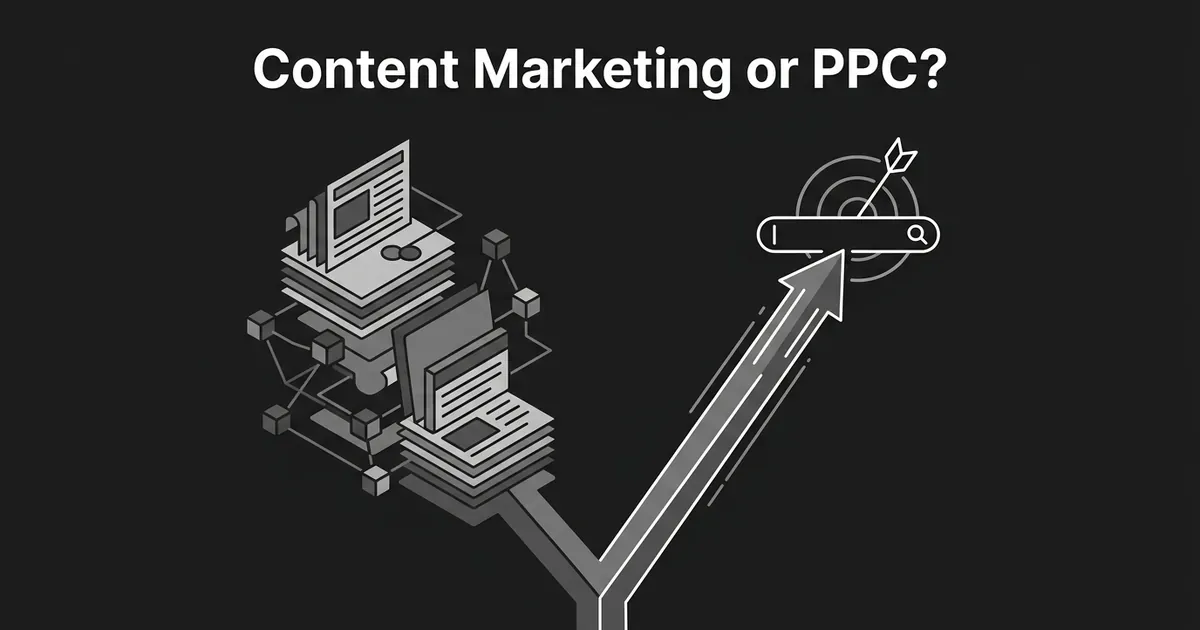
You have a marketing budget that isn't big enough to do everything, and someone is asking you whether the next dollar should go to content marketing or to PPC. There isn't one right answer that applies to every company, but there is a right way to think about it. If you need qualified pipeline soon, have clear commercial search demand, and your margin can absorb the cost of buying clicks, PPC is usually the better place to put the next dollar. If your buyers spend a long time researching before they ever talk to a salesperson, PPC alone won't reach them early enough, and content marketing earns the larger share. Most growth-stage teams need some of both, just not in equal measure, and not forever in the same ratio. This is the content marketing vs paid search budget question every growth-stage team eventually has to answer.
Before you split a budget, it helps to see the two side by side.
| Content marketing and SEO | PPC and paid search | |
|---|---|---|
| Job | Educate, build trust, answer questions, create a reusable asset | Capture existing demand and generate visits or conversions quickly |
| Time to show results | Slower, often weeks to months | Faster, visibility begins once ads go live |
| Spend pattern | Upfront investment that can keep paying off | Ongoing spend tied to continuing traffic |
| Best fit | Long research, comparison, education, trust-building | Existing demand with a clear next action |
| Biggest risk | Producing content with no defined audience or measurement plan | Buying clicks from low-intent searches or judging success on clicks alone |
The rest of this piece walks through the real decision, not a fixed percentage. There isn't a research-backed 50/50 or 70/30 split you can borrow from someone else's business, so don't go looking for one.
What content marketing actually is
Content marketing is the practice of creating and distributing useful, relevant material for a specific audience, on purpose and on a schedule, so that audience comes to trust you and eventually takes a profitable action. It's meant to help someone solve a problem or make a decision, not to pitch them.
The assets under that umbrella are wider than most people assume: educational articles and guides, original research, case studies, comparison content, webinars, video, e-books, calculators, nurture emails, and thought leadership. Content marketing is also bigger than SEO. SEO is one way people find your content through organic search. The same piece of content can also reach people through email, social, communities, sales enablement, or a direct link someone sends a colleague. And PPC can promote content too, so these channels aren't as separate as they first look.
The value of a good piece of content can outlast the time it took to make it. It keeps answering the same question for a new reader six months from now at no extra cost. That's the appeal. The catch is that visibility and impact usually take time to show up, and nothing guarantees they will.
What PPC actually is
PPC, or paid search, puts a sponsored listing at the top of search results, and you pay when someone clicks through to your site. Google describes it plainly: you're charged for the click, and you can watch impressions, clicks, and revenue as they happen, though results vary by advertiser. This piece keeps to paid search specifically, not the wider world of paid social, display, or video ads, so the comparison stays clean.
PPC buys you a seat at the table for however long you keep paying for it. It can send people to product pages, demos, comparison pages, or a piece of content you want more eyes on. Turn the spend off and the visibility goes with it. That's not a flaw so much as the nature of a rented channel: you're paying for access to demand that already exists, and the value is mostly captured while the campaign runs.
Where SEO fits in this decision
A lot of people shorten this whole question to "SEO vs PPC budget," and that framing is useful but incomplete. SEO is the discovery half of content marketing, the part that gets your content found through organic search. It doesn't cover the content that reaches people through email, sales conversations, or a peer recommendation, all of which can still influence a buyer long before they search anything. If you're only weighing SEO against PPC, you're comparing one slice of content marketing against paid search, not the whole picture. Treat the SEO vs PPC budget question as a subset of the bigger content marketing vs paid search budget question, not a replacement for it.
How fast each one shows results
PPC gives you a faster read. Once your ads and landing page are live, you start seeing clicks, and you can tell fairly quickly whether the offer and the traffic are a match. That speed is genuinely useful when you need to learn something this month, not this quarter.
Content moves on a different clock. Google's own guidance says changes from SEO work can show up anywhere from a few hours to several months later, and it recommends waiting several weeks before judging whether something worked. There's no guarantee a given page ranks at all. So the fair comparison isn't "fast PPC versus free content." It's paid distribution with quick feedback and an ongoing bill, against owned content with slower, less certain discovery and the chance of reach that keeps paying off well after you stopped actively working on it.
How your sales cycle length changes the split
A short sales cycle points you toward PPC. If your buyer can understand the offer quickly, is searching with commercial intent already, and your gross margin can absorb the cost of winning that click, paid search gets you there faster than content can. You still want some content in the mix here, but it plays a supporting role: clear explanations, proof, and answers to objections that a paid visitor needs before converting.
A long or complicated sales cycle points you toward content. When several people weigh in on the purchase, when buyers compare multiple vendors, when the problem itself needs explaining before anyone can evaluate a solution, and when the same questions come up in call after call, content earns its keep by answering those questions once and reusing the answer for every future buyer who asks. PPC can still help here, mostly by capturing the buyers who already know what they want and pointing the rest toward your educational content.
A useful way to sequence this if you're unsure: use PPC first to learn which problems and messages attract commercially relevant visitors, then build content around the questions that keep recurring, then measure whether that content is actually shortening deals or improving win rate rather than just adding traffic. Shift the split as your margin, sales cycle, and content library change.
How margin and CAC payback change the split
Revenue isn't the same as money you have to spend recovering the cost of getting a customer. Only the gross margin portion of revenue is available for that. Gross margin is revenue minus cost of goods sold, divided by revenue, and for a SaaS business that COGS usually covers hosting, support, and payment processing.
Once you know your margin, calculate your CAC payback period: customer acquisition cost divided by monthly recurring revenue, then adjusted for gross margin by dividing that revenue figure by your margin percentage first. A simple example from Maxio: an acquisition cost of $200 against $25 of monthly recurring revenue gives an eight-month payback before you account for margin. At 80% margin, the true payback stretches to ten months. Maxio also notes that many SaaS businesses can be profitable with a payback between nine and fourteen months, while the best performers land between two and nine, though the right number for you depends on your business.
If your margin and customer value can absorb that payback comfortably, PPC can support a more aggressive push for demand, and content still deserves funding wherever the buyer journey is research-heavy or paid costs are climbing. If your margin is thin, be careful about scaling PPC just because the clicks are measurable. A click can be trackable and still be a losing bet once you account for fulfillment, support, and churn. And if retention is weak, neither channel fixes that on its own. Fixing the leak matters more than choosing where the water comes from.
How much of the buying journey happens before sales
This is probably the single most useful thing to know about your own buyers before you split a budget. Several recent studies point the same direction, even though their numbers don't agree with each other exactly, because they're different samples measured different ways. Gartner's 2026 press release, based on 646 B2B buyers surveyed in August and September 2025, found that 67% preferred a rep-free buying experience. A separate Gartner buying-journey page, based on 148 technology buyers, put that figure at 75%. The 2024 6sense Buyer Experience Report, surveying 2,509 B2B buyers, found that 69% of the purchase process happened before buyers engaged a seller at all, 81% had already chosen a preferred vendor before that first conversation, and 85% had already settled their purchase requirements.
None of these numbers prove that content marketing causes someone to pick a vendor. What they do support is a planning assumption: in a lot of B2B categories, a large share of the real decision-making happens before your sales team is even in the room. If that's true for your buyers too, being absent from that early research is a bigger problem than a slow sales cycle.
Don't borrow someone else's percentage as your own fact. Check it against your own data instead: ask new customers what they looked at before they contacted you, note the gap between first website visit and first sales conversation, and read back through your own call notes for questions that keep repeating. If sales keeps explaining the same three things on every first call, that's content marketing's exact opening.
How to measure both channels without fooling yourself
Both channels get misjudged by the same mistake: crediting the last click for a decision that happened earlier. A last-touch report can hand a paid search click 100% of the credit for closing a deal that content quietly built over months. It can just as easily undercount content for the same reason it overcounts PPC.
Judge content by more than traffic. Content-influenced pipeline, content-assisted win rate, sales-cycle length for content-engaged accounts versus everyone else, and the gross profit those accounts eventually generate all tell you more than a pageview count. The Content Marketing Institute's 2025 B2B research found that 96% of marketers measure content performance, but only 51% of that group believed their organization measured it effectively, and 56% specifically named ROI attribution as a struggle. That gap is common enough that you shouldn't feel behind for hitting it, just aware that it needs a real fix.
Judge PPC by the same economic yardstick you use for content: qualified opportunities and customer acquisition cost, not clicks and cost per click. A channel can look efficient on a dashboard and still be a loser once you factor in the full cost of serving that customer. Whichever channel you're weighing, ask what it did to gross profit and retention, not just what it did to the traffic count.
Where each one wins right now
Content marketing is usually the stronger bet when your sales cycle is long, when the problem needs real education before anyone can evaluate a solution, when several people weigh in on the purchase, when most of the buying activity happens before a sales call, and when your margin makes a high paid acquisition cost hard to justify. It's also the right call when you have a repeatable set of questions your company can answer better than the competition, and enough runway to invest before it fully pays back.
PPC is usually the stronger bet when you need pipeline now, when clear commercial search demand already exists for your problem, when the offer is easy to understand without much education, when your margin and customer value support the payback period you need, and when your sales team can actually follow up fast enough to use the extra volume.
Most growth-stage companies land somewhere in between, and that's not a failure to decide. It's PPC capturing the buyers who are already close to acting, while content builds the case for everyone else who's still comparing options. The same piece of content that converts a shortlisted buyer can also be the landing page your paid traffic lands on, which is one more reason to stop treating these as two separate budgets fighting for the same dollar.
A simple way to test and reallocate
Start with your own economic guardrails: your average contract value, gross margin, retention, and the CAC payback period you can actually tolerate given your cash. Then score your buyer journey using the questions in the section above. Set a test period in advance for each channel, long enough to actually see a signal (PPC readouts usually come faster, content and SEO can reasonably take longer), and decide ahead of time what result would make you invest more, and what result would make you pull back.
Then reallocate based on the marginal dollar, not the historical one. If more PPC spend is still buying profitable customers inside your payback window, it can probably take more budget. If the payback is drifting the wrong way as you scale it, shift some of that marginal dollar toward content, or toward fixing the conversion experience, before you shift it toward more paid volume. If content is bringing traffic but not qualified pipeline, look at your topic selection and distribution before deciding content doesn't work. If content is clearly shortening your sales cycle even though last-touch reporting undersells it, protect that budget and fix the measurement instead of cutting the thing that's working.
If you're trying to figure out where your own content actually has gaps against what buyers are searching for and what competitors already cover, that's the kind of question a platform like DeepSmith is built to answer: it maps your site and your competitors' sites onto the same topics, so you can see where you're thin before you commit more budget to filling it. You can start a free trial and look at your own gap map before you decide anything. That's a research input to this decision, not a substitute for making it.