Look at your last twenty published pieces. If most of them explain a problem and the rest are product pages, the middle is empty, and that is where the people who were almost ready to choose you quietly leave. This guide walks you through planning and producing full funnel content with AI, so every stage has an asset built on purpose. By the end you will have a matrix for content across the buyer journey, a production sequence, and a review process you can hand to your team on Monday.
If that sounds like a lot, take a breath. You are probably closer than you think. Most teams already have the awareness pieces. What is missing is the connective tissue.
Step 1: Name the decision you want your reader to reach
Start at the end, not the top. Write one sentence describing the decision a qualified reader should be able to make, then work backward.
Three sentences, that is the whole exercise:
- Awareness (TOFU): what should a reader newly understand?
- Consideration (MOFU): what should a reader be able to compare or evaluate?
- Decision (BOFU): what should a qualified reader be able to validate or decide?
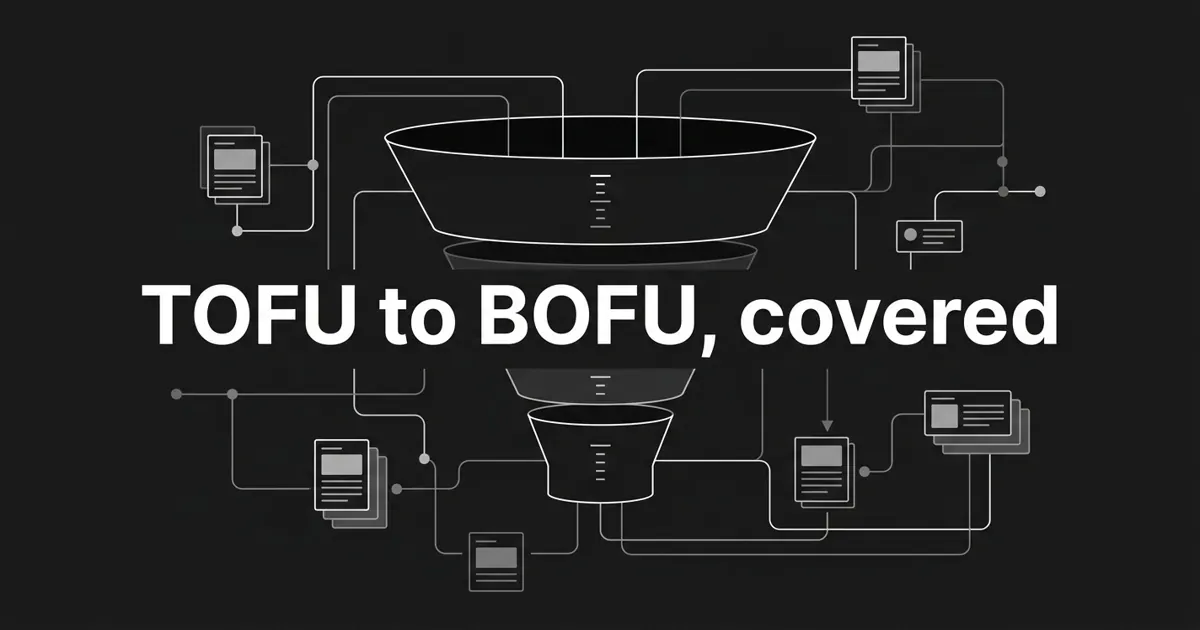
Those labels map cleanly. TOFU is top of funnel, where someone is recognizing a problem and learning the vocabulary. MOFU is the middle, where they are weighing approaches. BOFU is the bottom, where they are comparing vendors and looking for reassurance before acting.
Defining the decision destination first is a sequencing trick, not a law. It works because decision content gives everything upstream somewhere to point. Without it, you build a beautiful library of explainers with no exit.
How to tell it is done: you have a specific decision outcome, an evaluation path, and an entry point, and all three sentences describe reader progress rather than your preferred sales language.
Where people go wrong: treating the funnel as a traffic pyramid. A plan is not full-funnel because it has forty awareness posts and one pricing page at the bottom.
Step 2: Map buyer questions and give each one a primary stage
Now collect the real questions. Pull them from search queries, sales calls, support tickets, customer interviews, your existing pages, and the prompts people type into AI engines.
Then classify each question by the reader's intent, not by the format you plan to use or the length of the keyword.
For each row, record the primary stage, what the reader already knows, the outcome they should reach, the format, the next-stage handoff, and the evidence you will need. One primary stage per asset. You can note a secondary handoff, but resist labeling anything as two stages at once, because that is usually a sign you have not decided what the piece is for.
Here is the part most teams skip: label what you already published before you produce anything new. You cannot see a hole in your funnel coverage content plan while your existing library is untagged.
This is where a shared map earns its keep. DeepSmith's Content Map crawls and enriches every page on your site, classifies it onto a topic and an Awareness, Consideration, or Decision stage, and rechecks sitemaps every 24 hours so new pages fold in on their own. That gives you funnel distribution per topic as a measurement instead of a hunch. The lesson holds even without a tool: inventory first, produce second.
How to tell it is done: every planned asset carries one primary stage and one buyer question, and a reviewer can defend that stage without pointing at the URL or the CTA.
Where people go wrong: calling every blog post TOFU, every comparison MOFU, and every product page BOFU. A comparison of solution categories is usually consideration. A comparison of named vendors is usually decision. The reader's question decides, not the template.
Step 3: Match each question to a format, an outcome, and a next step
Intent picks the stage. Stage picks the format. Do not let the format pick the stage, because a webinar can be any of the three depending on what it teaches.
| Stage | Reader's starting point | The content's job | Formats that fit | Appropriate next step |
|---|---|---|---|---|
| TOFU, awareness | Recognizing a problem or learning a category, may not know your brand | Define the problem, the vocabulary, the stakes, the solution categories | Educational articles, explainer videos, research reports, ebooks, guides, checklists, thought-leadership webinars, podcasts | A deeper resource, a framework, a checklist, or a related consideration question |
| MOFU, consideration | Has a defined problem, evaluating approaches | Make evaluation easier: criteria, tradeoffs, requirements, implementation paths | Solution-category comparisons, implementation guides, ROI examples, FAQs, webinars, product tours | Fit assessment, detailed product information, proof, or a decision-stage question |
| BOFU, decision | Has narrowed the category, comparing vendors or seeking reassurance | Reduce uncertainty with proof, fit, requirements, and answers to objections | Case studies, testimonials, use cases, vendor comparisons, buyer guides, FAQ pages, demos, trials, consultations | Start a trial, request a demo, contact sales, or validate implementation requirements |
For every row, write a one-line brief in this shape: for a reader who currently knows ___, create a ___ that helps them ___, using ___ evidence, and points them to ___ next.
That single sentence is the difference between a title and an asset.
Match the ask to the readiness, too. An awareness piece should usually hand the reader more education or a framework, not a demo request. A consideration piece should hand them fit information or proof. A decision piece should make the action obvious. Handoffs are what turn a pile of pages into content across the buyer journey.
Pro tip: reuse a topic across stages only when the reader's question genuinely changes. A TOFU explainer, a MOFU evaluation guide, and a BOFU case study on the same topic form a real path. Three near-duplicate pages on the same topic form a cannibalization problem.
How to tell it is done: every row has a reason for its format, a reader outcome, a handoff, and a CTA that matches readiness.
Step 4: Build a calendar that shows stage coverage on its face
A list of dates and titles is not a plan. Convert each approved row into an operational brief carrying a production date, an owner, a stage, a format, a source pack, internal-link targets, a CTA, a review owner, and the distribution variants you will need afterward.
Then sequence for dependencies. Publish the foundational explainer before the consideration guide that assumes its vocabulary. Make sure the decision asset exists before you start driving traffic down the path toward it.
Keep stage visible as a column or a label. Not in your head. A calendar you can filter by TOFU, MOFU, and BOFU is a calendar you can audit in five minutes, because your whole TOFU MOFU BOFU content mix sits in one column instead of in somebody's memory.
Your completeness check is simple. Spread content across the buyer journey topic by topic, not site-wide. For each important topic, can you point to one awareness asset, one consideration asset, and one decision asset, or explain why a stage is genuinely irrelevant? If not, what you have is a topic list, not full funnel content.
How to tell it is done: a calendar review can answer six questions per row without anyone opening a doc: which stage, which buyer question, what source material is ready, who reviews it, what is the next handoff, and when does it get distributed.
Where people go wrong: dates and titles with no stage, no reader outcome, no source owner, and no next step. That calendar generates activity, not coverage.
Step 5: Give the AI durable brand and source context
Here is the honest reason most AI drafts read like everyone else's AI drafts: they were briefed with a title and a keyword. That is not the model's fault. It is a context problem, and context is fixable once instead of repeatedly.
Build a context pack that holds:
- Company positioning, category, differentiators, and approved terminology.
- A product profile with features, use cases, value props, requirements, limitations, and claims to make or avoid.
- The buyer persona: goals, triggers, requirements, challenges, objections.
- Brand voice rules with examples, words to use, words to avoid, and how direct to be.
- The content type and the stage definition for this specific asset.
- The reader's starting knowledge, primary question, desired outcome, CTA, and next-stage handoff.
- A trusted source list, first-party evidence, subject-matter-expert notes, and customer proof.
- SEO and AEO requirements: primary topic, related terms, heading structure, answer placement, metadata, schema, and internal-link targets.
- Visual guidance for the cover and any supporting images.
DeepSmith stores exactly this layer as Deep IQ: About Company, Products & Services, Buyer Persona, Brand Voice, Visual Guidelines, and reusable Content Types with a trusted-sources list. Every other part of the platform writes from it. The benefit is not that AI suddenly understands your brand by magic. The benefit is that briefing gaps, voice drift, and invented product claims stop being a per-article risk.
How to tell it is done: an editor can open the context pack and trace the source of every material product claim. A test brief produces the right stage, format, tone, and terminology without a long manual preamble.
Where people go wrong: a style adjective in place of real rules. "Professional but friendly" is not brand voice. Examples, approved claims, and banned phrases are.
Step 6: Produce in controlled passes, not one giant prompt
Planning AI content by funnel stage only pays off if production respects the plan. Split the work into passes that each have one job:
- Research pass. Organize the approved source pack, surface definitions, and flag missing evidence. The model may summarize sources. It may not fill gaps with invented facts.
- Planning pass. Confirm the primary stage, the reader's starting knowledge, the format, the outline, the evidence slots, the CTA, the handoff, and the internal-link targets.
- Drafting pass. Produce an original, brand-grounded draft that delivers the stage's reader outcome, with the primary intent visible in the structure.
- Enrichment pass. Add keyword and entity coverage, headings, metadata, schema, internal and external links, answer-first passages, and cover-image direction.
- Production pass. Generate the final article and its distribution assets from the same approved context.
DeepSmith runs these as one pipeline rather than five prompts you babysit. Content Studio's Writer turns a planned idea into a researched article with SEO and AEO structure, internal and external links, metadata, and a cover image already in place. It is a production engine, not a writing assistant, so what lands is meant to be publish-ready rather than a first draft to rescue. Your review still matters, which is the next step.
Common mistake: asking AI for more articles before deciding which buyer question and funnel stage each article serves. More volume does not repair missing consideration or decision coverage.
There is a real risk worth naming here. Google's guidance permits generative AI as a way to research and structure original content, and it warns against generating pages at scale without adding value. The test it applies is whether content helps people and adds original, trustworthy value, not whether a model touched it.
How to tell it is done: the output answers its assigned question, matches its assigned stage and format, uses approved evidence, carries usable links and metadata, and offers the promised next step. No placeholders, no unexplained jargon, no introduction that could belong to any company in your category.
Step 7: Run five review gates before anything publishes
Reviewing for grammar is not reviewing. Polished prose is the easiest thing for a model to produce and the least useful thing to check. Run gates instead.
Gate A, stage and intent. Does the page answer the question assigned to it? Is the assumed starting knowledge accurate? Does the format fit the outcome? Do the CTA and the handoff match readiness?
Gate B, accuracy and evidence. Can every statistic, date, capability, integration, customer result, and comparison claim be traced to an approved source? Are changeable facts flagged for rechecking? Did the model invent a quote, a result, a feature, or a citation?
Gate C, original value. Does the piece add a framework, first-hand experience, product knowledge, synthesis, or decision criteria? Would it help someone who arrived cold, with no idea who you are?
Gate D, voice and product accuracy. Does it sound like your brand? Are product names and approved claims exact? Are the claims you avoid actually absent? Is the tone right for the reader's stage without getting pushy?
Gate E, structure and operations. Are headings, lists, tables, metadata, schema, internal links, external sources, image direction, and CTA all complete? Do the internal links move the reader to a useful next question rather than pad a link count?
Decide as a team which content classes require review before publishing. Claims-heavy decision-stage pages are the last place to experiment with hands-off publishing, not the first.
How to tell it is done: your editor spends the review on strategic alignment and factual integrity, not on rebuilding structure, voice, and claims from scratch.
Where people go wrong: trusting fluency. A confident sentence and a sourced sentence are different things.
Step 8: Schedule, publish, and repurpose as one motion
Distribution is not a phase that happens later. Later is where distribution goes to die.
For every published article, schedule three things at the same time: the next-stage handoff, the internal links that carry readers toward it, and the channel-native adaptations. Then review those variants for stage fit and claims rather than pasting the same paragraph into five channels.
DeepSmith handles this as one flow. Ideas move through New Ideas to Planned Content to Produced Content, and giving an idea a date is what plans it. Autowrite can generate a scheduled article on its date so your calendar keeps moving during the weeks when you cannot get to it. Produced Content is where you review, edit, and publish to WordPress, Webflow, Strapi, Sanity, Contentful, or your own webhooks. Repurpose and the Apps Library turn a finished article into LinkedIn posts, X threads, Medium or Substack versions, newsletter and nurture email, Reddit, Facebook, Instagram, Slack or Discord, and WhatsApp formats.
How to tell it is done: every core asset has a publication date, a stage label, a review decision, a handoff, internal links, and planned distribution variants, all visible without a second spreadsheet.
Where people go wrong: publishing the article and leaving the handoff, the linking, and the channel assets as future tasks. Those tasks do not have a future.
What to do next
Do not rebuild the whole library this week. Take your next batch, the ten or fifteen pieces already on the calendar, and run them through the matrix. Label each one's primary stage. Find the topics that have an entry point and a destination but nothing in the middle. Schedule those handoffs first.
That is one afternoon of work, and it will tell you more about your coverage than a quarter of publishing. It is also how a funnel coverage content plan starts: not with a strategy deck, with fifteen labeled rows.
When you want the planning, production, review, and distribution steps running in one place with your own brand context behind them, start a free DeepSmith trial and watch a piece move from planned idea to publish-ready article on your own topics. It is 7 days, no long-term contract.
You have got this. Full funnel content is a system, not a heroic quarter, and systems get built one row at a time.