You published it. It did well. And now, quietly, it doesn't anymore.
That slow fade has a name. Content decay is the gradual loss of a page's traffic, rankings, and visibility as the world moves on around it. It rarely arrives as one dramatic drop. It shows up as a plateau that turns into a slide, and most teams notice it about six months late.
Here's the good news: this is one of the most fixable problems in content. The pages are already written. They already have links, history, and authority. You don't need a bigger team to keep pages ranking. You need a loop you can actually run.
This guide gives you that loop, end to end. What decay is and what it isn't. How it hits rankings and AI search citations in different ways. The signals worth watching. How to decide between refreshing, restructuring, consolidating, pruning, or leaving a page alone. And how to measure whether the work landed.
Each step here links out to a deeper guide, so treat this as the map. Take it one page at a time.
What content decay is, and what it isn't
It is the slow decline of a page's organic traffic and rankings over months or years. Not a penalty. Not one bad day. Erosion.
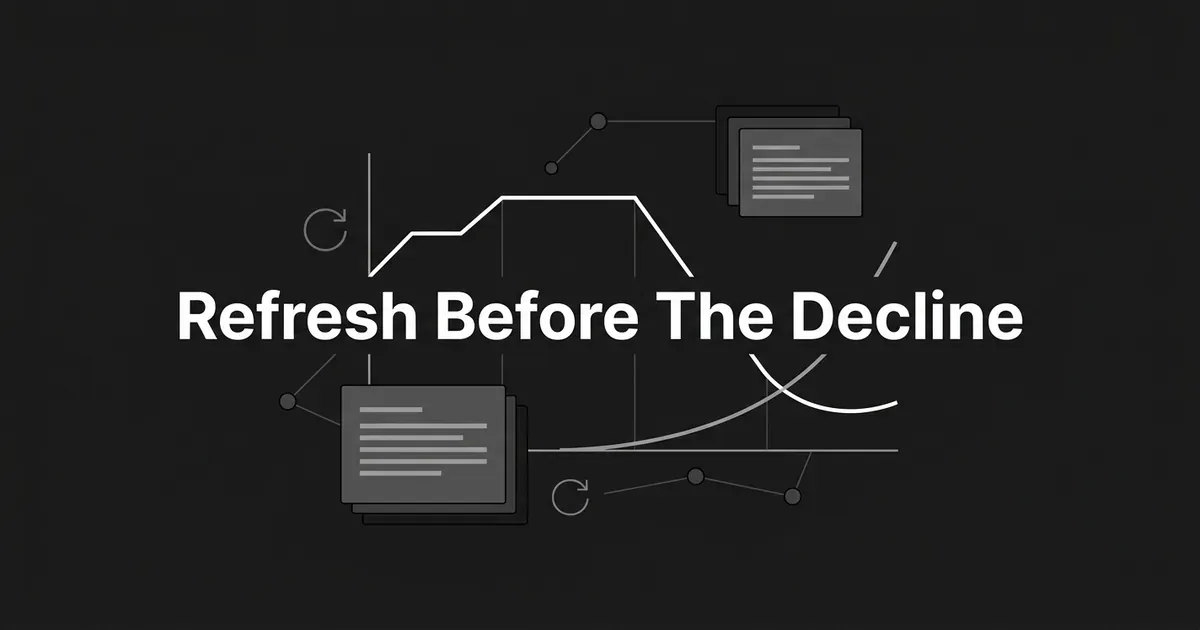
Most pages follow the same arc: early traction, growth, a traffic peak, a long plateau, then decline. The plateau is the part that fools people. Traffic looks steady while rankings quietly slip and competitors close the gap. By the time the number moves, the position has been sliding for a while.
Decay becomes visible when one of a handful of things happens. Fresher or more authoritative pages push yours down. Search intent shifts, and the page answers a question people stopped asking that way. The facts inside go stale. Or your own site creates overlapping pages that split authority between them.
Not every drop is decay
This part matters, so let's slow down. A traffic drop is a symptom, not a diagnosis.
A sudden fall after a core update is a different problem. So is a technical incident, a tracking change, a seasonal dip, a SERP redesign, or plain old falling demand for the topic. If traffic fell right after somebody edited the page, the edit may have broken a page that was working fine.
The pattern inside the numbers tells you a lot. Impressions falling while click-through rate rises usually means you lost positions but stayed compelling when shown. Impressions flat while click-through rate falls usually points at your title, your snippet, or a new SERP feature eating the clicks, not at the content itself.
Check the boring explanations first. You'll save yourself a rewrite you didn't need.
Old is not the same as stale
Google's own position is narrower than the shorthand "fresh content wins." Google runs freshness systems that surface newer content for queries where freshness is expected. That means freshness is query-dependent, not universal.
A stable definition, a historical explainer, or a framework that still holds does not need a rewrite because a date on it looks old. A price, a product feature, a regulation, a benchmark, or a "best current approach" can go stale in weeks.
So the question is never "how old is this page?" It's "is this page still true, still useful, and still aimed at what people ask now?"
Why rankings and AI search citations decay differently
Here's the shift that catches most teams. Ranking loss and citation loss are related, but they are not the same failure.
Search systems decide which indexed pages to show. AI systems retrieve sources and choose which ones to lean on when they write an answer. Those are two different jobs, and they can disagree about your page.
A page can sit comfortably on page one of Google and never show up in a ChatGPT answer. Another page can get cited in an AI answer without ranking in the top ten at all. If you only watch one scoreboard, you'll miss half of what's happening.

What AI engines need from your page
For Google AI Overviews and AI Mode, the baseline is ordinary Search eligibility. The page has to be indexed and eligible to appear with a Search snippet. Google says there are no extra technical requirements and no special optimizations for these features. There's no magic AI file to add.
The practical prerequisites still matter, though. Let crawlers in. Put the important information in text, not locked inside an image or a script. Make the page reachable through internal links. Keep structured data matched to what's actually visible. None of this guarantees you get served. It just keeps you eligible.
How AI citations slip away
AI citation decay has its own causes. A page goes factually stale. Its answer gets buried in a wall of prose. It no longer matches how people phrase the question today. A newer, better-supported source shows up. Its references break. Or it's simply hard to extract a clean answer from.
Notice what's missing from that list: keyword density and clever markup. The fix is to preserve the page's usefulness, clarity, evidence, and extractability. That second lens is what turns an ordinary update into content refresh AEO, where you maintain a page so engines can still find it, trust it, and quote it.
Structure does real work here. Put a direct answer near the top of each section, then explain it. Use headings that describe what's below them. Give definitions their own paragraph. Use a list when order matters and a table when the reader needs to tell options apart. That's a format recommendation, not a promise of citations. It makes your answer easy to lift, which is the part you control.
Is freshness itself a factor? Some. Ahrefs analyzed 16.975 million cited URLs across seven AI and search groups. URLs cited by AI assistants averaged 1,064 days old, against 1,432 days for organic search results, so about 25.7 percent fresher. By last-update date the gap narrowed to 909 days against 1,047, roughly 13 percent.
Now read the caveat, because it changes what you do. ChatGPT showed the strongest pull toward fresh content in that study, with citations averaging 458 days newer than organic results. Google AI Overviews went the other way and cited content 16 days older than organic on average. And the average AI-cited page in the whole study was still about 2.9 years old.
Translation: freshness is one input, not the game. A well-made three-year-old page is still very much in play. That's a relief, not a loophole.
The signals that tell you a page needs attention
You can't watch 400 pages by feel. You need triggers that do the noticing for you.
Start with an inventory. One row per indexable page, built once and maintained after that. Record the URL, title, topic, intent, funnel role, publish date, last substantive update, primary queries, clicks, impressions, click-through rate, average position, conversions where you can get them, referring domains, internal links, business importance, and whether the page currently earns AI citations for the prompts you track.
That last column is the one most inventories are missing. Add it now, even if it starts empty.
Compare windows that mean something
One weird week is noise. A practical starting point is to compare the last three months against the same three months a year earlier, then zoom into shorter windows to find where a break started.
Be careful with Search Console numbers while you do it. Impressions count how often a link to your site was seen or could be seen. Clicks are visits from a result. Average position is averaged across impressions, and it's recorded only when the result actually gets an impression. Position isn't a fixed rank, because location, device, history, and SERP layout all move it. Canonical attribution can also roll several page variations into one URL.
Segment by page, query, device, country, and search type when you can. A site-wide view hides page-level damage beautifully.
The trigger list
These are triage rules from practitioner frameworks, not Google ranking laws. Use them to decide what to look at, not what to conclude.
- Organic traffic down more than 20 percent over 90 days, or more than 20 percent year over year in a comparable window.
- Target keyword positions down more than five places.
- Impressions and click-through rate falling together.
- Impressions flat while click-through rate falls, which points at title, snippet, or SERP competition.
- AI mention or citation rate declining for the prompts this page is meant to answer.
- Engagement dropping below the page's own historical baseline.
- No new referring domains for six months or more, read in context rather than alone.
- Facts, prices, screenshots, tool names, or regulations that are visibly out of date.
- A competitor now answering the same intent more completely or with fresher evidence.
- Two or more of your own pages chasing the same intent.
One signal means investigate. Two or more at once means put it in the queue. Before you label anything decayed, rule out seasonality, tracking breaks, technical problems, algorithm updates, falling demand, and the effect of your own last edit.
Then classify the cause: stale facts, intent drift, a stronger competitor, weak click appeal, poor structure, a technical or indexing problem, cannibalization, shrinking demand, or a bad edit. The cause picks the remedy. Skip this step and you'll rewrite copy on a page that was never being indexed.
Watching all of this by hand is where most teams stall, and that's fair. It's a lot of tabs. This is the part worth automating: pulling search data, crawl data, and AI-citation data into one place so the flags come to you. DeepSmith tracks mention rate, citation rate, and share of voice per prompt and per page across the AI engines on your plan, so the AI half of that inventory column fills itself instead of waiting for someone to check manually.
How to prioritize: refresh, restructure, consolidate, prune, or leave
A flagged page is not a task yet. It's a candidate. Refreshing everything old is how a content refresh strategy turns into busywork.
Score candidates on five things:
- Opportunity. Impressions, past traffic peak, how close it still ranks, and how much performance was lost.
- Business value. Conversions, assisted conversions, funnel role, and whether the topic matters strategically.
- AI gap. Tracked prompts where you're absent, mentioned without a citation, or losing citations to a competitor.
- Recoverability. Existing backlinks, internal authority, topical fit, and whether the intent is still worth winning.
- Effort and risk. Research depth, expert review, legal review, and the risk of changing a URL that currently works.
A sane operating order: high-value and highly recoverable pages first, then high-impression pages with weak click-through rate, then pages that just need their facts corrected, then the low-value, duplicated, unlinked ones. Keep technically blocked or deindexed pages on a separate track. Rewriting the copy will not fix an indexing problem.
Then pick the lightest action that works
Five options. The goal is the smallest defensible change, not the biggest one.
Leave it and monitor. The page is accurate, useful, reachable, and stable against its baseline. Set the next review date and walk away. Cosmetic edits on a healthy page are risk without upside.
Refresh it. Keep the URL when it has authority, real rankings or impressions, and the core intent still holds. Update facts, examples, statistics, sources, title, description, internal links, and the weak sections. Keep what's working.
Restructure or expand it. Use this when the page is pointed the right way but hard to scan, incomplete, or missing a clear answer up top. Fix the hierarchy, the answer order, the tables, the definitions. Add evidence, not filler.
Consolidate. Use this when several thin pages chase the same underlying intent. Choose the strongest destination, merge what's genuinely useful, update the survivor, and redirect the retired versions where the destination is truly relevant. Don't merge two pages just because they share a keyword.
Redirect or retire. When a page is genuinely replaced, Google recommends a permanent server-side redirect such as a 301 or 308. Send people somewhere actually relevant, not to whatever page you'd like traffic on. And before you retire anything, check backlinks, historic traffic, conversions, internal links, indexation, unique intent, and whether other pages depend on it. Low traffic alone is not proof a page is doing harm.
One more thing on duplicates. Google treats redirects and rel=canonical as strong canonical signals, while sitemap inclusion is weak. Pick one canonical, link to it internally, and stay consistent. Don't reach for robots.txt or noindex as a substitute for making the choice. Google can still pick a different canonical when your signals conflict.
How to refresh without faking freshness
A refresh is supposed to improve the reader's answer. Changing the date is not a refresh. It's a costume.
Google explicitly warns against changing dates to make unchanged pages look fresh, and against adding or removing large chunks of content mainly to seem active. Update the modified date when the content genuinely changed enough to deserve it.
The work that actually moves a page
Start by re-checking intent. Search the target query today and look at what's ranking and what AI answers say. Intent moves, and a page written for the old intent can be excellent and still wrong.
Then work through the page:
- Replace outdated data and claims with current, attributable evidence.
- Cut obsolete examples, dead screenshots, and broken links.
- Add the subquestions your current query data shows people asking.
- Tighten the opening answer of each section so it can stand alone.
- Rewrite the title and description when click-through rate says the click appeal is the problem.
- Add internal links from your relevant authoritative pages, and fix links pointing at this one.
- Keep the URL unless you have a real consolidation or migration reason to change it.
Evidence deserves a note of its own. A controlled generative-engine benchmark found that adding credible citations, quotations, and statistics produced relative improvements of 30 to 40 percent on one visibility measure and 15 to 30 percent on another. Directional research, not a promise. Still, it points the same way as common sense: a page that shows its sources is easier for an engine to trust and quote.
Show your people, too. Visible authorship and first-hand experience do work that no amount of formatting replaces. If AI helps you produce the update, keep human fact-checking and editorial judgment in the loop, and be straightforward about how the piece was made when a reader would reasonably wonder.
Finally, write down what you changed. Date, sections touched, target queries, expected outcome. Two months from now, that note is the only way you'll know what caused what.
Does this sound like a lot for one page? It is. That's why the queue matters more than the checklist. Fix the five pages that carry the most value this month, not the fifty that are merely old.
How to measure recovery, and keep pages healthy after
You changed the page. Now give it room. Crawling, re-ranking, and demand patterns all take time to settle, and refreshing again a week later teaches you nothing.
When you do measure, compare like for like: the same page, the same query group, the same length of window. Look at clicks, impressions, click-through rate, position, conversions, indexation, backlinks, and internal links. Then look at AI mention and citation data separately, because it answers a different question.
Keep those two lenses apart in your head. Bing's AI Performance reporting is a clear example of why. It reports visible citations, unique pages cited per day, page-level citation counts, and grounding queries, across seven-day, 30-day, and three-month windows. A grounding query is a phrase tied to retrieval, not necessarily what the user typed. And the report says plainly that citations are visible references, not clicks, traffic, engagement, rankings, or a quality score. A comparison shows you what changed. It doesn't tell you why.
Expect some noise, and don't panic at it. Citation counts move with the prompt mix, the engine version, the location, and the day. Losing a citation doesn't prove your page got worse. A competitor may have improved, or the answer may simply have been written without a citation this time.
Set cadence by volatility, not by age
There's no universal "refresh every X months" rule, and anyone selling you one is guessing.
A workable starting model looks like this. Quarterly, run a light pass: check statistics, re-verify external links, and look at AI visibility for the prompts that page owns. Annually, run the deep review: competitor comparison, weak sections, structure, and a full content refresh AEO pass. Re-verify statistics, quotes, and tool references at least once a year.
Then override the calendar whenever reality moves. A product change, a policy change, a market shift, or a visible change in search intent should trigger a review regardless of when the last one happened. Fast-moving topics need event-driven checks. A stable explainer can wait.
Automate the detection, not the judgment
At any real scale, the loop only survives if the boring parts run themselves. A monitoring setup can pull in search data, analytics, crawl data, backlinks, content changes, and AI-citation signals, flag pages that cross your thresholds, group related pages, and build the refresh queue for you. AI can summarize what changed, surface missing questions, compare competitor coverage, and draft the update brief.
What stays human: the diagnosis, the sourcing of claims, anything legal or regulated, the canonical and redirect calls, and the decision to publish. Automate the detection and the routing. Never automate the truth.
Keep a record of each cycle too: the signals that fired, the decision made, the edits, who reviewed it, and what happened after. That record is what turns a content refresh strategy from a project someone ran once into a system your team can hand off.
And that's the whole loop. Baseline, detect, diagnose, decide, act, measure, then back to monitoring. It doesn't end, and it isn't supposed to.
Start with one page this week
Content isn't a thing you ship. It's a thing you keep.
You don't need to audit your whole library to begin. Pull your ten highest-value pages. Check each one against the trigger list. Find the one page that has slipped the furthest from something that still matters to your business, and fix that one. Then write down what you changed.
That's the first turn of the loop. The second one is easier, and by the fourth it's just how your team works.
If you'd rather have the detection running in the background, that's what DeepSmith is built for: tracking where AI engines cite you, finding the pages and prompts where you're losing ground, and producing the on-brand content to close those gaps from the same data. You can start a free trial and see your own numbers before you commit to anything.
Either way, start with one page. Momentum matters more than coverage.