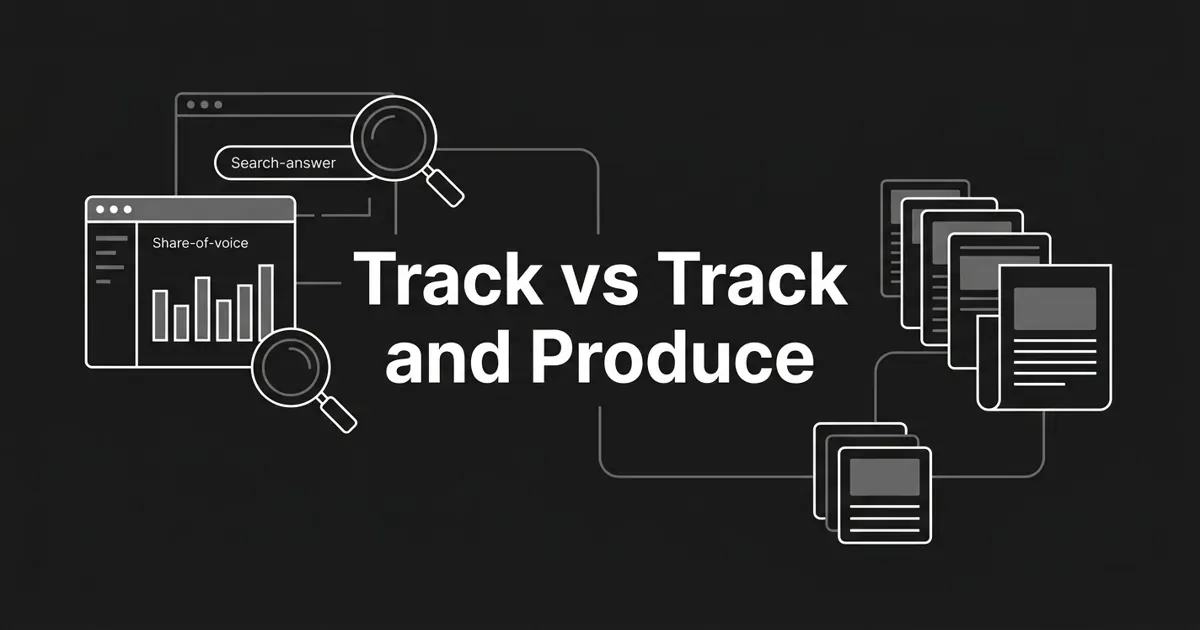
The choice in deepsmith vs brandofy comes down to a single question about scope: does the team need to see where AI engines mention the brand, or does the same team also need to close the gaps that measurement exposes. Both platforms run ai brand visibility tracking across the major answer engines, report share of voice against named competitors, and turn missed prompts into a plan. They diverge at the point where the plan becomes published work. Brandofy measures and briefs. DeepSmith measures and ships.
That distinction is the whole decision, and it maps cleanly onto how a content function is staffed. Organizations that have writers and editors ready to execute a brief tend to want the sharpest possible measurement layer and little else. Organizations where the person watching the visibility dashboard is also the person who has to produce the content tend to want the measurement and the production engine in one place. The two models suit different operating structures, and the comparison below is organized to make that fit obvious.
DeepSmith vs Brandofy at a glance
The table summarizes the entry tiers, both priced at $99 per month, since that is where most evaluations begin.
| Capability | DeepSmith Pro ($99/mo) | Brandofy Growth ($99/mo) |
|---|---|---|
| Category | AI search analytics plus content production | AI search analytics plus content briefing |
| Tracked prompts | 50 | 150 (30 prompts across 5 surfaces) |
| Engines tracked at entry | ChatGPT | ChatGPT, Gemini, Perplexity, Google AI Mode, Google AI Overviews |
| Core metrics | Mention rate, citation rate, share of voice, sentiment, visibility trend | Share of voice, citations, top sources, sentiment, weekly trends |
| Content output | 20 publish-ready articles per month | 30 auto-drafted briefs per month |
| Repurposing | Apps Library across LinkedIn, X, newsletter, Reddit, and more | Not advertised |
| CMS publishing | WordPress, Strapi, Webflow, Sanity, Contentful, webhooks | Not advertised |
| Internal-link automation | Up to 5 links auto-inserted per article | Not advertised |
| White-label reports | Not advertised | White-label PDF reports |
| Seats at entry | 5 | 2 |
| Free trial | 7 days | Offered, length not stated publicly |
The rows split into two groups. On measurement breadth at the entry price, Brandofy is the wider product: more tracked prompts and five answer engines against DeepSmith's single engine on Pro, though those 150 prompts are 30 per surface while DeepSmith Pro concentrates all 50 on ChatGPT. Across the full ladder that order reverses, since DeepSmith widens engine coverage by tier up to all ten tracked engines on Enterprise and Custom, against the five Brandofy names. On what happens after measurement, DeepSmith is the wider product: publish-ready articles, repurposing, direct CMS publishing, and internal-link automation that Brandofy does not advertise. Reading the table by those two groups, rather than row by row, is the fastest way to see which platform matches a given team.
What Brandofy is, and where it is strong

Brandofy is an AEO analytics platform whose stated purpose is to track and increase brand visibility in AI answers. As a brandofy aeo tracker, its core loop is straightforward: define the high-intent prompts buyers ask, run them on a weekly schedule across the named answer engines, and report share of voice, citations, sentiment, and the sources those engines cite most. Missed prompts become a prioritized action plan with auto-drafted content briefs that a content team is expected to execute. The product frames AI answers as the new top of the funnel, and its positioning pages argue that a brand absent from an engine's recommendation is effectively off the shortlist before a buyer ever visits a site.
Several strengths are worth naming precisely. First, engine coverage at the entry tier is broad. Brandofy's Growth plan tracks ChatGPT, Gemini, Perplexity, Google AI Mode, and Google AI Overviews from the base price, so a team that needs Google AI Overviews and Google AI Mode in the same view gets them without an upgrade. Second, the measurement surface is designed for reporting to other people. White-label PDF reports and shareable read-only dashboard links are built in, which matters for an agency presenting AI visibility results to clients or a marketing lead reporting upward to leadership. Third, the account model is multi-brand from the start, so an agency can run several clients in isolated workspaces, each with its own prompts, competitor set, and audit history. Fourth, sentiment scoring sits on top of presence, so the platform reports not only whether an engine mentions the brand but in what tone.
A fifth strength is vertical range. Brandofy maintains dedicated positioning for SaaS, agencies, Shopify and DTC sellers, Amazon sellers, local services, restaurants, hotels, education, and professional services, and it tracks category-specific surfaces such as Amazon's Rufus assistant. That breadth signals a product tuned to how AI answers show up differently across markets rather than a single generic dashboard.
Brandofy's content layer exists, and it should be characterized accurately. The Growth plan includes 30 AI blog articles per month, which the product positions as drafted briefs handed off for a team to ship rather than finished pieces. The platform also runs a content opportunities generator that surfaces topics competitors are winning and the brand is not, and an action plan that spans schema, documentation, citations, PR, and content tasks. For a buyer whose bottleneck is knowing what to write and in what priority order, that briefing layer is a real asset. The measurement-first design is coherent, and for measurement-first teams it is a reasonable fit.
Where Brandofy is not built to go
The limits of a brandofy aeo tracker follow from its design rather than from any deficiency; the product stops at the brief on purpose. Several capabilities are absent from Brandofy's product pages, and a buyer weighing a brandofy alternative should weigh these directly.
Brandofy does not advertise CMS publishing. There are no listed integrations to push finished content to WordPress, Webflow, Contentful, or comparable systems, so the last step from approved draft to live page remains manual. Brandofy also does not present itself as a finished-article generator; the 30 articles per month are described as drafted briefs, which means the writing, editing, and formatting labor still sits with the team. Native multi-channel repurposing is not advertised, so turning one article into channel-native LinkedIn, X, newsletter, or Reddit versions is a separate task in separate tools. Internal-link automation and sitemap-based content awareness are not advertised, which leaves the cross-referencing work that many teams find time-consuming as a manual step. Cover-image generation for articles is not part of the described product. Claude is not listed among the tracked answer engines, so a team that specifically needs Claude visibility in the tracked set will not find it named.
Several operational details are simply not published, and the honest posture is to flag rather than guess. Brandofy does not state team-seat counts beyond the two included at Growth, refresh cadence beyond weekly, audit-history retention, API access, SSO or SAML availability, or data-retention windows. The company also does not publish a founding year, funding, headcount, paying-customer count, or named customers beyond three testimonial personas on its own site. None of these absences is disqualifying for a measurement-first buyer, but they are relevant to procurement in a larger organization, and they are the kind of detail worth confirming directly with the vendor before a decision.
What DeepSmith is, and where it is strong

DeepSmith is an AI search analytics and content production platform in one, built on the premise that the team seeing a visibility gap is often the team that has to close it. It runs the same class of measurement Brandofy does, then extends into planning, writing, scheduling, and publishing brand-grounded articles. The production stance is explicit: DeepSmith is a production engine rather than a writing assistant, and its output is a finished, on-brand article rather than a first draft to rescue.
The measurement layer is a full module. DeepSmith reports mention rate, citation rate, share of voice, sentiment, and visibility trend, with a per-platform breakdown, a competitor leaderboard, and the sources engines cite most. A Prompts view carries per-prompt mention and citation rates with full answer history, and a Discover Prompts function generates a starter prompt set from stored product, persona, and buyer-stage context. A Pages view reports which of a site's pages engines actually cite and which prompts drive those citations, and a Competitor Citations view reports who wins citations for tracked prompts, on which exact pages, by platform. For a team building competitive AI visibility benchmarking, that page-level attribution is the substantive part.

The production side is where DeepSmith diverges from a measurement-only tool. Opportunity Agents read the visibility and Content Map data and return ideas with the justifying data point attached, and Content Studio moves that idea from an always-stocked New Ideas backlog through Planned Content to the Writer, which turns one planned idea into a researched, internally and externally linked article with a cover image and publish-ready metadata. Autowrite carries that further into hands-off production: an article configured at planning time writes itself on its scheduled date and lands in Produced Content with no one in the app, which is the mechanism that turns a content calendar from aspiration into an operating system. Produced Content then publishes directly to WordPress, Strapi, Webflow, Sanity, or Contentful, with webhooks and Markdown or HTML export as fallback. Two supporting layers make the output consistent: Deep IQ stores company positioning, product profiles, buyer personas, brand voice, and visual guidelines so every draft is grounded in the same context, and Content Map classifies every existing page onto a shared topic and funnel taxonomy, which drives internal-link automation of up to five links per article. Distribution is built into the article as well, since the Apps Library converts a finished piece into platform-native versions for LinkedIn, X, Medium, Substack, newsletter and nurture email, Reddit, and more.

The one boundary to state plainly is what DeepSmith does not promise. It tracks mention and citation across the covered engines; it does not control or guarantee rankings, citations, traffic, or revenue, and DeepSmith is explicit about that boundary. The value proposition is throughput and consistency at higher volume, not a guaranteed outcome.
Where DeepSmith is not built to go
DeepSmith carries its own limits, and a fair comparison names them. Engine coverage at the entry tier is narrow: DeepSmith Pro tracks ChatGPT only, and broader coverage unlocks by tier, with Perplexity on Grow, Gemini on Scale, and the full set of ten tracked engines on Enterprise and Custom. A team that needs five answer engines in the base plan will find Brandofy's entry tier wider on that specific axis, even though DeepSmith's upper tiers run wider overall.
DeepSmith is also lighter on the agency-style client-reporting features that Brandofy foregrounds. White-label PDF reports and shareable client dashboards are central to Brandofy's agency positioning and are not part of DeepSmith's product in the same way, so an agency whose deliverable is a branded visibility report to a client should weigh that gap; DeepSmith's Multi-Workspace does run each client in an isolated workspace with its own context, content, and plan, so the gap is the branded report artifact specifically rather than multi-client management. As with Brandofy, several operational specifics are not published: DeepSmith does not list a public API for tracking or content generation, a status page, an uptime SLA, a public integrations directory for tools such as GA4 or Search Console, or customer counts. These are the same class of procurement questions to raise directly, and neither vendor publishes a head-to-head benchmark against the other, so this comparison rests on each product's published capabilities rather than a tested result.
Pricing: what $99 buys on each side
Both platforms start at $99 per month, which makes the entry tiers directly comparable on price and instructive on philosophy. Brandofy Growth allocates that budget toward measurement breadth: 150 tracked prompts across five answer engines, up to 10 competitors, sentiment analysis, white-label PDF reports, a content opportunities generator, an action plan with task tracking, CSV export, and two team seats, plus 30 auto-drafted briefs. Additional brands are billed at $99 each, and an Enterprise tier adds customizable brands, competitors, and audit prompts, along with support for Amazon catalog signals.
DeepSmith Pro allocates the same $99 toward the full production stack behind a narrower measurement window: 50 tracked prompts on ChatGPT, 20 publish-ready articles per month, five seats, and the complete Content Studio, Deep IQ, Apps Library, and direct-publishing pipeline. DeepSmith then scales measurement and volume together across Grow at $199 per month, Scale at $399 per month, and a custom Enterprise tier, with annual billing lowering the effective monthly rate on every plan. Both vendors offer a free trial and impose no long-term contract. The pricing does not favor one platform on value in the abstract; it favors whichever capability the team actually consumes. A team that will use five engines and hand briefs to writers extracts more from Brandofy's entry tier, while a team that will publish and distribute finished articles extracts more from DeepSmith's.
DeepSmith or Brandofy: which should you choose
The decision in deepsmith or brandofy resolves by operating model, not by feature count. The following situations map to a clear recommendation.
Choose Brandofy when measurement and handoff is the product. If the marketing operations function needs AI-visibility dashboards while a separate writing or editorial team produces the content elsewhere, Brandofy's measurement-first design and its briefing layer fit that division of labor. Choose Brandofy when the deliverable is a client-ready report: its white-label PDFs and shareable dashboards are built for agencies and stakeholders who consume visibility results rather than produce content. Choose Brandofy when five answer engines in the base plan, including Google AI Mode and Google AI Overviews, is a firm requirement at the entry price.
Choose DeepSmith when the team noticing the gap also has to close it. If one person or a lean team both watches the visibility dashboard and produces the content, DeepSmith's combined track-and-produce design removes the handoff and the second tool. Choose DeepSmith when the goal is to raise output without adding headcount, since Autowrite and publish-ready articles are aimed directly at that constraint. Choose DeepSmith when distribution matters as much as production, because the Apps Library turns each article into channel-native posts in the same workflow. Choose DeepSmith when direct publishing to WordPress, Webflow, Contentful, or a similar system is part of the requirement, or when the tracked engine set has to run wider than five, since Enterprise and Custom cover all ten engines, Claude, Grok, Meta AI, Microsoft Copilot, and DeepSeek among them.
For teams that already run a mature stack of separate measurement and production tools, a third path exists: keep the existing tools and evaluate each platform against the specific seam that is failing. The two products are not mutually exclusive in principle; a team could run Brandofy for reporting and DeepSmith for production, though most buyers at this price point will consolidate on the platform that covers the larger share of their workflow.
Teams that want to see both the measurement and the production side against their own data can start a DeepSmith free trial and evaluate real prompts and real drafts before committing.