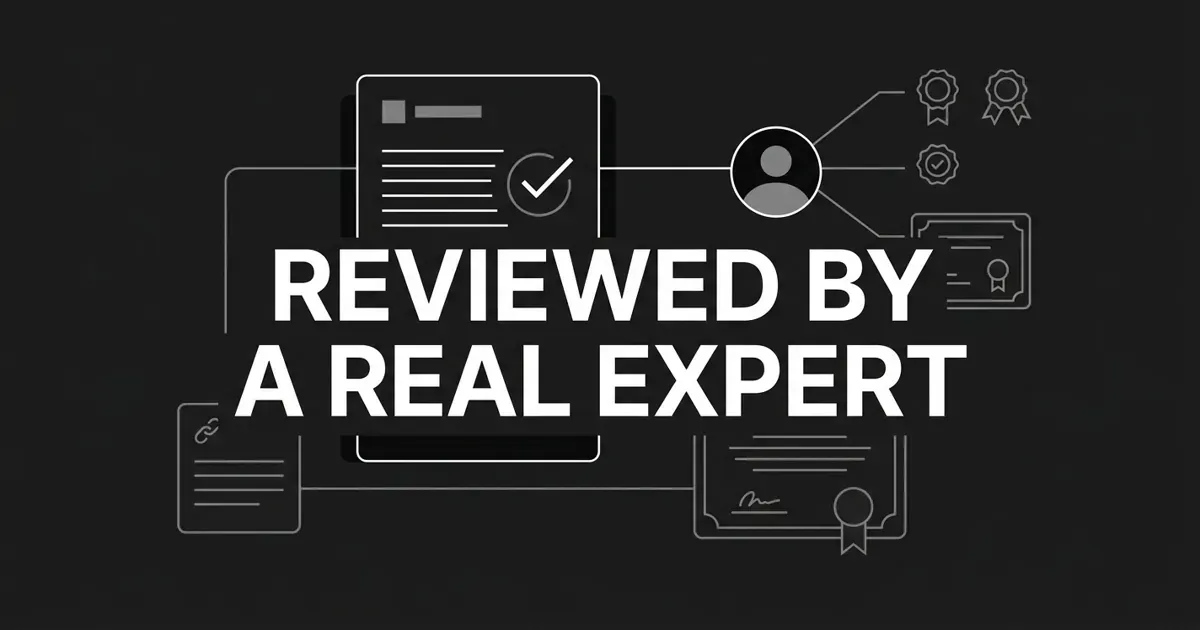
You published good content. An AI engine cited someone else. The gap is often not the writing, it is that nothing on your page proves a qualified human stands behind the claims. Among the expertise signals AI search engines can actually verify, a named reviewer with a real credential is one of the few you fully control. This guide shows you how to set up an expert-review program: who to recruit, how to run the review, and how to surface credentials so answer engines can read them.
You do not need a medical board or a newsroom budget. You need a handful of real experts, a repeatable workflow, and disclosure that machines can parse.
Why reviewer signals move the needle at all
Let's start with what is true, because overselling this helps nobody.
E-E-A-T stands for Experience, Expertise, Authoritativeness, Trustworthiness. It lives in Google's Search Quality Rater Guidelines, the document that trains the human evaluators who rate search results. Those ratings feed back into ranking systems. It is a quality lens, not a dial you turn.
Reviewer disclosures feed three of those four letters. Expertise, because a credentialed outsider validated the claims. Authoritativeness, because you are visibly connected to a network of real experts. Trustworthiness, because your editorial process is transparent and checkable. Together they produce the credentials trust signal AI systems can weigh: a real name, a real license, a real date, none of it taken on faith.
Here is what the observational research suggests. Pages with named author bylines are associated with meaningfully more AI citations than anonymous or corporate-only bylines, and adding credentials next to the name lifts it further, roughly double in the studies that have looked. Nearly all citations inside Google AI Overviews come from sources that already show strong E-E-A-T signals. Pages carrying structured data show up in AI Overviews noticeably more often.
Read those as directional, not contractual. No AI engine has confirmed reviewer signals as a direct ranking factor. The datasets shift. These are correlations from third-party analyses, and anyone who promises you a guaranteed lift is selling something.
Why bother, then? Because the old shortcut stopped working. The overlap between top organic results and AI Overview citations has roughly halved over about a year in one large keyword analysis. Ranking first no longer means getting cited. The expertise signals AI search engines reward run partly independent of backlinks and on-page tweaks, which is exactly why reviewer and credential work matters more here than it ever did for classic SEO.
That is the good news. This is one of the few levers that is fully in your control.
Step 1: Map your topics to the credentials that qualify a reviewer
Before you recruit anyone, decide what "qualified" means for each thing you publish.
Build a simple matrix. One row per content category, three columns: the category, the credential a reviewer must hold, and where you verify it.
| Category | Reviewer credential | Verification source |
|---|---|---|
| Cardiology content | Board-certified cardiologist (MD/DO) | NPI registry, board check, hospital profile |
| Personal-finance tax content | CPA or EA | State board of accountancy, IRS directory |
| Estate planning | JD plus bar admission in the relevant state | State bar directory |
| Cloud architecture | Cloud solutions architect certification plus work artifacts | Certification registry, public code, conference talks |
| Mental health | Licensed psychologist or LCSW | State licensing board |
Notice the third column. A credential you cannot verify is not a credential. That column is what separates an expert reviewer content EEAT frameworks actually reward from a name you pay to sit on a page. It is also the difference between a claim and a checkable fact, and only one of those survives scrutiny.
One rule to hold onto: "industry expert" is not a credential. Neither is "seasoned professional" or "15 years of experience." A credential is a license, a board certification, or a professional designation that a third party issues and a stranger can look up.
How to tell it is done: every category on your calendar has a named credential and a working verification link.
Where people go wrong: starting with the reviewer they already know, then reverse-engineering which topics that person can cover. That is how you end up with a credential-topic mismatch on page one. Start with the topics.
Which topics come first? If everything feels urgent, look at where you are already losing. DeepSmith's AI visibility tracking shows which prompts you are missing and which competitor pages win those citations, so you can point your first reviewer at the pages that are actually costing you ground instead of guessing.
Step 2: Recruit a bench of 8 to 15 reviewers
One reviewer is a single point of failure. They get busy, they change jobs, and your pipeline stops.
A bench of 8 to 15 covers most editorial calendars. For scale, the big health publishers run panels spanning dozens of specialties. Verywell Health's medical expert board covers more than 30 specialties. Healthline's network reviews well over a thousand articles a year. You are not building that on day one. You are building the smallest version that covers your main subject areas.
Where do you find them? Professional networks, alumni associations, industry bodies, and the people already quoted in your space. Your own customers sometimes hold the credential you need.
Put it in writing. A short agreement should define:
- Scope: what they review, and what they do not
- Turnaround: five to ten business days is typical
- Compensation
- Disclosure of any conflicts of interest
- Permission to use their name and credentials on the page
- Independence: the reviewer is not the author
That last line matters more than it looks. The whole value of a reviewer is that they are not the person who wrote it. Independence is what makes an expert reviewer content EEAT standards treat as validated, rather than a second byline on your own work.
How to tell it is done: you have signed terms and a verified credential link for every reviewer on the bench.
Where people go wrong: treating it as a favor. Unpaid, undocumented arrangements quietly decay, and then your review dates go stale.
Step 3: Give reviewers a checklist worth their time
Send a doctor a Google Doc and say "thoughts?" and you will get spelling fixes. That is not what you are paying for.
Give them a checklist scoped to their domain:
- Are the factual claims in my field accurate and current?
- Are statistics and guidelines up to date?
- Are risks, limitations, and alternatives presented fairly?
- Where it matters, does this cite primary sources rather than only secondary ones?
- Is the language balanced rather than promotional?
- Could a reader acting on this come to harm?
Notice what is missing: grammar, tone, keywords. Your editor owns those. The reviewer owns truth in their domain.
How to tell it is done: reviewers return substantive comments on claims, not line edits.
Where people go wrong: letting the reviewer rewrite the piece. Their job is to catch what is wrong, not to make it sound like them.
Step 4: Render the byline where readers and engines both see it
Now make the work visible. The reviewed by expert byline pattern is the one every major health publisher uses, and it is worth copying exactly:
Medically Reviewed By Dr. [Full Name], [Credentials]. Last reviewed on [Month Day, Year].
Swap the verb for your vertical. "Reviewed by [Name], CFP" for finance. "Reviewed by [Name], Esq." for legal. "Reviewed by [Name], [Title], [Company]" for technical content.
Four rules for placement:
- Put it above the body, near the author byline. That is where Healthline, Verywell, WebMD, Cleveland Clinic, and Forbes Health all put it.
- Link the reviewer's name to their profile page.
- Spell out credentials in plain text ("MD, FACC"), not just initials a parser has to guess at.
- Show the review date, and the next-review date if you have one.
The medically reviewed AI citations pattern you see across health publishers is not magic. It is just the same four facts, rendered the same way, on every single article. Consistency is the signal.
How to tell it is done: a reader can see who reviewed it, what they are qualified in, and when, without scrolling. If your reviewed by expert byline survives that three-second test, it is working.
Where people go wrong: burying the disclosure in the footer or an editorial policy page three clicks away. If it is hard to find, it is not doing its job. The medically reviewed AI citations pattern works because the proof sits where the claim sits, not in a policy document nobody opens.
Common mistake: sourcing a "medical reviewer" whose name does not appear in the NPI registry or on any hospital staff page. AI systems and human readers can both detect it, and the FTC's 2024 rule treats fabricated reviewers as deceptive endorsements.
Step 5: Build a profile page for every reviewer
The byline links somewhere. That somewhere needs to earn the click.
One URL per reviewer. It carries:
- Full name with credentials
- Specialty and subspecialty
- Education and training
- Board certifications
- Active license, and for clinicians the NPI number
- Practice or institutional affiliation, linked
- Publications, talks, or other public artifacts
- LinkedIn and professional profiles
- Their relationship to you: employed, contracted, paid advisor, volunteer
- A statement on conflicts of interest
Then cross-link it. From their institutional page where possible, from LinkedIn, from the registry entry. You are building a web of corroboration that an engine can follow, which is how large language models recognize and match entities in the first place.
Pro tip: build the reviewer profile page before the first reviewed article ships. AI engines and human readers both check it. A reviewer with a profile that links back to the NPI registry, the state bar, or a certification registry is qualitatively different from a reviewer with a name and a thumbnail.
How to tell it is done: every reviewer name on your site resolves to a page with at least one verifiable outbound credential link.
Where people go wrong: a profile page with a photo, a job title, and three sentences of adjectives. Adjectives are not credentials.
Step 6: Mirror the disclosure into your schema
Everything above is for humans. This step is for machines.
Schema.org has a property built for exactly this. reviewedBy is a property of WebPage, and it expects a Person or Organization. The definition is plain: people or organizations that have reviewed the content on this page for accuracy or completeness. For clinical content, use the MedicalWebPage subtype, which inherits reviewedBy and adds medicalAudience and specialty.
The reviewer should be a Person node carrying name, jobTitle, hasCredential, affiliation, sameAs (the registry, institutional, and LinkedIn URLs), and knowsAbout.
{
  "@context": "https://schema.org",
  "@type": "MedicalWebPage",
  "headline": "How to Read a Blood Pressure Reading",
  "author": { "@type": "Person", "name": "Jane Author" },
  "reviewedBy": {
    "@type": "Person",
    "name": "Dr. Maria Reyes",
    "jobTitle": "Cardiologist",
    "hasCredential": {
      "@type": "EducationalOccupationalCredential",
      "name": "MD",
      "credentialCategory": "degree"
    },
    "affiliation": { "@type": "Hospital", "name": "Stanford Health Care" },
    "sameAs": ["https://www.linkedin.com/in/example-md"]
  },
  "lastReviewed": "2026-05-15"
}
Validate it. Google's Rich Results Test and the Schema.org validator both accept reviewedBy.
Does markup guarantee a citation? No. What it does is remove ambiguity. It turns a credentials trust signal AI parsers would otherwise have to infer from prose into a structured fact with a defined relationship. Prose says a cardiologist checked this. Schema says which person, which credential, which date, and where to verify each one.
How to tell it is done: your markup validates, and the visible byline and the JSON-LD say the same thing.
Where people go wrong: drift. The page says one reviewer, the schema says another, or the schema keeps a review date the page stopped showing. A mismatch is worse than no markup.
This is the step that quietly breaks at volume, because it depends on every article being built the same way. DeepSmith's writer renders schema and structured metadata as part of producing the article rather than as a cleanup pass afterward, which is what keeps the markup and the visible page agreeing on article number four hundred.
Step 7: Put re-review on a cadence
A review date is a perishable good. A 2019 date on a 2026 article does not say "reviewed." It says "abandoned."
Tag every reviewed article with a next-review date in your CMS. Reasonable defaults:
- Medical content: every 6 to 12 months, sooner for fast-moving topics
- Tax and legal: every 6 to 12 months, aligned to the relevant cycle
- Financial planning: every 12 months
- General how-to: every 12 to 24 months
Anything tied to a regulation, a guideline, or a price gets re-reviewed when the underlying source changes, whatever the calendar says.
When you refresh, update both the visible date and lastReviewed in the schema. Both. Every time.
How to tell it is done: you can pull a list of every article past its next-review date in under a minute.
Where people go wrong: treating the review as a launch task. It is a maintenance commitment, and freshness is itself a signal engines weigh when picking sources.
Scheduling is the part that slips first. If your calendar can trigger the refresh automatically on each topic's cadence, the freshness signal stops depending on someone remembering.
Step 8: Disclose relationships and audit quarterly
The FTC issued its final rule banning fake reviews and testimonials on August 14, 2024. It prohibits fake reviews, AI-generated reviews presented without disclosure, insider reviews that hide the relationship, and review suppression. Civil penalties apply per violation. The related Endorsement Guides require clear disclosure of material connections between an endorser and a brand.
For an expert-review program, that lands on four requirements:
- The reviewer is a real, credentialed human.
- Any compensation or material connection is disclosed on the page.
- The reviewer actually reviewed the content.
- The credentials are accurate and current.
None of that is hard if your reviewers are real. It is only hard if you were hoping to skip the recruiting.
Then audit, quarterly. Check that every reviewer is still active in practice, that every credential link still resolves, that no reviewer has had a license suspension or disciplinary action, and that every reviewed article still carries a current date.
How to tell it is done: the audit is on someone's calendar with a named owner.
Where people go wrong: letting a departed reviewer's name sit on fifty pages for a year.
Here are the mistakes that quietly destroy the whole signal, collected in one place:
- Fabricated or unverifiable reviewers
- "Reviewed by our team of experts" with no name or credential
- Stale review dates
- Credential-topic mismatch, like a CPA reviewing estate law
- Undisclosed paid or employment relationships
- The reviewer and the author being the same person
- Disclosure hidden below the fold
- Any AI-invented reviewer or credential
- Visible byline and JSON-LD disagreeing
Step 9: Measure whether reviewed pages actually get cited
You made a real investment. Now find out if it paid.
Pick the pages you reviewed first, and track them as a cohort against comparable pages you have not reviewed yet. Watch citation rate, not vibes: how often engines link to those pages as sources when answering the prompts you care about.
Give it time. Re-crawling, re-indexing, and model behavior all lag, so a month of data is noise. Look at a quarter.
DeepSmith tracks mention rate, citation rate, and share of voice across ChatGPT, Gemini, Perplexity, Claude, and Google AI Mode, with a page-level view of which of your pages actually earn citations and for which prompts. That is the honest way to find out whether your reviewer program is working, page by page, rather than assuming. It cannot make an engine cite you, and no tool can. It can tell you the truth about whether the needle moved.
How to tell it is done: you can answer "did reviewed pages get cited more?" with data.
Where people go wrong: measuring rankings instead of citations. They are not the same thing anymore, which is the entire reason you are doing this.
What to do next
Do not build the whole program this month. Pick your five highest-value pages, the ones tied to prompts you most want to win. Find one credentialed reviewer for those topics. Build their profile page. Ship the byline and the schema on those five.
That is a real, complete version of this program at small scale. Everything after is repetition. The expertise signals AI search engines can verify are the ones attached to a real person with a real credential, and five pages is enough to start proving it.
If you only change one thing this quarter, make it this: stop publishing expertise you cannot prove, and start proving the expertise you already have.
Want to see which pages AI engines cite today, before you invest in reviewers for the wrong ones? Start a free DeepSmith trial and check your real citation data first.