If you publish about health, money, or the law, you already know your content gets graded harder than everyone else's. That instinct is right, and it now applies to AI answers too. This guide walks you through eight steps to clear the higher trust bar answer engines apply to Your Money or Your Life topics, so your pages become the ones ChatGPT, Perplexity, and Google AI Overviews are willing to cite.
You know what E-E-A-T is. This is about what changes when your topic can hurt someone.
What actually changes when your topic is YMYL
YMYL is Google's label for content that could meaningfully affect someone's health, financial stability, safety, or the welfare of society. The Quality Rater Guidelines, updated on September 11, 2025, list health and safety, financial security, civics and government, groups with elevated vulnerability, and news of public importance. Legal content lands here too in practice.
That September 2025 update did two things worth your attention. It formalized government, civics, and society as a YMYL category. And for the first time, it asked raters to judge AI Overviews on accuracy, sourcing, and trust signals. Google's own quality document now ties AI answers to the same trust framework it applies to pages.
So what's different for you? Three things, and they drive every step below.
Credentials stop being optional. An uncredentialed byline is fine on a camping gear review. On drug interactions or estate planning, it reads as a trust deficit.
Source quality gets graded per claim, not per page. YMYL claims need primary sources. Another commercial blog does not count.
And there's a harm test. Raters are told to ask whether wrong information here could hurt someone in the real world. The accuracy threshold rises to match. This is the part people miss: a YMYL page can carry every signal you'd want on a normal page and still rate poorly, because the signals don't match the stakes of the topic.
There's a pattern in how AI engines respond to all this, and it's useful. Google has steadily saturated educational health and finance queries with AI Overviews while pulling back hard on the risky ones: local practitioner searches, real-time prices, crisis topics. Those now show almost no AI Overview at all. Healthcare went from roughly half of keywords carrying an AI Overview to the large majority in about two years, and clinical explainers are near saturation. Finance tells the same story from the other end, where educational queries draw AI Overviews heavily and live tickers and local advisor searches draw almost none.
Read that as a map. Answer engines want general, evergreen, well-sourced YMYL explanation. They avoid YMYL that touches transactions, live data, local choice, or imminent harm.
That's good news, actually. It tells you exactly which pages are worth the work. If your YMYL content is educational and thoroughly sourced, you're aiming at the part of the surface engines are actively trying to fill.
Step 1: Inventory every YMYL page you publish
Export your URL list and tag each page by YMYL subcategory: medical condition, treatment, medication, financial product, tax topic, legal process, civic question, safety, or content aimed at children and vulnerable readers.
Tag by degree, not by yes or no. A comparison post on high-yield savings accounts is fully YMYL. A glossary entry defining an ETF is lighter. A travel rewards roundup isn't YMYL at all.
Two areas tend to get missed. Legal topics, because the guidelines file them under "other topics that could affect future well-being" rather than naming them outright, so immigration, family law, employment, contracts, and estate planning slip through untagged. And civics, because it only became a formal YMYL category in September 2025. If your site touches elections, voting, public policy, or social welfare programs, that content is now graded on the steep curve and probably wasn't when you published it.
Done when: you have a tagged spreadsheet of every URL touching YMYL, sorted by subcategory.
Common mistake: treating YMYL as binary. Most sites have a long tail of partial YMYL pages that never get the review they need because nobody flagged them.
Take it one subcategory at a time. You do not need to fix anything yet. You just need to know what you're holding.
Step 2: Assign a credentialed author and a matching reviewer
For every fully YMYL page, name a credentialed author and a credentialed reviewer whose expertise matches the topic. Not adjacent to it. Matches it.
A page on hypertension medication needs a board-certified internist or cardiologist. A page on Roth conversion rules needs a CPA, CFP, or tax attorney. A page on child custody needs a licensed family law attorney in the relevant jurisdiction.
For high-stakes pages, one named person isn't enough. Show both an author and a reviewer, each credentialed for that specific topic.
Done when: each YMYL page lists an author and a reviewer, both with verifiable credentials and a public verification link.
Common mistake: listing a "Medical Advisory Board" without naming who actually reviewed the page. A generic board is a weak signal next to a named specialist with a verifiable NPI or bar number. The same goes for topic creep: a general family physician reviewing a pediatric oncology page is a mismatch, even though both are doctors.
This is the step teams put off longest because it needs people, not software. Start with your ten highest-traffic YMYL pages. Ten reviewed pages beat a hundred unreviewed ones.
Step 3: Rebuild your author and reviewer bio pages
Every author and reviewer needs a real bio page. Full name, credential, license number and jurisdiction, board certification, education, current practice or institution, years of experience, specialty areas, and a link to the public registry where anyone can check.
Those registries exist for a reason: state medical boards, the NPI registry, state bar directories, FINRA BrokerCheck, CFP Board verification, SEC IAPD. Link to them.
Then link the bio back to every article that person wrote or reviewed. That loop is what turns a name into an entity. An engine that can connect a claim to a person, that person to a credential, and that credential to a public registry has something it can act on. A name floating at the top of a post is just text.
Keep the details identical everywhere the person appears: same name form, same credential, same affiliation, on the bio, in the byline, in your schema, and on their public profiles. Inconsistency is what breaks the chain.
Done when: a stranger can land on the bio page, click through to the state medical board or bar lookup, and confirm the credential without your help.
Common mistake: stock photography. A silhouette captioned "doctor" actively works against you. Real, named, credentialed humans are the whole signal here. If you're wondering how to show expertise without it reading as bragging, that's a normal worry, and the fix is documentation, not adjectives.
Step 4: Mark up authors, reviewers, and your publisher entity
Now make it machine-readable.
Add Article schema to every YMYL page with author and reviewedBy populated, plus accurate datePublished and dateModified. Add Person schema for each author and reviewer with hasCredential, jobTitle, worksFor, alumniOf, knowsAbout, and sameAs. Add Organization schema for the publisher with sameAs links to its authoritative profiles.
Keep every entity consistent across the site. Consistency plus sameAs links is what feeds Google's Knowledge Graph and lets an engine connect your author to a real, verifiable person.
Done when: the Rich Results Test passes on every YMYL template, and your publisher Organization entity validates with consistent sameAs links.
Common mistake: marking up an author with no matching bio page, or declaring credentials with no verifiable sameAs link. Schema doesn't manufacture trust. It only describes trust that's already visible on the page and checkable off-site. Markup that contradicts the page is worse than no markup.
Step 5: Replace secondary citations with primary sources
Go claim by claim. Every substantive factual statement on a YMYL page should point to a primary source.
Here's the hierarchy worth internalizing. The top tier is peer-reviewed journals, government agencies, central banks, courts, legislatures, and regulators like the FDA, SEC, FTC, CFPB, and IRS. The second tier is established clinical and reference publishers, the Mayo Clinics and NHS and MedlinePlus of the world. The third is accredited professional bodies and licensed practitioners with verifiable credentials.
By sector, that means:
- Health: systematic reviews, randomized trials, clinical practice guidelines, FDA labeling, CDC and WHO data.
- Finance: SEC filings, IRS publications, FINRA notices, CFPB guidance, Federal Reserve data, audited financials.
- Legal: statutes by section, regulations by citation, controlling case law by reporter cite, state bar ethics opinions. Always name the jurisdiction.
Perplexity makes this unusually concrete. Its Premium Health Sources list names what its health answers lean on: the New England Journal of Medicine, BMJ, The Lancet, JAMA, CDC, WHO, NICE, Mayo Clinic. Being cited alongside that company is the most reliable path to a health citation.
It helps to know what you're up against here. A handful of very large domains soak up an outsized share of AI Overview citations across nearly every industry, and encyclopedic and video sources sit near the top. You aren't going to outrank Wikipedia on general definitions, and you shouldn't try. Your opening is the specific, well-sourced question those giants answer generically, on a page an engine can verify.
When a secondary source is genuinely the only one available, cite it, and say what its limits are. Naming the weakness in your evidence is itself a trust signal, and it's more honest than dressing up a thin source.
Show your source dates. A stale citation on a fast-moving topic is a red flag on its own.
Done when: every numeric, clinical, legal, or financial claim carries a dated primary citation.
Common mistake: citing other commercial articles as authority. Engines and human raters both discount citation chains that loop from one marketing blog to the next without ever touching ground.
Step 6: Add disclosures, disclaimers, and an editorial policy
Put the trust markers where people and crawlers can see them.
On the page: a visible "Medically reviewed by Dr. X, MD, cardiology, on [date]" line. Published and reviewed dates. A disclaimer suited to the category. Per-page disclosure of any affiliate link, sponsorship, or advisory relationship, following the FTC's endorsement guides on clear and conspicuous placement.
Site-wide: an editorial policy explaining how you pick authors and reviewers, what you'll cite, how often you update, and how you handle conflicts of interest. Link it in the footer. Add the basics of a real business too: HTTPS, a registered address, and contact information someone could actually use.
Sector rules bite here. Finance content needs affiliate relationships with brokerages, lenders, and card issuers disclosed, and jurisdictional limits stated on tax, securities, and real estate topics. Legal content falls under state bar attorney advertising rules and should name the jurisdiction every time, because the law varies by state. Civic content should lean on official sources: .gov domains, election commissions, court records, legislative sites.
There's a platform reason this matters now. On October 29, 2025, OpenAI tightened its usage policies to prohibit using ChatGPT to deliver tailored advice that legally requires a license in medicine, law, or finance. ChatGPT Health, launched January 7, 2026, is positioned to help people understand information and prepare for appointments, not to diagnose or treat. The engines are drawing a bright line between education and licensed advice. Your content should sit clearly on the education side of it, and say so.
Done when: every YMYL page shows review, dates, disclaimer, and disclosure, and the editorial policy is linked sitewide.
Common mistake: treating a disclaimer as a substitute for accuracy. "This is not medical advice" does not repair wrong medical information. Disclaimers are necessary. They are not sufficient. And burying a disclosure in the footer doesn't count when the recommendation lives halfway up the page.
Step 7: Structure each page so AI can extract the answer
All that credibility does nothing if an engine can't lift a clean answer off the page.
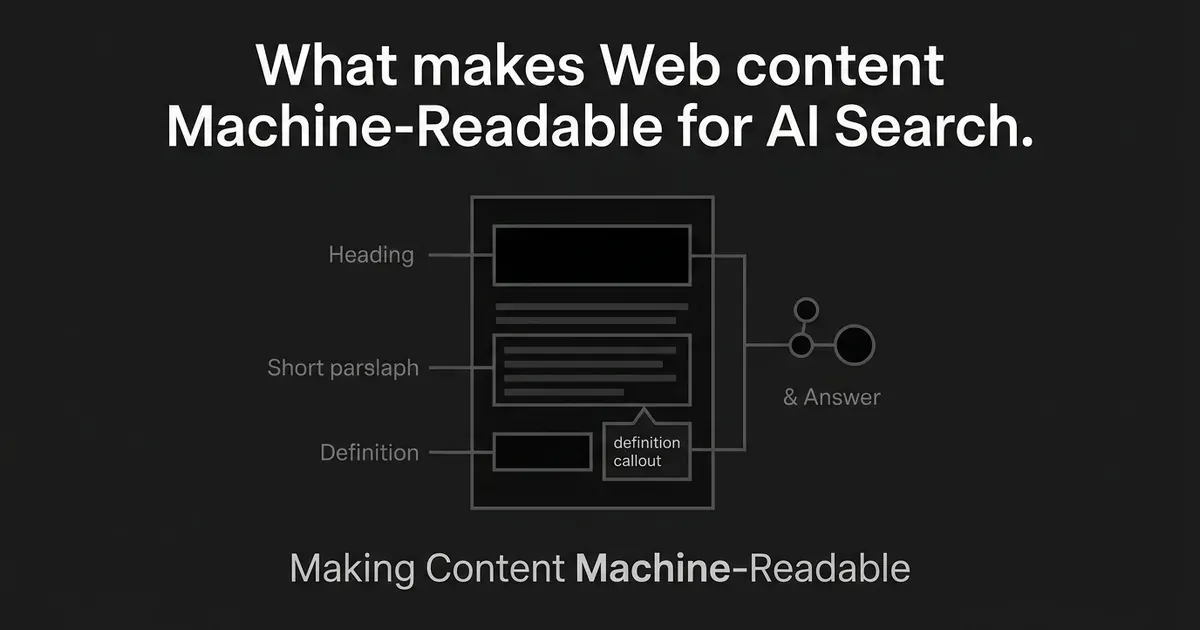
Lead every section with a direct answer of roughly 40 to 60 words. Phrase your H2s and H3s as the questions readers actually ask. Use bullets for processes and comparisons, tables for options and fees, and close with a short FAQ block of three to five real questions. Define terms inline instead of assuming.
The goal is simple. Question in the heading, answer in the first sentence beneath it, source link right there next to the claim.
Done when: a reader can answer each section's question by reading only the first sentence under the heading, and a scraper can pull a clean answer plus its citation from every section.
Common mistake: burying the answer in narrative. On YMYL pages this is doubly costly, because the credentialed review you paid for never gets close enough to the claim for an engine to associate the two.
This is where production discipline pays off. Grounding drafts in stored context (your product facts, your reviewers, your approved claims, your content formats) is how a citation-ready structure becomes the default instead of a rewrite. DeepSmith builds that structure during creation rather than after, which is the difference between editing for AEO and never having to.
Step 8: Track citations and keep the review clock running
Define the prompts your audience actually types into ChatGPT, Perplexity, Gemini, Claude, and Google AI Mode. That set is your scoreboard.
Then watch three numbers: mention rate, how often an engine names you; citation rate, how often it links your page as a source; and share of voice against the competitors you name. DeepSmith tracks those across engines by plan tier and shows which of your pages earn the citations, so you can tie a specific fix to a specific movement instead of guessing.
Keep the review clock running too. A documented cadence, every twelve months or whenever a guideline changes, is itself a trust signal. Cited answers skew toward fresher content, and a page that stops being maintained tends to quietly drop out.
One more lever worth knowing: across the research, brand mentions on authoritative third-party sites correlate with AI citation more strongly than backlinks do. Getting listed in the registries, directories, and recognized outlets in your field moves YMYL citation more than link building alone.
Done when: you can produce a monthly view of mention rate, citation rate, share of voice, and pages refreshed, and connect content changes to citation changes.
Common mistake: optimizing once. Citation patterns shift fast. This month's cited page is next month's runner-up if a fresher source shows up.
What to do next
You do not need to do all eight steps this quarter.
Pick your ten highest-value YMYL pages. Get a credentialed author and a matched reviewer named on each. Build their bio pages with verification links. That's steps 2 and 3, and it's most of the gap for most sites.
Everything after that is real, but it compounds on top of credentialed humans. Without them, perfect schema is just markup pointing at nobody.
Start with one page this week. Ready to see which of your YMYL pages engines already cite, and which ones they skip? Start a free DeepSmith trial and watch it on real data.