You've seen the same advice on E-E-A-T a dozen times. Add an author bio. Get more backlinks. Cite your sources. And every time, you walk away thinking, "Okay, but which of these actually matters for the comparison page I'm trying to fix?"
That's the real problem, isn't it? E-E-A-T isn't some universal checklist you tick off once for your whole content program. It's a fit problem. It's about matching what a searcher is trying to do, what kind of page you've built, and what proof you need to show for both the reader and the algorithm to trust you.
While E-E-A-T isn't a direct ranking factor, the signals that build it are the exact same signals that build user trust. Those are what Google's systems are built to reward. When we treat it as a generic list, we burn cash on tactics that don't move the needle for our specific pages, and we ignore the signals that would actually make a difference. I've been there. It's a frustrating place to be.
This article is the prioritization map I wish I'd had. We're going to break it down by search intent, by content type, and by what kind of "proof" you actually need. We'll also cover how to tell if any of this is working, especially in AI-generated answers, which I know is the thing your boss is starting to ask about.
What E-E-A-T signal should you prioritize first for each search intent?
Before you even think about content type, you have to look at intent. A person comparing project management tools has completely different trust needs than someone looking for a tutorial on webhooks. Getting this priority wrong is how you waste a whole quarter adding fancy author credentials to your how-to guides when what was really missing was proof that you'd actually done the thing you're writing about.
Informational intent: what "helpful" proof looks like (and what doesn't)
When someone's searching to learn, they're just trying to get their head around something. They aren't ready to buy. They aren't shortlisting vendors. They just want a clear, accurate, and genuinely helpful explanation. This is the "people-first" content Google talks about, written by someone who gets the topic, not just a summary of other summaries.
For informational content, Expertise and Trustworthiness are your main goals. Experience is important, but it shows up in the quality of the explanation itself. It's in the specific nuances and the "here's where people usually get tripped up" moments. It's the stuff only someone who has actually worked with the topic would know to include.
What doesn't work? Adding a star rating widget, padding the bio, or citing a Wikipedia article. Those are just authority theater. Your readers, and Google's raters, can feel the difference between content from a real expert and content just dressed up to look like it.
Commercial investigation intent: what builds confidence before a shortlist
At this stage, the searcher is comparing things. They're reading your "best project management tools for remote teams" or your "Notion vs. Confluence" breakdown. They need to trust the judgment behind your recommendation.
Here, Experience and Trustworthiness are what matter most, in that order. The reader has to believe you've actually used these products and that your evaluation method is sound. Expertise is nice, but expertise without firsthand experience just sounds theoretical here.
Trust shows up as transparency. How did you test these? What was your criteria? Did you get paid for any of these recommendations? Teams that bury that information, or just leave it out, lose trust fast, even if their work is solid.
Transactional intent: what reduces risk at the moment of action
When someone is ready to sign up, book a demo, or start a trial, they've mostly made up their mind. They aren't looking for more information. They're looking for reasons not to back out. E-E-A-T at this point is almost entirely a Trustworthiness job.
What helps here are clear security and privacy signals and real customer evidence (not just "500+ companies trust us"). You need specific language that confirms your product is right for them and a page that doesn't feel like it's hiding the fine print. This is where authoritativeness from third parties like G2 badges, analyst reports, and named customers really pulls its weight.
YMYL and YMYL-adjacent intents: when the bar jumps
YMYL stands for Your Money or Your Life. It covers topics where bad info can cause real harm like medicine, finance, and law. But a lot of SaaS content touches on what I call YMYL-adjacent territory: compliance workflows, security configurations, financial reporting, and HR policies.
For these topics, Google's quality guidelines set a much higher bar for all four E-E-A-T components, especially Expertise and Trustworthiness. This isn't the place for anonymous posts, unverified claims, or instructions that skip the important warnings. Every claim needs a source or an owner. Authors need visible credentials. And you need a process to fix things quickly if the content is wrong, with proof that the process exists.
If your SaaS deals with security, compliance, data, or regulated industries, you have to apply YMYL-level discipline to that content. Don't wait for Google to tell you.
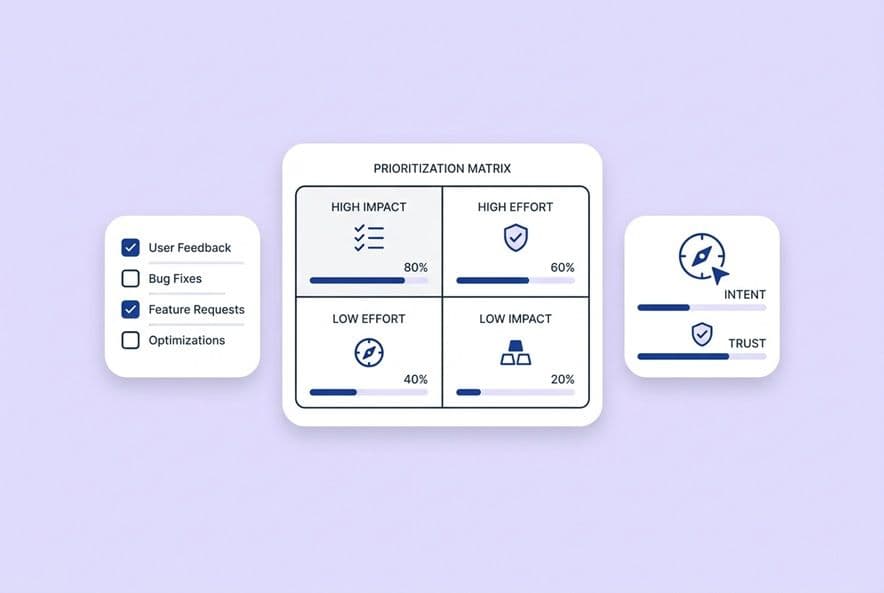
Which E-E-A-T signals matter most by content type? Use this prioritization matrix
The matrix: content type × intent × "proof required"
| Content Type | Primary Intent | Primary Signal | Secondary Signal | Proof to Add |
|---|---|---|---|---|
| Blog explainer | Informational | Expertise | Trustworthiness | Author credentials, cited sources, nuanced examples |
| Thought leadership | Informational | Expertise + Experience | Authoritativeness | First-person perspective, decision logic, specific context |
| How-to / tutorial | Informational | Experience | Expertise | Screenshots, steps with edge cases, "what goes wrong" notes |
| Implementation guide | Informational | Experience | Trustworthiness | Real workflow steps, gotchas, outcomes from actual use |
| Product comparison | Commercial | Experience + Trustworthiness | Authoritativeness | Testing methodology, evaluation criteria, conflict-of-interest disclosure |
| Best-of listicle | Commercial | Experience | Expertise | Firsthand testing notes, evaluation rubric, update log |
| Landing / solution page | Transactional | Trustworthiness | Authoritativeness | Social proof, specific fit language, security/compliance signals |
| Case study | Transactional | Trustworthiness | Experience | Named outcomes, customer voice, verifiable context |
| Documentation / help | Informational | Trustworthiness | Expertise | Version notes, last-updated date, ownership, accuracy process |
Blog explainers and thought leadership posts
For an explainer, your main job is to show Expertise. The mistake I see all the time is teams trying to signal expertise through decoration, like long author bios or lists of publications, instead of through the writing itself.
Real expertise shows in the specificity of your explanation. It shows when you name the exception to the rule, when you admit there's a tradeoff, or when you go one level deeper than the obvious. Generic explainers that just rehash the front page of Google aren't just bad for readers; they're exactly what quality raters are trained to flag.
Thought leadership adds a layer of Experience. You aren't just explaining a topic; you're taking a stand on it based on what you've seen. That position needs to be grounded in something real, like a project that went sideways or a trend you've been watching. It can't just be conventional wisdom spoken with more confidence.
How-to tutorials, implementation guides, and playbooks
Experience is doing all the work here. You can immediately tell when a step-by-step guide was written by someone who's never actually done the steps. The phrasing is too clean, the edge cases are missing, and the screenshots are either gone or look like stock photos.
The proof that works is actual screenshots from real products. It's version-specific notes like "as of Q1 2025, this setting moved." It's callouts for what happens if you skip a step. It's realistic time estimates. These details can't be faked, and they're what make your tutorial the one people actually use.
Product comparisons and "alternatives" pages
On comparison pages, trust signals are under a microscope. Readers are actively looking for bias because they know these pages are often just sales pitches in disguise.
Your work here is all about your methodology. Spell it out. Name your criteria. Be honest when a competitor actually does something better. If you're reviewing a product you sell against, just say so and explain how you manage that conflict. People forgive bias they know about; they don't forgive bias they feel like they had to discover. For these pages, secondary authority signals like industry awards can also reinforce that your evaluation is credible.
One other thing. AI answer engines love to pull from comparison pages that are clearly structured. If you use labeled sections, consistent criteria, and clear recommendations, your content is more likely to get picked up and cited.
Product reviews and "best X tools" listicles
Firsthand testing is non-negotiable here. "We tested 12 project management tools for 30 days" only works if the article actually sounds like a real evaluation, complete with friction, mixed results, and a few surprises.
Every tool in a roundup needs its own distinct notes, not just templated descriptions. Listicles that use the same sentence structure for every item are easy to spot and impossible to trust. Readers notice, and so do the AI systems that decide who to cite.
Landing pages and solution pages
Trustworthiness is the heavy lifter on these pages. The reader is already interested, so the page's job is to remove doubt, not to explain the whole category from scratch.
What builds trust here is specific customer evidence (company name, role, and outcome, not just "10x results!"). It's clear pricing, relevant security callouts, a human face, and language that speaks to the exact problem the reader has.
Case studies and customer stories
The big risk with case studies is that they sound like press releases. The results get inflated, the messy details get removed, and the whole thing reads like propaganda. This destroys the trust you're trying to build.
A good case study names the problem clearly and describes the messy middle (what didn't work, the specific challenges). It quotes the customer in language that sounds like a real person and ties the outcome to specific actions. Verifiability is key. Link to the customer's site or name the use case with enough detail that it feels plausible.
Documentation, help center, and support content
Docs often have the weakest E-E-A-T of any content, which is a huge problem because readers treat them as the absolute source of truth for your product.
The trust signals for docs are operational. There should be clear ownership (who's responsible for accuracy?), a last-updated date that's actually current, a process for flagging errors, and version-specific notes. Docs that haven't been touched in 18 months quietly kill trust across your entire brand.
How do you prove "Experience" if you're a small team or new site?
This is the question everyone has, and it's the one most guides skip. The honest answer is that you can't fake it, but you can build it much faster than you think.
Experience proofs you can create internally (without "original research")
You don't need a huge, published study to show Experience. You just need to document your real work.
Here are some artifacts you can create right now: implementation notes from setting up an integration your team uses, a post-mortem on a content experiment that failed (and what you learned), a log of why you chose one approach over another, or screenshots from a product walkthrough. You could even write about support ticket patterns that revealed how customers misunderstand a feature.
Publish these as their own posts or embed them in other articles. They aren't just proof of experience; they're also unique content that AI engines are more likely to pull because the claims are so specific.
Experience proofs you can borrow ethically (UGC, partners, SMEs)
If your team hasn't run a process, someone in your network has. This is how you borrow Experience ethically. These tactics also help build your site's overall Authoritativeness. You can do a structured interview with a customer who used your tool in a weird way, get a verified quote from a partner on a technical topic, or curate a community Q&A.
Just be respectful. Attribute correctly, get permission to use their name and words, and don't twist their experience into a claim they didn't make. When you do this right, borrowed Experience is incredibly valuable. When you do it wrong, it looks like a cheap testimonial farm.
Red flags that make "experience" look fabricated
Some patterns scream that the experience claims are fake. Generic process descriptions like, "Simply navigate to settings and enable the feature." Outcome claims with no context like, "This approach increased conversions." Stock photos illustrating a "team workflow." Numbered lists with no "what to do when this breaks" section.
These are common in AI-assisted content because AI only knows the ideal path. It doesn't know what went wrong. That gap is where your human judgment becomes the most valuable asset you have.
How do you use AI to produce E-E-A-T content without sacrificing trust?
AI tools can be a huge help with content production. The real question isn't if you should use them, but where the human has to stay in the loop for the final output to be trustworthy.
The "human must own" layer: experience claims, judgments, and accountability
An AI can draft an outline, summarize research, and write a first pass. What it can't do is own a firsthand experience claim, make an editorial judgment, have an opinion that requires accountability, or handle YMYL-adjacent topics where a mistake has real consequences.
Here's my rule: if a claim would be trusted because of who said it, a human needs to be the one saying it and owning it. Putting an author's name on AI-assisted content isn't just disclosure; it's an accountability structure that protects your readers and your brand.
AI disclosure: what to disclose, where to disclose, and how to keep it user-first
Disclosure doesn't have to be a liability. When it's done right, it's a trust asset. It shows you have a process and you aren't trying to hide anything.
A simple statement at the end of the article is all you need. Don't bury it in the footer and don't use legalese. Something like, "This article was drafted with AI assistance and was reviewed and edited by [Name], who is responsible for its accuracy." That's it. Readers respect transparency; they hate feeling deceived.
Editorial QA checklist that prevents generic, unverifiable content
Before you publish any AI-assisted content, run it through this quick checklist:
- Does every experience claim have a specific, verifiable source (a screenshot, a quote, a real example)?
- Are there any outcome claims that lack context (what, for whom, when)?
- Does the how-to content explain what to do when a step goes wrong?
- Is the editorial angle a real judgment call, or is it a take any AI could have generated?
- Does the author byline represent real accountability?
If you can't say yes to all five, it's not ready.
What schema markup and structure help E-E-A-T by content type (and what's overkill)?
Schema isn't a trust signal on its own. It's a parsability signal. It just helps search engines and AI systems understand your content and extract it correctly. The real question is: what is this page trying to answer, and what schema type matches that shape?
| Content Type | Recommended Schema | Notes |
|---|---|---|
| Blog / thought leadership | Article, BlogPosting | Include author with sameAs to their professional profile |
| How-to / tutorial | HowTo | Only use when it's a genuine step-by-step process |
| Comparison / review | Review, ItemList | Use when you have specific ratings and a clear methodology |
| FAQ content | FAQPage | Only for real questions, not just keyword stuffing |
| Landing / solution page | Product, Organization | Only include AggregateRating if you have real, current reviews |
| Case study | Article + mentions | Link to the customer entity whenever you can |
FAQ and HowTo schema: when they help vs when they create clutter
FAQ schema is great when the questions are real things people ask. It's just clutter when the "questions" are just keyword phrases with answers that repeat the article.
HowTo schema helps when the content is truly sequential, meaning skipping step 3 breaks step 4. It's overkill for a best-practices guide.
Structure patterns AI engines extract well (tables, bullets, answer-first openings)
AI citation systems love content that's structured for easy extraction. Think answer-first openings where you state the conclusion upfront, labeled sections, tables with clear headers, and bullet points. Long, unbroken paragraphs are harder for them to parse. If you want your content to show up in AI answers, format it like you're writing for someone who might only read one paragraph at a time.
How do you measure whether E-E-A-T work is paying off (SEO + AI visibility)?
Seeing your rankings go up is a lagging indicator. By the time it happens, the work is weeks old. A better model tracks leading indicators that tell you if trust is building before it shows up in the ranking data.
Define success by page job: rank, convert, or get cited (not just "traffic")
Your measurement has to match the page's intent. A case study's job is to convert a reader who is already evaluating you, not to rank for high-volume keywords. A blog explainer's job might be to get traffic and AI citations, not sales. If you measure everything by traffic, you'll misjudge whether your E-E-A-T work is paying off.
Map every piece of content to its primary success metric before you even open your analytics dashboard.
Traditional SEO proxies (what to watch, and what not to overinterpret)
Some useful proxies are an improved click-through rate for branded queries, more time on page for tutorials, and position changes for pages where you made specific trust improvements. Total impressions and new backlinks are less useful in the short term, as they're too noisy or lag by months.
Honestly, a lot of E-E-A-T improvements affect quality signals you can't see in your analytics. Proving causation is hard; usually, correlation is the best you can do.
AI visibility measurement: prompts, citations, and page attribution
This is the measurement layer most teams don't have yet, but it's what leadership is starting to ask about. It works in two ways: prompt-level (what percentage of your buyer's prompts mention or cite your brand?) and page-level (which of your pages are earning those citations?).
You could try to track this manually by running dozens of prompts across different AI platforms every week, but that's not a sustainable system.
This is where platforms like DeepSmith AI Visibility are incredibly helpful. The Prompts module lets you track mention and citation rates for the queries your buyers actually use. The Pages module shows you which specific pages are being cited. It gives you a number and a direction, so you can stop saying "we think AI visibility is improving" and start showing it.
A lightweight reporting template
| Metric | Source | Frequency | Page Types It Applies To |
|---|---|---|---|
| Avg. position for target keywords | GSC / Ahrefs | Monthly | Blog, comparison, how-to |
| CTR for branded + semi-branded queries | GSC | Monthly | All |
| Time on page (tutorial + explainer) | Analytics | Monthly | How-to, implementation guides |
| AI mention rate by prompt | AI Visibility platform | Monthly | All |
| AI citation rate by page | AI Visibility platform | Monthly | Blog, comparison, how-to |
| Competitive citation share | AI Visibility platform | Quarterly | Blog, comparison |
| Conversion rate on trust-heavy pages | CRM / Analytics | Monthly | Landing pages, case studies |
How do you operationalize this across your content program (audits, briefs, freshness, and vendor questions)?
Frameworks are only useful if they can survive your actual production schedule.
Run a "page type audit" and assign an E-E-A-T backlog
Start by tagging your existing content by type and intent. Then, score each piece against the matrix. Which signal does it need, and is that signal actually there? You'll probably find a pattern. I see this all the time: sites are under-invested in Experience signals on tutorials and over-invested in generic authority gestures on pages that really just need Trustworthiness.
Build your backlog by focusing on the highest-leverage gaps first: pages with decent rankings but low conversions, pages with high impressions but low CTR, and any YMYL-adjacent content that doesn't have clear ownership.
DeepSmith Topics can turn this into a prioritized queue. It maps keyword clusters to your coverage gaps and competitor content, so you can see where you're thin and push that gap directly into production.
Briefing template: what to specify so writers produce the right "proof"
A good brief for E-E-A-T needs to answer four questions: What is the primary E-E-A-T signal for this page? What specific proof assets should the writer include (screenshots, decision logs)? Who owns the experience claim (an internal expert, a customer, firsthand testing)? And what's the disclosure requirement for AI?
Writers can't produce the right trust signals if the brief doesn't tell them what they are. This is where your strategy meets execution.
Freshness that builds trust: change logs, versioning, and "what changed" notes
Just updating the publish date on an old article doesn't build trust. It actually damages it. Real freshness means noting what changed and why at the top of the post, maintaining version notes for technical docs, and re-running experience proofs when the product changes.
For big content libraries, this needs a systematic process, not just a "freshness sprint" once a quarter. DeepSmith Autowrite can help by generating revised drafts on a schedule, leaving your team to focus on accuracy and experience proofs instead of rewriting from scratch.
Vendor evaluation questions for scaling E-E-A-T + AEO production
If you're looking at tools to help systematize this, ask about workflow, not just features:
- Does it bake SEO and AEO into the writing pipeline, or is optimization a separate step?
- Can it enforce brand voice and product claims automatically?
- Does it support disclosure workflows for AI?
- Does it track AI citation visibility at the prompt and page level?
- What does the editorial QA step actually look like? Is the human focused on strategy and proof, or just line-editing?
DeepSmith Content Studio is worth a look here. It's a multi-agent pipeline that handles everything from research to publishing, so your team's time goes to judgment and proof, not production mechanics. The idea is to build E-E-A-T discipline into how content is made, not bolt it on later.
Build your E-E-A-T prioritization system (and measure it)
This article gives you the framework. Now you need to apply it to your own content program.
Start with five pages. Pick the ones with the biggest gap between impressions and clicks, or the tutorials you know are underperforming. Tag each one by type and intent, score it against the primary signal it needs, and identify the one proof asset that's missing. That's your backlog.
Then, set up your measurement model before you make any changes so you have a baseline. If you aren't tracking AI visibility at the prompt and page level yet, that's the first gap to close. It's the measurement that will matter most as leadership's attention shifts from rankings to AI citation share.
If you want to see how a platform like DeepSmith handles this whole process, from identifying gaps to production and measurement, it's worth a look. The goal is a system that makes E-E-A-T discipline the default, not just another checklist in your already-full process.