You have the ideas. You have a calendar full of dates. What you do not have is another forty hours a week to brief, restructure, link, format, illustrate, publish, and promote every single piece. If that feels like a lot, it is, and you are not behind for finding it hard.
Here is the good news. The cap on your output is almost never typing speed. It is the repeated work stacked around each article, and most of that work can be removed rather than staffed. By the end of this guide you will know which tasks are capping your throughput, which one to take out first, and how to scale content without hiring a single extra person.
One honest note before we start. 10x content output is an operating ambition, not a promise. No research says a typical team can multiply its volume tenfold. What research and practice do support is that several smaller gains compound, and that is the plan we are going to build.
We are not designing your stage-by-stage workflow here, and we are not picking tools. We are finding your bottleneck and taking it out.
Step 1: Measure the whole job before you automate anything
Not sure where to begin? Begin with work you have already done.
Take the last five to ten pieces you published. For each one, write down every task between "idea approved" and "live on the site": briefing, research, drafting, editing, SEO review, internal linking, metadata, images, formatting, publishing, distribution. Log who did it, how many hands-on hours it took, and how long it sat waiting for someone.
That last column matters more than you think. Active work and waiting time are different problems with different fixes.
You are hunting for the serial task that everything queues behind. If every draft stops for your SEO pass and your manual link hunt, that is your bottleneck, and a faster drafting tool will not move it an inch.
Keep the sample honest. Include the piece that flew and the piece that got stuck for three weeks.
How you know it's done: you can say out loud your current monthly output, your average hands-on hours per finished piece, your typical cycle time, roughly what share of those hours went to rework, and the three tasks that eat the most repeated time.
Common mistake: measuring only the writing. Orbit Media's 2025 blogger survey, with 808 respondents, put a typical post at 1,333 words and just under three and a half hours to create. That is the drafting benchmark, not the cost of the brief, the SEO repair, the link pass, the cover image, the CMS transfer, and the LinkedIn version. Your real number is much bigger, and the gap between those two numbers is where your capacity is hiding.
Pro tip: if most of your cycle time turns out to be waiting rather than working, automation alone will not fix it. Clear ownership and a real schedule will.
Step 2: Define what one finished piece actually is
Before you can increase content production, you need one shared definition of done. Pick it now and write it down.
For most blog-led teams, one unit of primary output is a publish-ready article: correct structure, metadata, internal links, a cover image, and a distribution pack ready to go. LinkedIn posts, newsletter sections, and social threads are derivative assets. Count them separately. A social post is not a second article.
Now set a baseline and a first target. Most marketing leads are genuinely aiming at two to three times their current volume without proportional headcount, so start there and prove it. 10x content output is what compounding those wins looks like a year out, not what you commit to this quarter.
The math is simple enough to keep in your head:
finished pieces = available production hours divided by hands-on hours per finished piece
You have two levers, and only two. Add hours, which means hiring. Or shrink the hours each finished piece demands. Everything below is the second lever.
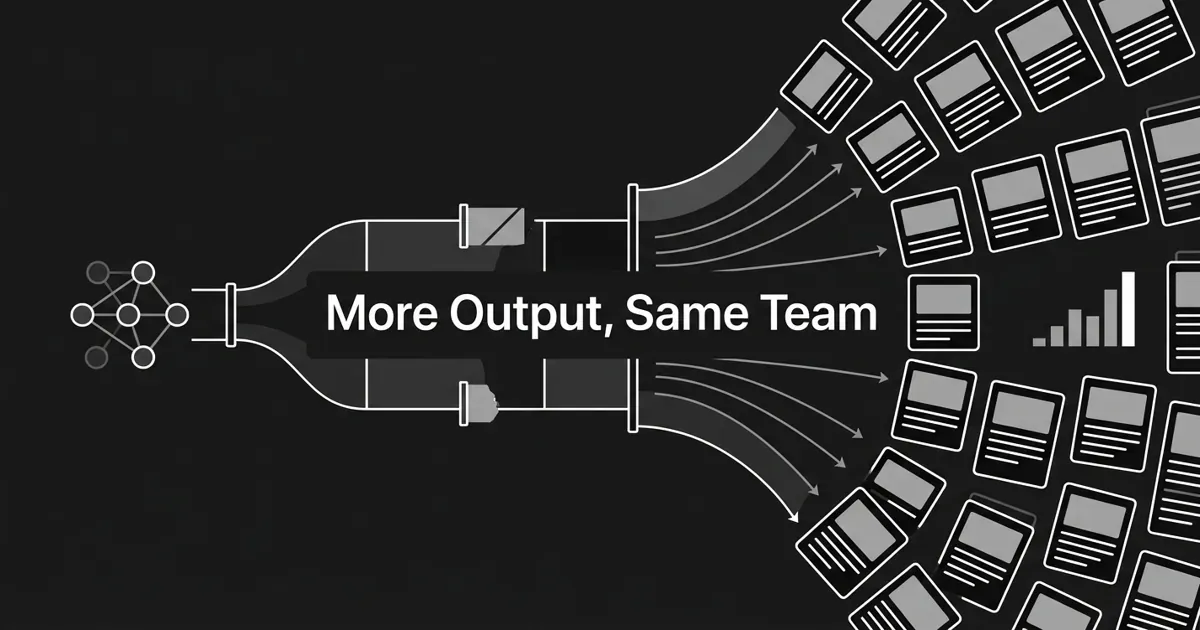
Write the target somewhere visible: more content same team, same budget.
How you know it's done: your calendar has a primary-asset target, a separate derivative-asset target, a time period, and one definition of publish-ready that everybody uses.
Where people go wrong: counting AI generations as production. A draft that still needs a structural rewrite, a keyword pass, and an hour of manual linking has not released any capacity. It has moved the work later in the week.
Step 3: Store your context once instead of re-briefing every time
Think about how much of every brief you write is the same information. Who the buyer is. What the product does. Which claims you are allowed to make. How your brand sounds. What a how-to guide should look like for you.
How many times have you typed that same paragraph this year? Writing it out again for every assignment is the most expensive habit in content operations, and it is completely removable.
Convert the repeated brief into structured, reusable context:
- company positioning, differentiators, approved claims, and claims to avoid
- a profile per product with features, use cases, and value propositions
- buyer personas with goals, triggers, requirements, and challenges
- brand voice, with real examples of language that sounds like you
- content types such as how-to, comparison, and listicle, each with the job it does
- visual direction for covers
- a trusted-sources list and your existing content corpus
This is not a style-guide PDF that nobody opens. It is context a production system applies every time, so voice drift and invented product claims stop arriving in your inbox.
DeepSmith calls this layer Deep IQ. You set it up once from your website during onboarding, and About Company, Products and Services, Buyer Persona, Brand Voice, Visual Guidelines, and Content Types then feed every other module. Context does not replace your judgment. It stops you paying for the same briefing twice.
How you know it's done: a new article can start without you rewriting the same background, and when your positioning changes you update it in one place.
Where people go wrong: telling an AI tool to "sound professional" and calling that brand voice. That is surface tone, not context. The other failure is quieter: three versions of your product facts living in three folders, so every draft is accurate about something different.
Step 4: Move SEO, links, and metadata into creation, not after it
This is the step that does the most to scale content without hiring, so give it real attention.
Stop treating optimization as a repair job. Everything you currently fix after a draft lands should be a requirement the draft is built against: keyword and topic coverage, heading hierarchy, a crisp answer near the top where the format calls for it, metadata and schema, contextual internal links drawn from your real site inventory, relevant external sources, cover-image direction, and the format your CMS expects.
Look at that list again. It is your job description on a bad week.
Answer engine optimization belongs here too. Clear headings, direct answers, and structures that make information easy to lift are what give answer engines something to work with. That is formatting discipline, not a guarantee of citations.
DeepSmith builds these into the writing pipeline instead of bolting them on afterwards. The Writer in Content Studio produces a finished, brand-grounded article with research, internal and external links, a cover image, and publish-ready metadata, and the linking step reads your enriched sitemap to place up to five internal links during generation. You still make the editorial call. You stop doing the mechanical repair.
How you know it's done: the piece that reaches you already has its structure, links, metadata, and image direction, and your review is about angle and accuracy rather than header levels.
Where people go wrong: using AI for prose only. Automate the drafting, keep the keyword, header, metadata, and internal-link work by hand, and your bottleneck sits exactly where it was. Internal linking is usually the first thing that gets skipped when the week gets tight, and skipping it costs you compounding value across the whole site.
Step 5: Turn evidence into a ranked production queue
An unranked idea list is not a backlog. It is a wish.
Give every item a reason attached to data. Record the buyer question, the persona, the funnel stage, the content type, the evidence behind it, the target date, and whether it is a new page, a refresh, or a derivative.
So what counts as evidence? Things like this:
- topics where your own coverage is thin
- topics competitors cover far more deeply than you do
- topics competitors own that you have nothing on
- buyer prompts where AI mentions your brand but does not cite it
- prompts where a competitor takes the citation instead
- pages worth refreshing rather than replacing
- funnel-stage gaps across awareness, consideration, and decision
Prioritize by strategic value, not by what is easiest to generate. Content output at volume becomes a liability the moment you publish four pages answering the same question because the system made it cheap to do so.
DeepSmith's Content Map builds this evidence for you. Your site and your competitors' sites are mapped onto one shared topic taxonomy, classified by topic and funnel stage, with coverage gaps and untapped topics called out and sitemaps rechecked every 24 hours. Opportunity Agents read that map or your AI visibility data and return ideas with the specific data point that justifies each one, landing in New Ideas as your single backlog. The win is that you can defend the queue, not just fill it.
How you know it's done: every planned item answers why this, why now, and for whom, and you can name the change in coverage or visibility it is meant to create.
Where people go wrong: keeping research, competitor tracking, and production planning in separate tabs. Insight that never reaches the queue never becomes output. In CMI's 2024 B2B outlook, drawn from a survey run in 2023, 31% of marketers said they had no structured content-production process at all and 29% had no editorial calendar with clear deadlines. That is not a discipline problem. It is a systems gap.
Step 6: Put dates on the work and let the calendar run itself
Give every selected item a date, then decide how it moves on that date.
A date on its own does nothing. You have probably had an aspirational calendar before, and it aged into a list of overdue tasks. A scheduled item only moves if it already carries its context, format, target, and destination, so nobody has to reopen the brief when the day arrives.
Batch your planning too. Deciding what to write on a calm Monday is a different activity from deciding it at 4pm on the day it was due.
Then automate the handoffs around creation: moving a planned item into production, generating the article with its metadata and cover, landing it in a review queue, and sending it to your CMS. That is how you increase content production without adding a person to chase it.
In DeepSmith, giving an idea a date is what plans it. Autowrite goes further: configure the article at planning time and it writes itself on its scheduled date and arrives in Produced Content with nobody in the app. From there you review, edit, and publish to WordPress, Webflow, Strapi, Sanity, or Contentful, or to your own webhooks, with Markdown and HTML export as a fallback. That is the difference between content as a task you run and content as a system that runs.
How you know it's done: a genuinely bad week does not stop the pipeline, because nothing was waiting on someone to open the next brief.
Where people go wrong: automating drafting and leaving scheduling, formatting, images, CMS transfer, and distribution by hand. The article still waits on the same person. The bottleneck did not move, it just changed clothes.
Step 7: Make distribution part of the article, not a separate project
Be honest with yourself. How many of your last ten posts got the LinkedIn version, the newsletter mention, and the thread?
You are in good company if the answer is "a few." In CMI's 2024 outlook, 48% of marketers named not enough content repurposing as a barrier to scaling production, and in its 2025 B2B benchmark, drawn from 980 respondents, repurposing was still a challenge for 37%.
Fix it by making the distribution pack an output of the article rather than a project that starts after it.
Pick the primary asset, find its two or three strongest teaching points, and adapt them per channel while the material is fresh. A LinkedIn post that makes one point land. A newsletter section with context and a next action. A thread built from a sequence of connected points. A short community post. A nurture email section.
Adapt, do not paste. A paragraph lifted from an article is rarely a good social post.
CMI has published one example of the mechanics: a post about forest-land loss became a series of nine tweets, and traffic to that post rose 50% within seven days. Treat it as one team's example, not your forecast.
DeepSmith ships social posts with every finished article, and the Apps Library turns one piece into platform-native versions for LinkedIn, X, Medium, Substack, newsletter and nurture email, Reddit, Facebook, Instagram, Slack or Discord, WhatsApp, and more, each adapted to the channel's tone and length. Distribution stops being the thing that falls off.
How you know it's done: every primary article has a documented set of channel assets with dates, and you can report distribution coverage next to article count.
Where people go wrong: choosing ten channels before proving you can serve three consistently. Start where your buyer already pays attention and expand only when the cadence holds.
Step 8: Reassign the hours you freed, then check the new ceiling
Removing work is only half the win. So where do those freed hours go?
Decide deliberately, and say it out loud, because unassigned hours get eaten. Move your time toward what only you can do: choosing what to write and why, understanding the buyer, setting the angle, contributing product and customer insight, reading performance and acting on it. Let the system carry the repeatable mechanics it has enough context to execute.
Then inspect the new numbers on a fixed cadence:
- finished primary assets per period
- derivative assets per primary asset
- hands-on hours per finished asset
- cycle time, split into working and waiting
- rework hours and number of rewrite cycles
- share of planned items produced on schedule
- share of articles with a distribution pack
- topic and funnel coverage
- the outcomes you already report: qualified traffic, conversions, assisted pipeline
Compare against your own baseline, never against someone else's headline. Adoption numbers are not outcome numbers. HubSpot's 2026 State of Marketing report has 80% of marketers using AI for content creation and 61% saying marketing is in its biggest disruption in 20 years, which tells you the practice is mainstream, not that it gave anyone back 80% of their time. The St. Louis Fed's 2025 work on generative-AI adoption is the useful corrective: across US workers including nonusers, reported time savings came to the equivalent of 1.6% of all work hours, and a production-model estimate put the productivity lift at up to 1.3% since ChatGPT arrived. McKinsey's widely quoted 5% to 15% figure for marketing productivity is modeled economic potential expressed against marketing spend, not a measured increase in anyone's article count.
None of that means the gains are not real. It means the only number that proves your case is your own before and after.
One boundary to respect while you push volume. Google treats scaled content abuse as generating many pages primarily to manipulate rankings rather than to help people, and it says plainly that using generative AI to make many pages without adding value counts. The line is not human versus machine. It is useful versus not. Scale content that answers a real question for a real reader and you stay on the right side of it.
How you know it's done: you can show which manual hours disappeared, where they went, and whether finished output and results both moved. Your next bottleneck is visible instead of buried in somebody's inbox.
Where people go wrong: staying the final mechanical editor for every piece after automating everything upstream. That just makes you the approval queue instead of the production queue. The opposite mistake is worse: waving everything through and calling that scale.
What to do next
You do not need all eight steps this quarter. You need the first one.
Pick one month of published work and audit it this week. Find the single most expensive repeated task. Remove or automate that one, then measure finished pieces rather than drafts.
That is the whole method. More content same team, one bottleneck at a time.
If you want to see whether shared context, evidence-backed ideas, scheduled production, and built-in distribution move your numbers, start a free DeepSmith trial. Seven days, real data and real drafts, no long-term contract.