You are here because something in your current setup is not working. Maybe the engine coverage stops short of where your buyers actually ask. Maybe the bill grew faster than the insight did. Maybe you see the gaps just fine, and nothing happens after you see them.
That is a normal place to be. This category is about two years old, and the tools inside it are still deciding what they want to be.
So let's keep it simple. Below are eight Getmint alternatives, each one for a different kind of team. You do not need to read all eight. You need the one that matches your engine coverage, your budget, and how often you have to report.
Getmint is a real product. It tracks visibility across AI answers, reports citations, sentiment and share of voice, compares competitors prompt by prompt, and turns prompts you are losing on into content briefs. Starter is $80 a month for 50 prompts and 2 topics. Growth is $349 for 300 prompts and 5 topics. Enterprise and Agency are custom. This list is not here to tell you that is bad. It is here to help you find a better fit.
How we picked these Getmint alternatives
Here are the criteria. Six of them, and they are the same six a good procurement conversation ends up using.
- Engine coverage that matches your buyers. Not the number on the homepage, the number included in the plan you would actually buy.
- Prompt-level reporting. Mention rate, citation rate, sentiment, and competitors, broken down per prompt and per engine.
- Refresh cadence and reporting workflow. Daily or weekly, and how the data reaches your stakeholders.
- Pricing you can compare. Some tools price by prompts, some by credits, some by domains. That difference matters more than the headline number.
- What happens after the report. Does the tool hand you a finding, or does it help you act on it?
- Fit with the rest of your content work. You already have a production backlog. A tool that ignores it just adds another tab.
One caveat before the list. Visibility scores are not interchangeable across vendors, because prompt sets, collection methods, geography, cadence, and weighting all differ. No independent head-to-head study exists that would let anyone claim one tool measures citations more accurately than another. So this ranking compares disclosed methodology, coverage, and workflow, not vendor scores.
Prices below are the published figures at the time of research. This category moves fast, so recheck before you sign.
Getmint alternatives at a glance
| Tool | Best fit | Entry price | What the entry plan includes |
|---|---|---|---|
| DeepSmith | Teams that need visibility data connected to production | $99/mo ($80/mo billed yearly) | 50 prompts, 20 articles/mo, 5 seats, ChatGPT |
| Peec AI | Analytics, prompt research, and agency reporting | $95/mo | 50 prompts, 1 project, 3 models, 1 country, daily tracking |
| OtterlyAI | Small teams on a tight budget | $29/mo ($25/mo annual) | 15 prompts, 4 engines, daily tracking, 1 workspace |
| Profound | Prompt demand, agent, and shopping analysis | $99/mo billed yearly | 50 prompts, ChatGPT only, 100 agent credits, 1 seat |
| Scrunch | Visibility plus AI-readiness audits | $250/mo | 125 prompts, 5 site audits/mo, 4 LLMs, 5 user licenses |
| Rankscale | Broad engine and regional coverage | From $20/mo; $99/mo Pro | Pro: 1,200 credits, up to 4,800 answers, 10 dashboards |
| Semrush AI Visibility Toolkit | Teams already living in Semrush | $99/mo per domain, billed annually | 25 tracked prompts, 1 Brand Performance domain |
| AthenaHQ | Broad model coverage on a credit model | Free Essential; $295/mo Starter | Starter: 3,600 credits, 10 models, unlimited topics |
1. DeepSmith: best when the report has to turn into published work
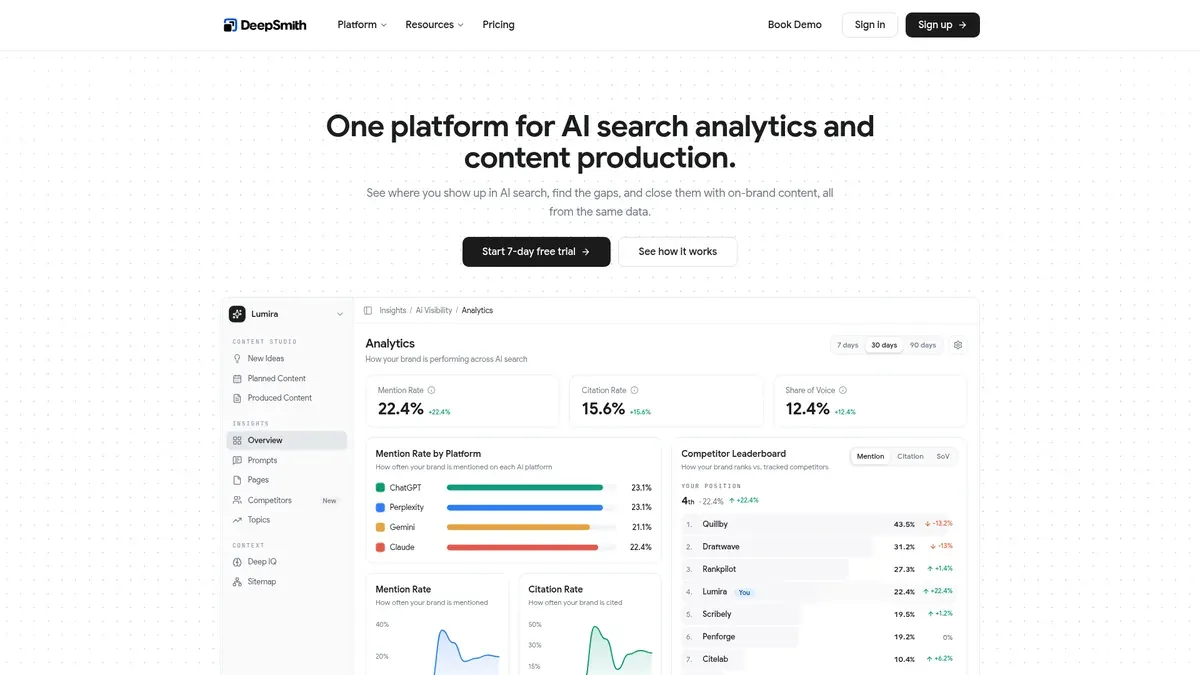
Best for: marketing leads and content teams who need one workflow that runs from prompt research and competitor gaps all the way to on-brand, published articles. It also fits agencies, because each brand gets its own isolated workspace with its own context, content, and plan.
Here is the question most visibility tools leave hanging. You run the report. You learn you are invisible on eleven buyer prompts. Now what?
For most teams, "now what" is the real bottleneck. Measurement was never the hard part. Writing the eleven pages was.
DeepSmith is an AI search analytics and content production platform in one. It tracks how AI engines answer questions about your brand, finds where you are invisible or losing, and produces the on-brand content that closes those gaps, from the same data.
Key features
- AI Visibility. Mention rate, citation rate, share of voice, sentiment, and visibility trend, with a per-platform breakdown, a competitor leaderboard, the sources AI cites most, full prompt history, and page-level citation attribution.
- Ten engines, tiered by plan. ChatGPT, Gemini, Perplexity, Claude, Google AI Overviews, Google AI Mode, Grok, Meta AI, Microsoft Copilot, and DeepSeek. Pro covers ChatGPT, Grow adds Perplexity, Scale adds Gemini, and Enterprise or Custom covers all ten.
- Discover Prompts. Generates a starter set of buyer questions from your product, persona, and buyer-stage context, so you are not staring at an empty prompt list on day one.
- Content Map. Crawls your site and unlimited competitor sites, sorts every page onto one shared topic taxonomy and a funnel stage, then flags coverage gaps and untapped topics. Sitemaps re-check every 24 hours.
- Opportunity Agents. Named agents read your own visibility or Content Map data and return ideas with the evidence attached. Every idea carries the exact data point that justifies it, so you can defend the backlog instead of guessing at it.
- Content Studio. Ideas move through New Ideas, Planned Content, the Writer, and Produced Content. The Writer turns one planned idea into a researched, brand-grounded article with internal and external links, a cover image, and publish-ready metadata.
- Autowrite. Schedule an article and it writes itself on its date, with nobody in the app.
- Deep IQ. Your positioning, products, personas, brand voice, visual guidelines, content types, and trusted sources stored once as structured context that every writing run reads.
- Publishing and distribution. Publish to WordPress, Webflow, Strapi, Sanity, or Contentful, or to your own webhooks. The Apps Library turns a finished article into LinkedIn, X, Medium, Substack, newsletter, Reddit, and other channel-native versions.

Pricing
Pro is $99 a month, or $80 billed annually: 50 prompts, 20 articles, 5 seats, ChatGPT. Grow is $199, or $160 annually: 100 prompts, 40 articles, 7 seats, ChatGPT and Perplexity. Scale is $399, or $299 annually: 200 prompts, 90 articles, 10 seats, and Gemini on top. Enterprise is custom, covers all ten engines, and adds 1:1 onboarding and a dedicated account manager. There is a 7-day free trial with real data and real drafts, no long-term contracts, and no cancellation fees.
Look at that against the getmint pricing you are replacing. Getmint Starter is $80 a month for 50 prompts. DeepSmith Pro is $99 for 50 prompts plus 20 finished articles a month. The extra $19 is not buying you a better chart. It is buying the production step that usually costs you a freelancer invoice.

The honest limitation
The lower plans do not cover all ten engines. If your board wants cross-platform monitoring across ChatGPT, Gemini, Claude, Copilot, and the rest starting Monday, Pro will not deliver that on its own, and Enterprise is the tier that does.
The tiering is at least clear about it. Start on ChatGPT, add Perplexity on Grow, add Gemini on Scale, move to Enterprise when breadth becomes the priority. For most marketing teams, the honest sequence is that ChatGPT is where the volume is first, and the harder problem is publishing against what you find there.
2. Peec AI: best for structured analytics and agency reporting

Best for: SEO and content managers who want prompt organization and volume-informed prioritization, and agencies that need client projects, exports, and dashboards.
Peec AI is an analytics platform built around brand representation. It reports visibility, position, sentiment, share of voice, competitors, and cited sources, and adds AI Shopping visibility and crawlability analysis.
Key features
- Default coverage includes ChatGPT, Google AI Overviews, Google AI Mode, Microsoft Copilot, Perplexity, and Gemini. Upgrade models add OpenAI Search API, Claude Sonnet and Haiku, DeepSeek, Qwen, Grok, and Mistral.
- Prompts carry states (Active, Suggested, Inactive), and active prompts get an estimated volume score from relative industry search volume.
- Competitors can be auto-suggested after appearing beside your brand twice, or added by hand with aliases and regular expressions.
- Sources are classified as Editorial, Corporate, UGC, Reference, or Own website, which is genuinely useful when you are trying to work out where citations actually come from.
- Crawlability checks test robots.txt against more than 40 AI bots from more than 20 vendors.
- Exports run through CSV, Looker Studio, an API, and a Peec MCP server.
Pricing: Starter $95/mo (50 prompts, 1 project, 3 models, 1 country, daily tracking, unlimited users). Pro $245/mo (150 prompts). Advanced $495/mo (350 prompts). Enterprise is custom. Annual billing saves about 15%. Agency plans are separate, from Essential at $245/mo to a custom Comprehensive tier, priced in credits where one credit is one prompt on one model for one day.
The limitation: Peec is an analytics and workflow layer. The researched material does not show a publish-ready article pipeline, scheduling, CMS publishing, or built-in repurposing. For an analytics-led buyer that is not a defect, it is the product working as designed. There is also a plan-scope wrinkle worth asking about: Looker Studio starts at the Growth agency plan and API, MCP, and SSO are listed as Comprehensive-only for agency plans, while the general product information describes CSV, API, and MCP on all plans. Get that clarified in writing.
3. OtterlyAI: best when budget is the first constraint

Best for: solo marketers and small teams who want daily monitoring without a four-figure commitment.
OtterlyAI covers prompt research, visibility monitoring, citation and sentiment analysis, competitor-gap analysis, content audits, briefs, and GEO recommendations. At $29 a month, it is the most accessible serious option on this list.
Key features
- Prompt Research surfaces the prompts, topics, and intent patterns behind AI answers.
- Dashboards show brand coverage rate, competitor share of voice, platform-level visibility, sentiment, referenced links, and historical trends.
- Competitor analysis finds the queries where a rival is cited and you are not, which is the most actionable single view in a budget tool.
- Content Audit and Prediction, crawlability checks, Content Briefs, and GEO recommendations move monitoring toward optimization.
- An API is available for programmatic access.
Pricing: Lite $29/mo, or $25 annually, for 15 prompts. Standard $189/mo, or $160 annually, for 100 prompts. Premium $489/mo, or $422 annually, for 400 prompts. Enterprise is custom, starting from $1,000/mo. Every paid plan gets daily tracking, unlimited team members, and unlimited reports and export. A free trial is available. Standard can add up to 300 extra prompts before you have to move to Premium.
The limitation: the included engine set is four (ChatGPT, Google AI Overviews, Perplexity, Microsoft Copilot). Claude, Gemini, and Google AI Mode are add-ons. Fifteen prompts on Lite goes quickly too, so budget realistically for Standard if you have more than one product line.
4. Profound: best for deep answer-engine and agent analysis
Best for: organizations that need more than mention tracking, especially teams studying prompt demand, AI agents, and shopping visibility.
Profound is built around structured prompts across AI platforms and the analysis of how brands surface inside generated answers. Its module list goes wider than most: Answer Engine Insights, Prompt Volumes, Agent Analytics, Shopping, Agents, and Aim.
Key features
- Monitored platforms named in its official material include Perplexity, ChatGPT, Claude, Gemini, Grok, Microsoft Copilot, DeepSeek, and Google AI Overviews.
- Prompt Volumes is the standout. Knowing which prompts carry demand changes which gaps are worth closing first.
- Agent Analytics and Shopping cover territory the rest of this list mostly does not.
- Solutions are positioned for AEO and SEO, content and demand, and PR and communications.
- A REST API is available on request.
Pricing: Starter $99/mo billed yearly, with 50 prompts, 100 agent credits a month, 1 seat, ChatGPT only, and unlimited domains. Growth $399/mo billed yearly, with 100 prompts, 400 agent credits, and 3 seats. Enterprise is custom, with up to nine answer engines. Two months are free on annual billing, and a trial is offered on Growth. Agent credits are not the same thing as tracked prompts, so read that line carefully.
The limitation: Starter is deliberately narrow. Its pricing page states it does not include ChatGPT Shopping, searches, relevant keywords, exports, API, or SSO. One seat and one engine make it a low-cost way to start rather than a like-for-like replacement for a team that already needs multi-engine coverage and shared reporting.
5. Scrunch: best when site readiness matters as much as monitoring
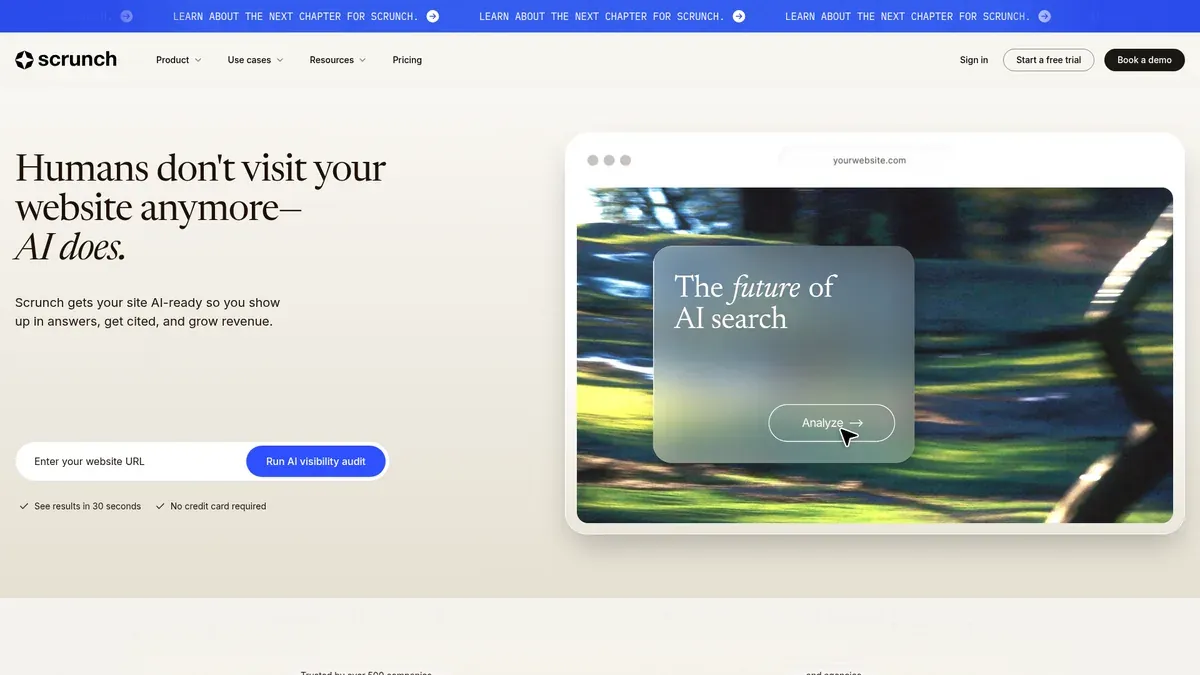
Best for: teams who want to monitor AI visibility and also audit whether their site can be consumed by AI systems at all.
Scrunch monitors brand presence in AI search, audits technical and content issues that block AI consumption, optimizes pages, and delivers AI-optimized content directly to AI agents without changing the human experience of the site.
One thing to know up front: Scrunch is in transition. Its current material talks about "the next chapter" and positions the company around an Agent Experience Platform, while the pricing page still publishes the Core and Enterprise visibility plans. That is not a red flag by itself, but it does mean you should confirm exactly which capabilities are inside the contract you are signing.
Key features
- Prompt tracking, authoritative citation analysis, and brand performance over time.
- AI-readiness audits of technical and content issues.
- Page optimization and content delivery aimed at AI agents.
- A Query API for aggregated metrics and a Responses API for response-level data.
- Enterprise adds API access, integrations, expanded model coverage, SAML or OIDC SSO, a dedicated account team, and complete site audits.
Pricing: Core is $250/mo: 125 unique prompts, 5 site audits a month, 1 workspace, 5 user licenses, 4 LLMs (ChatGPT, Perplexity, Google AI Overviews, Microsoft Copilot), 1 country, 3 personas, 2 languages, 5 competitors, a 25-page site map, and 1 page optimization a month. Enterprise is custom and lists 9 LLMs. No annual price is published for Core.
The limitation: the entry point is $250 with four LLMs, one workspace, and five users. Broader model coverage, API access, and integrations all sit at Enterprise. If your evaluation is mostly about prompt monitoring, you can get that cheaper elsewhere. Scrunch earns its price when the audit and delivery side is genuinely part of the job.
6. Rankscale: best for broad engine and international coverage
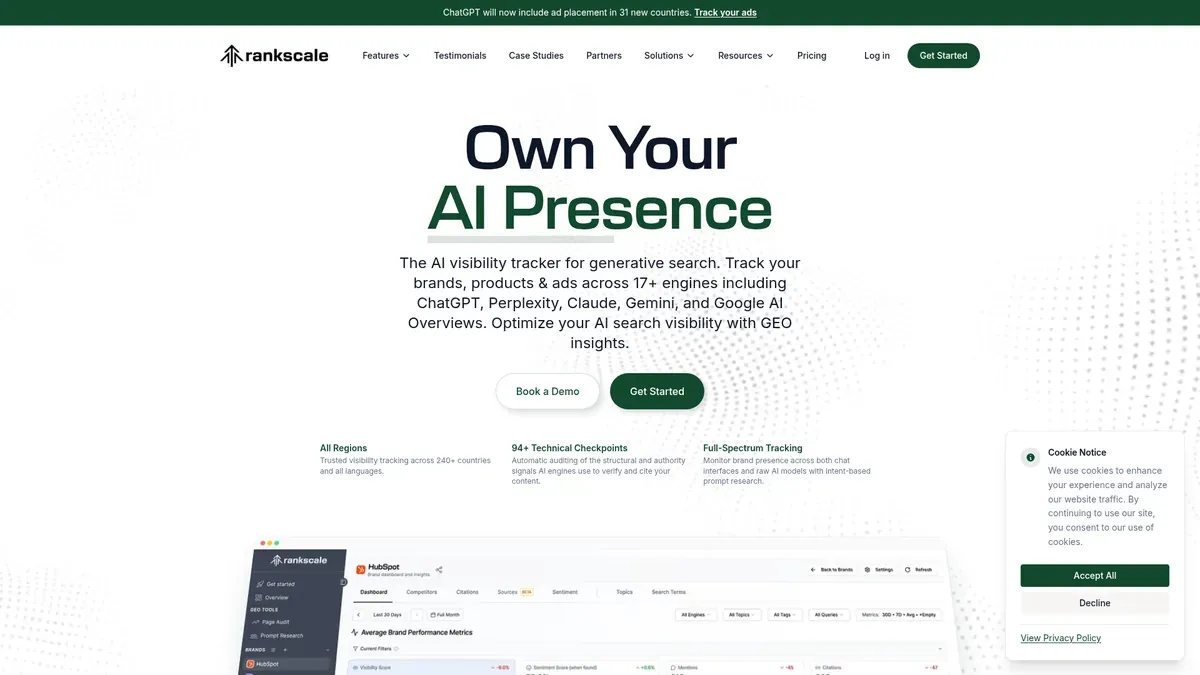
Best for: agencies and multi-brand teams where the deciding factor is how many engines and countries a tool can reach.
Rankscale is an AI SEO and GEO platform built for breadth. It claims more than 17 engines, including ChatGPT, Perplexity, Claude, Gemini, Google AI Overviews, Google AI Mode, DeepSeek, Grok, Copilot, and Mistral, across more than 240 countries and all languages.
Key features
- AI visibility score, rankings, sentiment, mentions, citations, and share of voice.
- Prompt research that estimates search volume through semantic reconstruction.
- Competitor tools that auto-identify rivals and expose ranking gaps.
- AI-readiness audits with more than 94 technical checkpoints across more than 200 factors.
- Multiple brand dashboards, historical trends, exports, white-label reporting, and REST API access on higher plans.
Pricing: Essentials starts at $20/mo. Pro is $99/mo with 1,200 credits (up to 4,800 AI-engine answers), 10 dashboards, and 50 URL checks. Growth is $385/mo with 5,500 credits and 50 dashboards. Enterprise is $780/mo with 12,000 credits and 100 dashboards. Annual billing advertises 15% off, each engine query typically uses 0.25 credits, and unused credits roll over. Pro includes a 7-day trial.
The limitation: the credit model is harder to compare than a flat prompt allowance, because consumption shifts with which engines you select. Essentials advertises at $20 but its included limits were not published in the pricing detail we captured, so treat that number as a starting point rather than a plan.
7. Semrush AI Visibility Toolkit: best if you already live in Semrush

Best for: teams already paying for Semrush who want AI visibility sitting beside their SEO, site audit, and reporting data.
The AI Visibility Toolkit adds answer-engine work to the wider Semrush ecosystem. If your stakeholder reports already come out of Semrush, this removes a tool from the stack rather than adding one.
Key features
- AI Visibility Score, brand appearances, competitor activity, regional analysis, and growth opportunities.
- Competitor Research finds prompts where rivals get cited and you do not.
- Prompt Research reports topic volume, difficulty, and intent, positioned as keyword research for AI.
- Prompt Tracking supports 25 custom prompts with daily rankings, using Google AI Mode and ChatGPT.
- Brand Performance runs common queries through ChatGPT and Google AI Mode and analyzes mentions, tone, attributes, and positioning.
- Site Audit's AI Search Health widget flags technical blockers stopping AI bots from crawling.
- Reports export to PDF or CSV, land in My Reports, and can become shareable dashboards or scheduled recurring reports.
Pricing: $99/mo per domain, billed annually, for 25 tracked prompts, 300 daily AI Analysis queries, 1,000 daily Prompt Research queries, 1 Brand Performance domain, audits up to 100 pages, and 10 CSV exports a day. Extra domains or locations are $99 each and extra users start at $45/mo. A seven-day trial is offered. Monthly pricing was not published in the material we captured.
Cadence: Visibility Overview, Competitor Research, Prompt Research, and Prompt Tracking update daily. Brand Performance updates weekly. Site Audit runs on demand.
The limitation: 25 tracked prompts is tight for a real prompt set, and the per-domain pricing adds up fast in a multi-brand shop. Scope is the bigger point though. This is measurement inside an SEO ecosystem, not a documented path from a visibility gap to a published, brand-grounded article.
8. AthenaHQ: best for broad model coverage on a credit model

Best for: teams that want wide model coverage at one paid tier and are comfortable buying AI responses as credits.
AthenaHQ positions itself as a command center for AEO and GEO, combining cross-platform monitoring, competitive intelligence, hallucination detection, sentiment, and prescriptive agents.
Key features
- All plans include ChatGPT, Perplexity, Gemini, Google AI Overviews, and Microsoft Copilot. Paid plans add Google AI Mode, Claude, Grok, DeepSeek, and Meta AI.
- Tracks brand mention frequency, competitor share of voice, and sentiment across more than 11 LLMs.
- Hallucination detection, which matters if AI answers are describing your product wrongly rather than ignoring it.
- Athena agents and a prescriptive content workflow turn findings into recommended actions.
Pricing: Essential is free with 300 credits plus a $25 free credit. Starter is $295/mo with 3,600 credits a month, 10 models, and unlimited topics, billed monthly or annually with 17% off annual. Enterprise is custom. One credit equals one AI response. A free tier you can actually test on is rare in this category and worth using.
The limitation: credits make prompt-to-cost comparisons indirect. You have to model your own prompt count, engine count, and refresh cadence to work out what you will actually spend. API access is a paid add-on on Starter and included only at Enterprise, so agencies should price that in before choosing.
How to choose your Getmint alternative
Take a breath. You do not have to evaluate eight tools. You have to answer one question about your own situation, and the answer points at one or two.
- Your reports need to become published pages. Choose DeepSmith. The visibility data feeds an actual production queue with scheduling, CMS publishing, and distribution attached.
- You need analytics depth and client-ready reporting. Choose Peec AI. Source classification and Looker Studio are the difference-makers here.
- Budget is the first constraint. Choose OtterlyAI. Four engines and daily monitoring at $29 is a real starting point, not a toy.
- You need prompt demand, agent, or shopping analysis. Choose Profound, and budget for Growth rather than Starter if multi-engine coverage matters.
- Site readiness and agent delivery matter as much as monitoring. Choose Scrunch, and confirm current contract scope given the AXP transition.
- International coverage and engine breadth decide it. Choose Rankscale. Nothing else on this list reaches as far.
- You already run on Semrush. Choose the AI Visibility Toolkit and keep one reporting system instead of two.
- You want broad paid model coverage and prescriptive agents. Choose AthenaHQ, after you model the credit math.
Notice what none of those bullets said. None of them said "pick the tool with the highest score." Vendor scores are not comparable to each other, and picking on a number you cannot audit is how teams end up switching twice.
One more thing, and most people get it wrong. Do not evaluate on the demo. Evaluate on your fourth week. Who opens this tool on a Tuesday in week four, and what do they do with what they find? If the answer is "nobody" or "add it to a doc," the tool is not the problem. The workflow around it is.
Ready to see where you stand?
If the gap you keep hitting is the one between knowing and publishing, that is exactly the gap DeepSmith was built to close. Start a 7-day free trial and you will see real visibility data and real drafts before you pay a thing. No long-term contract, no cancellation fee.