Here is the part almost nobody tells you. When ChatGPT answers a question, it pulls far more pages than it ever shows. In one analysis of 700,000 conversations, 85% of the pages it retrieved never appeared in the final answer. Only 15% made the cut.
So the page can be found. It can be relevant. And it can still lose.
If that stings a little, that is normal. You did the hard part already. You published something good. The frustrating gap between "retrieved" and "cited" is not a mystery, though. It comes down to a finite set of AI citation signals that engines weigh at each stage of a brutal filter.
This piece is your inventory of those signals. Not a deep dive on any one of them, but the whole map: the five families that decide who gets cited, and how they stack up at the moment an engine picks its sources. Once you can see the map, you can stop guessing which lever to pull.
Let's walk through it together.
The five signal families that decide every citation
Every citation decision comes down to five families of signals: relevance, structure, authority, freshness, and source diversity. The factors AI citation studies keep surfacing all sort into these five buckets. A page wins by clearing all five, not by maxing out one.
That last point matters, so let it land. This is why "we optimized and nothing happened" is so common. The page won on structure but failed authority. Or won on relevance and lost on freshness. The combination is the strategy.
A 54-study meta-analysis scored the citation ranking factors AI engines lean on by how repeatable and well-evidenced each one is. Here are the highest-weighted signals, on a 10-point scale, grouped by family:
- Relevance: search rank on the underlying engine (9.4), fan-out coverage across related sub-queries (9.3), direct query-answer match (9.2), format matching the query's intent (9.0), factual specificity with real numbers and names (8.3).
- Structure: crawler access with no JavaScript-only content (9.5), a clean quotable snippet (9.2), the answer near the top of the page (8.8), semantic headings and lists (8.6), self-contained passages (8.0).
- Authority: ranking across a whole topic cluster (8.9), brand and entity trust (6.8), entity consistency (5.8), and, near the bottom, plain domain authority (5.0).
- Freshness: content recency relative to the query type (7.0), higher for anything time-sensitive.
- Source diversity: the mix of source types a given engine prefers for a given query, applied at the final cut.
Two things jump out. Relevance and structure dominate the top. And domain authority, the old SEO trophy, sits near the bottom. So does the much-hyped llms.txt, weighted a mere 2.0 with no credible evidence behind it.
Now let's take each family one at a time. Small steps.
Relevance: did you answer the question, and every question behind it?
Relevance is not one keyword match. It is whether your page answers the asked question and the cloud of related questions the engine expands it into.
That expansion has a name: query fan-out. The engine breaks the prompt into many parallel sub-queries, pulls results for each, and merges them. A page that ranks for one narrow query but only grazes the surrounding ones gets filtered out early. A page that shows up across many of those sub-queries accumulates a higher merged score and survives.
This is why single pages rarely win alone. A cluster of connected pages on the topic does. If you take one thing from this section, make it that.
Here is what a relevant page looks like in practice:
- The direct answer sits near the top. Across studies, 44.2% of all citations come from the first 30% of the page.
- It matches the format the query expects. Listicles for "best" queries, how-tos for procedural ones, comparison tables for alternatives.
- It uses named entities and specific numbers, not vague phrasing. "Grew 22% in Q1" beats "has been growing lately."
- It is readable by the crawler at all. Roughly 60% of sites are at least partly invisible to AI, because they block the bots, hide content behind JavaScript, or serve
noaiheaders.
The specifics compound. Pages with original research or proprietary data get cited at 38% to 65% rates, versus 6% to 15% for standard blog content. Quoting named experts with credentials lifts citations by about 40.9%. Pairing statistics with named sources adds around 30.6%.
So what makes AI cite a page here? A complete answer, in the expected format, backed by specifics, sitting inside a broader cluster the engine already trusts on the topic. That is the relevance win.
Structure: can the engine lift a clean answer off your page?
Say your page cleared relevance. The engine still has to extract a quotable, self-contained chunk to drop into its answer. If your best insight is buried in a wall of prose or hidden behind a tab, it fails this step even though it was relevant.
Structure is the most controllable family on this whole list. That is the good news. You do not need more authority or a fresher industry to fix it. You need cleaner pages.
What extraction-friendly structure looks like:
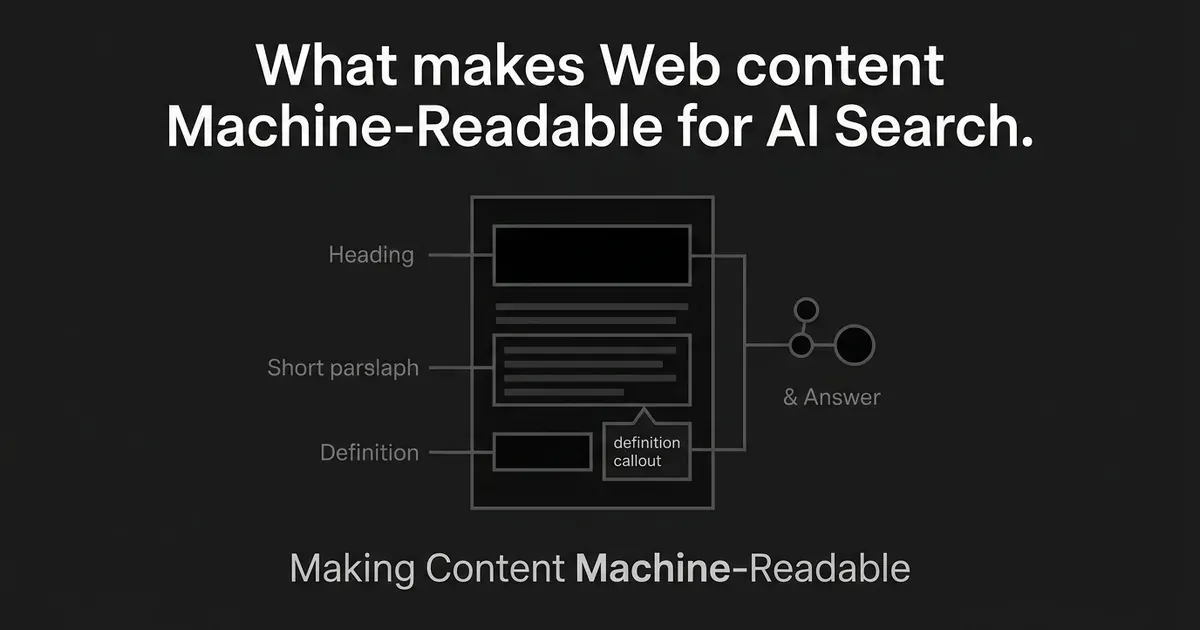
- Question-shaped headings, each followed by a 30 to 60 word direct answer, then the elaboration.
- Short paragraphs of one to three sentences, and self-contained passages that make sense on their own.
- Real semantic HTML: actual headings, lists for steps, tables for comparisons.
- Visible, server-rendered text the engine can read without executing scripts.
The formatting payoffs are concrete. Bullet points and numbered lists get pulled 67% more often than the same content written as prose. Charts and graphs add around 40% lift. A named author byline with credentials adds about 40%. And length has a sweet spot: cited pages average roughly 2,290 words, usually landing in the 1,500 to 3,000 range. Too thin reads as flimsy. Too bloated and the engine struggles to retrieve the whole thing.
Now, schema markup, honestly. You have probably been told to add it and citations will follow. The truth is gentler and more useful. Correlation studies show schema-heavy pages appear in AI summaries about 36% more often. But a controlled test of 1,885 pages that added JSON-LD found no meaningful lift: a slight, statistically significant decline in Google AI Overviews, and changes too small to matter for AI Mode and ChatGPT. Google's own guidance says plainly that no special markup gets you into AI answers.
Read schema as hygiene, not a magic switch. It helps a page get crawled and understood. It does not rescue a page that was not going to be cited anyway. The correlation exists because good sites do everything well at once.
And llms.txt? There is no credible evidence it moves citations. If someone sells it to you as the fix, you can let that worry go.
Authority: does the engine already trust you as a source?
Authority in AI citation is not your Domain Rating. It is closer to a yes-or-no gate: does the engine recognize you as a real, trusted entity on this topic?
The evidence for this is striking. In an analysis of 2,400 AI Overview citations, 96% came from sources with strong experience, expertise, authority, and trust signals. Pages ranking sixth to tenth on Google with strong signals were cited 2.3 times more than pages ranking first with weak ones. The quality of the source outranks its slot on the results page.
So where does that trust come from? Less from links than you would expect. Across 75,000 brands, branded web mentions correlated with AI Overview visibility at 0.664, while backlinks came in at 0.218. That is roughly three times the signal strength for being talked about versus being linked to.
And most of that talk is not on your own site. More than 85% of non-paid citations come from earned media: third-party coverage, reviews, industry outlets. Earned media outperforms your owned content by a wide margin. Your blog is necessary. It is not sufficient.
There is a helpful frame here that breaks authority into coverage (how deeply and broadly you cover the topic), architecture (how legible your site and entity are to a machine), and position (whether the engine returns to you as the canonical answer). Coverage and architecture make you eligible. Position is what actually gets you picked.
One more piece: entity consistency. The engine uses entity resolution to decide whether two mentions of "Acme" are the same Acme. Name your brand the same way across your site, your profiles, and the press, and the engine grows more confident citing you as one clear source.
The honest takeaway? Authority is mostly a long game. But the page-level moves are within reach today: a named author with credentials, real attribution, and a page woven into the topic cluster it claims to own.
Freshness: is your page current enough for this question?
Freshness is conditional. That is the key to not overspending on it.
For questions about pricing, regulations, market data, or recent events, freshness sits near the top of the stack. For evergreen definitions, it fades to a tiebreaker. The engine reads the query type first, then decides how much recency matters.
When it matters, it matters a lot. Content under 30 days old earns roughly 3.2 times more AI citations. About half of all AI-cited content is less than 13 weeks old. Across studies, cited content runs about 25.7% fresher than the organic top ten. Perplexity is the most aggressive here, discounting content over 30 days old on fast-moving topics.
You saw how fast the ground can shift on January 27, 2026, when a Gemini model update replaced about 42% of previously cited domains in AI Overviews overnight and started pulling more sources per answer. Winning once is not winning forever.
How do you signal freshness honestly? A visible "last updated" date. Accurate dateModified markup, which correlates with roughly a 1.8 times citation lift. And here is the part people skip: the update has to be substantive. Engines snapshot pages and discount cosmetic freshness, where the date changes but the content does not. Changing a timestamp fools no one.
So freshness is a cadence, not a stamp. Refresh the fastest-decaying pages monthly. Let evergreen pages breathe. Match the rhythm to how quickly the topic actually changes, and you spend your effort where it moves the needle.
Source diversity: which kinds of sources does each engine want?
Here is the trap that catches careful teams. You optimize beautifully for one engine, then wonder why you are invisible on another. Each engine has a learned preference for the type of source it likes to cite, and the right mix on the wrong engine is still wrong.
Look at how different the preferences are:
- Google AI Overviews lean on video and encyclopedic sources. YouTube alone is the single most-cited source at around 20.9%.
- ChatGPT with browsing leans on Bing's results plus Wikipedia, which accounts for roughly 47.9% of its top citations.
- Perplexity leans on Reddit, which makes up about 46.7% of its top citations, plus fresh direct sources.
- Claude with web fetch leans toward blogs, around 43.8% of its top citations, and institutional sources.
The overlap is smaller than you would guess. Only about 11% of domains are cited by both ChatGPT and Perplexity for the same query. And 71% of all cited sources show up on just one platform. A single question genuinely produces a different set of winners depending on where it is asked.
There is also concentration to reckon with. The top 1% of domains capture roughly 47% of all Google AI Overview citations. Breaking into that set is less about publishing more and more about being the kind of source the engine reaches for.
So what does this ask of you? Not to chase one engine's mix and call it done. Audit where you win and lose engine by engine, then earn the source types each one wants: video, community presence, industry coverage, not just another post on your blog.
How the signals combine at selection time
You now have the five families. The last move is seeing how they stack up, because that is where most effort gets misspent.
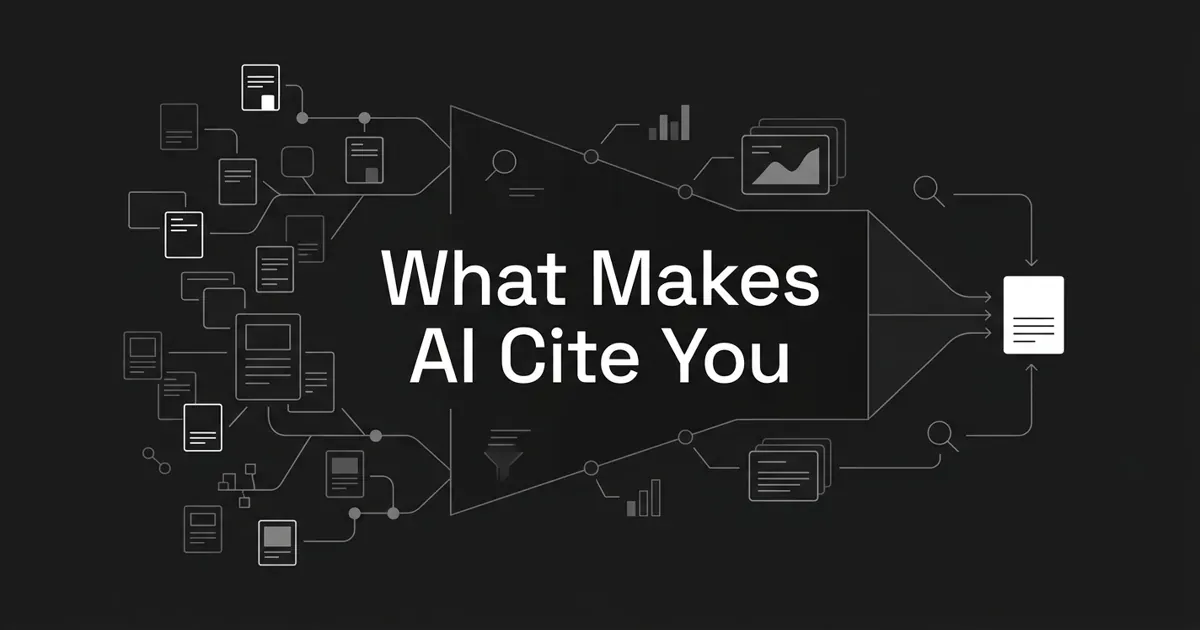
Every engine runs a multi-stage filter that narrows a wide net down to a handful of cited sources. The pattern holds even where the details differ:
- Retrieval. Cast wide. Perplexity pulls a handful of pages; Google AI Overviews can pull hundreds. Relevance dominates here.
- Eligibility. Apply binary gates: crawl access, language match, a freshness threshold, and the trust check. Authority dominates here.
- Re-rank. Score the survivors on how cleanly they can be quoted. Structure dominates here.
- Final cut. Pick the final few. Freshness and source diversity are the tiebreakers among pages that already passed.
That funnel is why AI citation signals have to be understood together. A page can pass relevance and die at eligibility. Pass both and lose on structure. Clear all three and miss the engine's preferred source mix. This is exactly why AI chooses a source that, on paper, looks no better than yours: it cleared a gate yours did not.
So how do you know which gate is holding you back? You measure. This is the honest core of it: every team has to test which signals correlate with their own wins, on their own prompts, across their own engines. There is no universal answer key.
That feedback loop is what turns this map into a plan. AI citation tracking, watching your mention rate, citation rate, and share of voice per prompt across engines, tells you which family is the real bottleneck. This is what DeepSmith's AI Visibility module is built to do: track the prompts you want to win across ChatGPT, Perplexity, Gemini, Claude, and Google AI Mode, show which of your pages earn the citations, and surface where competitors are beating you. From there, the deep-dive work on any single signal has a target.
So which signal do you fix first?
Take a breath. You do not have to fix all five families this quarter.
Come back to the funnel. The win is never one heroic signal; it is clearing every gate for the handful of prompts you actually care about. So start there. Pick two or three prompts your buyers really ask. See where your page falls out of the filter. Then fix that one gate, and only that one, this week.
Maybe it is structure, and you move your answers to the top of the page. Maybe it is relevance, and you build out the cluster around a lonely page. Maybe it is freshness on a pricing page that has not moved in a year. You will know once you can see the gap.
Momentum matters more than perfection here. One gate at a time, on the prompts that matter, is how invisible pages start getting cited.
When you are ready to see which signals are moving your wins, you can start a free DeepSmith trial and track it directly.