Google's Knowledge Graph helps Search connect a query to the real person, place, or thing behind it, and that helps Google give a more relevant answer. But showing up in the graph is not a documented shortcut to a higher spot on the results page. If you have been told that fixing your entity recognition will boost your rankings, this is the piece that separates what Google has actually confirmed from what the SEO world has assumed. This kind of Google Knowledge Graph SEO advice gets repeated a lot, and most of it skips the part where "understood" and "ranked higher" are two different things.
Marketing teams keep running into this gap. You read that entities matter, you add some schema, you maybe claim a knowledge panel, and then you wait to see if anything moves. Understanding the actual mechanism tells you what to expect from that work and what you are wasting time chasing.
What is Google's Knowledge Graph?
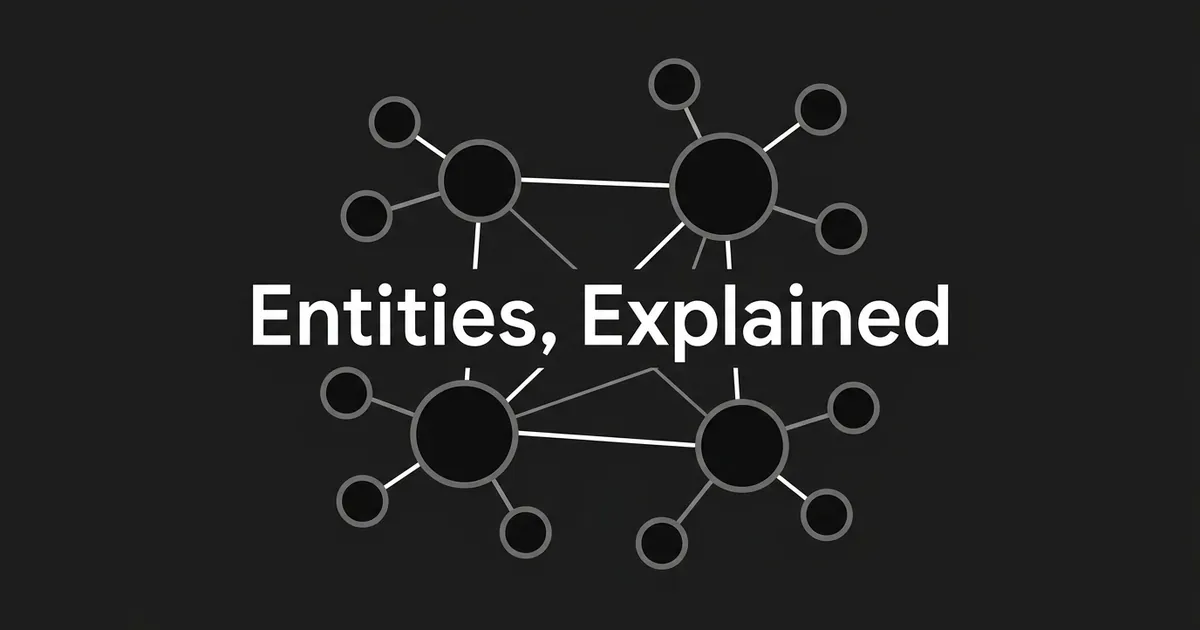
Google's Knowledge Graph is a system for organizing facts about entities and the relationships between them. It is not a list of keywords, and it is not the same thing as a knowledge panel. The panel is a feature in Search that pulls from the graph; the graph is the underlying structure that holds the facts.
Google launched the Knowledge Graph on May 16, 2012, under the phrase "things, not strings." The idea was to stop treating a search as just a sequence of characters and start recognizing the real-world thing those characters point to. At launch, Google said the graph held more than 500 million objects and more than 3.5 billion facts and relationships between them. By 2020, Google's Danny Sullivan put the number at over 500 billion facts about 5 billion entities. Those are useful for understanding scale, but treat them as historical snapshots, not a current count, since Google has not published an updated figure.
Google's own explanation describes the graph as a database of billions of facts about people, places, and things, and it gives examples like how tall the Eiffel Tower is or where the 2016 Olympics were held. The information comes from several places: public sources that compile facts, information shared across the web, licensed databases, data partners for things like sports scores and movies, and corrections submitted by the people or organizations the facts are about. The 2012 launch named Freebase, Wikipedia, and the CIA World Factbook as public sources used at that time, though Google has not published an updated source list since.
Here is the distinction worth holding onto for the rest of this piece: an entity is the actual thing, a name is just the text used to refer to it. Cornell University and Cornell are two names for one entity. The word "Sun" could mean the star, a company, or a fictional character. The graph's job is sorting that out.
How does Google match a query to the right entity?
Names are ambiguous, so Google uses context to figure out which thing a search is actually about. This is how Google matches entities, and it is a separate step from simply matching the words someone typed.
Google's 2012 launch used "Taj Mahal" to make this point. That name could mean the monument, the musician, a casino once referenced in Atlantic City, or a restaurant. A page full of the words "Taj Mahal" does not automatically answer the right question if it is talking about the wrong one of those things.
Researchers who study this problem, including the entity linking survey by Wei Shen, Jianyong Wang, and Jiawei Han, break it into two related tasks. Named entity recognition finds where a name appears in text and marks its boundaries. Entity linking then maps that name to the specific entry in a knowledge base it refers to. The survey calls out the same two problems Google's own example shows: one entity can have several names (Cornell University and Cornell, New York City and the Big Apple), and one name can point to several entities (the Sun as a star versus a company versus a character).
Context does the disambiguating. "Taj Mahal concert tickets" points toward the musician because concert language rules out the monument. "Taj Mahal architecture" does the opposite. A company called Acme that makes robots and a dental practice that also calls itself Acme need more than a shared name to tell them apart, which is exactly where a clear description of what each business actually does earns its keep. This is how Google matches entities in practice: not by the name alone, but by everything around it that narrows down which thing is actually meant.
It does not stop once Google figures out which entity you mean, either. Two people can search the exact same company name while wanting completely different things: one wants support documentation, the other wants its founding history. Getting the entity right is step one. Matching the right page to the right question about that entity is a separate job, and it is the one your content actually has to do.
How does the Knowledge Graph affect search rankings?
This is the question most SEO advice gets wrong, so the answer deserves to be precise: entity understanding helps Google figure out what a page or query is about, which supports relevance, but public evidence does not show an automatic ranking boost tied to graph membership. Treating entity recognition as a ranking factor with a hidden score is not supported by anything Google has said.
It helps to keep three separate effects apart instead of blurring them into one idea:
| Effect | What it actually means | What gets claimed instead |
|---|---|---|
| Better matching | Google understands which subject a page or query concerns | That every entity-related change raises rankings |
| Factual presentation | Google shows a fact box or entity snapshot | That the snapshot proves the page ranks higher |
| Organic ordering | One page outranks another for a given search | That graph membership itself causes this |
Entity work mostly lives in that first row. It helps Google interpret the content correctly. It does not hand you the second or third row for free.
The Knowledge Graph is also not the whole story on how Google interprets meaning. Google's documented ranking systems include BERT, which helps understand how combinations of words change meaning and intent, RankBrain, which connects words to concepts so relevant content can surface without exact keyword matches, and neural matching, which links concepts in a query to concepts in a page even when the wording is loose. None of these are the Knowledge Graph wearing a different name, and nothing in Google's public documentation says every semantic match has to pass through a graph entry first. That is also a different system from how a large language model is trained to decide which brands to cite in a generated answer, which runs through its own separate recognition and matching process outside classic Search.
Keyword matching has not disappeared either. Google still describes matching the words in a query as a basic relevance signal, alongside its ability to understand synonyms and related meaning. The honest framing is not entities replacing keywords. It is literal wording plus context working together, which is the core idea behind semantic SEO more broadly.
The clearest statement on this comes from John Mueller at Google. In reporting from November 2019, Mueller explained that Google uses structured data to understand entities on a page and figure out where that page is relevant, but he was explicit that technically correct implementation does not make a page inherently better, does not mean Google will show it to more people, and does not mean it will rank higher. A more recent report from April 2025 has Mueller saying plainly that structured data won't make your site rank better, tying its real value to specific Search features instead of a general ranking lift. Whether traditional SEO fundamentals still matter in an AI-search world is a fair question on its own, and entity clarity is one of the fundamentals that clearly does.
So is entity recognition a ranking factor in the way people usually mean that phrase, a named, weighted input Google scores your page on? No. People searching "entity recognition ranking factor" are usually trying to settle exactly that question, and the honest answer sits in between a flat yes and a flat no. There is no published entity-recognition score and no disclosed density of entity mentions you need to hit. What Google has confirmed is narrower and more useful: entity understanding supports relevance by helping Google figure out what something is about. A yes-or-no answer to "entity recognition ranking factor" misses that distinction, and so does any advice built on treating it as one.
What can structured data actually change?
Structured data can make an organization's identity clearer to Google and support specific Search features. It does not force your way into the Knowledge Graph, and it does not guarantee a ranking increase.
Organization markup is the clearest documented example. Google says this kind of structured data helps it understand an organization's administrative details and disambiguate that organization from others with a similar name. Some properties work behind the scenes for disambiguation, business identifiers, and classification. Others can affect what you actually see, like which logo shows up next to a brand in Search or a panel.
A few properties are worth knowing. The name property states what the organization is called, though a name alone often will not distinguish two similarly named businesses. alternateName captures other names or variations the organization genuinely goes by, not a dumping ground for unrelated keywords. url helps uniquely identify which website belongs to the organization. sameAs points to other pages describing the same organization, such as a verified social profile, and Google allows several of these, but it is identifying information, not a documented way to borrow authority from whatever you link.
Google recommends putting this information on the homepage or a dedicated page like an About page, not repeated everywhere. There are no required properties for this type of markup; Google's guidance is to include what is relevant and use the most specific subtype that applies. That specific rule does not carry over to every structured data type, several of which do have required fields for their own Search features.
A general fact worth knowing if your team is implementing this: Google supports JSON-LD, Microdata, and RDFa, and recommends JSON-LD. Markup has to truthfully represent what is actually on the page. Google explicitly warns against markup that is irrelevant, misleading, or impersonates something it is not, and a structured data manual action for that kind of violation removes a page's eligibility for rich results without, by Google's own account, directly touching its web ranking.
Whatever format you use, remember what markup is and is not. It is information you are handing to Google, not an instruction Google is obligated to follow. Passing a validation tool does not promise that any feature will display. The evidence on whether schema markup improves AI citations tells a similar story: it helps clarity, not any guaranteed outcome. Schema will not repair a page that does not actually answer the question a reader came with.
What does a knowledge panel prove?
A knowledge panel shows Google's chosen snapshot of an entity for a particular search. It is not proof of ownership, endorsement, or a ranking advantage for the associated website.
Google describes panels as automatically generated boxes built from the Knowledge Graph, pulling information from multiple sources on the web and, for some subjects, authoritative data partners or verified representatives. A panel appears when Google's systems decide there is enough information available and that a panel is the right answer for that query, and it can stop showing later. Google itself notes that someone may have seen a panel before that is no longer there. None of that is evidence that the underlying information about the entity got deleted; display and underlying knowledge are not the same thing.
A person or organization can claim their panel and suggest corrections. Verified feedback can get priority, but Google still reviews it against other public information before accepting a change. Claiming a panel is a way to participate in keeping it accurate. It is not editorial control over everything Google chooses to show, and it is not a ranking lever.
One distinction worth being precise about: a knowledge panel and a Google Business Profile look similar but are not interchangeable. Business Profiles concern a business serving customers at a specific location or service area. A general knowledge panel about a brand is a different thing entirely, and managing one does not substitute for the other.
If you have ever used Google's Knowledge Graph Search API to look up an entity, keep its resultScore in context too. That score reflects how well a result matches the specific search request you made, not a measure of your brand's authority, trustworthiness, or likelihood of getting a panel. One failed lookup through that interface does not mean Google has no information about you; it means that particular query did not return a match.
What should marketing teams do differently?
Make your organization's identity and each page's purpose unambiguous, then back that clarity up with accurate structured data where it applies. That is the real takeaway buried under most of the advice on this topic, and it is worth sitting with instead of rushing past.
| What to do | What it actually fixes | What it does not guarantee |
|---|---|---|
| State clearly what the organization is and does | Reduces confusion with similarly named organizations | A rankings increase |
| Keep facts consistent across your site and profiles | Makes the public record about you less contradictory | A published consistency score |
| Separate the organization, its people, and its products in your content | Avoids collapsing distinct entities into one vague description | An automatic entity count win |
| Use relevant Organization structured data | Gives Google documented disambiguating information | A panel or position improvement |
| Make the page genuinely answer the question | Matches content to intent, not just identity | A substitute for helpful content |
| Correct real errors in a panel with evidence | Improves accuracy when Google accepts the change | A ranking benefit |
This sits close to the kind of trust work covered under AI search's version of E-E-A-T too: consistent, accurate information is what both systems reward, even where the two frameworks are not identical.
A good example looks like an About page that clearly states what the business does, distinguishes it from similarly named organizations, and backs that up with markup describing the same entity, consistently. A bad example repeats the brand name alongside a wall of industry terms, never says what the company actually does, and attaches unrelated well-known organizations through markup as if sharing a mention made them identity equivalents.
If you are putting together a Google Knowledge Graph SEO checklist for your team, this is the part worth leading with, not markup syntax or panel-claiming steps.
It also helps to separate what you are actually measuring. Identity accuracy, whether Google's representation of you is correct, is a different question from matching relevance, whether your pages show up for searches that fit their actual subject. Presentation, whether a panel or logo appears, is yet another. And organic performance, whether your visibility or traffic actually moved, is a fourth. Collapsing all four into one "entity score" in your head is where most of the frustration with this topic comes from. If your traffic changes after you clean up your entity signals, that is useful observational evidence, but query mix, competing pages, and plenty of other factors move at the same time, so hold that correlation loosely rather than calling it proof.
Before you brief your team on more markup or another round of entity-focused content, ask a simpler question first: can a reader, or Google, tell exactly what your organization is, what distinguishes it from anything with a similar name, and what each page of yours is actually trying to answer? That question does more for you than any entity density target someone suggested in a tool.