Someone on your team asked what is structured data, and you realized you couldn't answer it cleanly. That's normal. The term gets thrown around in SEO tickets and AEO decks as if everyone already agreed on it, and almost nobody stops to define it.
Here's the good news: this is a small concept wearing a big coat. You can hold the whole thing in your head by the end of this page.
So let's do that. No code to copy, no plugin to install, no decisions to make today. Just a clear picture of what structured data is, how engines actually use it, and why structured data for AI search became the thing your competitors keep bringing up.
One page at a time. Let's start with the definition.
What Is Structured Data, in Plain English?
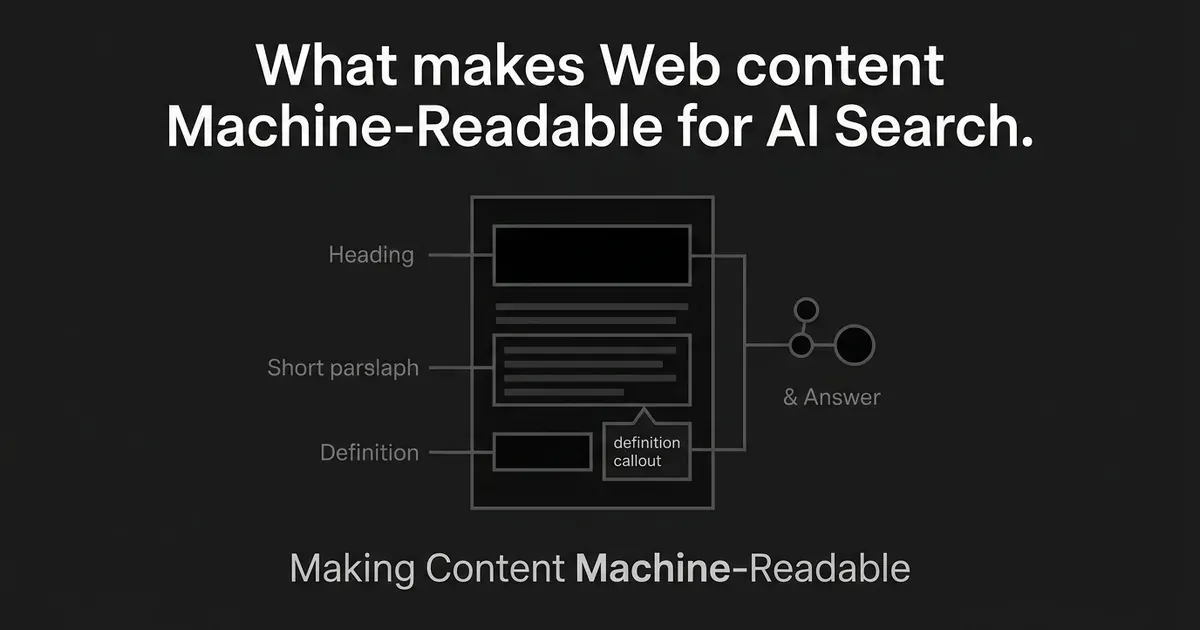
Structured data is a machine-readable label layer on your page that tells software what your content means instead of making it guess.
That's it. That's the idea.
Think about how a person reads your pricing page. They see "$99" sitting under a heading, and they instantly know it's a price, in dollars, for the plan named above it. They know because they have context, eyes, and years of looking at pricing pages.
A machine has none of that. It sees a string of characters. It sees $99 and has to infer, from surrounding text and layout, that this is probably a price and probably belongs to that plan. Usually it infers correctly. Sometimes it doesn't.
Structured data removes the guessing. It lets you attach an invisible tag that says: this is a Product, its name is this, its price is 99, its currency is USD, it's in stock.
Google's own framing is worth keeping, because it's the most precise short version out there. Structured data is a standardized format for providing information about a page and classifying the page content.
Two words in there are doing the heavy lifting.
Standardized means you don't invent the labels. Everyone uses the same dictionary, so the engine already knows what your tags mean before it arrives.
Classifying means you're not adding new information for humans. You're sorting information that's already visible on the page into named boxes.
That's the whole structured data meaning in one sentence: you're not writing anything new, you're labeling what's already there so machines stop guessing.
Feeling better already? Good. The next part is the piece most people skip.
What Is Schema Markup, and How Is It Different?
Schema markup is structured data written in the Schema.org vocabulary. Structured data is the concept. Schema markup is the concept done in the language everyone agreed to use.
If that distinction feels like hair-splitting, stay with me for a moment, because it explains why any of this works at all.
Back in 2011, this was a mess. If you wanted to label your content, you had to pick between competing metadata vocabularies, and different search engines understood different ones. You could mark up your site for one engine and be invisible to another.
On June 2, 2011, Google, Bing, and Yahoo did something unusual. They launched Schema.org together, a single shared vocabulary, so you'd never have to choose sides again. Yandex joined later. Stewardship moved to a W3C community group in April 2015, and it's been maintained as an open collaborative project since.
So the question of what is schema markup has a tidy answer: it's the shared dictionary those engines all speak.
And it's a big dictionary. Schema.org now defines roughly 800 types and more than 1,500 properties. Types are the nouns: Product, Article, Person, Event, Recipe, Organization, JobPosting. Properties are the details each noun can carry: a Product has a price, an Article has an author, an Event has a start date.
You'll never touch most of it. A handful of types cover almost everything a normal business publishes.
- Organization or LocalBusiness declares who you are, and feeds how engines understand your brand as an entity.
- Article, NewsArticle, or BlogPosting declares editorial content.
- Product with Offer and aggregateRating declares what you sell, for how much, and how it's rated.
- BreadcrumbList declares where a page sits in your site's hierarchy.
- Person declares a human, like an author or an executive.
- FAQPage declares question-and-answer pairs.
Recognize any of those? You should. They map almost exactly to the page types you already publish.
Here's the reassuring part. This isn't a frontier tactic anymore. Schema.org's own 2024 disclosures put adoption at more than 45 million domains, exposing over 450 billion Schema.org objects. Roughly 40% of all websites use some form of structured data. You're not early. You're not pioneering. You're catching up to a settled default, which is a much easier thing to do.
Schema Markup Explained: How It Reaches an Engine
Your markup has to physically live somewhere on the page. There are three ways it can, and knowing they exist matters more than knowing which to pick.
JSON-LD puts the markup in its own script block, separate from your visible HTML. Your content stays untouched. The labels sit in a tidy JSON object off to the side. Google recommends this one, and the web agreed: W3Techs measures JSON-LD on roughly 54.5% of all websites it crawls, and among sites using any structured data at all, it accounts for over 80% of adoption.
Microdata weaves the labels directly into your HTML tags as attributes. It works. It's valid. It's also harder to maintain, because your data and your markup are tangled together.
RDFa does something similar with a different set of attributes. You'll see it more in academic and publishing contexts than in commercial marketing.
That's schema markup explained at the delivery level. All three say the same things in the same vocabulary. They just differ in where the words sit.
Which one belongs on your site is a real question, and it's not one you have to answer right now. What you need today is simply this: the vocabulary is separate from the syntax. Schema.org is what you say. JSON-LD, Microdata, and RDFa are how you say it.
One more distinction, because it's the one that trips up almost every marketing team.
Structured data, schema markup, and rich results are three different things.
- Structured data is the broad concept of machine-readable labeling.
- Schema markup is that concept expressed in Schema.org's vocabulary.
- Rich results are the enhanced search displays you sometimes get afterward: star ratings, prices, breadcrumbs, recipe cards.
Read that order again. Rich results come last, and they're a maybe. A page can carry perfect schema markup and never earn a rich result, because the engine is never obligated to show one. But you can't earn a rich result without valid markup underneath it.
Mixing these three up is why people say "we added schema and nothing happened." Something did happen. It just wasn't the thing they were watching for.
What Actually Happens After You Add It
You add markup. Then what? Here's the pipeline, in five plain steps.
1. Crawl. A crawler fetches your page and reads the HTML. Googlebot, Bingbot, and the newer AI crawlers all do this.
2. Parse. The parser spots your structured data block, pulls out the JSON, and checks the vocabulary against what that engine actually supports.
3. Map to entities. This is the interesting step. Your values get normalized into entity-attribute pairs, roughly: "this page describes a Product, its name is X, its price is Y, its rating is Z." Those pairs get matched against the engine's knowledge graph.
4. Decide eligibility. The engine weighs policy compliance, content quality, and its usual ranking signals, then decides whether your page can be considered for a rich result. Google's documentation lists around 30 supported rich result features, covering things like Articles, Events, Products, Recipes, Videos, and Job Postings.
5. Feed AI systems. When an AI retrieval pipeline ingests your page, those structured fields can be lifted straight into the model's context or matched against a structured query.
Notice what's missing from that list? A ranking boost. It isn't there, and it isn't supposed to be.
You're not pushing your page up. You're handing the system a higher-fidelity map of what your page says. That map widens the set of formats and answer types your page can be selected for. Different lever, different outcome.
Why Structured Data for AI Search Changes the Stakes
For a decade, structured data was mostly a rich-results play. Add markup, maybe get stars, maybe get a better click-through rate. Nice to have.
AI search moved it from cosmetic to structural. Here's why.
AI answer experiences run on retrieval. AI Overviews, AI Mode, ChatGPT with browsing, Perplexity, Gemini with grounding, Claude with web tools: they all pull candidate pages, feed pieces of them to a language model, and let the model compose an answer. Your page isn't being displayed. It's being read, summarized, and maybe credited.
That shift makes machine comprehension the whole ballgame. Four things follow from it.
Your entities stop being ambiguous
Engines run on entity graphs, not keywords. So when your page says "Apple," the system has to work out whether you mean the company, the fruit, or someone's surname.
Schema markup lets you just say it. Declare the type as Organization and there's nothing left to infer.
This sounds small. It isn't. Being understood is the price of admission for being cited. A page the system can't confidently place doesn't get argued with. It gets quietly dropped.
Your facts get retrieved with confidence
A retrieval system that encounters a clean, typed fact treats it differently than a sentence it has to interpret. Price 99, currency USD, availability InStock is unambiguous. "Plans start around a hundred bucks" is not.
When the model composes its answer, it leans toward the value it's confident in, and it's likelier to credit where that value came from. Industry research has found that pages carrying structured data see meaningfully better citation rates. The direction of that finding is what matters here.
Your content becomes better grounding material
Grounding is the practice of making a model answer only from retrieved evidence rather than from memory. It works best when the evidence arrives structured.
There's a mechanical reason. Retrieval pipelines chunk pages into pieces, then embed each piece as a vector. Structured fields chunk beautifully, because each one is already an atomic fact. They also embed cleanly, because they carry none of the ambiguity that natural language does. At query time, typed attributes make it possible to filter and boost by the attribute itself.
Then the model generates. Attribute names map almost directly onto answer slots. "The price is $X" lines up with offers.price with nothing lost in between.
Your numbers get misquoted less often
This one gets overlooked, and it might be the most practical benefit on the list.
Even when an AI system doesn't cite you, structured facts constrain how it paraphrases you. If your price or your date or your rating is a typed value rather than a sentence, the model has far less room to get it wrong.
Every marketer worries about AI hallucinating about their brand. Typed values are one of the few things you actually control that narrows that surface.
Put those four together and the summary is simple. Schema markup is one of the few on-page signals you control that directly improves how an AI system reads, understands, and cites your page. It's not magic. It guarantees nothing. It raises the floor on accuracy and the ceiling on selection.
The Honest Caveats
You deserve the limits alongside the promise. False comfort helps nobody.
It's not a ranking factor. Google has said this consistently. Structured data isn't a direct general ranking signal for web search. It's an eligibility signal for enhanced presentation and a clarity signal for entity understanding. Anyone selling you schema as a rankings lever is selling you something else.
Eligibility isn't a guarantee. Perfect markup, and the engine still might not show a rich result for a given query or page. That's the deal.
It has to describe what's actually visible. Marking up content users can't see violates Google's structured data spam policies. The markup describes the page. It doesn't extend it.
It has to be true. Wrong prices, invented ratings, misleading availability: that path leads to manual actions or a quiet demotion in feature eligibility. Accuracy isn't optional here.
FAQ and HowTo rich results are largely gone. In August 2023, Google limited FAQ rich results to well-known government and health-authority sites. HowTo rich results left desktop search in 2023 and continue on mobile. Then in May 2026, Google formally deprecated the FAQ rich-result feature entirely. The markup still validates, and it still has value for AI ingestion and content clarity. It just won't produce an FAQ accordion on Google for a typical commercial site. If someone pitched FAQ schema to you as a quick rich-results win, that window has closed.
Invalid markup counts as no markup. There's no partial credit. Google's Rich Results Test and Schema.org's Validator exist for this reason.
It has to survive rendering. Because JSON-LD is injected as a script block, it needs to be in the server-rendered HTML or in JavaScript that actually executes. Markup that only appears after a user interacts may never be seen.
Coverage across AI engines is uneven. The major engines read schema. Smaller AI crawlers may not honor it, and some fall back on plain HTML tables and lists as structural cues instead.
None of these are reasons to skip structured data. They're reasons to hold accurate expectations, which is what separates a team that gets value from this from a team that gets frustrated by it.
Where This Leaves You
Let's land the throughline.
Structured data is the machine-readable layer that tells engines and AI what each part of your page means. It uses Schema.org, the vocabulary Google, Bing, and Yahoo agreed on back in 2011. It's most often delivered as JSON-LD. It won't lift your rankings, and it will make you legible to systems that increasingly answer your buyers' questions before your website ever gets a click.
Ten years ago, being readable by machines was a bonus. Now it's the mechanism by which you get quoted at all.
Here's what's genuinely encouraging: you've just done the hard part. The concept was the barrier, not the execution. Implementation is mostly mechanical once the mental model is in place, and 45 million domains got there before you.
Notice that this only works if the markup ships on every page, not on the three you remembered. That's an operations problem more than a technical one, and it's exactly where content programs tend to leak. It's also why DeepSmith builds schema markup, heading structure, internal linking, and metadata into the writing pipeline itself rather than leaving them as a cleanup task after the draft exists. Structure that's part of production doesn't get skipped when the week gets busy.
You don't need to fix everything this month. Pick your most important page type. Get that one right. Momentum matters more than perfection here.
Want to see how your content is actually being read by AI engines today? Start a free DeepSmith trial and find out where you're showing up and where you're not.