You typed your brand name into ChatGPT, watched it cite a competitor instead, and felt that quiet drop in your stomach. That is normal. It does not mean your brand is worse. It usually means the model could not confidently connect your name to your topic.
Here is the good news. This is a mechanic, not a mystery. Before an answer engine ever cites anyone, it runs a quick, invisible process: it reads a name, decides which specific thing that name refers to, and links that thing to the topic in the question. The entity recognition AI search engines run happens in a fraction of a second, and it decides who is even eligible to be cited.
By the end of this piece you will understand that whole path. You will see how a model turns a string of letters into a known entity, how it matches that entity to a topic, and what makes it confident enough to name your brand as the authority. We are not covering how to build authority step by step, or how to mark up your pages with schema. Those are their own projects. Today is about the mechanic underneath all of them.
What an "entity" actually means to an answer engine
An entity is a specific, real-world thing the model can identify and reason about: a company, a person, a product, a place, a concept. Your brand name is just text until the model resolves it into an entity.
That distinction matters more than it sounds. The word "Salesforce" is nine characters. The entity Salesforce is a company founded in a specific year, headquartered in a specific place, in a specific category, connected to specific people and products. When a model can map your name to a rich, stable entity like that, it can trust itself to talk about you. When it cannot, it either stays vague or reaches for a brand it does understand.
So the real question behind AI visibility is not "does the model know my name?" It is "can the model resolve my name into one clear, well-connected entity?" That resolution is the quiet heart of entity recognition AI search relies on, and everything else follows from it.
Think of it as a four-step pipeline the model walks every time. First, it recognizes your name as a specific entity. Second, it resolves that entity to a stable identity it can look up. Third, it finds several sources that agree about that entity. Fourth, it pulls one clean sentence from those sources to answer the question. Anything that strengthens one of those steps improves your odds of being cited. Anything that weakens one lowers them.
Let's walk each step.
The two recognition systems running inside every model
Before we get to matching, you need to know that a model recognizes entities in two very different ways. Most brands only think about one of them.
The first is parametric memory. During training, the model reads enormous amounts of text (encyclopedias, news, forums, review sites, public filings) and compresses a statistical map of the world into its weights. Brands that showed up a lot in that data exist inside the model as strong patterns. Mention a well-covered brand and the model instantly "knows" its category, its founders, its home city, because it saw those words together thousands of times.
This is powerful and also fragile. Coverage is uneven, so a brand with a thin footprint may barely exist in the model's memory. Training has a cutoff, so anything recent is missing. And when memory is the only signal, the model can sound confident while quietly inventing facts.
The second system is live retrieval. For grounded answers, the model rewrites your question into search queries, hits an index, pulls back candidate pages, and builds its answer from those pages. This is the path that produces real, clickable citations. The retrieval-augmented generation pipeline is where being cited actually happens, because the model is pointing at a source it just read.
Real products blend both modes, with different weights. ChatGPT answers many questions from memory and switches to Bing-powered retrieval for others. Perplexity is retrieval-first by design. Gemini leans on memory by default and can ground its answers with Google Search when asked. That blend is why the same question can produce different citations on different engines. Each one mixes memory and retrieval its own way, from its own pool of sources.
For you, the takeaway is simple. If you only live in the model's memory, you are at the mercy of whatever it happened to absorb. If you are also strong in the retrieval index, you get a second, fresher, more controllable path to the citation.
How AI matches brand entities to a topic
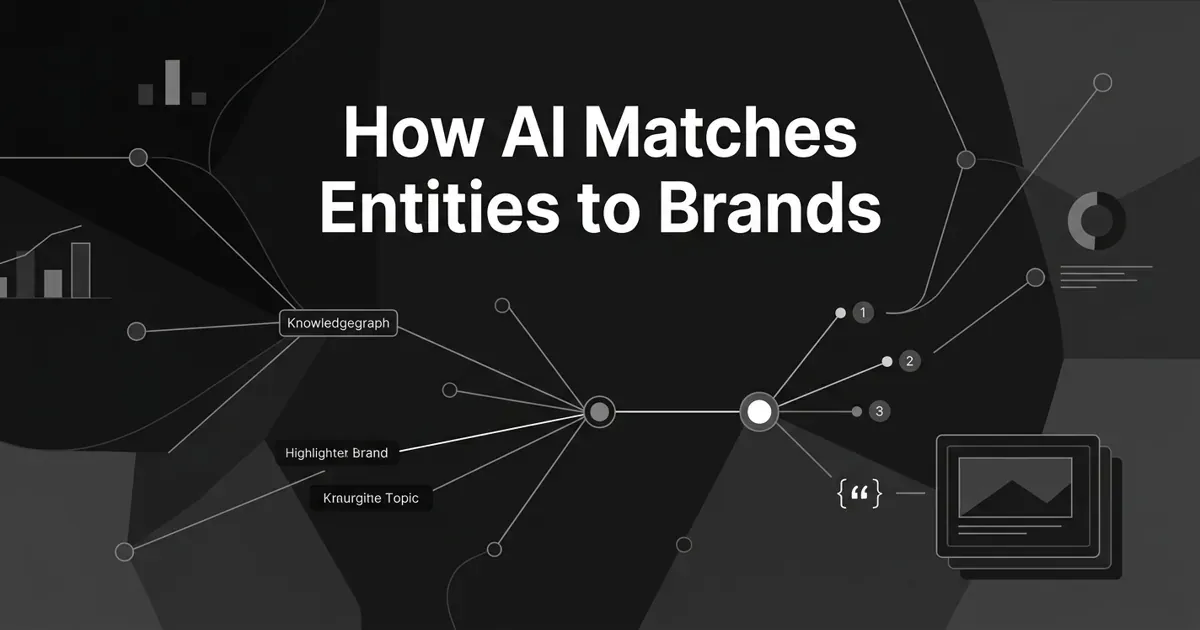
Here is where the pipeline gets specific. Matching a name to an entity is three moves stacked together, and understanding how AI matches brand entities is understanding these three moves.
The first move is recognition. The model reads your text and tags the spans that are entities: this is an organization, this is a person, this is a product. Older systems used a narrow classifier trained on a few labeled types. Modern models do this generatively, using their world knowledge to spot entities they were never explicitly trained on, including new and rare ones. On standard tests they now match or beat the specialized tools, and they pull ahead on tricky cases like nested names.
The second move is linking. A recognized span still has to be tied to one specific identity. "Jaguar" could be the animal, the car, the sports team, or an old operating system. Entity linking picks the right one, usually by matching to a canonical record like a Wikipedia page or a knowledge base entry. The model generates candidates that share the name, then scores each by how well it fits the surrounding context and how it coheres with the other entities nearby.
The third move is disambiguation, and this is where many brands quietly lose. The model scores each candidate on context fit, on prior popularity, and on coherence with everything else in the passage. Popularity is the trap. When two entities share a name, the model defaults to the famous one. Research on using knowledge-graph hierarchies to guide this step (published as an entity disambiguation study) found that giving the model a coarse-to-fine type map, like Person to Athlete to Tennis Player, lets it reject wrong candidates early and resolve names far more accurately. The lesson for you is that clear category signals around your name do real work.
Get these three moves working in your favor and entity recognition AI search starts pointing at you instead of past you. That is how AI matches brand entities under the hood: recognize the span, link it to an identity, disambiguate to the right one. When your name is common, thinly covered, or brand-new, any of these three can break, and the entity matching LLM citation systems reward simply never gets a clean handle on you.
Knowledge graphs: the structured backbone
Behind the linking step sits a structure most marketers never see: the knowledge graph. It is a giant web of typed facts stored as connections. Company X was founded in year Y. Person Z founded Company X. Product P is made by Company X.
These graphs are huge and load-bearing. Google's Knowledge Graph reportedly holds around 500 million entities and roughly 5 billion facts, and it is the layer behind knowledge panels, AI Overviews, and Gemini grounding, as Ahrefs details in its knowledge graph explainer. Wikidata holds roughly 110 million open-licensed items and is the structured backbone under Wikipedia. When a model needs to confirm who you are, these are the records it leans on.
Models use knowledge graphs in a few ways. Sometimes the facts get turned into sentences and folded into training. Sometimes relevant facts are pulled in at answer time to ground a response. Sometimes a draft answer is checked against the graph and corrected. One 2025 benchmark found that grounding answers in a knowledge graph cut entity-attribute mistakes by 18 to 34 percentage points versus not grounding at all.
Why does this decide the knowledge graph AI citation question for your brand? Because a company with a well-formed structured record (a clear founding date, headquarters, founders, parent org, products) is dramatically easier to resolve into one stable identity. A brand with no such record and inconsistent descriptions across the web is harder to pin down, and a model that cannot pin you down will not cite you with confidence. Strong knowledge graph AI citation outcomes start with a clean, consistent structured identity.
This is exactly where the schema and structured-data work lives, and it is worth its own effort. If that is your gap, our guide to schema for AI citations picks up where this explainer stops.
Where the citation actually gets chosen
So the model knows who you are. That still is not a citation. The citation is selected inside the retrieval pipeline, and this is the stage you can influence most directly.
The flow runs in steps. Your question becomes one or more search queries. A retriever pulls a few hundred candidate pages using a mix of keyword overlap and meaning-based similarity. A reranker then scores those candidates for how well they answer the specific question and keeps the top handful. The model writes its answer from those, attaching a source to each substantive claim. If you want the full path from question to cited sentence, we walk it in how LLMs select and extract citations.
What does that reranker actually reward? Studies of real systems keep landing on the same signals. Relevance to the exact question carries the most weight. After that: entity density (pages naming more specific things get cited more), authority signals, freshness, and clean structure with named entities near the top. These are the citation signals that determine whether a model cites you, and notice how many of them come back to entities.
The numbers make it concrete. Pages with fifteen or more recognized entities in a passage show roughly 4.8 times higher citation probability than pages with fewer than five, holding the topic steady. On Perplexity, content updated within the last 30 days gets cited about 3.2 times more often than content aged six to twelve months. A quick gut check: if your page can be summarized in one sentence with no proper nouns in it, the retriever will struggle to match it to anything.
Engines weight these signals differently, which is why the entity matching LLM citation behavior shifts platform to platform. Wikipedia alone accounts for nearly 48 percent of ChatGPT's top-cited domains, while Perplexity leans hard on community and video sources, and Google AI Overviews over-weights forums, video, and vertical authorities. If per-engine differences matter to you, we break them down in how citation selection differs across engines. The pattern underneath is constant, though: recognizable entity, corroborated across sources, cleanly extractable.
The entity chain, and where it breaks
Here is the idea that ties it all together, and it is the one to remember. Call it the entity chain: the path a model can walk from your brand out to everything that vouches for it.
Your brand connects to people (founders, executives, quoted experts). Those people connect to concepts (your category, your method, the problem you solve). Concepts connect to publications that established them. All of it connects to platforms: Wikipedia, review sites, forums, video, analyst reports. When every link in that chain is present and agrees, a model can start anywhere and confidently arrive at you. That is a brand that gets cited across every engine.
A brand with no chain is invisible. A brand whose whole footprint is its own website is fragile, because retrieval systems deliberately down-weight single-source signals. Corroboration is the strongest trust signal there is, and one voice is not corroboration.
So where do chains break? A few common places, and each is fixable once you can see it.
Your name might be a common word. If your brand shares a name with something famous, the model resolves to the famous one unless the category is right there beside it. Say "the platform" and you disappear. Say your full name next to your category and you stay yourself.
Your sources might disagree. When your site says you were founded in one year and a public record says another, the model trusts the structured source and may quietly correct you. Consistency across every surface is one of the highest-leverage fixes there is.
Your footprint might be owned-media only. Brands that live entirely on their own domain post the lowest citation rates in large datasets. The chain needs outside links to hold.
If you want to know whether the chain is even reaching you, the fastest move is to ask the engines directly and score what comes back. Our brand knowledge diagnostic gives you a simple rubric for that. Tracking which prompts cite you over time is exactly the feedback loop the AI visibility work is built to run, so you can watch a fix show up in real answers instead of guessing.
Turning the mechanic into your next move
Take a breath. You do not need to fix all of this at once. You need to strengthen one link in the chain at a time, and you now know which links exist.
Start with entity clarity. Use your full, unambiguous name with your category next to it, and keep your basic facts (founding, location, founders, products) identical everywhere they appear. That single act of consistency does more for brand entity AEO than almost anything else, because it makes you resolvable in the first place.
Then build corroboration. One credible third-party source about you is worth more than ten pages on your own site, because the pipeline is built to reward agreement across sources. This is the trust layer, and if you want the full model for it, our AI search trust system lays it out in four layers.
Then sequence the rest. You cannot do everything, so score each signal by impact and effort and work the highest-leverage ones first. Our framework for prioritizing AI search authority gives you a way to sort them. The deeper trust work (experience, expertise, authority, and how those signals get built and audited) lives in our E-E-A-T signals guide, which is the how-to layer this explainer deliberately hands off to.
The whole brand entity AEO picture comes down to one loop. Make your entity clear, get it corroborated, structure it so it is easy to extract, then watch the answers to see what moved. That is the work of a strong brand entity AEO program, and none of it requires a bigger team. It requires a smaller, sharper first step.
If watching those answers is where you want to start, that is what we built DeepSmith to do: track where your brand shows up across AI engines, find the gaps, and produce the on-brand content that closes them. You can start a free trial and see your real citation picture before you change a single page.