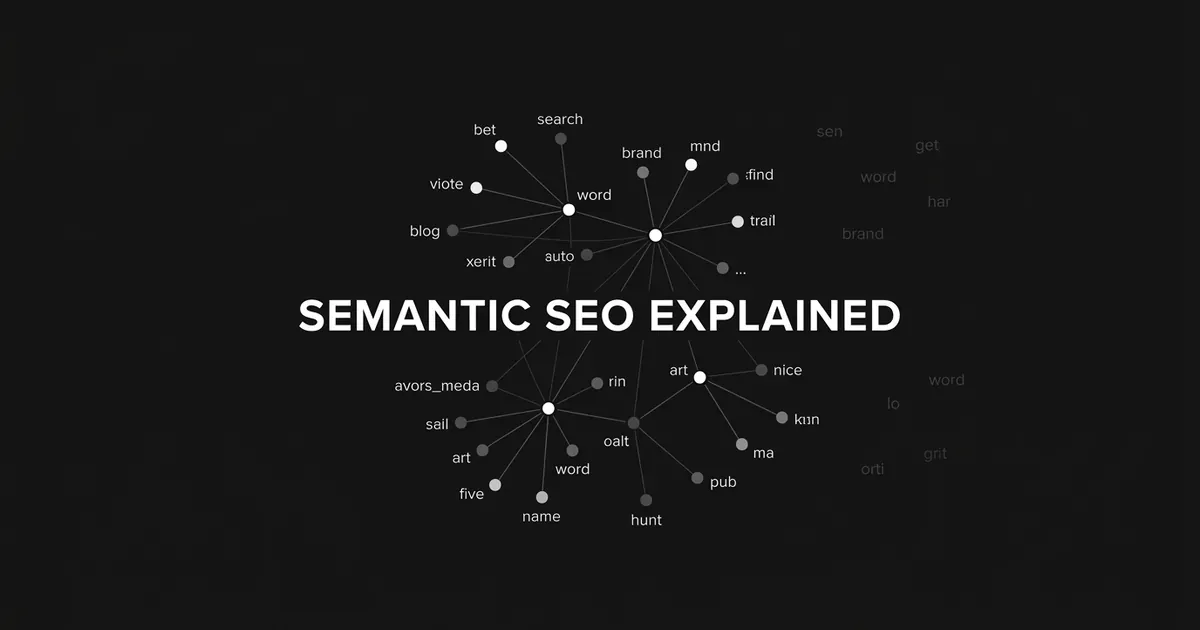
Semantic SEO is the practice of making a page's meaning clear: answering the searcher's real question and naturally covering the terms, related ideas, and identifiable things (people, places, products) that explain the subject. It sits next to keyword optimization rather than replacing it. Keywords tell a search system which words appear on the page. Semantic SEO tells it what the page is actually about and how the pieces relate to each other.
If you have felt unsure what to ask a writer to change in a draft that already has the right keywords but still feels thin, this is the gap semantic SEO fills. Some people search for the same idea as entities SEO, because entities are the part of it that is easiest to point at, but the practice is broader than naming things: it is about the page's meaning as a whole, not a single ingredient. It is not a technique Google publishes under that exact name. It is a working description of how to write so a page's meaning is clear to a reader and legible to the systems that read it too.
What semantic SEO actually is
A page written for semantic SEO answers a specific question, uses the words a reader would actually use, and explains how the ideas inside it connect. Google's own explanation of semantic search defines it as searching for contextual meaning and intent rather than relying only on literal keyword matches. Semantic SEO is the content-side response to that: write so the meaning is unmistakable, not just the wording.
Four ideas do most of the work here, and it helps to keep them separate instead of treating them as the same thing.
A keyword is a word or phrase a searcher types. A synonym or alternate expression is a different way of saying something close to the same idea, useful because an expert and a newcomer often reach for different words. A related concept is a distinct idea you need in order to explain the main subject properly, the way you cannot explain a CRM without also explaining contact records and a sales pipeline. An entity is a specific, identifiable thing being discussed: a named company, product, person, or place. None of these should get inflated into a rule about counts or density. The point of naming them is so you can check a draft against each one, not so you can hit a quota.
How it is different from keyword optimization
Keyword optimization treats the query as a string to match. Semantic SEO treats the query as a question to answer, with the words as one signal among several. Google says this plainly: matching the same words as the query is still one of its most basic relevance signals, and its systems also use language understanding and a synonym system to find relevant pages even when the exact words are not present. Those two statements sit together. Search behavior itself has moved past keywords in a more basic way too, since queries have grown longer and more conversational, and a page written for a single exact phrase can miss how people actually ask now. Exact terms have not stopped mattering, and meaning-matching has not replaced them.
Where the two approaches actually diverge is in what a "good" page looks like while you are writing it. A keyword-first draft repeats the target phrase, labels itself the best option in the category, and stops. A meaning-first draft explains what the thing is, distinguishes it from what it is not, and shows how it relates to the concepts around it. Picture a page answering "what is CRM software." Written for keywords, it repeats "CRM software" a dozen times and calls itself "the best CRM software" without ever explaining what the software does. Written for meaning, it expands the acronym once, then explains how contact records, interactions, leads, and a sales pipeline fit together, and it says plainly when a CRM system is doing something a spreadsheet cannot. That second version still contains the keyword. It just is not built around it.
Google's ranking systems guide gives three examples of the kind of language understanding involved: RankBrain, which relates words to broader concepts; neural matching, which connects the meaning behind a query to the meaning behind a page even when the wording differs; and BERT, which helps interpret how a combination of words changes meaning, including small words that carry a lot of weight. A query like "can you get medicine for someone pharmacy" hinges on the word "for": the question is about picking up medicine for another person, not about the medicine itself. These are useful illustrations of how meaning gets parsed, not instructions to write for a particular algorithm. Whether the older fundamentals still matter is a fair separate question, and the short answer is that most of them do, alongside this newer layer rather than instead of it. No researched source ties RankBrain, neural matching, or BERT to a specific ranking weight for entities or synonyms.
What entities and related concepts add to an explanation
An entity earns its place in an article by being necessary to the explanation, not by being namedropped. If a section explains a category and a specific product is relevant to that explanation, name it accurately and say how it relates to the category. Dropping a brand name into an unrelated list does the opposite of what semantic SEO is for: it adds a string without adding meaning. This is also close to the mechanism behind how LLMs match entities to a brand when deciding what to cite, though that is a more specific question than the one this piece answers.
The same goes for related concepts. A good test is whether removing the concept would make the answer less accurate or less complete. If removing it changes nothing, it was never doing real work in the piece, and adding it back does not improve anything either. Google's own Knowledge Graph writeup describes searching for things, people, and places instead of only strings of characters, and that idea illustrates why a recognizable subject matters more than a string of matching words. It does not mean every named thing on a page needs its own Knowledge Graph entry, and it does not mean naming more entities automatically helps a page perform better. No researched source establishes a ranking benefit tied to how many named things appear in an article.
This is worth separating from a related but different question: how a whole site earns depth on a topic across many pages, sometimes called topical authority. That is a site-level, multi-page question about coverage and internal linking, and we cover it separately. Semantic SEO, in the sense used here, is about one page doing right by its own subject regardless of what else the site covers.
Why search can match meaning without exact wording
Systems built for semantic matching work by comparing meaning rather than only comparing strings. One accessible way to understand how embeddings work is that they turn a piece of text into a vector and let a system compare how close two pieces of meaning are, even when the wording differs. For an explainer like this one, the practical takeaway is simpler: a page does not need to anticipate every phrasing a reader might use, because the systems reading it are already built to bridge some of that gap.
Google's own SEO Starter Guide makes a version of the same point when it tells publishers to anticipate that a knowledgeable reader and a newcomer might use different words for the same thing, using "charcuterie" and "cheese board" as its example. It also says not to worry about anticipating every possible variation. That is a useful boundary: write in language your reader actually uses, including a reasonable alternate expression where it clarifies something, but do not treat the page as incomplete because it is missing a synonym.
This bears on how AI search features behave too, because the underlying mechanism is closely related. Google's own guidance for its generative Search features says established SEO principles remain relevant, explicitly warns against creating separate content for every possible wording, and says its systems can understand synonyms and general meaning even when a page does not contain the exact words a person searched for. It also says publishers do not need to rewrite content in a special way just for generative AI search. The honest limit here matters: a clear, accurate page can reasonably serve readers who phrase a closely related question differently, but that is not the same as a guarantee that better semantic coverage causes an AI Overview, a ChatGPT answer, or any other AI system to cite the page. Citation selection involves more than language coverage, and no researched source ties entity count or semantic-term density to a citation outcome.
What good semantic coverage looks like in one article
A workable test for a finished draft: if you removed every repetition of the target phrase, could a reader still identify the subject, understand the important terms, tell similarly named things apart, and get the answer they came looking for? If the answer is no, the fix is to add the explanation that is missing, not to add more related words around the gap.
A few concrete checks follow from that test. State the reader's question precisely before you write a word, because a page can use all the right terms and still answer the wrong question. Use the ordinary name for the subject, expand an acronym once where it helps, and reach for an alternate expression only when it genuinely clarifies something rather than just adding variety. Explain the relationships that matter: what a named product actually is, what an entity refers to, how one concept differs from another one that sounds similar. Simply having two ideas in the same paragraph does not tell the reader how they connect; you have to say it. Include an adjacent concept only when removing it would make the page worse, not because a competitor's page happens to mention it. Read the draft aloud and notice where a phrase repeats in a way no person would actually talk; Google's own spam policy defines keyword stuffing as filling a page with keywords in an attempt to manipulate rankings, and it does not define an ideal density to aim for instead.
Once a page is live, checking how different search intent types should shape the way you structure content is a useful next step, because a page can nail the language of a subject and still miss what the searcher actually wanted from it. Search Console's performance report is the other half of this check: it shows which queries a page actually earns clicks and impressions for, which is often the fastest way to see where the page's language and a reader's actual phrasing are not lining up yet.
What good looks like in practice: a newcomer could read the piece and explain the subject back to you, tell the important terms apart, and see why each named thing belongs in the answer. What bad looks like: a repeated target phrase standing in for an explanation, a list of named entities with no stated relationship between them, or a page that sounds broad without ever resolving the question the reader actually came with.
What semantic SEO does not guarantee
Semantic SEO is not a formula, and treating it like one tends to produce the exact page it is meant to prevent. A few claims are worth naming and rejecting directly, because each one shows up often enough to sound settled.
"Keywords are dead" is not accurate. Literal matches between a page and a query remain one of Google's most basic relevance signals, alongside the meaning-matching systems that work beyond exact words. "Add every synonym you can find" is not the goal either; different expressions can imply different products or audiences, so a variant earns its place by helping the reader, not by rounding out a list. "Mentioning more entities signals more authority" is not established by anything in Google's own documentation; the Knowledge Graph describes how identifiable things get organized, not a scoring bonus for naming more of them. "A semantic content score proves the page will perform" overstates what a drafting tool can tell you; a score can be a useful editing aid, but no official Google source defines a semantic score or a passing threshold to hit. If your own brand is the entity in question rather than a concept on the page, the more specific task of working to establish your brand as an entity AI engines recognize is a related but separate project from what this piece covers.
None of this makes semantic SEO less worth doing. It just means the payoff is a clearer, more accurate page, which is a real outcome on its own, not a guaranteed multiplier on rankings or AI citations. Depth means explaining what is genuinely relevant, correctly. It does not mean maximizing how many related terms and named things you can fit onto the page, and a page stuffed with tangential entities is often harder to read than one that stayed narrow and got the explanation right. This piece stays with language and meaning inside a single page; the separate, machine-readable layer of structured data is worth its own read if markup is what you are actually trying to fix.
If your published articles were written keyword-first and have never had this kind of pass, that is usually a faster fix than a rewrite: reread the piece with the test above and see whether the explanation actually holds up once you strip the repetition away.