If you have ever written a page that uses your target keyword several times and still watched it sit on page two, you have run into the gap between a keyword match and an actual answer. How Google determines relevance is not a word count problem. Google looks at what the query means, what the page actually says, and the context around the search, then layers quality and usability on top before anything ranks. There is no public formula that turns a similarity score into a position. What Google has published is a model you can use, and this piece walks through it so the next time someone hands you a term-weighting debate about TF-IDF or LSI, you have something solid to measure it against.
What relevance actually means in Google Search
Relevance is how well a result fits a particular search, not how often it repeats the words in that search. Google treats a query as evidence of what someone wants, not a full statement of the task. Two people can type the same four words and want different things from the page that answers them.
It helps to hold two questions apart. Is this page relevant to the search, meaning does it fit the subject, the intent, and the context? And is this page indexed, meaning has Google found it, analyzed it, and stored it so it is even eligible to show up? Being indexed does not mean a page will appear for a particular query, and appearing in a search does not mean the page beat every competing consideration. Relevance is one input Google weighs. It is not the final ranking, and it is not the same thing as authority or factual accuracy either, both of which matter but answer a different question.
Google also describes its ranking systems as working mostly at the page level, while still drawing on site-wide signals and even individual passages within a page. A strong site does not drag every page up with it, and a weak site does not sink every page either. This matters for query processing SEO work because it means the fix for one underperforming page usually lives on that page, not in some abstract site score you cannot touch directly.
Why exact keywords are only part of the match
Shared words are a real relevance signal. Google says so directly, and it names headings and body text as places those words carry weight. Its Search Essentials guidance recommends using the words people actually search for, placed in the title, the main heading, and other descriptive spots like alt text and link text. None of that is secret. The part people miss is what happens after the words are there.
Google's own example makes the limit clear: a page that repeats the word "dogs" hundreds of times is not what most people searching "dogs" actually want. They might want pictures, a breed list, or training advice. Repetition signals that a page concerns the subject. It says nothing about whether the page is useful once someone gets there. That gap between mentioning a topic and answering the need behind it is the whole reason similarity scoring search tools exist, and also the whole reason they can mislead you if you treat their number as the goal instead of a proxy.
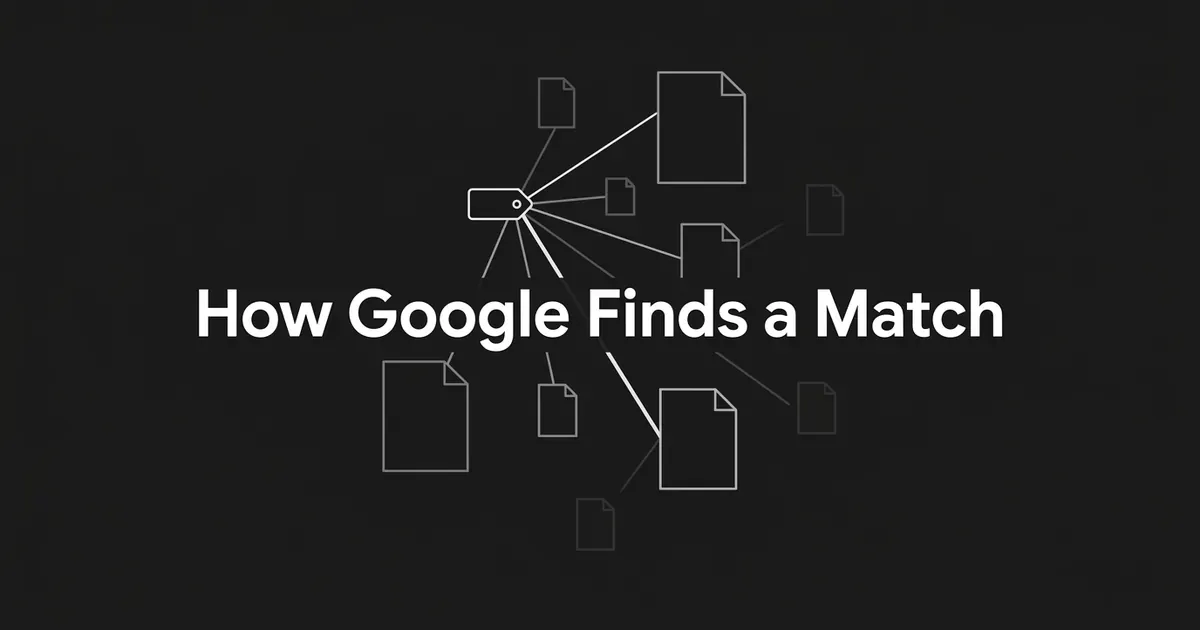
Google can also match a search to a page that uses none of the query's exact words. Its public example is "change laptop brightness" matching a page that says "adjust laptop brightness." The verb changed, the task did not. Google has named a few systems that support this kind of matching in its public documentation: BERT, which helps interpret how word combinations shift meaning and intent, RankBrain, which connects related words and concepts, and neural matching, which works with how concepts are represented across a query and a page. None of these are mutually exclusive stages in a pipeline you can diagram with confidence, and Google has not published how much weight each one carries. Treat the names as evidence that meaning-based matching is real, not as a sequence you need to reverse-engineer.
Takeaway: make the topic explicit first, then answer the actual need behind the words. Exact wording still helps a reader and a search engine recognize what a page is about. It just is not the finish line.
How context changes what counts as relevant
The same words can point to different right answers depending on who is asking and from where. Google names language and location among the contextual factors that shape results, along with device and a person's settings. A French-language search tends to surface mostly French-language pages. A search for "bicycle repair shops" returns different businesses to someone in Paris than to someone in Hong Kong, because the useful answer to that query depends on where the person stands when they ask it.
The type of information someone is after matters too. Google's systems try to recognize when a query calls for a recipe, an image, or a how-to rather than a general article, and serve that format when the signal is strong enough. A page can be squarely on topic and still be the wrong kind of answer if it is a long opinion piece when the searcher wanted a quick definition.
Freshness works the same way: it depends on the query, not on a blanket preference for new content. Google documents systems built to surface newer pages when a search implies that freshness matters, its examples being reviews right after a movie's release or coverage immediately following an earthquake. A search for a well-established historical fact does not carry that same pull toward recency. The practical read is that the relevant time window is a property of the question, not a universal rule that newer always wins.
Takeaway: relevance is contextual, not a fixed property stamped onto a page once and done. The same content can be a strong answer for one searcher and a weak one for another, depending on language, location, and what kind of answer the query is really asking for.
Why relevance is not the whole ranking decision
Relevance answers one question: does this fit the search. Ranking answers a different one: where should this result sit relative to everything else that also fits. Google keeps several considerations distinct, and worth keeping distinct in your own head too: whether a page is relevant, whether its information is reliable and genuinely helpful, whether the page is usable, and whether it is even eligible to appear at all. Meeting one of those does not guarantee the others, and a page can clear every eligibility bar and still rank modestly because something else in that set falls short.
Google's people-first guidance pushes on the second of those: does a page offer original information, real analysis, and value a reader could not get just as easily somewhere else. Adding query terms to a page that was already thin does not fix the thing actually holding it back. E-E-A-T, which stands for experience, expertise, authoritativeness, and trustworthiness, is part of that same conversation, and Google is explicit that E-E-A-T itself is not a ranking factor you can calculate. It describes a mix of signals that can indicate those qualities are present, not a published score sitting on a page somewhere.
Usability plays a smaller, conditional role. Google names things like mobile-friendliness and page speed as considerations, with the caveat that they tend to matter most when other things are roughly equal. A faster page does not out-rank a better answer; it can tip the balance between two answers that are already close.
One signal worth naming on its own: Google uses aggregated, anonymized interaction data, turned into inputs for its machine-learned systems, to help judge whether results are relevant. That is a documented role, but it is a long way from "a single click raises a ranking" or "your Search Console click-through rate is a visible relevance score you can watch move in real time." Google has not confirmed either of those shortcuts, and treating them as fact will send you chasing the wrong lever.
Takeaway: a page that is clearly on topic is not automatically a page that ranks well. Relevance, quality, usability, and eligibility are separate questions, and a weak answer on any one of them can hold a page back even when the others look fine.
What this means for SEO and AI visibility
The practical shift in day-to-day query processing SEO work is in what you brief and what you check before publishing. Specify the actual deliverable before you choose supporting vocabulary: a reader searching for a comparison wants a comparison, not an essay about why the topic matters that happens to mention the comparison. Make the subject explicit in the title and the opening answer, cover the subtopics that genuinely help answer the question rather than padding toward a word count, and use related terms naturally where they sharpen the explanation instead of as a checklist to tick off.
A content-optimization score, the kind that measures similarity scoring search style overlap between your draft and top-ranking pages, can be a useful editorial prompt. It is not a disclosed Google number, and nothing published converts that score into a ranking position or an AI citation. When a tool's score and your own read of the answer disagree, trust the read of the answer; the tool is measuring a proxy, not watching Google's systems directly.
Google's AI Overviews and AI Mode follow the same relevance groundwork rather than a separate rulebook. Google has stated that ordinary SEO practices remain relevant there and that no special optimization is required. To be eligible as a supporting link, a page still needs to be indexed and eligible to appear in Search with a snippet, which is a floor, not a guarantee of inclusion. Google's own recommendations for these features are familiar: make important content available as real text, keep it easy to find through internal links, keep structured data matched to what the page actually shows, and support the text with images where they genuinely help. No new file format or special markup is required to show up there.
Performance data tells you something real, but less than it looks like. Impressions, clicks, click-through rate, and average position describe visibility and interaction, not Google's internal assessment of how relevant your page was. Average position in particular can mislead if you do not account for how it is calculated: a position is only recorded against impressions, and the way result formats get counted affects the average you see. Use that data to notice patterns and ask better questions, not to read it as a confirmed explanation of why a page sits where it does.
Before you add another keyword to a page that is not performing, ask what the reader still needs from the answer that is not there yet. That question tends to surface the real problem faster than another pass at the wording.