You wrote the post. You covered the topic. You even used the exact words your buyer would type. Then you asked ChatGPT the same question, and it cited a competitor instead of you. Same three keywords, different result. What happened?
Here is the good news: this is not a mystery, and it is not bad luck. AI engines do not pick pages the way you might expect. They do not scan for your keywords and reward the page that repeats them most. They compare meaning. Once you understand how that comparison works, a lot of confusing citation results start to make sense, and you get a clear lever to pull.
This piece walks you through what are embeddings, how semantic matching decides which pages an engine pulls in, and why a page that is genuinely about a topic beats a page that just repeats the words. No formulas. Just the mental model, one page at a time.
What are embeddings, really?
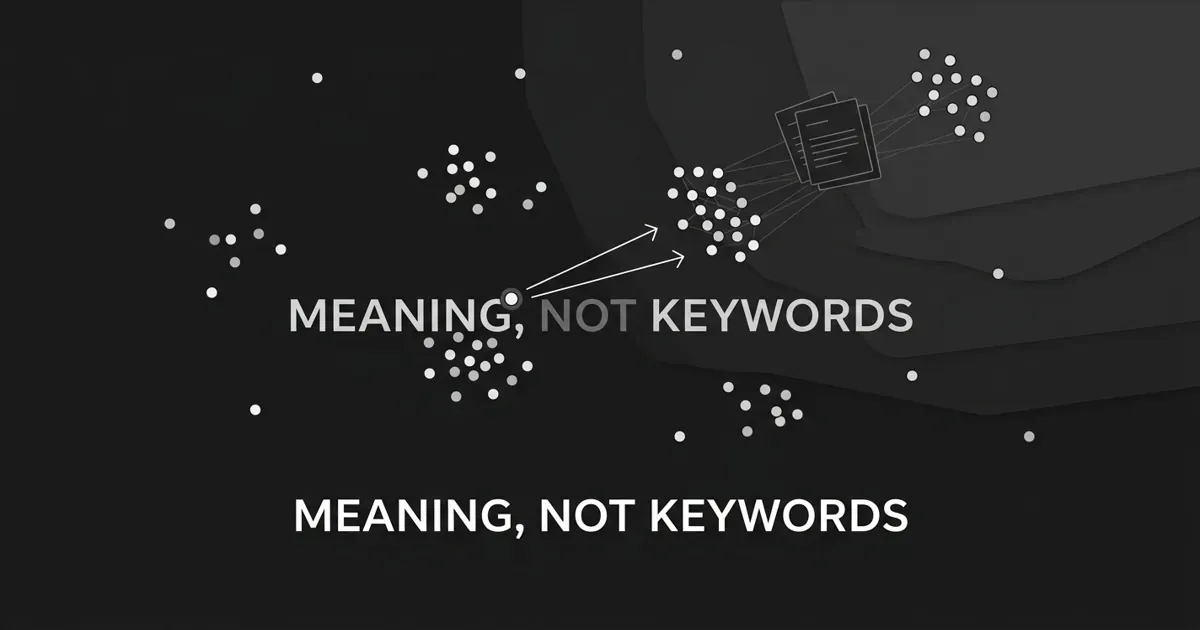
Let's start with the one idea everything rests on. An embedding is a way of turning a piece of text into a location on a giant map of meaning.
Picture a library. Not one shelved by author or title, but by what each book is actually about. Cat books sit near other cat books. Dog books sit one aisle over. Car books are across the building entirely. The map is organized by meaning, so things that mean similar things end up close together.
That is what an embedding does for text. It reads a sentence, a paragraph, or a whole page, and it hands back the coordinates of that text on the map. In practice those coordinates are a long list of numbers, often around a thousand of them. Each number captures some abstract slice of meaning. You do not need to read the numbers. You only need to know that two passages about the same thing land near each other, and two passages about different things land far apart.
Here is a plain definition you can keep. An embedding is a list of numbers that captures what a piece of text is about, in a way that lets a computer compare it to other pieces of text by measuring how close their two lists point in the same direction.
The map is not hand-drawn. The model learns it by reading enormous amounts of text and noticing which words and ideas tend to show up together. Over time it tunes the coordinates so that meaning, not spelling, decides where things sit. That is why "car" and "automobile" land in nearly the same spot, even though they share no letters.
One more thing worth knowing. Embeddings are not just for text. Images, audio, and code can all be placed on a map like this too, sometimes on the same map, so you can search images with words. For your work, the text version is the one that matters, because it is the one deciding whether your page gets pulled into an AI answer.
Semantic search vs keywords: the one difference that matters
This is the shift that explains almost everything. So let's make it concrete.
A keyword search does roughly what Ctrl+F does, with smarter counting. It looks for the exact words in your query and rewards pages where those words appear often. Type "automobile" and it finds pages with the word "automobile." Type "car" and it finds a different set. The words have to match.
A semantic search does not care about the exact words. It turns your question into a location on the map, then looks for pages sitting nearby. Search "affordable electric vehicles" and it can surface pages about the Nissan Leaf, the Tesla Model 3, and EV tax credits, even if the phrase "affordable electric vehicles" never appears on any of them. Those pages live in the same neighborhood as your question, so they get pulled in.
Here is the example to hold onto. Imagine someone searches "heart-healthy meals." A keyword engine only returns pages that contain that exact phrase. A semantic engine returns pages about omega-3 recipes, low-sodium dinners, and Mediterranean-diet options, because in meaning-space those all sit right next to "heart-healthy meals," even without the words. That is the whole difference between semantic search vs keywords: one matches letters, the other matches meaning.
Meaning-matching also fixes a problem keywords cannot. Think about "Apple." Is that the company or the fruit? Keywords alone cannot tell. But an article about the tech company lives in a completely different part of the map from an article about fruit, because everything around the word gives it away. The engine reads the neighborhood, not just the word.
Does this mean keywords are dead? Not at all, and this is worth being honest about. Keyword search is fast, predictable, and unbeatable when someone types a precise thing: a model number, a product SKU, a name, a quoted phrase. Most real AI engines actually run both approaches at once and blend the results. So the takeaway is not that semantic replaced keywords. It is that semantic matching now wins the step that decides which pages even get considered. And that step is the one you have been losing without knowing why.
How vector similarity decides what gets retrieved
So the engine has your question as a point on the map, and it has every candidate page as a point on the map. How does it pick? This is where vector similarity retrieval comes in, and the intuition is simpler than the name.
Think of each point on the map as an arrow starting from the center. Your question is one arrow. Each page is another arrow. The engine asks one question about every pair: are these two arrows pointing the same way?
Arrows pointing in roughly the same direction mean the two texts are about roughly the same thing. Arrows pointing in different directions mean different topics. The pages whose arrows line up best with your question's arrow are the ones the engine forwards to build the answer. That directional check has a name, cosine similarity, but you do not need the math. You just need the picture: same direction means same meaning.
Why direction and not distance? Because on a map with that many dimensions, plain distance gets unreliable, and direction stays meaningful. There are a few other ways to measure closeness, and engineers debate them, but here is the honest shortcut for a marketer: for the question "which page is most relevant," they all rank pages in nearly the same order. So you can stop worrying about which one your engine uses. What matters is that your page's arrow points the same way as your buyer's question.
That is the entire retrieval decision in one line. Your page gets pulled into the answer when its meaning points in the same direction as the question being asked. Not when it repeats the question's words. Strip away the jargon and vector similarity retrieval is just this: the engine keeps the pages whose meaning aims where the question aims, and drops the rest before it writes a single word.
What actually happens inside ChatGPT, Perplexity, and Gemini
You do not need to see the plumbing to write for it. But a peek helps, because it shows where your page is won or lost.
Every major AI answer engine follows the same three-beat shape. First it retrieves: it builds a shortlist of candidate passages using some mix of keyword and semantic matching. Then it reranks: it promotes the strongest candidates. Then it generates: it writes a natural answer and cites the passages it leaned on. OpenAI, Google, Perplexity, Anthropic. Same shape, different details. The moment you care about most is the first one, retrieval, because a page that never makes the shortlist can never be cited. Semantic matching AI search is what builds that shortlist, so it is the gate every later step depends on.
A couple of things worth knowing about the engines your buyers use. ChatGPT does not go to the web for every question. One analysis of roughly 80 million queries found that only about 46 percent of them actually triggered a web search. The rest were answered from what the model already knew. So for your topics, the engine reaches out to the web maybe half the time. That makes every retrieval you can win more valuable, not less.
Perplexity leans hard on meaning-matching. It runs its own embedding models and blends keyword and semantic signals to build its shortlist, then reranks in several passes. For an engine like this, how well your page's meaning aligns with the question matters more than how many times you used the phrase. This is semantic matching AI search in its clearest form. If you have ever seen Perplexity cite a page that never used your buyer's exact wording, this is why: the page still landed in the right neighborhood on the map, and the words were beside the point.
Google's AI Overviews add their own twist. They tend to cite a tight set of trusted pages, and one study found that 38 percent of AI Overview citations came from pages already ranking in Google's top 10 for that query. In other words, classic search strength and AI citation still feed each other. They are not the same game, but they are not separate games either.
Claude and other engines follow the same retrieve-then-cite pattern. The specifics stay behind the curtain, so it is not worth guessing at the internals. The shape is what to remember.
Why a topically aligned page beats a keyword-stuffed one
Now we can answer the question you actually came with. Why does the page that is genuinely about a topic beat the page that just repeats the keyword?
Because retrieval is a meaning test, not a word count. An embedding captures what your whole passage is about, not which words you sprinkled in. A page that repeats your target keyword six times but wanders across five unrelated ideas produces an arrow pointing in a muddled direction. A page whose every paragraph circles the same subject produces an arrow that points cleanly at that subject. When a related question comes in, the clean arrow wins. That is how embeddings pick content: by the topic the page actually commits to.
The SEO world has a name for this: topical authority. It describes how tightly your site's content clusters around a subject. When your pages all point at the same neighborhood on the map, engines start treating you as the source for that neighborhood. Google's own internal signals reportedly include measures of exactly this kind of topical concentration. Sites that cluster tightly around a topic tend to earn visibility faster and get cited more.
And this is not just theory. Sites with strong topical authority have been shown to rank across a wider range of related searches, including long-tail questions they never directly targeted. One study tracking a set of sites found that strong topical authority sped up how fast new pages became visible. Being cited in AI answers has real downstream value too: one analysis found pages cited in AI Overviews saw a 120 percent lift in organic clicks per impression compared to pages that were not cited. Covering your topic deeply is not a nice-to-have. It compounds.
There is a practical wrinkle here worth naming. Tracking which prompts already name you, and which ones your competitor owns, is the most concrete way to see where your topical map has holes. That kind of measurement only pays off if you can act on what it tells you, which is why AI-visibility tracking and content production sit together in platforms like DeepSmith: find the gap, then write the page that closes it, in one loop.
What this means for the page you publish next
Feeling like this is a lot to act on? It is really just a handful of moves. Let's make them small.
Cover the topic, not just the query. Write the page you would write if you wanted to be the definitive source on the subject, not the page that hits a keyword five times. Depth pulls your arrow into the right neighborhood and keeps it there.
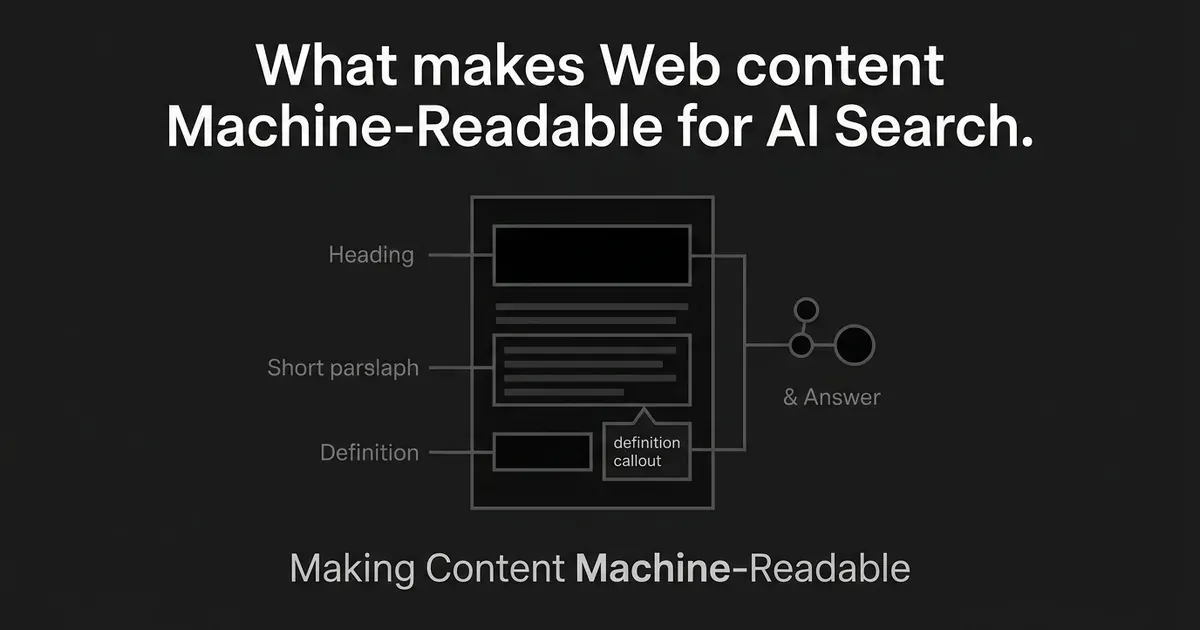
Break the page into clean, self-contained passages. Engines do not read your whole page as one blob. They split long pages into chunks and match the best chunk to the question. So give them clean seams. Use clear H2 and H3 headings, and let each section answer one distinct question completely. A page that breaks into eight or ten tidy passages, each handling one sub-question, is exactly the shape engines like to cite.
Lead each section with the answer. Put a crisp, forty-to-eighty word answer right under the heading, then elaborate. That answer-first block is easy to lift into a response, and it is the format retrievers reach for.
Add real proof. Include specific numbers and name your sources. Content with concrete statistics has been reported to earn AI citations more often, and the academic work on optimizing for AI answers points the same way: credible citations, real data, and an authoritative tone all lift how often you get cited. Treat the exact figures as directional, but the direction is clear.
Link your related pages together. When you internally link the pages in a topic cluster, you tighten how concentrated your site looks around that subject. That is a measurable pull on your topical center, and it is one of the easiest wins on this list.
If any of this feels like a second job, that is the honest part. This is where a production system earns its keep. DeepSmith's AI Visibility tracks how you show up across ChatGPT, Perplexity, Gemini, Claude, and Google AI Mode, and its writing pipeline builds answer-first structure, clean headings, and internal links in during creation, not after. You review for judgment, not for header formatting. One team put it plainly: they went from four articles a month to fifteen with the same two people.
The one thing to remember
Embeddings do not care about your headers or your keyword count. They care about whether your whole page is about the same thing your buyer's question is about. Match the meaning, and the retrieval step takes care of itself.
You do not need to master the math to use this. You need to write pages that commit to a topic, break cleanly into answerable passages, and back their claims. That is how embeddings pick content in the end: they reward the page that means what the question is asking, not the page that echoes it. Do that, and you stop guessing why the competitor got cited. You start being the page that does.
Want to see where you show up in AI answers right now, and which pages are winning the citations you want? Start a free DeepSmith trial and check it on your own brand.