

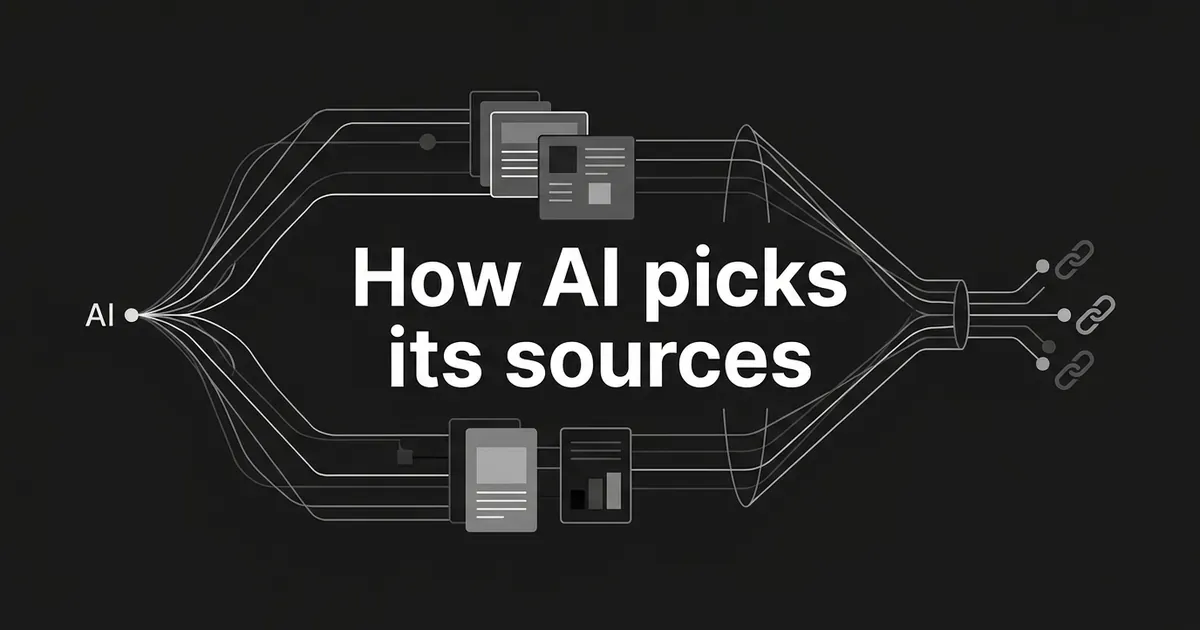
AI search engines choose citation sources by interpreting a question, retrieving candidate pages, ranking the relevant information, and linking the sources they use to the answer they generate. That is a shared way of explaining how AI chooses sources, though it is a teaching model, not one published algorithm that every engine follows in the same way. Some engines search more than once while they write, and they can keep finding pages while the answer is still being built.
If you have ever asked ChatGPT or Google a question about your own topic and wondered why your page wasn't in the list of links, it helps to know that a citation is the end of several smaller decisions. This article walks through those decisions in order, shows which ones you can influence, and is honest about the ones nobody outside the engine can see.
What does it mean for an AI engine to choose a source?
When an engine "chooses" a source, it is really making a chain of choices. It decides whether to search the web at all, what to search for, which pages to pull back, which pieces of those pages to use, and which sources to show next to the finished answer. A page can drop out at any step, so a citation is not a prize handed to the highest-ranking website.
A few terms make the rest of this easier to follow.
- Crawling is discovering and fetching a page.
- Indexing is processing and storing what was found so it can be searched.
- Retrieval is finding candidate pages or passages for a particular query.
- Ranking is putting those candidates in order, or filtering them, by how useful they are for that query.
- Citation attachment is linking a source to a statement in the answer, or listing it as a reference.
These are different jobs. A page can be crawled but never indexed, indexed but never retrieved for a particular question, and retrieved but never shown as a link in the answer.
Many AI answers rely on retrieval-augmented generation, usually shortened to RAG, where the model gets information from outside itself, such as a search index, and uses it while it writes. Not every answer works this way, though. ChatGPT may search automatically when a question would benefit from current information, and in the Gemini API the model decides whether a Google Search would improve the answer when the search tool is turned on. Some answers come from the model alone, with no AI citation sources to show.
One more distinction is worth holding on to. Letting a company crawl your site to train its models is a separate permission from letting it use your site in search. OpenAI, for example, has one crawler for search and a different one for training, so you can allow the first and block the second. A citation also isn't proof that the cited page was part of a model's training data, because search retrieval and training are different processes.
The takeaway for this section is that a citation comes out of several selection steps, and each step can remove a page from the running.
How does a question become a set of searches?
The first step is that the engine works out what the person is really asking and what information it would need to answer. A short question can carry constraints the words don't show. Someone asking which heating setup suits a small house in a cold climate needs facts about cold-weather performance, installation, running costs and local conditions, and the engine has to decide which of those matter.
Context can shape this step. OpenAI says ChatGPT may use relevant saved memories when it rewrites a search query, if memory is turned on, and it may use an approximate location based on an IP address to give relevant local results. Bing lists location and language among the things it considers in ranking. Google describes AI Mode as built for more detailed questions, exploration, comparisons and follow-ups.
The second step is that the question you type is not always the query that gets searched. OpenAI says ChatGPT search typically rewrites a question into one or more targeted queries when it uses search providers, and after reading the first results it may send more specific queries to other providers. Google says AI Overviews and AI Mode may use what it calls query fan-out, which means running several related searches across subtopics and data sources and then bringing them together into one response. The Gemini API documentation describes something similar, with prompt analysis followed by one or more generated Google Search queries when they would help. If you'd like a longer look at this idea, query fan-out explained covers how one question turns into many searches.
This is a big reason a narrow page can show up for a broad question. Suppose the heating question sends out a sub-search about cold-weather performance. A specialist page on exactly that could be useful for that one part of the answer, even though it isn't the broadest page about home heating. That is a hypothetical example, and nobody can say those exact searches happen.
So a page competes to answer the searches the engine generates, and those can differ from the literal words the user typed. That is the heart of how AI chooses sources for broad questions. If you want to understand why ChatGPT cites certain sites for a question, a good first place to look is the rewritten queries behind it, because those are what the pages were matched against.
How are candidate pages retrieved and ranked?
Once the searches exist, the engine pulls back a candidate set from whatever search infrastructure that product uses. Different products use different sources, so there is no single index behind every answer. ChatGPT sometimes works with other search providers, and its public documentation doesn't say every search uses one exclusive provider. Google's AI Mode describes drawing on web content and other sources such as the Knowledge Graph and shopping data, which means a grounded answer isn't always built only from ordinary articles.
Perplexity has published the most detailed description of this layer, so it makes a good example, with the caveat that it is Perplexity's own account of its own system. In its architecture article, the company describes an index that is queried with both lexical and semantic retrieval, and the results are merged into one candidate set. Lexical retrieval matches on the words in the query and the document. Semantic retrieval looks for related meaning, even when the wording is different. At this early stage Perplexity says the priority is covering enough ground, and the later stages are there to improve precision.
Google says its systems understand concepts and relationships between words, so a page can surface without containing every word in the query, and Bing also considers synonyms and abbreviations. Matching what the reader needs matters more than repeating one exact phrase.
Retrieval isn't the end, because the candidate set is then narrowed. Perplexity describes a prefilter that removes clearly off-topic or stale content, followed by several ranking stages. Faster scorers based on words and embeddings run first, and heavier cross-encoder rerankers run later on the smaller set. Doing it in steps makes sense, since finding broadly relevant pages and comparing a small group closely are different kinds of work.
OpenAI gives a higher-level description. It says ChatGPT ranks search results using multiple factors meant to help people find relevant and reliable information, and it doesn't publish the weights or a full formula for citation. Google says AI Mode is rooted in its core quality and ranking systems, and its general documentation covers page-level and site-wide signals, freshness, and systems meant to surface reliable information. That documentation helps you understand the search infrastructure that can feed AI answers. It isn't a published formula for which pages end up cited.
Access matters here too. If a publisher's crawler settings, hosting setup or content delivery network stops the search crawler from reaching a page, that page can't take part. OpenAI, for instance, says the crawler that surfaces sites in ChatGPT search is OAI-SearchBot, and it recommends allowing both that crawler and traffic from its published IP ranges. A permissive robots file doesn't fix a separate firewall block. If you want the details on how ChatGPT fetches pages, see how ChatGPT fetches and renders your pages, and for the robots side there is a guide on configuring robots.txt for AI crawlers.
The takeaway is that access gets a page into the pool, and after that it still has to be relevant enough for the specific query to make it through the ranking steps.
Why does one passage become a citation?
Retrieving a page doesn't mean the model reads and uses the whole thing. Perplexity describes parsing documents into self-contained spans and retrieving and scoring information at both the document level and below it. Its stated reason is to hand the model precise units of information without dragging in unrelated text from elsewhere on the page.
Google has a related idea in its passage ranking system, which finds sections of a page to understand how relevant the page is to a search. That doesn't mean each passage becomes its own indexed page, and it isn't the whole story of AI citation. It does help explain why a long guide with one clearly written section on a specific limitation can be useful for a narrow question. A page doesn't need to be chopped into tiny standalone articles to benefit. Google says directly that you don't need to break content into very small pieces for generative AI search, and that there is no ideal page length or special writing style required for it.
After retrieval, the model works out an answer, and this part can loop. The Gemini API documentation lays the sequence out plainly: analyze the prompt, generate searches if needed, process the results, put the information together, and return a grounded answer. ChatGPT may run more specific searches after it sees early results, and Google says its models can identify additional supporting pages while a response is being generated. So the search and the writing can interact, and the sources are not always all fixed before the answer begins.
Then comes citation attachment, which is its own piece of the system. The Gemini API returns grounding metadata with the search queries used, the source objects, and links between segments of the response text and those sources. The documented fields are webSearchQueries, groundingChunks and groundingSupports. OpenAI's web search API returns citation annotations with the source address, the title, and the place in the answer the citation belongs to. Microsoft's Copilot Search announcement describes linking a sentence or passage to its sources. Those are API and product examples, and they don't tell us everything about how the consumer apps behave.
The pages an engine consulted and the pages it cites are not the same list, and these AI citation sources are only the visible part. OpenAI's API documentation separates the full set of consulted sources from the inline citations, and it says the source list is often larger than the citation list. So a page can be retrieved and still not appear as a link. Nobody outside the engine can say why one consulted page was left out.
None of this reveals a universal rule for which eligible page wins when several say similar things. What the documentation supports is that a source has to fit the answer being written, and not only the topic. If you're curious about judging how much a given citation is worth to you, how to tell whether an AI citation is helping you takes that up separately, and this article stays with the selection side.
Which factors can you influence?
You can influence the inputs, and you can't control the output. That is the honest way to put it, and it's worth keeping in mind as you read the rest of this section, because nothing below is a promise that a page will be cited.
Access and eligibility. For Google's AI features, the documentation says a supporting page must be indexed and eligible to appear in Search with a snippet, and that no extra technical requirements apply. It also says meeting the requirements doesn't guarantee crawling, indexing or serving. Its AI features documentation recommends the usual fundamentals: let crawlers in, link your pages internally, give people a good page experience, put important information in text, and make sure structured data matches what is visible. For OpenAI and Perplexity, the access question is about their search bots, OAI-SearchBot and PerplexityBot, and both companies recommend allowing the bot and its published IP ranges. Both say a change in crawler settings can take up to about 24 hours to be reflected.
The training question comes up a lot here, so it's worth repeating. For the OpenAI controls described in its crawler documentation, OAI-SearchBot and GPTBot are independent, so you can allow search crawling and decline training crawling. Perplexity says PerplexityBot doesn't crawl for training either, but each provider has its own controls.
Matching the real question. Because retrieval is partly semantic and queries get rewritten, covering the actual question, its constraints and the terms people really use does more than repeating a target phrase. No public source gives a keyword density that works.
Clear, specific sections. Since engines can pick out useful passages, a section that states an important fact with its qualifications and exceptions is easier to use than one that only hints at it. Every paragraph doesn't need to be a formulaic answer block, and Google says that isn't required.
Original or first-hand information. Bing's ranking explanation mentions first-hand information and transparency about who produced a page, and Google recommends helpful, reliable content. Giving a page a reason to exist beyond repeating other pages is sensible. There is no published number for how much it counts.
Keeping facts current. Google applies freshness where a query calls for it, Bing says whether timeliness matters depends on the topic, and Perplexity talks about filtering stale content. A product price needs regular upkeep and a stable definition may not. The newest page doesn't automatically win every query.
Reputation. Bing describes reputation, including the kinds of sites that link to a page, and Google describes site-wide signals. Perplexity says its indexing prioritizes authoritative domains and undercovered topics, which is no promise that a new page on a thin topic will be cited. Credibility seems to count in the search layer that feeds answers, but there is no basis for turning backlink counts or authority scores into known citation weights.
Structured data. Google says structured data should match visible content, and that you don't need special AI schema or new AI text files to appear in its generative features. That is a Google-specific statement and doesn't prove no other application ever reads such files. If you want to go further, there are pages on what the evidence says about schema markup and AI citations and on whether llms.txt improves AI visibility.
If you'd like a practical next read on the topic of eligibility, why some pages get cited and others get ignored goes through it from the publisher's side.
The takeaway is to improve access and usefulness, because no universal score has been published to chase.
What stays outside your control?
You can't decide whether a particular answer uses web search at all. You can't decide how the engine reads an ambiguous question, or what the exact rewritten queries and subqueries are. The providers, indexes and extra data sources used for a given request are the engine's choice. So are the ranking weights, the reranking decisions and the internal thresholds, and none of those are public.
Other things depend on the moment, such as which competing pages are relevant right then, the user's location, and whether their memory setting is on. Which consulted pages get visible citations, and the wording, number, placement and order of those citations, are also decided by the engine.
Two products from the same company don't necessarily return the same links either. Google says AI Mode and AI Overviews can use different models and techniques, so they can produce different answers and different links. AI Overviews also don't appear for every search, only when Google's systems decide they add value beyond classic search.
A few common beliefs don't hold up well against this.
- "The top Google result gets the AI citation." Not established. With query fan-out and extra supporting pages found during generation, a source can be relevant to a subquestion without being the top result for the original query. No source we reviewed maps one conventional ranking position to an AI citation, so any top-three or first-page rule is invented.
- "All AI engines prefer the same domains." There isn't support for that as a universal rule. Engines use different models, query handling and retrieval infrastructure. That said, domain reputation can still matter in some systems, and it can sit alongside query-specific usefulness.
- "A special AI file or schema makes the engine pick you." Google says that isn't required for its generative Search features.
- "A retrieved page has already won the citation." Consulted and cited are separate lists.
- "The final link tells you every reason the engine chose the page." It doesn't. The public documentation describes broad mechanisms and leaves the weights and many implementation details undisclosed.
That last point matters if you're trying to work out why ChatGPT cites certain sites. OpenAI describes relevance and reliability as its aims, but it doesn't publish a recipe that explains each individual citation, and it doesn't claim to guarantee that those aims are met every time. The honest answer is general: pages that fit the rewritten queries, are reachable by the search crawler, and say something useful for the question have a better chance of being retrieved and used, and past that point the engine decides.
So what can you do with this? A reasonable way to start is to take one page you care about and ask whether the search crawlers can reach it, whether it answers the real question in a section that makes sense on its own, and whether the facts in it are still right. Those three checks are within your control, and they fit the mental model you now have. If you want to look at how these sources show up across a topic, how citation selection differs across ChatGPT, Google AI Overviews and Perplexity compares the engines side by side.
Publishers can make content accessible and useful, and the engine decides which information fits a particular response. Planning around the first part and accepting the second is a calmer way to work than hunting for a trick. If you're deciding what a page still needs to explain more clearly, this model gives you a decent set of questions to ask. If you later want help seeing where your own brand appears across AI answers, the best AI visibility tools roundup is a place to start, and for a view of the tools that report on which sources engines cite, there is a list of citation tracking tools. This article doesn't go into how to measure any of it.
Related guides
- What Citation Trackers Cannot See: Limits of AI Citation Data: Learn what citation trackers cannot see, such as private chats, personalized results and unlinked influence, so you read the numbers with the right caution.
- A Monthly AI Citation Review Checklist: Use a checklist for a monthly pass over citation share, new and lost sources and follow-up tasks.
- How to Read AI Citations as a Content Brief: Pull the structure, questions and evidence from pages AI cites for a prompt and turn them into a brief for one new article.
- How to Turn Citation Gaps Into Content and Outreach Opportunities: Turn a gap list into two work queues: pages you should create or update, and third-party sites worth pitching.
- An AI Brand Monitoring Playbook: Roles, Escalation and Response Times: Define roles, escalation paths and response times for issues found in monitoring.


