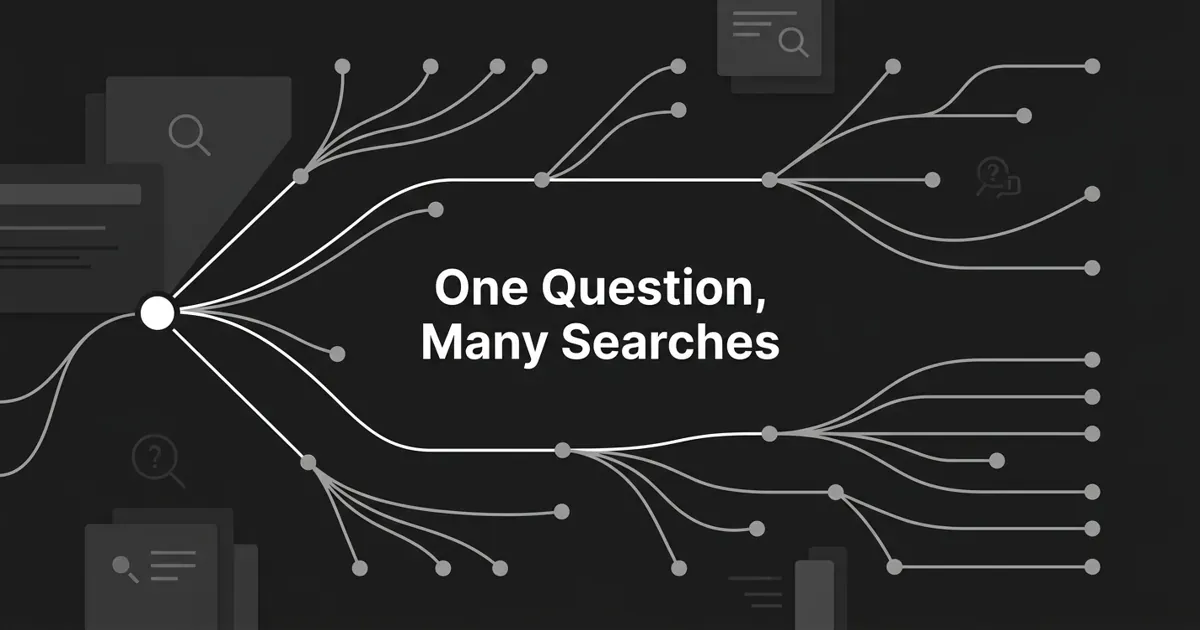
You type one question into ChatGPT or Google's AI Mode. Behind the scenes, the engine runs eight, ten, sometimes more than twenty searches before it writes a single word back to you. That hidden step has a name, and understanding it changes how you think about getting found.
So what is query fan-out? It is the technique an answer engine uses to take your one prompt and quietly break it into many smaller searches, each aimed at a different piece of what you actually meant.
Here is the good news: once you see how query fan-out AI search works, the whole game of getting cited by AI starts to make sense. By the end of this piece, you will understand what fan-out is, why engines do it, and how that one mechanism decides which pages even get a chance to show up in an AI answer.
Let's take it one step at a time.
What is query fan-out, in plain terms
Query fan-out is when an AI answer engine takes a single question and automatically generates many related sub-queries, each targeting a different facet of what you asked.
The name says it all. One query "fans out" into many. The engine sends those sub-queries against its search index at the same time, pulls back the results, merges them, re-ranks them, and only then writes you a single grounded answer with citations.
This is not a fringe trick. Google uses the exact phrase "query fan-out technique" in its own description of AI Mode. In Google's words, the system "breaks down your question into subtopics and issues a multitude of queries simultaneously on your behalf."
And it is not just Google. Every major answer engine runs a version of this: Google AI Mode and AI Overviews, ChatGPT search, Perplexity, Claude, Gemini, and Copilot. They use different names for the expanded queries. Google calls them fan-out queries or subtopics. Patents describe them as variant queries and thematic subqueries. Research papers call them synthetic sub-questions. Same idea underneath: many targeted searches behind your one question.
If that already feels like a lot, take a breath. You only need to hold onto one sentence: your question is never searched as-is. It gets multiplied first.
Why answer engines break one question into many
The short answer: one search cannot satisfy a modern question, so the engine runs many at once.
Let's unpack the three reasons that made this the default.
Your prompts carry more than one intent. Ask for "the best CRM for a SaaS startup" and you are quietly asking about comparisons, pricing, integrations, security, and onboarding all at once. A single ranked list of ten blue links cannot answer all of those. A fan-out lets the engine probe each thread on its own.
The model needs evidence. A large language model cannot answer with real authority from memory alone, especially on recent, niche, or buying-decision questions. This is where fan-out fits into retrieval-augmented generation, or RAG: it is the step that gathers the source material the model will actually build its answer from. If you want the deeper mechanics, our explainer on how retrieval-augmented answers pick the sources they cite walks through the full loop.
Many searches beat one search. Instead of one query and one ranking pass, the engine turns one search into many, runs them in parallel, and merges the evidence. That is how AI expands a query into something that can cover more angles at once. The result is an answer that cites more sources and covers more subtopics than a single search ever could.
Put simply, query fan-out is where two older ideas meet: the query reformulation search engines have done for years, and the parallel retrieval pattern from RAG. Nothing here is magic. It is just those two things running together in the age of large language models.
A worked example: one buyer question, many searches
The fastest way to feel how AI generates sub-queries is to watch one question explode.
Say a buyer types this into an answer engine:
"What's the best CRM for a B2B SaaS startup with a 5-person sales team and a budget under $1,000 per month?"
Behind the scenes, a typical fan-out might spin that into something like:
- "Best CRM software for B2B SaaS startups 2026"
- "CRM comparison HubSpot Salesforce Pipedrive for small sales teams"
- "Affordable CRM under $1000 per month with pipeline management"
- "CRM with native HubSpot and Slack integrations"
- "CRM for early-stage SaaS companies with limited admin support"
- "User reviews and ratings of top CRM platforms for SaaS"
- "CRM with API and workflow automation for B2B sales"
Look at what happened. One human question became roughly seven machine searches. Each one targets a different facet: the category, a comparison, the price, integrations, the team's scale, social proof, and the technical fit.
Now here is the part that matters for you. A page that only answers "best CRM" matches one of those seven doors. A page that answers all seven sub-questions is in the running for every door.
This holds across topics, not just software. In the AI search literature, a simple prompt like "moisturizing cream for dry skin" fans out into sub-queries for "dry skin causes," "moisturizing cream ingredients for dry skin," and "best moisturizing cream for dry skin 2026." Same pattern, different aisle.
A few details about how AI generates sub-queries are worth knowing, because they tell you what the engine is really reaching for. The sub-queries are short, around 6.7 words on average. A meaningful share carry a brand name, roughly one in four, and about one in five carry a year stamp like "2026." And here is the one that surprises most people: the large majority of these fan-out sub-queries have essentially zero traditional search volume. They are questions no keyword tool would ever have shown you, invented on the fly for one buyer's prompt.
Feeling the shift yet? The thing you are competing for is no longer the one keyword the buyer typed. It is the whole set of sub-queries the engine invented on their behalf.
What happens after the fan-out
Fan-out is the front door. Citation is the back door. What happens in between is what decides whether your page gets named.
Most engines follow roughly the same six steps once a question comes in.
First, the model reads your prompt and figures out the intent and the gaps you did not spell out. Second, it generates the list of sub-queries. Third, it dispatches them in parallel against a search backend (Google uses its own index, ChatGPT and Copilot lean on Bing, Perplexity blends its own crawler with partner feeds, Claude uses Brave). Fourth, each sub-query returns its own ranked list of documents. Fifth, all those results get merged into one pool and re-ranked together. Sixth, the model writes the answer and attaches citations to the passages it actually used.
You only ever see step six. The first five are invisible.
Here is the number that reframes everything. For a single prompt, each sub-query pulls back ten to fifty documents. Across eight to twelve sub-queries, that union becomes a candidate pool of roughly 200 to 500 documents. From that pool, the engine cites only about 5 to 15 sources in the final answer. Engines rarely cite more than fifteen.
So there is a wide funnel and a narrow exit. Getting into the pool is not the same as getting cited, but you cannot get cited if you never make the pool. Our guide to how LLMs select and extract citations traces this full path from question to cited source if you want to see every stage.
This is also why AI answers feel so different from a classic results page. Because the engine is pulling evidence from many searches at once, the answers run much longer than a traditional listing and reference far more distinct entities per answer than old-style search ever did. When you watch how AI expands a query into a whole spread of parallel searches, that richer, more comprehensive answer stops being a mystery. It is the direct result of the fan.
One more fact worth sitting with: a large share of AI-cited URLs do not even rank in Google's organic top ten. In one analysis, only about 12% of cited URLs also held a top-ten organic spot. The pool that fan-out builds is far wider and more varied than the first page of search results, which is exactly why a page can be cited by AI while sitting well down the rankings, and why a number-one page can be skipped. We dig into that gap in why ranking first doesn't guarantee an AI citation.
How AI Overviews fan-out compares across engines
The core pattern is shared, but the dials differ. This is where it helps to know your engines.
Google AI Mode is the heavyweight. It runs many sub-queries in parallel, often eight to twelve, and synthesizes a long, citation-rich answer. The AI Overviews fan-out is the lighter-weight cousin: same technique, but it produces shorter summaries and fires fewer sub-queries, and it only appears above the classic results when Google decides the query calls for it.
ChatGPT search runs a tighter fan-out, often five to ten sub-queries, and it has a habit of stamping the current year onto some of them. Perplexity leans on hybrid retrieval and tends to cite just three to four sources per answer, with recency treated as a first-class signal. Claude tends to cite fewer sources and keeps its citation formatting clean.
Why does this matter to you? Because the AI Overviews fan-out and the AI Mode fan-out reward slightly different things, but they reward the same core trait: a page that answers many sub-questions clearly. You do not need to chase every engine's quirks on day one. You need content that survives the shared mechanism first. If you want to see how these shifts landed in Google's own announcements, our read on what changed at Google I/O covers fan-out sub-queries in plain terms.
Not sure where to start? Start with the mechanism, not the engine.
Why fan-out decides which pages an AI could cite
This is the heart of it. Query fan-out AI search does not just change how questions get searched. It changes which pages are even eligible to be cited.
Sit with one figure here. In one analysis of AI citations, roughly half of them traced back to fan-out sub-queries rather than the original prompt as typed. Read that again. A majority of the chances to be cited live in questions the buyer never actually asked out loud. If your content only speaks to the literal prompt, you are competing for the smaller half of the opportunity and skipping the larger one.
Think back to the candidate pool. Once your page is in it, a handful of filters decide whether it survives to the final answer.
Coverage breadth. Pages that explicitly answer several sub-questions of the original prompt get retrieved again and again. A page that only covers the surface question matches one door and gets dropped at the rest.
Entity clarity. Pages that name specific brands, products, people, and places in clean, plain language get pulled more often. Vague prose fails the matching step.
Authority signals. Backlinks, brand mentions, author credentials, and trust markers act as a gate. In this pipeline, that gate is closer to pass-or-fail: a page that fails it gets dropped no matter how good the writing is.
Freshness. For anything time-sensitive (best tools this year, latest pricing, recent changes), how current your page is can matter more than how relevant it is.
Notice the shift. The unit you compete on is no longer the keyword. It is the fan-out sub-query, that hidden cluster of questions the engine invents. That is why so many practitioners now separate answer engine optimization from classic SEO. If you want the clean version of that split, AEO vs SEO lays out what actually changes when the goal moves from ranking to being cited. And if a page can be pulled but never seems to make the final cut, why some pages get cited and others get ignored walks through the eligibility gates in order.
If your pages rank but never get cited, this is usually why. They were built to win one keyword, not to answer the fan.
What this means for your content
You do not need to rebuild your whole site this week. You need to change how you picture the target.
Traditional SEO optimizes a page to rank for one keyword. Fan-out-aware content optimizes a page to be retrievable for the whole cluster of sub-queries an engine invents behind the scenes. Same page, wider job.
The pages that keep winning citations tend to share a few habits. They cover a topic thoroughly instead of thinly. They are structured so a reader (or a model) can lift a clean, self-contained answer from any section. And they give retrieval systems tidy signals about what they are and who they are about.
Your measurement changes too. Rank tracking for a keyword tells you less and less. The questions that matter now are which prompts trigger a citation, which sub-queries pull your pages in, and which competitor pages get named instead of yours. That is why teams are shifting to tracking what actually determines whether a model cites your content rather than just watching positions move.
This is also the problem DeepSmith was built around: it tracks where you show up across engines like ChatGPT, Perplexity, and Gemini, finds the prompts where you are missing, and produces on-brand content designed to be retrievable for the sub-queries behind them. The point is not to write more. It is to write pages that answer the fan.
If you are just getting your bearings on the vocabulary, our AEO glossary defines fan-out and the terms around it in one place, and the founder's introduction to answer engine optimization frames it as a growth channel you can actually start on.
Here is the one thing to take with you. Every answer an engine gives started as many searches, not one. Build pages that can be found across that whole fan, and you stop competing for a keyword and start competing for the answer.
And if this still feels like a lot, that is normal. You do not have to fix every page at once. Pick one important page, list the sub-questions a buyer's prompt really contains, and make sure that page answers them. That is a small, doable first step, and it is the right one.
Want to see which sub-queries are pulling your pages in, and which ones are pulling in a competitor instead? You can start a free DeepSmith trial and look at your own data before you commit to anything.