You searched your own topic in ChatGPT, saw a competitor cited, and felt your stomach drop. Your page is good. It ranks. So why does AI cite some pages and skip yours entirely?
Take a breath. The answer is usually simpler than it feels, and it is fixable.
Before an AI engine ever decides which page to cite, it decides which pages are even allowed into the running. That first filter is citation eligibility, and most pages that get ignored never fail on quality. They fail on eligibility, quietly, before the real contest begins. Understanding what makes content citable starts here, not with better prose.
Here is the good news: eligibility comes down to five yes-or-no checks. By the end of this piece you can run all five on any page and know whether it is a candidate at all. We are not covering how to win the citation once you qualify. We are covering the gate you have to clear to be considered. Let's walk through it together.
What citation eligibility actually means
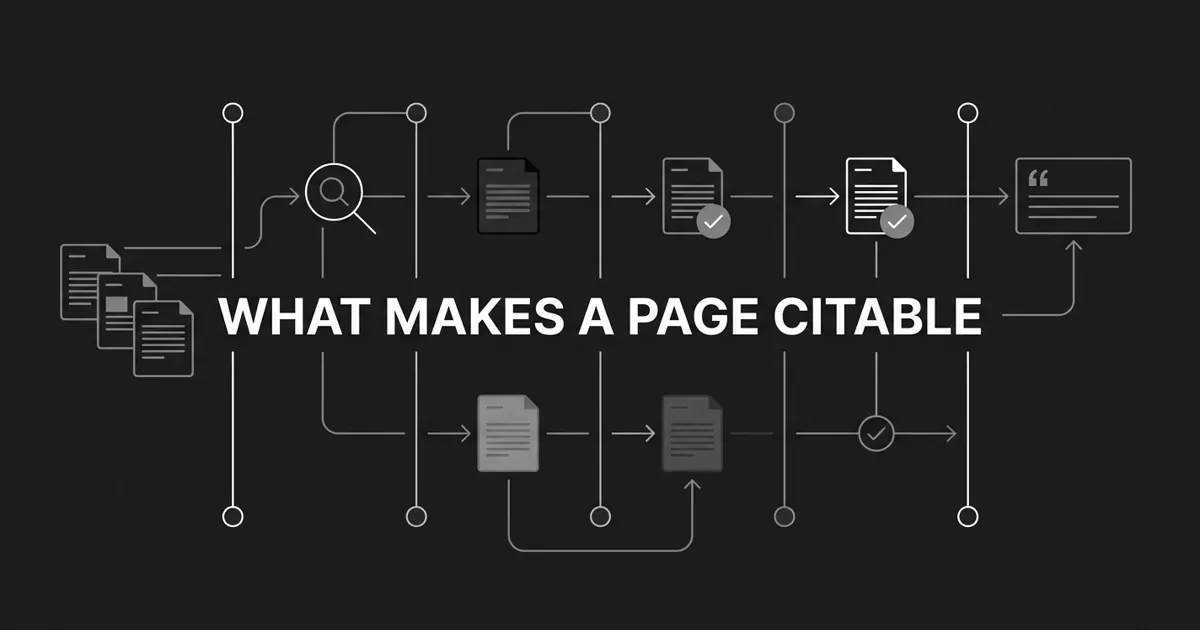
Citation eligibility is whether an AI engine can retrieve your page, pull a self-contained passage from it, and quote that passage as the source for something it says. Eligibility is the gate. Ranking is the score that happens after.
This distinction matters more than almost anything else, so let's make it concrete.
Every major AI engine works the same way underneath. It retrieves a set of candidate pages, then a separate step decides which passages get used and cited. ChatGPT search runs your query through search providers and shows its sources in a sidebar. Perplexity runs a multi-stage pipeline that pulls a handful of candidates and cites only a few of them. Google's AI Overviews fan a query out into several related searches, then filter the results before writing an answer. That filtering is AI Overview source selection at work. Claude grounds its response in the documents it was given and points to the exact text spans that back each claim.
In every case there are two stages: get onto the candidate list, then win from there. Citation eligibility AI engines check first is only about stage one. If your page never makes the candidate list, no amount of ranking work saves it.
So when a page that already ranks well still gets skipped, that is usually a ranking-layer story, not an eligibility one. We cover that separately in why high-ranking pages still miss AI citations. This piece stays on the gate before it. If you want the wider map of how answer engine optimization fits together, start there and come back.
One more reassurance before the checklist. You do not need to pass all five gates on every platform tomorrow. You need to know which gate a page is failing. That alone puts you ahead of most teams still guessing.
Gate 1: Can the AI bots actually reach your page?
The most binary check is the simplest one: if the engine's crawler cannot or will not fetch your page, it cannot cite you. Full stop.
This is where a lot of teams trip, because the crawler landscape is messier than "block the AI bots" or "let them in." Each engine runs more than one bot, and they do different jobs.
Take OpenAI. It runs several user agents, and two of them get confused constantly. GPTBot crawls content that may train future models. OAI-SearchBot is the one that surfaces pages in ChatGPT search answers. If you block GPTBot to keep your writing out of training, you have done nothing to your search citations. If you want to stay out of ChatGPT search, you block OAI-SearchBot. That is the single most common mistake we see: a team blocks the training bot and assumes they have controlled the citation surface. They have not.
Perplexity splits things too. PerplexityBot surfaces and links pages, and it honors robots.txt. Perplexity-User fires when a person asks a live question, and it generally ignores robots.txt because a user triggered it. So a page you think you blocked can still show up in a user-prompted answer.
Google folds AI into Search, so Googlebot governs whether you appear in AI Overviews and AI Mode. Google-Extended is a separate, opt-in control for Gemini training and grounding in other products. Blocking Google-Extended does not pull you out of AI Overviews. It only affects Gemini outside Search.
Two more things quietly block eligibility here:
- Your CDN, firewall, or host can refuse a bot even when robots.txt is wide open. Google lists this in its own AI features documentation as a thing to check.
- Content that only exists after JavaScript runs may never be seen. If the important text is not in the initial server response, the crawler can miss it. That is a whole discipline on its own, covered in making JavaScript-heavy sites visible to LLMs.
And noindex? It is not the universal kill switch people assume. For Google Search AI features, a page must be indexed and eligible to show a snippet, so noindex does remove it from AI Overviews and AI Mode. For ChatGPT search, Perplexity, and Claude, noindex is a partial signal at best, because those engines do not index the web the way Googlebot does. Treat noindex as a strong Google lock, not a blanket one.
Your Gate 1 check: for each engine you care about, is the citation bot allowed in robots.txt, is the page reachable through your CDN and host, and (for Google) is it actually indexed with a snippet? If yes, you passed. A full technical checklist for LLM retrieval walks the access layer end to end.
Gate 2: Can your page be broken into self-contained passages?
Once a bot fetches your page, the next question is whether the engine can find a passage on it worth quoting on its own. Every engine cites passages, not whole pages.
Think about how Claude handles this, because it is the clearest model to picture. Its documents get chunked into small units, down to the sentence, and each citation points back to a specific span of text. If a claim cannot be traced to a clean chunk, it does not get cited. Images, scanned PDFs with no readable text, and content stashed in fields the model treats as context rather than quotable source all fall outside the citable zone.
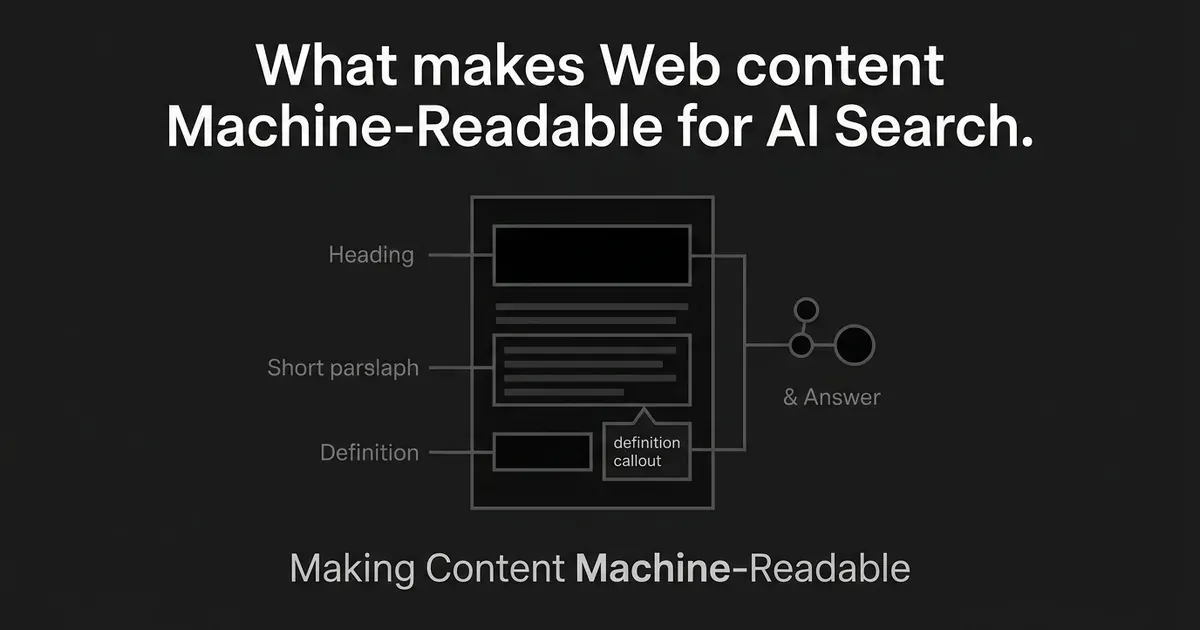
So what makes a passage self-contained? A useful working definition is that it carries four things: the entity (who or what the claim is about), the claim itself, the scope (the conditions under which it holds), and the limit (the boundary, like "in the US" or "as of 2025"). Strip any of those out and lean on the surrounding paragraph to fill the gap, and the passage breaks when it is lifted. The engine cannot quote it without distorting it, so it moves on.
Here is what that looks like in practice. A paragraph that jams three separate claims together, with no subheads and no clean break, offers the engine fewer quotable units than a page that gives each claim its own heading, its own fact, and its own boundary. You are not writing worse in the first case. You are building a page that is harder to extract from.
This is an architecture question, not a wordsmithing one. Can the page be chunked into standalone passages? That is eligibility. Whether you then wrote a genuinely great passage is the next layer, and it is a different spoke. If you want to see exactly how engines slice a page into passages, how LLMs select and extract citations traces the full path from question to quoted source.
Your Gate 2 check: pick any section of your page and read it alone, with nothing above or below it. Does it still make complete sense? If yes, it can survive extraction. If it only makes sense in context, it is not yet citable on its own.
Gate 3: Are your claims specific enough to quote?
A page can have clean, self-contained passages and still fail here, because AI engines quote claims, not commentary. If every passage is a vague restatement of a definition, there is nothing to lift into a footnote.
Picture the test the engine is running. Can it copy a sentence from your page straight into a numbered citation without editing it? That is the bar. When analysts reverse-engineered Perplexity's selection pipeline, one of the stages they identified was exactly this: an extractability check, asking whether a passage can be cleanly pulled into an answer.
So what disqualifies a passage at this gate? A few patterns:
- Definitional filler like "X is a tool that helps businesses do Y," with no number, date, or named thing in sight.
- Sentences that only hedge and add no fact.
- Anecdotes with no quotable claim underneath them.
And what qualifies it? Each self-contained passage should carry at least one of these:
- A number, percentage, or measurement.
- A date or a time bound.
- A named entity, whether a person, product, organization, or rule.
- A defined limit or condition.
- A direct comparison between two named things.
This gate is binary for each passage. It is quotable or it is not. And if not one passage on the whole page clears it, the page is not eligible, no matter how often it surfaces in retrieval. The page elements that get content cited are the specific ones, not the smooth ones. This is the heart of what makes content citable, and it is worth being honest with yourself about. Specific beats smooth. For a deeper look at the evidence formats engines actually quote in AI Overviews, that guide goes passage by passage.
Your Gate 3 check: highlight one passage and ask, "Is there a fact here a stranger could quote and attribute to me?" If you cannot find one, add one.
Gate 4: Is it clear who or what the page is about?
Entity clarity keeps showing up as a leading predictor of whether a page gets cited, and it works as a gate because an engine cannot attribute a passage to something it cannot identify. If it does not know who the claim is about, it will not risk citing you.
Engines read entities first and passages second. They treat a brand, product, or subject as a node with a name, a type, and attributes, then attach passages to the right node. If your page keeps that node fuzzy, the passage has nowhere clean to attach.
What does entity-clear look like on the page?
- The brand is named, in the same form, in the title, the first hundred words, and at least one heading.
- The product has one canonical name and gets described with its category, attributes, audience, and use case in the same passage where the claim lives.
- A claim about "the best X" names the X specifically. "The best accounting software for freelancers," not "the best software."
And what quietly breaks it?
- Passages that lean on pronouns. "It does X," with no noun nearby the engine can pin to an entity.
- Brand-name drift. "DeepSmith," then "Deep Smith," then "the platform," then "the tool," across four passages, so the engine cannot unify them into one entity.
- Claims with an implicit subject. "It is widely known that," without naming who knows or what.
None of this requires a rewrite. It usually requires a find-and-replace and a little discipline. Entity clarity is one layer of a broader trust picture, and the four-layer trust system for AI search shows where it sits alongside evidence and extraction.
Your Gate 4 check: read one citable passage cold and ask, "Could a stranger tell exactly who or what this is about, from these sentences alone?" If they would have to scroll up to know, tighten it.
Gate 5: Is the page fresh enough to clear the recency floor?
Freshness is part gate and part ranking signal. There is a floor below which a page is barely considered, and above that floor freshness becomes one signal among many. The floor is what we care about here.
The cleanest evidence comes from Ahrefs, which analyzed millions of citations across AI search platforms. AI assistants prefer fresher content than traditional search does. Their cited pages ran meaningfully fresher on average than the pages that simply rank, and a striking share of ChatGPT's top-cited pages had been updated within the last thirty days. Recency is not a nice-to-have. It is a threshold on most platforms.
Perplexity's pipeline reportedly tests recency as its own discrete step, right alongside entity clarity and extractability. Pages that fail it get moved out of the pool before anything else can lift them. Google leans on its broad, constantly refreshed index. Claude depends on whatever the source set contained at the time of the query.
Here is the part that trips people up. Freshness is about signals a crawler can read, not just about the date in your text. A page fails this gate quietly when:
- It shows a date in the body but no updated date in the metadata.
- Its publish date sits in a template corner the crawler cannot easily parse.
- Its evergreen claims went stale years ago and nobody refreshed them.
You do not need to churn content for its own sake. A page that was right from the start and is only a few months old still clears the floor. The goal is to stay above the line, not to rewrite weekly. If you want a system for deciding which pages earn a refresh first, which pages gain the most from content refreshes sorts that for you.
Your Gate 5 check: does the page carry a machine-readable updated date, and is its core information still true today? If both are yes, you cleared the floor.
Your five-gate eligibility self-audit
Here is the whole thing on one page: the five checks that make page eligible for AI citation, in order. Run them on any URL and stop at the first "no." That is your problem.
- Crawlable. Is the citation bot for each engine allowed in, and is the page reachable and (for Google) indexed with a snippet?
- Chunkable. Can you read a section alone and have it still make complete sense?
- Specific. Does at least one passage carry a fact a stranger could quote and attribute to you?
- Entity-clear. Could a reader tell who or what a passage is about from that passage alone?
- Fresh. Does the page carry a readable updated date, with information that is still true?
Pass all five and your page is a candidate. This is the citation eligibility AI answer engines gate on before any ranking begins, and it is where a lot of pages fail without anyone noticing.
Now, one honest note so you do not overclaim to your boss. Passing all five gets you onto the list. It does not guarantee the citation. From there, ranking signals like authority decide who wins among the eligible pages, which is why a page can clear every gate and still lose to a stronger source. And notice what is not on this list: schema. You do not need special markup to be eligible. Google is explicit that no extra schema is required for AI Overviews or AI Mode. Schema is a ranking and presentation concern, useful for improving AI citations once you qualify, not a ticket to the gate.
You are closer than you think
So, why does AI cite some pages and leave yours out? Almost never because your writing is weak. Notice how few of these gates are about writing talent. They are about access, structure, specificity, clarity, and freshness. Every one of them is fixable this week, on the page you are worried about, without a rewrite.
So do not try to fix all five everywhere at once. Pick your most important page. Run the five checks. Fix the first "no" you hit. That is your smallest next step, and it is the one that moves the needle.
If you would rather see which of your pages are actually being retrieved and cited across ChatGPT, Gemini, Perplexity, Claude, and Google AI Mode, and where a competitor is winning the gap, that is exactly what DeepSmith is built to show you. You can start a free trial and see your real pages, not a theory. Either way, you have the checklist now. Go clear a gate.