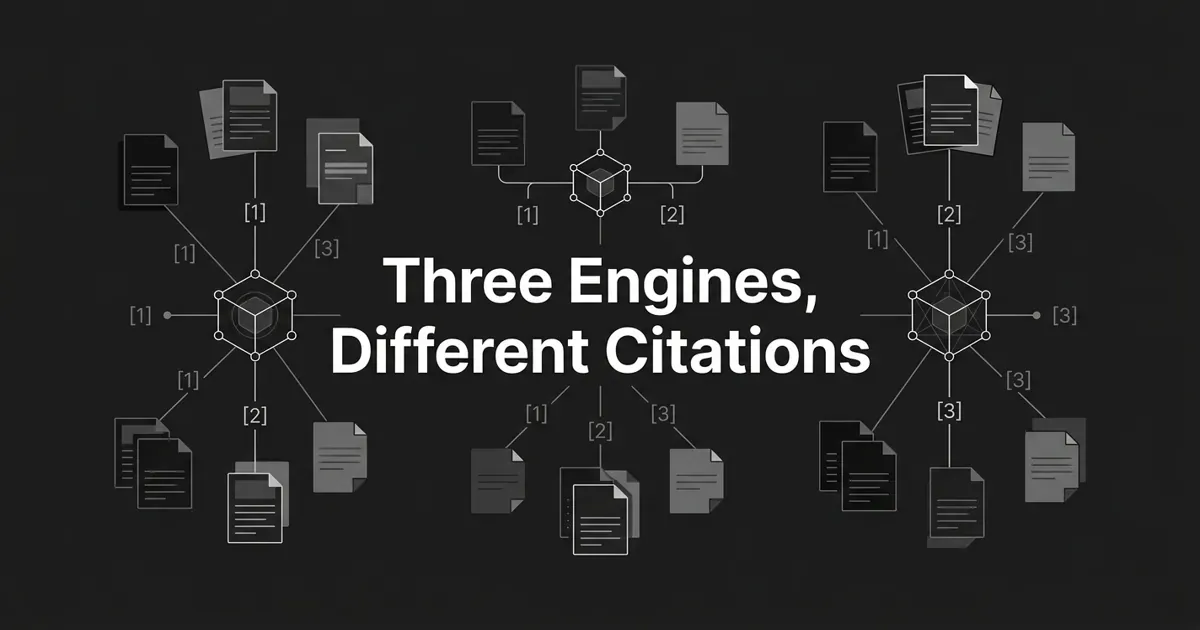
Most teams treat answer engine optimization as one discipline with one playbook. The evidence from citation-level analysis does not support that assumption. ChatGPT, Google AI Overviews, and Perplexity read different indexes, decide when to retrieve on different triggers, return very different numbers of sources per answer, and show those sources to the reader in different ways. The clearest single figure: only about 11 percent of domains get cited by both ChatGPT and Perplexity for the same query, and roughly 71 percent of all cited sources appear on just one platform. The ChatGPT vs Perplexity citations gap is not noise, it is structural. This comparison sets out the concrete citation differences AI engines display across four mechanics, so a content team can decide where a per engine AEO strategy earns its keep and where a single, well-built page is enough.
The four mechanics that separate the engines
Before comparing the platforms one by one, it helps to name what actually varies. Citation selection differs along four dimensions, and every meaningful difference between the engines reduces to one of them.
| Dimension | ChatGPT (with Search) | Google AI Overviews | Perplexity |
|---|---|---|---|
| Index source | Microsoft Bing web index plus direct publisher partnerships; roughly 87 percent of cited pages match Bing's top organic results | Google Search index plus the Knowledge Graph, read through retrieval-augmented generation | Own crawl (referenced at 200B-plus URLs) using hybrid keyword and embedding retrieval, with Bing as a supplement |
| Retrieval trigger | Probabilistic, not rule-based; search fires on about 46 percent of queries | Always live; runs retrieval on every query and fans out into related sub-queries | Always live; retrieval is a fixed stage in a multi-step pipeline |
| Sources per answer | About 7.92 on average; 3 to 6 clickable citations in browsing mode | Typically 4 to 8 source cards; about 82 percent of citations come from deep pages beyond the top organic results | About 21.87 on average; retrieves 5 to 10 pages per query and cites 3 to 4 |
| Link display | Inline clickable citations plus an end-of-answer sources sidebar; desktop hover shows a preview | Right-hand panel of source cards on desktop plus inline links; mobile collapses to inline only | Numbered inline citations throughout plus a bibliography; every citation is a direct link |
| Brand citation rate (Otterly, 1M citations) | 44.7 percent | 59.8 percent | 28.9 percent |
| Approximate click-through | Roughly 0.5 to 2 percent | Roughly 4 to 8 percent, the highest of the three | Roughly 0.5 to 2 percent |
The table condenses the argument, but the reasoning behind each column is where the optimization decisions live. The sections that follow take each engine on its own terms.
How ChatGPT selects citations
ChatGPT is the only one of the three engines that does not always search. In its default mode it answers from patterns learned during training, with no live retrieval, and in that state it can produce citations that point to URLs which do not exist. A brand earns a real ChatGPT citation only when the model decides to run a web search, and that decision is probabilistic rather than governed by a fixed rule. Analysis of 80 million queries attributed to Semrush puts the search trigger rate at about 46 percent, concentrated on current events, factual verification, and questions about specific companies, people, and products.
When ChatGPT does search, it queries the Microsoft Bing index, supplemented by direct licensing deals with named publishers such as the Associated Press, Reuters, the Financial Times, and Axel Springer. The dependence on Bing is the most actionable fact about the engine: a Seer Interactive study of roughly 129,000 domains found that about 87 percent of ChatGPT citations match Bing's top organic results, and pages in Bing's top three positions carried a citation rate near 63 percent. A brand invisible in Bing is, for practical purposes, invisible to ChatGPT.
Beyond the Bing prerequisite, reverse-engineered analyses converge on a familiar set of amplifiers. Structured answer capsules of roughly 120 to 150 characters placed directly after a heading are among the strongest predictors of citation. Original data helps materially, with pages carrying nineteen or more statistical data points averaging far more citations than data-thin pages. Recency matters at the margin, with content updated inside 30 days earning a meaningful lift, though ChatGPT is less recency-sensitive than Perplexity. Third-party presence on review platforms such as G2 and Capterra correlates with higher citation rates, while schema markup carries modest weight and does not compensate for weak domain authority.
One caution belongs in any honest account of ChatGPT citations: they are not always accurate. Independent testing, including work from the Tow Center for Digital Journalism, has found that AI search tools misattribute or fabricate sources at rates high enough that any brand claim resting on a ChatGPT citation deserves direct verification before it is repeated.
For link display, ChatGPT shows inline citations in the answer body only when search is active. Each is clickable, desktop users can hover to preview the source, and a sources button at the end of the response opens a sidebar listing every reference used.
How AI Overviews picks sources
Understanding how AI Overviews picks sources starts with a single behavior that neither of the other engines shares: query fan-out. Rather than answering the user's exact question against page one, Google generates several related sub-queries, runs retrieval-augmented generation across all of them, and synthesizes a summary grounded in citations drawn from the combined set. The consequence is counterintuitive. Citations frequently come from pages that never ranked on the first page for the original query. A Search Engine Journal analysis found that roughly 82 percent of AI Overview citations come from deep pages beyond the traditional top results, and that fan-out sub-queries can raise a page's citation odds by around 161 percent relative to the head query.
The index underneath is Google's own search index plus the Knowledge Graph, with the Gemini model family handling synthesis. Because the foundation is classic Google Search, the ranking signals that earn Overview citations overlap heavily with established SEO. A top-ten organic position functions as a baseline prerequisite, E-E-A-T remains the primary lens, and structured data helps: FAQPage, HowTo, Article, and Organization schema are associated with a roughly 40 percent higher chance of citation for pages already ranking in the top ten. Entity coverage and standalone answer blocks of 40 to 60 words after each heading reinforce inclusion, and pages refreshed inside the last twelve months are about twice as likely to be cited as stale ones.
Two behaviors make AI Overviews distinct in practice. First, its heavy fan-out into video means YouTube is cited far more than on a pure text engine, so brands with video assets have an additional surface to compete on. Second, Overviews produce the highest click-through of the three engines at roughly 4 to 8 percent, and brands cited inside an Overview tend to earn more organic clicks on the underlying results page even as the Overview depresses overall organic click-through. A citation here is comparatively valuable per impression, which raises the stakes of understanding how AI Overviews picks sources for any team that already invests in traditional search.
On display, desktop Overviews place a panel of four to eight source cards beside the summary, with inline links in the text mapping to those cards. On mobile the panel collapses and only the inline links remain.
How Perplexity selects citations
Perplexity is the most transparent of the three about the fact that it always retrieves. There is no parametric fallback; every answer is grounded in sources pulled at query time from Perplexity's own crawl, referenced at more than 200 billion URLs, using a hybrid of keyword matching and dense semantic embeddings, with Bing as a supplement. Reverse-engineered accounts describe a multi-stage pipeline in which the retriever pulls 5 to 10 candidate pages per query, a series of rerankers and a quality gate discard the weakest candidates, and only the surviving three to four sources are cited in the final answer. Perplexity has not published this architecture, so the stage-by-stage description should be read as a strong reconstruction rather than official documentation.
The headline number that separates Perplexity from the field is volume. Across all responses it returns an average of about 21.87 sources, close to three times ChatGPT's 7.92, even though any single answer visibly cites only three to five. This is part of why the ChatGPT vs Perplexity citations comparison shows so little overlap: the two engines are reading and surfacing largely different pools of content.
Perplexity's single most distinctive ranking signal is recency. It carries the strongest freshness bias of any major AI search engine, with content updated inside 30 days citing at roughly an 82 percent rate against about 37 percent for content older than a year, a 45-point premium. For time-sensitive queries, that advantage decays within days of publication, and its crawler revisits top sources every one to three days. The format signals reward front-loaded writing: a declarative answer in the first 100 words is extracted far more often, comparison tables and named researchers lift academic density, and Person schema with real credentials correlates with higher citation rates. Notably, raw backlink authority matters less here than on the other engines; the large majority of cited Perplexity pages carry very few referring domains, so a focused niche page can out-cite a major publisher.
Perplexity also exposes focus modes that swap the index entirely. An academic mode restricts retrieval to peer-reviewed journals, a social mode reaches Reddit and forums, and a video mode reads YouTube with timestamps, which means the same question can produce a completely different citation set depending on the mode selected. Its separate deep research mode runs dozens of searches and reads hundreds of sources before answering, a different regime again from the single-pass retrieval that governs everyday queries.
Display is where Perplexity earns its citation-first reputation. Numbered markers run throughout the answer, every one is a direct clickable link, and a formatted bibliography closes the response.
Where the three engines diverge most
The per-engine mechanics matter, but the decisive evidence for treating these as separate channels is how little their citation sets overlap. ChatGPT and Perplexity cite the same domain for the same query only about 11 percent of the time. Even inside Google's own stack, AI Overviews and AI Mode share only around 13.7 percent of cited domains. Aggregated across engines, roughly 71 percent of all cited sources appear on a single platform. A page tuned for one engine will, on average, miss the other two.
The source preferences reinforce the point. ChatGPT leans encyclopedic, with Wikipedia accounting for nearly half of its most-cited sources. Perplexity leans toward community discussion, with Reddit dominating its top sources. AI Overviews lean toward video and forums, with YouTube and Reddit leading. Reddit appears prominently in all three, but for different underlying reasons, which means even a shared favored domain is reached through different mechanics. These are the citation differences AI engines exhibit at the level that actually governs whether a given page gets pulled into an answer.
The engines also differ in how tightly they bind a claim to its source. In complex research questions, Perplexity ties roughly 78 percent of its claims to a specific cited source and ChatGPT ties about 62 percent, while Google AI Overviews reaches close to full coverage by design, because every inline link maps to a card in the source panel. For a brand, the practical reading is that a Perplexity or Overview citation is more likely to sit directly beside the claim it supports, whereas a ChatGPT answer more often blends cited and uncited material in the same passage.
Do you need to optimize per AI engine
The honest answer is conditional. Whether to optimize per AI engine depends on how much citation share matters to the business and how many engines the target audience actually uses. The 71 percent single-platform share is the strongest argument that a single generic page underperforms, because most of the citation opportunity sits outside whatever one engine that page happens to fit. At the same time, a great deal of the underlying work is shared: crawlability, clear entity definitions, front-loaded answers, and factual density help on every engine. A sensible per engine AEO program builds that common foundation once, then layers engine-specific moves on the pages that matter most.
The layering divides cleanly by content type and audience:
- For B2B SaaS, definitional, and how-to content, prioritize ChatGPT. The path runs through Bing: earn Bing indexing and top-three positions, add answer capsules after headings, and publish original data. Expect a lag of several weeks between a Bing ranking gain and a visible citation lift.
- For high-volume informational queries, evergreen topics, and brand searches, prioritize Google AI Overviews. The work is disciplined traditional SEO plus E-E-A-T, schema, strong entity coverage, and video, since a top-ten rank is the entry ticket and fan-out rewards depth.
- For time-sensitive, comparison-heavy, and research or product queries, prioritize Perplexity. Front-load the answer, keep data current on a days-not-months cadence, and lean on tables and named sources over raw domain authority.
If budget forces a single target, the brand citation rates offer a tiebreaker. Google AI Overviews shows the highest brand citation rate at 59.8 percent and the highest click-through, which makes it the highest-leverage single engine for most brands. That said, the 11 percent overlap means a one-engine strategy accepts leaving the majority of citation opportunity on the table, so single-engine focus is a budget compromise rather than a complete answer to whether to optimize per AI engine.
Tracking and producing for per-engine citation selection
A per-engine strategy creates an operational problem before it creates a content problem: a team cannot optimize for behavior it cannot see. Because the engines cite different pools and change their behavior over quarters, the citation picture has to be measured per engine and per prompt rather than inferred from a single dashboard number or the occasional manual spot check.
This is the layer DeepSmith is built for. It tracks mention and citation rates across ChatGPT, Perplexity, Gemini, Claude, and Google AI Mode, reporting per-prompt results and a per-platform breakdown so a team can see which engine is citing which pages, and where a competitor is winning that a brand is not. Coverage rises by plan: the Pro tier tracks ChatGPT, Grow adds Perplexity, Scale adds Gemini, and Enterprise covers all five engines. On the production side, the same platform generates AEO-formatted articles grounded in stored brand context, so the common foundation, front-loaded answers, clean structure, entity clarity, gets built into every draft rather than retrofitted. DeepSmith measures and produces; it does not control which sources any engine chooses to cite, and no honest tool can promise that outcome.
For teams that want to see per-engine citation data on their own prompts before committing, DeepSmith offers a 7-day free trial with real tracking data and real drafts, no long-term contract required.