AI is changing B2B go-to-market teams from groups that pass information between marketing, sales, revenue operations, and customer success by hand into human-and-AI systems that read the data continuously, recommend or handle the routine actions, and leave people responsible for strategy, judgment, relationships, and the calls that carry real risk. If you run a lean SaaS team, this matters more than whether AI can write your next email, because it changes how your team spends its week.
Most of the AI go-to-market conversation gets stuck on content: a tool that drafts a sequence, summarizes a call, or writes a one-pager. Those are useful, but they are still one person getting help with one task. The bigger shift is happening one level up, in how work moves between people and systems at all. That shift is worth understanding on its own terms, separate from an AI GTM strategy that starts and ends with content, and separate from B2B GTM AI framed only as a writing tool.
What actually changes when AI enters the GTM operating model
There is a real difference between AI as a task assistant and AI as part of the operating model. A task assistant helps one person finish one piece of work faster. An operating model connects the signals, decisions, handoffs, systems, and permissions across the whole revenue organization, and it changes five things at once.
It changes what the team notices, because AI can scan data sets that are too large or too scattered for a person to review by hand, and it surfaces accounts, risks, and patterns that would otherwise sit unseen in a CRM field nobody checks. It changes what the team decides, because AI can recommend a next-best action, a lead priority, or an account that needs attention today rather than next week. It changes how work moves, since AI can route a task, update a record, summarize an interaction, and trigger a workflow without someone doing it by hand. It changes who does the routine work, since AI can handle standardized research, qualification, and follow-up. And it changes what people are left holding: strategy, complex judgment, customer trust, exceptions, and the responsibility for whether an AI-supported decision was actually a good one.
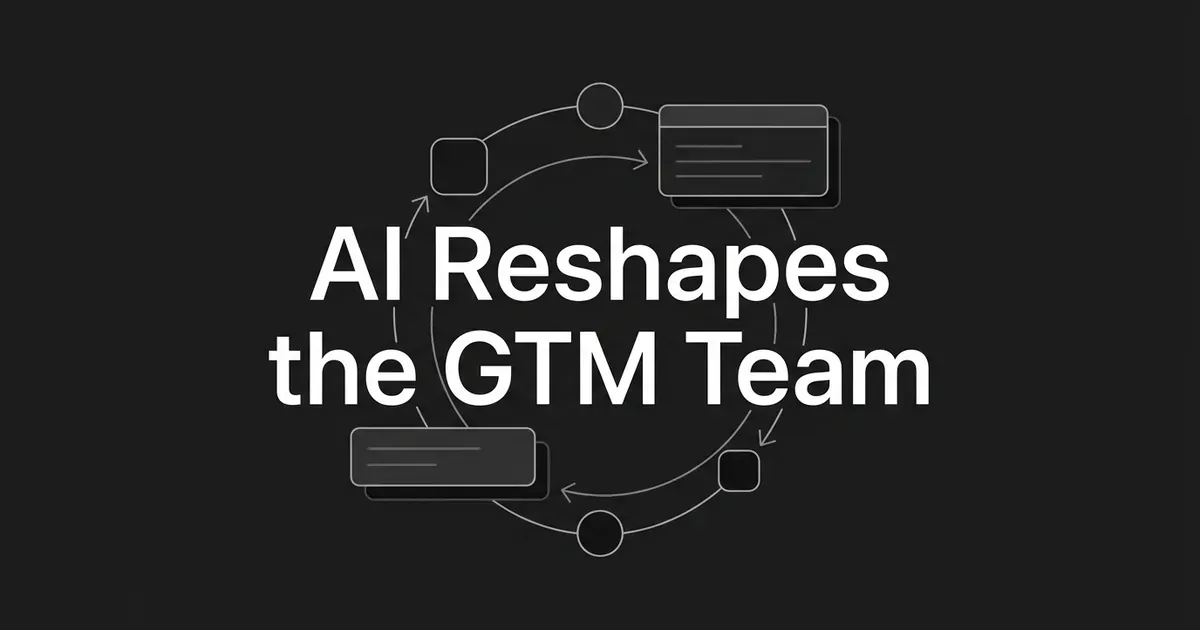
None of that runs quietly in the background. It is a closed loop: the team senses signals from CRM data, product usage, and buyer behavior, interprets what they mean, prioritizes which ones matter most, recommends the next move, executes the parts safe to automate, escalates anything sensitive to a person, and records what happened so the loop improves over time. Run continuously instead of in weekly batches, that loop is the real change, and it makes a feature like "AI writes a follow-up email" look like one small piece of something bigger.
Opportunity identification stops being a weekly exercise
A traditional GTM motion depends on someone sitting down, usually a rep or a manager, and manually deciding which accounts deserve attention this week. That review often happens in a spreadsheet, runs on whatever the person remembers, and goes stale the moment it is finished.
McKinsey has described AI's role here as finding the "next-best opportunity": pulling in disparate data sources, including unstructured material like PDFs and flat files, and consolidating it into a view a seller can actually use. For a small team, the practical effect is that opportunity review no longer has to depend entirely on someone's memory or a Friday-afternoon spreadsheet pass. A system can continuously flag accounts that fit your ideal customer profile, show a new signal, or look ready for an intervention.
That does not remove the need for a real definition of a good opportunity. AI does not invent your ideal customer profile, your qualification logic, or your territory rules for you. It just means those rules run all the time instead of once a week, which is a meaningful difference for a team too small to staff a dedicated pipeline review.
Next-best-action replaces generic activity lists
A typical playbook tells a rep to "follow up" or "nurture the lead," which is not really an instruction, it is a category. AI can be more specific: move a quiet lead into a longer nurture track, flag a deal whose activity pattern suggests it is stalling, or recommend that a specific account gets a call today because usage dropped last week.
McKinsey describes AI and machine learning as supporting these next-best-action calls across the whole deal cycle, not just at the top of the funnel. The operational change worth noticing is that teams start organizing around prioritized decisions instead of undifferentiated task volume. Instead of "here are forty leads, work through them," the system says which three matter most right now and why, and a person decides what to do with that.
Boston Consulting Group frames this as a spectrum rather than a single switch. In augmented selling, AI hands over talking points and recommendations, and a person still makes the call and does the customer-facing work. In assisted selling, AI listens to calls, drafts follow-ups, and updates records while the person stays focused on the conversation. In autonomous selling, AI prioritizes inbound demand, nurtures leads, and handles standard actions across touchpoints, while a person sets the boundaries and steps in when something is strategic or uncertain. Most lean teams will sit somewhere between the first two for a long while, and that is fine. The point is not to reach full autonomy, it is to know which level you are actually operating at for each workflow.
Seller research moves earlier in the process
Gartner has forecast that by 2027, 95 percent of seller research workflows will start with AI, up from under 20 percent in 2024. That is a forecast, not a finished measurement, but the direction it describes is already visible in how research gets done today.
The likely shape of that workflow: AI assembles an initial account or opportunity brief, the seller reviews the evidence and looks for gaps, AI proposes relevant questions or risks worth raising, and the seller applies judgment before ever talking to the buyer. This does not mean sellers stop researching. It means the human part of research moves higher up the chain, from collecting every fact by hand to judging which facts actually matter and whether the brief is missing something important.
That shift matters for a founder-led team especially, because the person doing outbound is often also building the product, and the time saved on assembling a brief is time that goes back into the parts of a sale that actually need a human: reading the room, handling an objection nobody scripted, and building enough trust that the buyer takes the deal to their own team.
Administrative work moves behind the scenes
Salesforce's sixth State of Sales report, released in July 2024, found that reps spend around 70 percent of their time on non-selling work, including admin and meeting prep. That number should land uncomfortably close to home for anyone who has watched a week disappear into CRM updates.
AI can take a real bite out of that by capturing and summarizing call details, updating CRM records, flagging missing or inconsistent information, preparing a meeting brief, and catching a pipeline or forecast anomaly before it becomes a surprise in the Monday review. The point of automating this work is not to free up sellers so they can be busier. It is to return that time to customer conversations and the judgment calls that actually move a deal, which is the part no system does for you.
RevOps becomes the function that keeps this from breaking
AI increases how much a small team needs revenue operations, even if that function is one person wearing several hats rather than a department. Deloitte has described RevOps as the coordinating function across data, planning, execution, enablement, and reporting, and the reason it matters more now is that AI needs someone managing the connective tissue underneath it: which data sources are authoritative, which systems an agent can access, which actions it can take on its own, who owns the workflow when something breaks, and how exceptions get escalated.
A small company does not need to build a large RevOps department to get this right. It does need one named owner for the operating system, the data definitions, the workflow design, and how results get measured. Without that owner, an AI go-to-market push tends to produce a pile of disconnected tools rather than a system, and a pile of tools is not an operating model.
This is also where enablement stops being a department-only service and becomes something closer to an ongoing capability across the team. Highspot's 2025 State of Sales Enablement report, drawn from roughly 350 professionals across enablement, marketing, sales, and revenue operations, found that 49 percent of teams were already using AI to support go-to-market work and another 41 percent planned to that year. Teams adopting AI at that pace need to learn how to interpret a recommendation, verify AI-generated research, and know when to accept, edit, or escalate an output, and that is a training problem as much as a software one. The same report found organizations using AI in coaching were 20 percent more likely to improve revenue outcomes, though that is a reported association from a vendor survey, not proof that the coaching alone caused the improvement.
Marketing, sales, and customer success start reading from the same signals
AI works best when functions share data and definitions instead of each running its own separate read on the customer. The same signal often means something different depending on who is looking at it: marketing might read a new account signal as a qualification opportunity, sales might read it as a reason to prioritize outreach, and customer success might read a change in product usage as an early expansion or churn signal.
That makes shared ownership of the outcome more important than the boundary between functions. It also creates a real risk: if every team keeps a separate data set, a separate AI tool, and a separate interpretation of the same customer, AI can multiply the inconsistency instead of removing it. A useful starting point is agreeing on shared objects and states across the team: account, lead, opportunity, customer health, expansion signal, churn risk, owner, next action, and escalation status, all defined the same way everywhere they show up.
Customer success in particular is moving from a post-sale service that reacts to tickets toward something closer to continuous monitoring: watching engagement signals, catching declining adoption early, predicting churn risk, and routing the accounts that are strategic or at risk to a person rather than letting a script handle them. BCG describes customer-success agents supporting adoption and flagging expansion opportunities from real-time usage data, and TSIA's 2026 research on customer success connects AI and data unification directly to retention and expansion outcomes. The human role stays especially important wherever an account is strategic, unhappy, or politically complicated, because that is exactly where a wrong automated move costs the most.
What this changes about the seller's actual job
The seller's work shifts away from manually finding and entering information and toward validating what AI already assembled, choosing among the actions it recommends, handling the exceptions and ambiguity that do not fit a pattern, and building the kind of trust a buyer needs before committing budget. BCG is clear that this is augmentation rather than replacement: humans stay central for large strategic accounts, while more autonomous handling fits smaller or more standardized deals better.
Managers change too, and probably more than sellers do. The job moves from inspecting activity volume toward designing the human-AI workflow itself: setting the escalation rules, coaching people on using AI with judgment instead of blind trust, reviewing outcomes rather than just inputs, and watching override rates and errors as closely as revenue numbers. Microsoft's 2025 Work Trend Index, built from survey data across 31,000 workers in 31 countries, found that 51 percent of managers already expect AI training and upskilling to become a core part of their job within five years, and that leaders broadly expect teams to be training and managing agents within that window. New roles may show up around this work too, things like workflow design, data governance, or AI coaching, though a small company is more likely to fold those responsibilities into an existing role than to hire for each one separately. What matters is that someone owns each piece explicitly rather than assuming a tool will manage itself.
Buyers are changing at the same time
AI is not only reshaping the seller's side of the table. HubSpot's 2025 State of Sales report, based on a survey of 1,000 sales professionals, found that 74 percent believed AI was making it easier for buyers to research products before ever talking to a rep. That produces a more informed buyer walking into the first conversation, which sounds like good news until you consider what "informed" sometimes means: a buyer arriving with an AI-generated answer that is confident, plausible, and wrong in some specific way.
Gartner reported in 2026 that 69 percent of B2B buyers prefer to validate AI-generated insights with an actual sales rep before trusting them. That is a useful data point for a founder-led team, because it means the seller's job is shifting toward validator and interpreter rather than a basic source of product facts. Sellers who can correct a wrong assumption gracefully, explain a real tradeoff, and speak to a buying group with mixed knowledge are doing work an AI answer cannot replace.
Where this breaks if you are not careful
AI cannot fix bad data, and confident output built on incomplete or conflicting records is a specific kind of risk, since the recommendation still sounds authoritative even when it is wrong. Before automating anything, it is worth deciding the authoritative source for each field you rely on, how stale or conflicting data gets handled, and what confidence threshold should trigger a human look before an action goes out.
Automation can also make a bad process faster without making it better. Automating a fuzzy qualification rule or an unowned handoff just means the mess happens at higher speed, which is worse, not better. And how much autonomy is appropriate should track risk: strategic accounts, sensitive customer issues, and anything touching legal or pricing deserve stronger human control, while routine qualification and administrative work can carry more automation without much downside.
It is worth being honest about the evidence, too. Salesforce reported that 83 percent of AI-using sales teams saw revenue growth in the past year, versus 66 percent of teams without AI, and that AI-using teams were more likely to have added headcount, not less. Those are useful signals, not proof that AI alone caused the difference. Teams that adopt AI early often already have stronger data, more mature processes, or more budget behind them, so read this as directional rather than a guarantee about your own results.
A starting point for a lean team
Start with a workflow inventory rather than a tool search. Map the recurring GTM work, from account research and lead prioritization to CRM maintenance, pipeline review, onboarding, and churn-risk monitoring, and for each one note the current owner, the systems involved, and where time actually gets lost.
Pick a low-risk, high-frequency workflow first, something repetitive, measurable, and easy to reverse if it goes wrong: account summarization, CRM hygiene, meeting prep, or lead routing are all reasonable starting points. Save strategic accounts, complex pricing, and anything sensitive for later, once you trust the workflow you built on lower-stakes ground. Every workflow you automate needs a named human owner responsible for quality and exceptions, because "the AI did it" is not an answer anyone can act on when something goes wrong.
Define the handoff clearly: what the AI is expected to produce, what evidence has to come with it, what the person checks before acting, and what confidence level triggers escalation instead of automatic action. Then measure outcomes rather than activity, things like time returned to customer conversations, CRM freshness, lead response time, and how often people accept or override the AI's recommendation. And decide in advance where the freed-up time goes. If AI removes a chunk of administrative work and nobody decides what replaces it, the freed capacity tends to just fill back up with more of the same kind of busywork, and you end up no further ahead than before.
The teams making real progress here are not the ones chasing full automation. They are the ones being specific about which decisions AI can make on its own, which ones need a person, and who is accountable either way. That specificity is what an AI GTM strategy actually is: not a bigger stack of tools, but a clearer answer to who or what owns each decision. Get that right and B2B GTM AI stops being a pile of point solutions and starts behaving like an operating system.