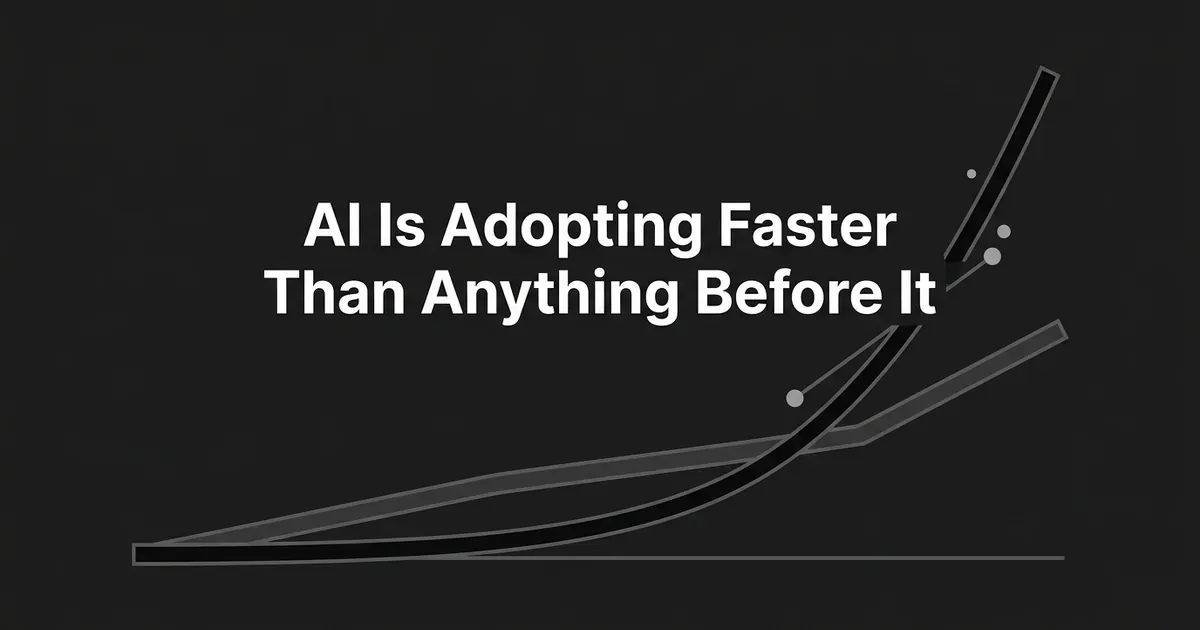
If you have watched people on your team pick up AI tools on their own, without anyone rolling out a plan, you are not imagining the pace. Generative AI has spread faster than the PC or the internet did at the same point in their early years. The AI adoption curve is steep mainly because people can try it right away, often for free, in plain language, and carry what works from home into their job before any company decision gets made. That is the honest version of the claim. Work adoption alone is closer to how PCs spread than the headline numbers suggest, and that gap matters for how you plan.
What "AI adoption" actually measures
"AI adoption" gets used to mean five different things, and mixing them up is where most claims about the pace of change go wrong.
- Awareness. Someone has heard of generative AI.
- Access or trial. Someone has used a tool at least once.
- Recent use. Someone used it in a set period, like the last week.
- Recurring work use. Someone uses it every workday, or it covers a real share of their work hours.
- Organizational deployment. A company reports using AI in at least one part of the business.
A person who tried ChatGPT once during lunch is not the same as a company that rebuilt a workflow around it. And a company reporting AI use somewhere in the business is not the same as most employees relying on it daily. For the rest of this piece, "adoption curve" means how fast a technology moves from launch to broad use, measured in years since a first mass-market product rather than by calendar year alone, since that is what makes the AI vs PC adoption and AI vs internet adoption comparisons apples to apples.
AI vs PC adoption: what the numbers show
The clearest side-by-side comes from a National Bureau of Economic Research working paper by Alexander Bick, Adam Blandin, and David Deming, first published in 2024 and revised in 2025. The authors line up three technologies against their own mass-market debut: the IBM PC in August 1981, commercial internet access from April 1995, and ChatGPT's release in November 2022. They then ask the same kind of adoption question of each, using a large, nationally representative U.S. survey of people ages 18 to 64.
Two years after launch, generative AI had reached about 39 percent overall adoption. The PC had reached about 20 percent after three years, a full year longer. That is the core of the AI vs PC adoption comparison: not just a higher number, but a higher number in less time.
The gap narrows sharply once you isolate work use. Generative AI reached 27 percent work adoption after two years, compared with 25 percent PC work adoption after three years. Those two figures are close. The overall lead comes almost entirely from somewhere else: non-work use. Generative AI hit 34 percent non-work adoption at the two-year mark, versus just 5 percent for the PC. People picked up a chatbot for personal use at a rate the personal computer never touched in its early years, and that is what pulls the overall AI adoption curve so far ahead.
A follow-up from the Federal Reserve Bank of St. Louis, published in November 2025, pushed the comparison to roughly three years after each technology's debut. Overall generative-AI adoption had reached 54.6 percent, against 19.7 percent for the PC at its three-year mark in 1984. The lead held and widened.

AI vs internet adoption: a similar story, with caveats
The AI vs internet adoption comparison runs on the same logic. Internet adoption stood at about 20 percent two years after commercial access opened in 1995, close to where the PC stood at the same stage. By the three-year mark, in 1998, internet adoption reached 30.1 percent, still well behind generative AI's 54.6 percent at the equivalent point.
This comparison carries more caveats than the PC one. The historical internet datasets used alongside the AI figures do not separate work use from non-work use, so you cannot run the same non-work breakdown that explains most of the AI-versus-PC gap. The starting point matters too: the researchers picked 1995 as the moment commercial internet traffic became possible, but plenty of people were online before that through universities and early providers, and a different starting year would shift the curve in either direction. The same caution applies to the PC comparison, where several computers already existed before the IBM PC's 1981 launch. Pick a different reference point and the numbers move, though the general shape of the story, AI adoption outpacing both, tends to hold up under reasonable alternatives.
One more note on precision: the Federal Reserve's own team found that its first estimate of August 2024 adoption undercounted usage because of how survey questions were ordered, and revised that figure up several points after retesting. Adoption numbers in this space are useful directional evidence, not a single fixed truth to quote forever.
Why AI spreads with so little friction
Three things explain most of the gap, according to the researchers, and none of them require a dramatic new theory.
No hardware to buy. Adopting a PC meant paying for a physical machine. Adopting the internet meant a modem and a service contract. Trying generative AI usually means opening a browser tab. There is no purchase order, no installation, no waiting on IT to image a new laptop.
Plain language instead of a learning curve. You do not need to know how to program or configure anything to ask a chatbot a question. Drafting a paragraph, summarizing a document, or rewriting a message for a different audience are things people already do in words, so the first experiment with AI looks almost exactly like the task it is replacing.
Personal use moves into work before anyone approves it. The researchers point to consumer-first adoption as the biggest reason the overall curve is so steep: people try a tool at home, find it useful, and bring it to their desk the next morning, well ahead of any formal rollout. OpenAI's own reporting on ChatGPT usage tells a similar story from the inside, describing the product reaching 100 million weekly active users within months of launch and workers picking it up without formal training. That is a vendor's account of its own product, worth reading as evidence of the pattern rather than as a neutral estimate of the wider market, but it lines up with the independent survey data.
Put together, these three things mean generative AI does not need a distribution network the way a PC or an internet connection did. It rides on infrastructure people already have.
Where the comparison gets misread
The most common mistake is treating a single adoption percentage as if it described your whole company. It does not, and the data says so directly.
Trying a tool once, using it every day, having it approved for a specific workflow, and seeing a measurable change in output are four different stages, and a team can be far along on one while barely started on another. The NBER survey found that only 9 percent of employed respondents used generative AI every workday, and that between 1 and 5 percent of total work hours involved it, even as overall adoption crossed 50 percent. People reported time savings equal to about 1.4 percent of total work hours, evidence that gains are plausible, not proof they have already shown up in the numbers everywhere.
Organizational surveys tell a compatible but separate story. The 2026 Stanford AI Index reports that 88 percent of surveyed organizations used AI in 2025 and 70 percent used generative AI in at least one business function, both up sharply from prior years. Useful as a sign that deployment keeps broadening, but the methodology behind those figures is not detailed enough to line up directly against the individual-level PC and internet comparisons above, so treat them as a separate benchmark rather than the same measuring stick.
None of this means the underlying claim is wrong. It means the honest version of "AI adoption is faster than anything before it" is specifically about how quickly people started trying the technology on their own, not a claim that every company has already rebuilt itself around it.
What this pace means for planning your content operation
A technology that spreads this unevenly, fast at the individual level and slower at the organizational level, punishes a plan built around one big rollout. It rewards a plan built around short, repeatable cycles.
A workable approach looks like this:
- Pick one bounded use case, not "AI for marketing" as a whole.
- Test it against a clear question: does it improve speed, quality, or coverage on that specific task.
- Write down who reviews the output and what has to pass before it ships.
- Watch whether use actually recurs, not just whether the pilot went well once.
- Expand only after the workflow holds up on its own.
It also helps to track more than one number. "Have people tried this" and "is this reliable enough to run without close supervision" are different questions, and a dashboard that collapses them into a single adoption percentage will tell you less than you think. Separate what people have tried, what they use regularly, which workflows are actually approved, and what those workflows produce once someone checks the work.
Because individual experimentation tends to run ahead of formal rules, it is worth putting basic guardrails in place early rather than after something goes wrong: what confidential information should never go into a prompt, how factual claims and statistics get checked before publishing, how brand voice gets preserved across a growing volume of output, and who signs off before anything goes live. None of that has to be heavy. It has to exist before volume makes it hard to retrofit.
For a team producing content at real volume, the practical version of this shows up as a shared base of brand and product context that every piece of writing draws from, so voice and facts do not drift as more of the work gets automated, paired with a way to see whether your pages are actually showing up when people ask AI tools questions in your category. DeepSmith's Deep IQ stores that brand and product context once and applies it to every article the platform produces, and its AI Visibility module tracks mention and citation rates across engines like ChatGPT and Perplexity, so you are not guessing at either side of the question. You do not need a platform to plan well here. You do need a way to keep the fast-moving, individual part of adoption from outrunning the slower, organizational part.
The pace is real, and so is the gap
Generative AI adoption has genuinely outpaced the PC and the internet at comparable points in their early years, and the reason is straightforward: low cost, no hardware, a language interface anyone can use, and a habit of moving from personal experimentation to work before a formal decision gets made. The part worth remembering, especially if you are the one planning around it, is that the biggest lead is in trial and non-work use, not in mature, governed, everyday deployment. Plan for a technology that people will keep trying faster than your organization can formally approve it, and you will be closer to the truth than either "everyone has already adopted this" or "this is moving no faster than anything else did."