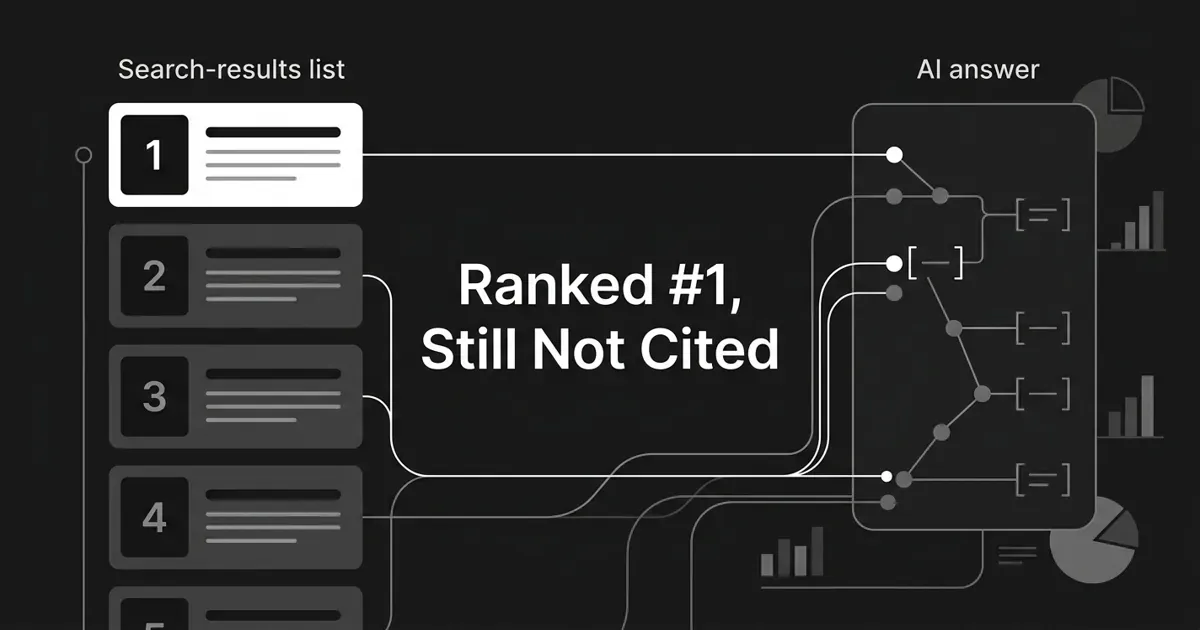
Ranking #1 in Google gets your page into the room. It does not get it cited in the AI answer. If that feels backwards, take a breath, because it is one of the most confusing shifts in search right now, and almost nobody saw it coming.
Here is the situation you are probably living. Your page holds the top organic spot. You earned it. Then you ask ChatGPT or Perplexity or Google's AI Overview the exact question that page answers, and your brand is nowhere. A competitor you outrank is sitting there in the citations instead.
You are not imagining it, and you did not do anything wrong. This is the story of ranking first but not cited by AI, and it is happening to strong pages every day. The searches people are typing say it all: "why isnt ai citing my page," "top ranking no ai overview citation," "google rank ai answer." Same confusion, different words.
By the end of this piece you will understand why the gap exists. Not a fix-it checklist yet, just the clear, calm reason your best page keeps getting skipped, so you know exactly where to aim next.
Ranking #1 Gets You Into the Room, Not Onto the Stage
Here is the good news first: your rank still matters. It helps your page get pulled into the pool of documents an AI engine considers. That is real, and you earned it.
The hard part is that the pool is not the answer. Getting retrieved is the door. Getting cited is the stage. Those are two different events, and rank only reliably buys you the first one.
The data backs this up, and it is more lopsided than most teams expect. In large studies of AI citations, holding the #1 organic spot only buys roughly a one-in-three chance of being cited in the answer. The median cited source does not even sit at position 1. It sits around position 2, with the next cited sources drifting further down the page.
So when you look at seo rank vs ai citation as two separate scoreboards, they only loosely agree. A big share of AI citations come from pages ranking below the top five. A meaningful chunk come from pages that do not rank in the top ten at all, and some from pages nowhere near the first page of Google.
There is a freshness angle sitting underneath this too. AI-cited pages tend to run a little fresher on average than the standard organic top ten. Not dramatically, but enough that a slightly newer page can edge out an older page holding the #1 spot. Rank rewards durability. Citations lean a touch toward recency.
And the gap is widening. Track the overlap between the organic top ten and AI citations over the last couple of years and you see it loosening, not tightening. The moat you built with rankings is still a moat. It is just no longer the same moat that wins the citation.
That is the whole tension in one line. Rank is an input, not the prize. That is what ranking first but not cited by AI really comes down to: two scoreboards, loosely linked, quietly drifting apart. Let's look at why they split in the first place.
Why AI Engines Choose Sources So Differently
The reason is simple to say and important to sit with: AI engines do not sort the web the way a results page does. People search "google rank ai answer" expecting the two to line up automatically, one feeding the other. They don't. A classic search ranks whole pages against a query and lines them up one to ten. An AI engine does something else entirely.
It retrieves a batch of candidate documents by meaning, not just keywords. It narrows that batch by relevance and trust. Then a language model re-reads the survivors and pulls only the passages it can lift cleanly and attribute. So the question is not "which page ranks highest," it is "which passage answers this best and can I quote it safely."
Picture it as a funnel. Hundreds of candidate documents get retrieved. That set shrinks to the ones that are topically on point. It shrinks again through a trust gate. It shrinks once more when the model judges which pages actually contain a clean, self-contained answer. Only a handful survive to become visible citations. Your #1 page can enter that funnel and fall out at any stage after retrieval.
This is really the heart of why isnt ai citing my page as a question. Your page cleared the retrieval step on the strength of its rank, then got beaten at a later step it was never built to pass.
It gets more surprising per engine. ChatGPT's search leans on Bing's index, not Google's. So a page that ranks #1 in Google can be nearly invisible to ChatGPT if Bing has not indexed it well. Perplexity runs its own retrieval-and-ranking pipeline over its own index, and it cites a much wider spread of sources than Google surfaces. Google's AI Overviews lean heavily on Google's own ecosystem and its own trust filters.
There is another wrinkle worth knowing. Before it searches, an engine often simplifies your question into shorter keywords, so the query it actually runs is not the polished phrase your page was optimized for. Small mismatch, real consequence.
And for some questions, the AI answer barely exists at all. Transactional and local searches trigger AI answers far less often than informational ones, so a page can rank #1 there and simply never show up in an answer box, because the box was never drawn. For sensitive money-or-health topics, engines lean hard on institutional sources, so a commercial page can lose to a government or university page ranking well below it. Same page, different query type, completely different odds.
Different engines, different rooms. Your Google rank is a key to one of them, not a master key to all of them.
The Query Fan-Out: One Question Becomes Dozens
Here is the single biggest reason a top page gets skipped, and it is oddly reassuring once you see it, because it is mechanical, not personal.
AI engines rarely search for your exact question. They break the question into a handful of related sub-questions, search all of them, and then synthesize one answer across the results. This is called query fan-out. A single prompt in Google's AI Mode can spin out several sub-queries at once, and deeper research modes can run many more.
Think about what that does to your #1 page. You rank for the head term. Wonderful. But the engine is not just asking the head term. It is asking five or ten adjacent questions around it, and citing the pages that answer those.
Picture someone asking how to start a podcast. The engine quietly fans that into questions about equipment, hosting, editing, and promotion, then builds one answer from the best source on each piece. Your definitive "how to start a podcast" guide might own the headline and still lose four sub-answers to four other pages.
If your page nails the main question and ignores the neighbors, a different page that covers the surrounding sub-questions racks up more matches across the whole fan-out and wins the citation. You were the best answer to one question. The engine asked twelve.
This is exactly why off-SERP and niche pages keep showing up in AI answers while the obvious #1 sits out. Those pages were never going to outrank you on the head term, and they did not have to. They just answered more of the surrounding questions. Pages that cover the full question space around a topic are meaningfully more likely to get cited than pages that only own the head term. It is not that AI dislikes your page. It just needed answers to questions your page never set out to cover.
Five Reasons Your #1 Page Gets Skipped
When practitioners line up hundreds of AI answers next to the pages that "should" have been cited, the same handful of reasons show up over and over. See if one of these sounds like your page.
-
It renders with JavaScript. If your key content only appears after client-side JavaScript runs, Googlebot may see it fine while AI crawlers see an empty shell. A page invisible to the crawler cannot be cited. This one quietly sinks a lot of strong pages.
-
The answer is buried. Your page opens with 400 words of brand story and context before the actual answer. Google is patient with that. AI engines want the first clean, direct answer block, and they reach for pages that lead with it.
-
Thin corroboration off the page. You have strong backlinks but few mentions of your brand and topic across the wider web. Models weigh that third-party reinforcement separately from links. A page can have the link profile of a champion and the mention footprint of a stranger.
-
A long guide loses to a short comparison. Your 4,000-word pillar ranks beautifully. For a "which is better" style question, a tight 600-word comparison page often gets cited instead, because the answer shape fits the question better.
-
No clean definition. Your page explains the concept beautifully in flowing prose but never says "X is Y" in one liftable sentence. Models love a quotable, self-contained statement. A paragraph that circles the definition rarely gets pulled, even when it is the smartest thing on the page.
None of these mean your content is bad. They mean the page was built to rank and read, not to be extracted. That is a fixable mismatch, not a verdict on your work.
The E-E-A-T Gate Nobody Told You About
There is one filter that sits between retrieval and citation, and it is closer to pass-or-fail than a gentle slider. Engines check for experience, expertise, authoritativeness, and trust before a page is eligible to be quoted at all.
In one analysis of thousands of AI-cited pages, nearly all of them carried strong trust signals. The rest is a rounding error. And the ranking twist lands hard here: a page sitting at position six with strong trust signals gets cited more often than a #1 page with weak ones. Rank does not rescue a page that fails the trust gate.
What feeds that gate is not what most SEO teams optimized for. Branded mentions across the web correlate with AI citations far more strongly than raw backlink counts. Named authors matter too. Content with a real byline, a bio, and visible credentials gets cited noticeably more than anonymous or corporate-only pages.
There is a compounding gap hiding in the mention data. The brands with the most mentions across the web pull dramatically more AI citations than the tier just below them, and it feeds itself. Mentions build trust, trust earns citations, citations drive more mentions. If you started late, that loop can feel discouraging. It is also exactly why a focused push on trust signals moves the needle faster than chasing more links. This is the real shape of the seo rank vs ai citation gap: it is not a glitch in the system, it is the system working as designed.
So if your top page is a strong, well-linked, but faceless corporate URL with no clear author and few brand mentions around the web, you have found a big part of your answer. It ranks. It just does not read as trustworthy to the filter that decides citations.
This is where the top ranking no ai overview citation problem usually lives. The page is good enough to rank and not yet trusted enough to quote.
What Actually Earns the Citation
Let's turn the corner, because knowing the pattern is most of the battle. You do not need to rebuild everything. You need to make your best pages extractable and trustworthy, which is a smaller job than it sounds.
At a high level, cited pages tend to share a few traits. They answer the question in the first breath, near the top, before any preamble. They break ideas into clean, self-contained passages a model can lift without the surrounding context. They use clear headings that mirror the questions people actually ask. They carry structured data, which correlates with a real lift in citation rates. They show a named author, credentials, and honest publish dates. And they cover the neighborhood of sub-questions around the head term, not just the head term itself.
That is the shape of a citable page. The full, step-by-step version is its own guide, and it deserves the room. For now, hold the throughline: extractable plus trustworthy plus complete beats "ranks #1" almost every time.
From Ranking to Being Cited: Your Next Step
Take a breath, because here is where it gets doable. The gap you have been staring at is real, but it is also a map. It tells you exactly which of your pages rank yet never get cited, and that is the shortlist worth fixing first.
There are two moves from here. The first is the fix itself: the citation-eligibility checklist a page has to clear to become quotable. That is a separate, tactical piece, and it is the right next read once you know a specific page is the problem.
The second move is seeing the gap clearly in the first place. You cannot fix what you cannot see, and most teams have never had a view of which pages earn AI citations versus which merely rank. This is the part DeepSmith is built for. Its AI Visibility tracks your mention rate, citation rate, and share of voice across the engines your plan covers, prompt by prompt and page by page, with a competitor leaderboard so you can see who is winning the citations you are missing. Coverage scales by plan, from ChatGPT on the entry tier up to ChatGPT, Gemini, Perplexity, Claude, and Google AI Mode together.
You do not need a bigger team to start. You need to see which pages rank and which get cited, side by side, so your next article aims at the gap instead of guessing. Want to see it for your own pages? You can start a free DeepSmith trial and track your own prompts across the AI engines your buyers actually use.
Ranking #1 was never the prize. The citation is. And now you know exactly why the two came apart, which means you already know where to point your effort next. That clarity is the hard part, and you have it.