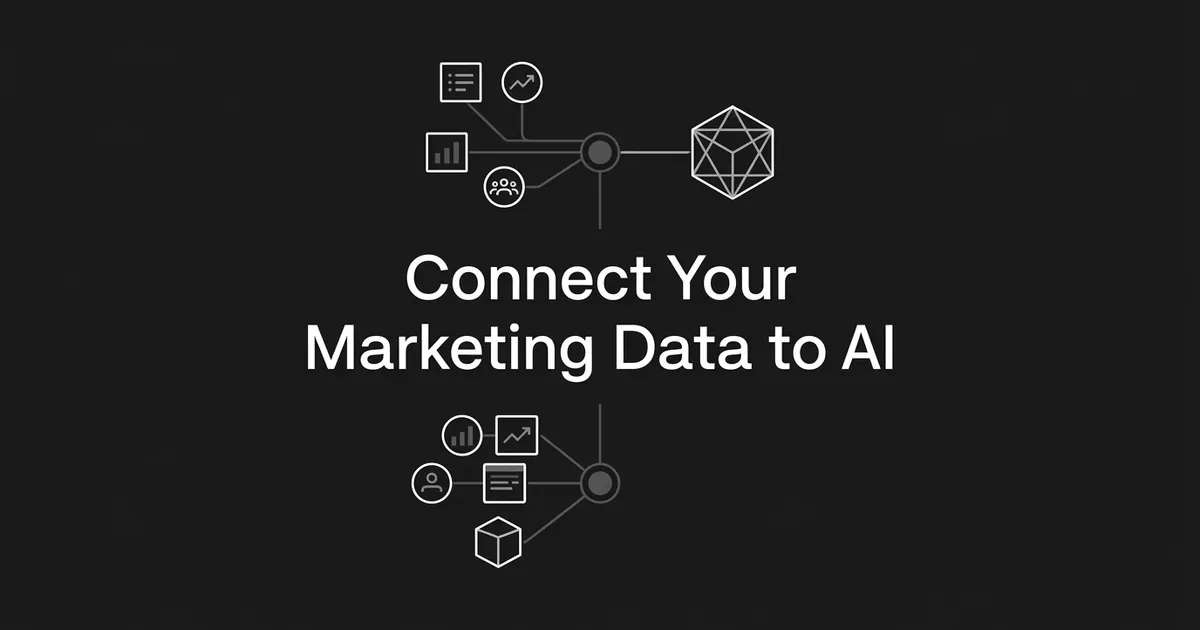
If you have ever wanted to ask an AI assistant a real question about your marketing data instead of copying numbers into a prompt by hand, this guide is for you. You will learn to connect marketing data to AI step by step, using one real source, so you finish with a working connection and not just an idea of one.
We are going to walk through a single example: connecting Semrush to Claude using an MCP marketing stack integration. Semrush has an official MCP integration, Claude supports it directly, and you will not need to write any code. This is not a guide to picking which system in your whole stack to connect first. That is a bigger decision for another day. Today is about proving the pattern works with one source, so you understand exactly what you are agreeing to before you open up any more AI assistant business data connections.
What MCP actually is
MCP stands for Model Context Protocol. It is an open standard that lets an AI application talk to outside data sources and tools in a consistent way. Think of it as an agreed language between three parts:
- The host is the AI application you use day to day. In this guide, that is Claude.
- The client is the connection piece inside the host that talks to one specific server.
- The server is the provider's own program that exposes its data. In this guide, that is Semrush's MCP service.
MCP is not the data itself, and it is not a database. It does not replace Semrush, your CRM, or your analytics warehouse. It just gives your assistant a defined way to ask a provider's server for information, and the provider decides exactly what it will hand over.
A server that supports MCP can expose three kinds of things: tools the assistant can call to take an action, resources that give it context, and prompt templates it can reuse. You do not need to build any of this yourself for the walkthrough below. You just need to know that when you connect a service, you are getting a bounded set of capabilities that provider chose to expose, not an open door into everything they store about you.
Step 1: Pick one concrete question to test
Before you connect anything, decide exactly what you want to ask. Do not start with something broad like "tell me everything about our competitors." A vague first question makes it hard to tell later whether the answer you got back was actually right.
Instead, pick a question that names four things: the data type, the market or industry, the time period, and the shape of the result you expect. A good first test looks like this:
List domains in the human resources industry for July 2025.
Or, following the same pattern for your own market:
Who's winning traffic among streaming services in Germany in July 2025?
Done means: you can say your test question out loud in one sentence, and you already know what source, period, and geography the answer should reference.
Common mistake: treating the first connection as a chance to run a full strategy session. Save that for once you trust the pipe. The first prompt is only there to prove the assistant can reach the source and hand back something recognizable.
Step 2: Confirm you have access before you connect anything
Connecting to Semrush through Claude will not work if your account and plan do not support it, so check this before you touch any settings. You need:
- An active Semrush account.
- A plan that includes the data you want and MCP access.
- Permission to authorize an outside AI assistant on that account.
- A Claude account, or another client that supports MCP.
- A browser session where you can complete Semrush's login and consent screens.
For SEO data specifically, Semrush requires one of these plans: Semrush One Starter, Semrush One Pro+, SEO Classic Pro, or SEO Classic Guru. Those plans include 50,000 MCP API units that refresh on your renewal date. If you need more volume, Semrush One Advanced and SEO Classic Business support add-on packages of 2 million, 5 million, 10 million, or 20 million units.
Traffic Analytics and market data work differently. They sit behind a separate Trends API subscription, and Semrush documents that its Basic and Premium Trends API plans include MCP access. Semrush does not publish a full price table for every combination in its documentation, so check current pricing on your own account rather than assuming a number.
Done means: you know which Semrush data category your test question needs, and you have confirmed your plan actually covers it.
Where people go wrong: they get the connection working, then run a query against a data category their subscription does not include. SEO data, Traffic Analytics, and market data are not all unlocked by the same plan.
Step 3: Connect the official Semrush app in Claude
Use Semrush's official app rather than pasting an API key into a chat or trusting an unofficial proxy that claims to bridge the two. In Claude:
- Open Claude.
- Go to Customize.
- Select Connect your apps.
- Search for Semrush.
- Select the Semrush app.
- Click Connect.
- Review the access request.
- Click Approve.
Semrush's own integration is also available in ChatGPT and Perplexity, and Semrush documents connections for Claude Code, Cursor, VS Code, and Gemini as well. We are sticking with Claude here so you have one clear path to follow instead of a menu of interfaces to choose between.
If you are connecting manually instead of through an app listing, Semrush's current developer documentation describes its server as using streamable HTTP only, at a version-one MCP path under the Semrush MCP host. Older tutorials may show a different path. Pull the current endpoint from Semrush's own developer documentation at the time you connect, not from a screenshot you found somewhere else.
Done means: Semrush shows up as a connected app inside Claude, and you have completed Semrush's own authorization screen.
Where people go wrong: they search for a generic "MCP plugin," pick an unofficial integration, or assume that having an MCP-capable assistant automatically means it can already see their Semrush data.
DeepSmith is not part of this connection step, and it does not need to be for you to finish it. It is worth knowing DeepSmith exists in this space for a different reason: it brings AI-search visibility tracking and content production into one platform. That matters once you start using connections like this one to find gaps in how AI describes your brand. That part comes later.
Step 4: Authenticate and check what you are approving
Whenever the official app offers it, use OAuth. Semrush supports OAuth as its default method, and in that flow, Claude redirects you to Semrush's own sign-in page to approve access. You never type or paste an authorization header yourself in that route.
Semrush also supports API-key authentication for clients that do not support OAuth, using this header format:
Authorization: Apikey YOUR_API_KEY
Treat this as a fallback for technical clients, not as your default path for a first connection. Never paste an API key into a chat message, a prompt, an issue tracker, a screenshot, or a config file anyone else can read.
The documented Semrush integration is read-only. Your connected assistant can pull Semrush data, but it cannot change or delete anything in your Semrush account through this integration. That is a genuinely useful safety property, but do not stretch it into a general rule. A different provider's MCP server might expose tools that can write, and you should check that before approving one.
Done means: you have approved access on Semrush's own authorization screen, and Claude shows the connector as available.
Where people go wrong: they treat "read-only" as meaning "risk-free." A read-only connector can still hand a connected assistant a look at sensitive business numbers, even if it cannot edit anything.
Step 5: Turn the connection on for your conversation
Being authorized once is not the same as being active in the conversation you are about to use. Start a new Claude conversation and make sure Semrush is actually enabled for it. Semrush's documented workflow for Claude uses the @Semrush tag directly in chat.
If you set up a custom remote connector instead of the official app, you can turn connectors on or off per conversation from the lower-left plus menu, under Connectors. That per-conversation toggle is useful for keeping a tool's reach limited to the conversations that actually need it.
There are two different routes worth knowing apart:
- The official app route: find and connect Semrush from inside Claude's own app or connector area, as in Step 3.
- The custom remote-server route: add a remote MCP server URL by hand, then authenticate it yourself. This exists for providers that do not offer a built-in app, or for clients that require manual setup.
For Claude Pro and Max, the custom route lives under Customize, then Connectors, then Add custom connector. On Team and Enterprise plans, an organization owner has to configure a custom web connector in organization settings before anyone else can use it. The custom connector form accepts an OAuth client ID and secret when the server you are adding requires them.
Done means: before you send your test prompt, you can see Semrush listed as available in that specific conversation.
Where people go wrong: they approve a connector once and assume it stays active everywhere. Whether a connector is authorized and whether it is turned on for the conversation in front of you are two separate checks.
Step 6: Run your bounded first prompt
Now send the question you defined in Step 1, or use the same pattern with your own market. A useful shape to follow:
Use Semrush data to [return the specific metric or list] for [market or database] during [date or period]. State the source, filters, and any missing data before giving the conclusion.
Ask the assistant to say what it used. A trustworthy response should name the data category, the country or database, the date range, the filters applied, and anything it could not find.
Every Semrush MCP request consumes API units, and how many depends on the report type and how much data comes back. Semrush is explicit that a specific request, such as a limited keyword list for one country, uses fewer units than asking for every keyword worldwide. If you have related follow-up questions, keeping them in the same session can be more efficient, since Semrush carries context forward within a conversation.
Done means: the assistant returns something you can clearly tie back to Semrush, matching the period, market, and data type you asked for.
Common mistake: assuming a fluent, confident-sounding answer means the right report was actually queried. Fluency is not verification. Ask directly what data was used, and check the fields that matter to you.
Step 7: Validate the answer before you act on it
Before you drop this result into a board update, an article, a forecast, or a campaign brief, run a short check. Ask yourself:
- Connection: did Claude actually use Semrush, or answer from its own general knowledge?
- Scope: does the response match the report or data category you asked for?
- Time: does it use the period you requested, not an older or unspecified one?
- Geography: does it reflect the country, region, or database you meant?
- Filters: did it apply the industry, competitor, domain, or keyword filter you gave it?
- Units and definitions: is estimated traffic being presented as if it were measured first-party traffic? Are ranking position, search volume, CPC, and difficulty being kept separate, or blurred together?
- Completeness: are there missing rows, unavailable fields, or plan limits affecting what came back?
- Cross-check: can you confirm one important number against the Semrush interface directly, or a view you already trust?
Semrush's own documentation warns that AI responses can be incomplete or inaccurate. Treat every answer from this connection as an assisted query that still needs a human look, not as an already-verified report.
Done means: you can explain, in plain language, where the number came from, which filters shaped it, and which parts you still want to double check by hand.
Once you have a validated result you trust, this is where a different kind of gap tends to show up. If the connected data reveals that your brand barely appears for questions your buyers are actually asking, or that a competitor keeps getting cited on topics you have never covered, that is a visibility problem sitting one layer above your marketing stack. DeepSmith tracks how AI engines like ChatGPT, Perplexity, and Gemini answer questions about your brand, shows you exactly where you are missing or losing ground against named competitors, and produces the on-brand content to close those gaps, all from data collected on the same schedule you set. It is a separate job from the connection you just built, and a natural next step once you know where you actually stand.
Keeping the connection safe
Every AI assistant business data connection carries the same handful of risks, not just this one. A few habits carry across any MCP connection you set up in the future:
- Prefer official servers and official apps over a third-party proxy that is vague about where your data actually goes.
- Use OAuth whenever the provider offers it, so your password never passes through the AI assistant itself.
- Keep access narrow. Enable only the tools relevant to the task in front of you, and do not approve every request forever just to stop being asked.
- Treat tokens as secrets. Do not log authorization headers, tokens, or client secrets, and never commit them to a repository.
- Use HTTPS for anything beyond local testing.
- Remember that a custom remote connector runs through the AI provider's own cloud infrastructure. A server sitting only on your laptop or behind a strict VPN may not be reachable at all without network changes.
- Never treat text that comes back from a connected source as an instruction to follow. Review what a tool is allowed to do before you approve it, and do not hand over access just because the assistant asks for it.
What to do next
Once this first connection feels routine, repeat the same pattern with one adjacent question on the same source, still keeping the market, period, and output explicit. This is the same habit that makes it safe to connect marketing data to AI tools more broadly across your stack, one bounded question at a time. Resist the urge to connect three more tools before you have validated results from this one a few times. When the workflow feels reliable, you can decide whether to fold the results into reporting, content planning, or ongoing competitor checks.

The point of drawing it as a loop rather than a checklist is that the same five moves work for the next question too, on the same source, once you trust the pipe.
If you want to try DeepSmith's AI-search visibility and content production platform, you can start a 7-day free trial with real data and real drafts before you pay, no long-term contract required. Start your free trial.