You typed your own core question into ChatGPT, and a competitor came back instead of you. That stings. If your brand not showing up in AI answers has you refreshing the same prompt hoping the result changes, take a breath. This is a fixable problem, and it is usually not the mysterious black box it feels like.
Here is the good news. Your absence almost always traces to one of five specific layers, and each layer has a known fix. The hard part is not the fixing. It is knowing which layer is actually broken, because working on the wrong one can burn months and change nothing.
This article is your diagnostic map. Treat it as a calm, ordered approach to AI visibility troubleshooting, not another pile of tactics to try at random. By the end, you will know which of the five layers is blocking you, and exactly which deeper guide to open for the repair. Let's find your layer.
Why Ranking on Google Doesn't Put You in AI Answers
A page can rank number one on Google and still be invisible inside ChatGPT. That single fact explains most of the confusion, and it is the first thing to make peace with.
Traditional search and AI answers run on different machinery. Google ranks a list of pages and hands you links. An AI engine reads across many sources, decides which brands and passages to trust, and writes one answer that names a few of them. Being findable is not the same as being quotable. So when you wonder why AI doesn't cite my brand despite strong rankings, the honest answer is that ranking is one input, not the whole system.
This reframe matters because it changes where you spend effort. If your brand not showing up in AI answers is really a trust or structure problem, no amount of new keyword ranking will move it. You have to find the actual broken layer first. That is the whole point of going in order.
Think of your visibility as a stack with five layers, checked in this order:
- Crawl access: can the AI engine reach your content at all?
- Retrieval eligibility: once fetched, is your page usable for an answer?
- Content structure: can the model lift a clean answer from your page?
- Authority: does the model trust your brand enough to name it?
- Recommendation eligibility: does your brand clear the final gates to be recommended?
The order matters more than anything else here. A problem at Layer 1 makes every fix above it useless, because nothing you improve on the page will ever be read. So we go bottom up. Work each layer in turn, and stop at the first one that is broken. That is your answer.
Layer 1: Crawl Access (Are You Blocking the Bots?)
The single most common reason a brand is invisible in AI answers is that its own site is blocking the bots that need to read it. Before you rewrite a word, check this. It is the fastest possible win.
Open your robots.txt file right now and look for blanket disallow rules. A stale User-agent: * / Disallow: / left over from a staging lockdown will quietly hide you from everything. Many sites also added aggressive AI-bot blocks during the content-scraping worries of a couple of years ago, then never revisited them. If that is you, your absence is self-inflicted, and reversible today.
Here is the piece most teams miss. AI crawlers come in two flavors, and they are not the same decision.
Training bots ingest content to teach future models. These include GPTBot from OpenAI, ClaudeBot from Anthropic, Google-Extended for Gemini training, Applebot-Extended, and Common Crawl's CCBot. Blocking these is a licensing and compensation choice. It has limited near-term effect on whether you get cited today.
Retrieval bots fetch pages live to build the answer a user is reading right now. These include OAI-SearchBot and ChatGPT-User from OpenAI, PerplexityBot and Perplexity-User, and Claude-SearchBot and Claude-User. Block these and you are directly choosing not to appear in real-time answers. This is the lever with the most immediate impact.
So the reflexive "block all AI bots" setting is the expensive mistake. If you are not appearing in ChatGPT answers and you find these retrieval agents disallowed, you have likely found your problem in one line of a text file.
One nuance worth knowing. Blocking Google-Extended does not hide you from Google's AI Overviews or AI Mode. Those pull from Google's standard index through the normal Googlebot, so that token only governs whether Gemini learns from you.
If this layer is your block, the fix is a careful robots.txt edit, not a content project. Confirm the retrieval bots you care about are allowed, then move up the stack.
Layer 2: Retrieval Eligibility (Crawled but Not Considered)
Crawl access is not the same as being considered. A bot can reach your page and still set it aside, because several technical signals decide whether a fetched page is usable for an answer. If Layer 1 is clean and you are still absent, this is the next place to look.
Start with rendering. Most AI crawlers read the HTML that comes back on the first request. They often do not run JavaScript. If your main content only appears after a script executes, many bots see a nearly empty page. Fetch your most important pages the way a bot would, using a tool that requests raw HTML with a bot user-agent, and confirm the body text is actually there. Sites built as heavy single-page apps fail here constantly, and the fix is server-side rendering or pre-rendering for content pages.
Then check the quiet blockers. An accidental noindex tag on a page you want cited will keep it out. So will conflicting canonical tags that point the bot to a different version of the URL, or parameter sprawl that splits one page into ten near-duplicates. Give the bot one clean, canonical version to keep.
Sitemap hygiene matters more here than in classic SEO. AI crawlers lean on your sitemap.xml because they lack Google's deep map of the web's link graph. Keep it clean, keep lastmod dates honest, and keep your URL structure flat and predictable.
Speed plays in too. AI bots tend to run shorter timeouts than Googlebot, so slow pages get crawled less deeply. A page that takes too long to respond can simply be skipped.
You may have heard about llms.txt, a proposed file that summarizes your site for language models. It is a low-cost experiment worth trying if you are curious. Be honest with yourself about it though. Adoption is still thin, the evidence that it lifts citations is mixed, and Google has said its AI features do not use it. Treat it as a small side bet, not the fix.
Layer 3: Content Structure (Can the Model Lift a Clean Answer?)
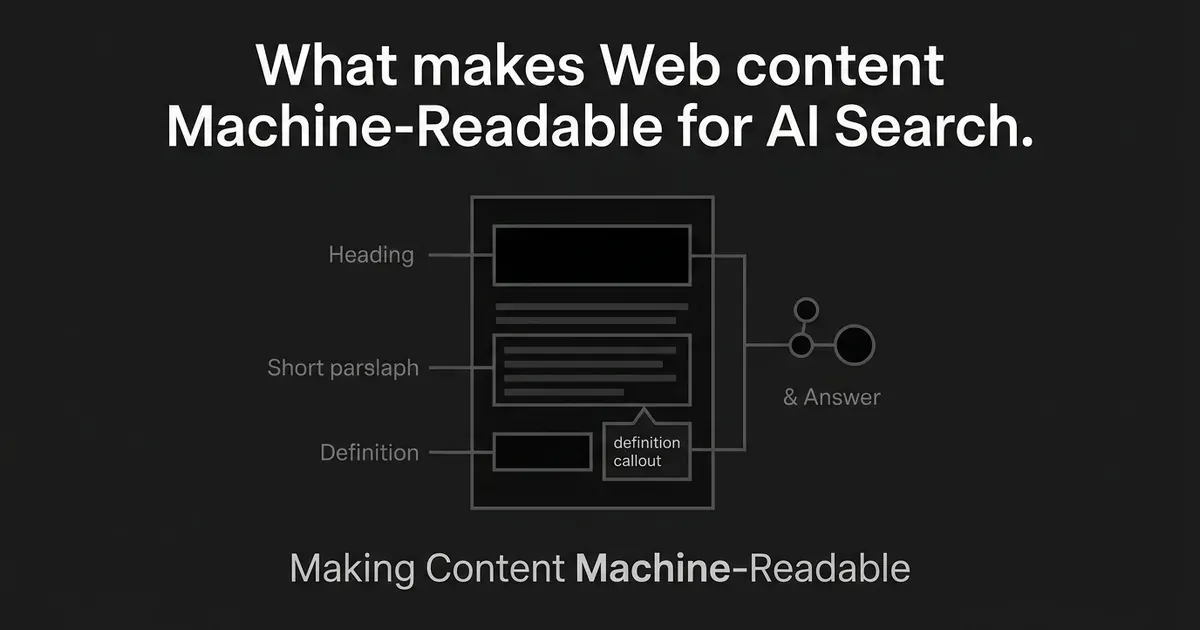
AI engines extract passages, not whole pages. The unit of citation is usually a few sentences that crisply answer one question. So the real question for this layer is simple: can a model lift a clean answer from your page without doing any work? If yes, you become easy to cite. If no, you get skipped even when the information is right there.
Lead every section with the answer. Put the short, direct response in the first sentence or two under each heading, then elaborate. This is the same pattern that wins featured snippets, and it wins AI citations for the same reason. Burying the answer three sentences deep, after a warm-up about your company's mission, is the most common structural failure there is.
Shape your headings as the questions buyers actually ask. "How is this priced?" beats "Pricing." "What is the difference between X and Y?" beats "Comparison." Natural-language headings match natural-language prompts, and they give the model a clean handle to grab.
Make each passage stand on its own. A section should make sense to someone who never read the paragraph above it. Watch for pronouns that only resolve if you read in order, because a model may pull that chunk out alone.
A few formats punch above their weight. Language models lean heavily on lists and tables for anything comparative or enumerable, so structure those answers accordingly. Content with a named author, linked primary sources, and original data gets pulled more often than a generic explainer that could have come from anywhere. If your pages read like undifferentiated AI output, they compete with everyone and win nowhere.
Here is your diagnostic move. Pull up the pages that AI engines currently cite in your category, and set yours beside them. Where is the answer? How are the headings written? What does theirs have that yours does not? The gap you spot is usually your Layer 3 work.
Layer 4: Authority (Does the Model Trust You Enough to Name You?)
AI engines do not rank pages the way Google does. They decide who to name using a rough, probabilistic sense of which brands belong in which categories, built from how often you are mentioned across the web and in what company. This is the layer that trips up teams with great SEO and thin reputations.
Mention volume and diversity are the core signal. A brand named across fifty review pages, a dozen listicles, several Reddit threads, and a handful of podcasts has a strong category association. A brand named only on its own website does not, no matter how good that website is. The model has almost no outside evidence that you belong.
This is why mentions can matter more than links here. Language models build category association from co-occurrence, from seeing your name near the right topics again and again. That is a different currency from the backlinks that drive classic SEO. A brand named in fifty relevant places with zero backlinks can hold a stronger category association than one with fifty backlinks from unrelated sites. Mentions build presence. Links build search rank. You need both, but do not assume your link profile is buying you AI trust.
Consistency compounds it. If different sources describe you with different names, categories, or positioning, you blur the model's picture of who you are. Keep your brand facts steady everywhere they appear, so the signals reinforce instead of fighting each other.
Third-party credibility feeds the same machine. Reviews on the sites buyers trust, press coverage, analyst mentions, and a clean presence on the reference sites models lean on all raise your standing. Research into cited sources keeps finding the same pattern: citations concentrate heavily on a small set of high-authority domains, with a large share of ChatGPT's citations coming from domains with very strong authority scores. You do not have to be one of the giants. You do have to build enough real-world footprint that the model stops treating you as a stranger.
Your diagnostic here is a search night. Look for your brand across Reddit, the major review sites, YouTube transcripts, podcast show notes, and industry newsletters. Then look for your competitors in those same places. The spots where they show up and you do not are your authority to-do list.
One reassurance before you spiral. Authority is slow, but it is not gatekept. You do not need to be the biggest name in your space to earn a mention. You need to be present and consistent in the places your buyers already trust. Pick three of those places this month and go earn one honest mention in each. That is how you fix AI search visibility at this layer, one real footprint at a time.
Layer 5: Recommendation Eligibility (Known but Not Recommended)
This is the layer most teams never think to check, and it is the most frustrating. A model can resolve your brand, retrieve your pages, and quote your facts, and still refuse to recommend you. Researchers have started calling this the recommendation gap. You are known, and you are still not named.
The signals here are about fit, not access. Models filter candidates by whether you look like the right kind of answer to that exact prompt. A high-priced enterprise tool rarely surfaces for a "best free" query. A brand whose positioning is vague, or contradicts how buyers describe the category, gets filtered out before the answer is even written. If your site never states plainly what you are, who you are for, and what you cost, you fail this test quietly.
Comparative substance is the second gate. Models recommend brands they can describe with concrete, comparable attributes: pricing tier, integrations, deployment model, ideal customer, honest limitations. If your pages are all positioning language and no specifics, the model has nothing to compare, so it reaches for a competitor that gave it the facts.
Reputation and policy gates finish the filter. Models tend to steer around brands with heavy unresolved complaints or review-site red flags, even well-known ones. And for sensitive categories like medical, legal, and financial topics, they apply a stricter source bar before naming anyone at all.
How do you know this is your layer? Test it directly. Run "best X for Y" and "X versus Y" prompts across the engines your buyers use. If you show up when the model states facts about you, but vanish the moment it makes a recommendation, you have found the recommendation gap. Ranking for facts and losing on recommendations is a distinct problem with a distinct fix.
This is often the real reason why AI doesn't cite my brand for the prompts that actually drive revenue. The model is not confused about who you are. It just does not have enough concrete, comparable substance to feel safe naming you as the answer. Give it the specifics, and you give it permission.
Match Your Symptom to the Right Layer
Not sure where to start? Start here. Match what you are actually seeing to its most likely layer, then go straight to the fix for that layer. This table is the shortcut for AI visibility troubleshooting when you do not want to read all five sections in order.
| What you are seeing | Most likely layer | What to do next |
|---|---|---|
| Brand never appears in any AI answer | Layer 1: Crawl access | Audit your robots.txt for blanket disallow rules |
| Competitors appear but you don't, on similar pages | Layer 2: Retrieval eligibility | Check rendering, indexability, and sitemap hygiene |
| Models describe you inaccurately or paraphrase badly | Layer 3: Content structure | Rework pages into answer-first, self-contained passages |
| You are mentioned in facts but never recommended | Layer 5: Recommendation eligibility | Add concrete comparative attributes and clear positioning |
| You appear on some engines but not others | Layer 4: Authority | Build category mentions across third-party sources |
| Your citation rate dropped after a model update | Layers 2 to 4 | Recheck retrieval, structure, and authority signals |
| Mentions exist but citation links don't | Layers 3 and 4 | Strengthen liftable passages and third-party footprint |
| Information about you is outdated and keeps repeating | Layer 3 | Refresh the stale pages models keep pulling from |
One symptom, one likely layer, one next move. If two layers feel plausible, always fix the lower-numbered one first, because it sits underneath the other.
How to Run the Diagnostic Without Fancy Tools
You do not need an expensive platform to run this diagnosis. You need disciplined testing and a willingness to look at three things: your prompts, your logs, and your rendered pages. Let's keep it simple.
Test prompts by hand first. Write down twenty to thirty questions a real buyer would ask, then run them across the engines your audience uses. For each one, record whether you appear, where, whether the answer links to you, and which competitors show up instead. That single spreadsheet tells you more than most dashboards.
Inspect your logs next. Pull your server logs and filter for the AI bot user-agents from Layer 1. Are they even visiting? Are they getting a clean response, or an error or a timeout? A bot that never arrives, or arrives and fails, explains a lot.
Then test your rendering. Fetch your key pages with a bot user-agent and confirm the full body content comes back without JavaScript. If it does not, you just confirmed a Layer 2 problem with your own eyes.
Manual testing is perfect for a first pass. It stops scaling once you are tracking many prompts across many engines and watching them shift week to week. That is the point where a platform earns its keep, by running the prompts on a schedule, tracking mention and citation rates per engine, and showing which competitor pages are winning the citations you want.
This is the loop DeepSmith is built to close. It tracks where you show up across ChatGPT, Perplexity, Gemini, Claude, and Google AI Mode, surfaces the gaps where you are invisible, and then produces on-brand content to fill them, all from the same shared context. The value is not just seeing the gap. It is going from diagnosis to a published fix without starting a separate project every time.
Your Visibility Is a Stack, Not a Trick
Here is the throughline to hold onto. AI visibility is a stack, not a single trick, and the five layers depend on each other. Fix the wrong one and nothing moves, which is exactly why so many teams pour effort into content while a stale line in robots.txt quietly holds them back.
So resist the urge to do everything at once. Run the diagnosis bottom up. Find the lowest layer that is broken, fix that one, then re-test before you climb higher. You are probably closer than the empty AI answers make you feel, and one honest pass through these five layers usually surfaces the real culprit.
Want the whole loop in one place, from tracking to fix to publish? You can start a DeepSmith free trial and see your real gaps and real drafts before you pay. Find your layer, fix your layer, and get your brand back into the answers your buyers are reading.