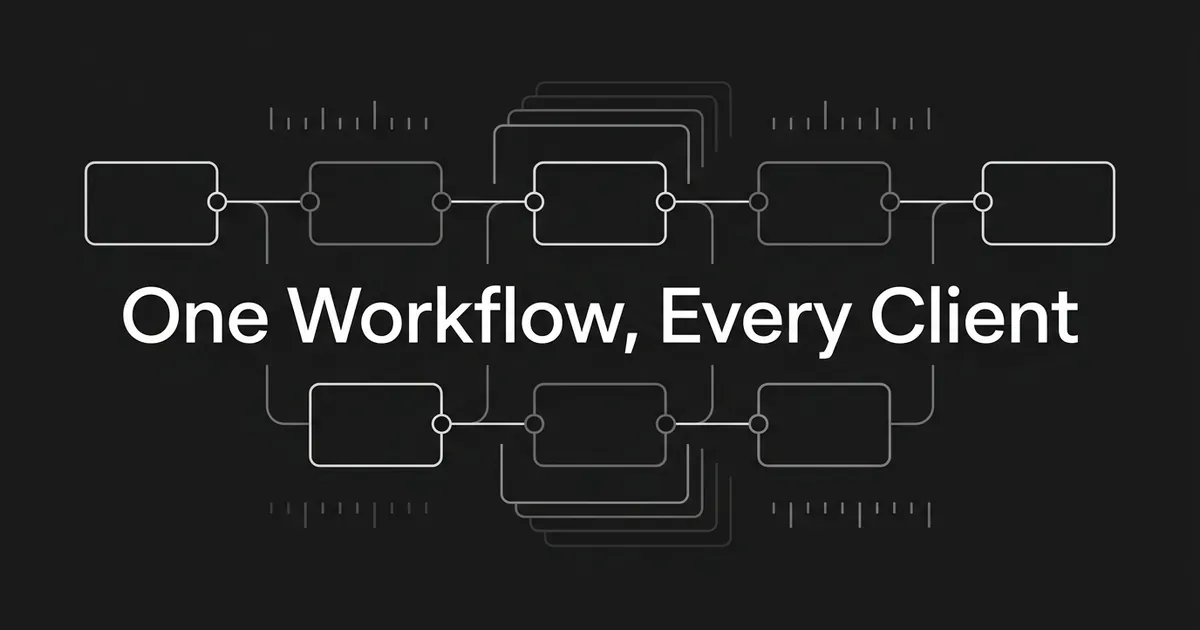
Producing for one brand is a workflow. Producing for eleven is an operations problem.
If your drafts are landing faster than your approvals, that's normal. AI took the slow part out of production and left every other part exactly where it was. The briefs, the reviews, the client who goes quiet for nine days, the version nobody can name.
Here's the good news: you don't need a bigger team to fix this. You need gates. The agency editorial workflow AI actually rewards is the one with clear stages, named owners, and a decision at the end of each. This guide walks you through a nine-step multi-client content process that takes a piece from client-approved idea to published article, with one owner at every stage.
The rule that holds it together is simple. AI can remove the mechanics. It cannot remove accountability.
Step 1: Separate every client before production starts
Give each client one isolated working environment. Their brand context, product facts, personas, competitors, trusted sources, content queue, and publishing destination all live in that one place.
Then set one operating rule for your team: never produce a client asset from a shared or ambiguous context.
Every task starts by naming the client workspace and confirming the content type, the buyer stage, and where the piece will be published.
This is where DeepSmith fits early. It runs each client as a separate workspace from one account, with its own brand context, competitor set, tracked prompts, and content queue. Deep IQ holds that context as structured records: positioning, products, personas, voice, content types, and approved sources. You set it up once per client instead of re-briefing per article.
How you know it's done. Before an idea enters production, you can name the workspace, the account owner, the delivery owner, the client's approved claims, the products in scope, the persona and stage, the agreed voice, the trusted source set, the client's review and publishing contacts, and the target date.
Where agencies go wrong. Treating client context as a prompt someone retypes from memory each time. That's how voice drifts, how product facts go stale, and how one client's example shows up in another client's draft.
Isolation lowers that risk. It does not delete it. Check the client name, workspace, product, and audience before anything leaves the building.
Step 2: Lock the brief and the approval route
Before any research or writing starts, agree on the brief with the client's authorized decision-maker.
Your brief should name the topic and working title, the audience and buyer stage, the objective, the content type, the angle and scope, the claim boundaries, required or forbidden sources, the distribution destination, the target publication date, the client reviewer, the final client approver, the review deadline, the included revision rounds, and what happens if a deadline is missed.
That's a long list. Write it once per client as a template and you fill it in minutes after that.
A brief is not a writer's prompt. It's the first approval contract for the asset. It stops a client approving one scope and then reviewing something else entirely.
Pick the approval model per client
Don't force the same client content approval workflow on every account. Choose one and write it into the agreement.
- Single approver. One named client decision-maker signs off. Other stakeholders can comment, but their input gets consolidated for that person. This suits general thought leadership and lower-risk SEO work where the client has one clear marketing owner.
- Multi-role gated. The piece moves through sequential client reviewers: a subject-matter expert, then legal or compliance, then the brand lead. Each gate has an owner and a stated reason for any revision. This suits regulated work in finance, healthcare, legal, and pharma.
- Auto-approve with exceptions. You publish on the agreed cadence unless a piece trips a defined exception, like a new product mention or a material factual claim. Treat this as earned, not default. Agency guidance suggests considering it only after a client has approved several months of content without significant rejection.
How you know it's done. You can answer every one of these before production: what is this for, who is it for, what's in scope, what's out, who reviews it internally, who approves it for the client, what's the response deadline, what counts as an approval, and what happens if nobody responds.
Where agencies go wrong. Letting strategic questions surface at final approval. If the client is still deciding whether the topic is right after the piece is written, the brief was never really approved.
Common mistake: treating the client as an open-ended editor. Your client is a decision-maker inside an agreed process, not an unlimited source of new briefing work.
Step 3: Turn an approved idea into a grounded draft
Only brief-approved ideas move into production. That one rule saves a surprising amount of rework.
A production sequence that holds up across a roster looks like this: confirm the idea and brief, research the topic, build the outline, draft, add internal and external links, apply SEO and AEO structure, generate or pick the cover image, prepare the publishing metadata, then drop the result into a review queue.
Notice the last item. The pipeline ends in a queue, not on the client's site.
This is where an AI content workflow agency teams can actually run starts to pay for itself. In DeepSmith, Content Studio covers that pipeline end to end, and the Writer turns one planned idea into a finished article with research, internal and external links, a cover image, and publish-ready metadata already built in. Autowrite can be configured at planning time so a scheduled piece writes itself on its date and lands in Produced Content for review.
Scheduling production is a real win when you have eleven queues to feed. Scheduling is not approval.
Set article-level controls from the brief, not from a house default. Depth, length, and link counts should come from the content type you agreed with that client.
Per client, also define what production must respect: the words they use for their products, the claims they can and cannot make, approved product facts, audience sophistication, voice, required structure, internal link destinations, trusted external sources, and any compliance constraint.
How you know it's done. The draft carries the approved angle and audience, a complete structure, research behind every factual claim, the client's own product language, relevant links, AEO-friendly formatting, metadata for the destination, and a status that says it's ready for internal review.
Where agencies go wrong. Describing AI output as self-approving. A near-final draft is near-final, not verified. And never let scheduled production skip a gate unless the contract spells out an exception path and the piece passed it.
Step 4: Run your internal quality gate
Every draft gets an agency review before the client sees it. This gate runs first, and it is separate from client review.
This is the gate that makes an agency editorial workflow AI drafts flow through feel like editorial work rather than forwarding. Give your editor a fixed checklist rather than intuition. Five buckets cover it.
Brief fit. Does the piece answer the approved question? Is the angle still in scope? Right audience, right buyer stage? Has anything strategic crept in that nobody approved?
Client accuracy. Are product names, features, and capabilities correct? Are claims supported by approved client information? Are comparisons fair? Are prohibited or unverified claims genuinely absent?
Brand and editorial quality. Does it sound like the client? Is the generic AI phrasing gone? Is the structure clear, are explanations precise rather than inflated, are the examples right for this audience?
Search and technical. Clear answer near the top, descriptive headings, relevant internal links, appropriate external sources, complete metadata and slug, working links, images with alt text.
Risk. Does anything here need a specialist? Legal, medical, financial, regulatory, or a big statistical claim? Has that reviewer been assigned? Does the piece trip an exception under this client's approval model?
Keep reviewers and approvers separate. Reviewers improve the work. Approvers decide whether it moves. Your editor recommends; your account lead decides it's fit to send.
How you know it's done. The checklist has been used, required changes are in, the account lead confirms it still matches the brief, any specialist review is complete, the exact client-facing version is frozen and labelled, and the handoff message is written.
Where agencies go wrong. Sending raw AI output straight to the client. That hands your editing, fact-checking, and strategic cleanup to the person paying you, and it makes you look like a relay service instead of an editorial partner.
The second mistake is three reviewers editing three copies. Keep comments and versions in one place so the account lead can settle conflicts before the client ever sees them.
Step 5: Send one controlled version to the client
After internal approval, make a formal handoff. Not a draft dropped into a chat thread.
Your handoff should carry the client and asset name, the content type and channel, a version number and date, the approved objective, the review deadline, the named approver, specific review instructions, the decision options, where to leave comments, how many revision rounds are included, an escalation contact, and the publication target.
Label the version plainly. Something like Northwind - Cost of Downtime guide - v1.2 - 9 Apr is enough. Your client approves a specific version, never a document that keeps moving underneath them.
Pick one submission channel per client and stick to it. A portal, a shared folder, a review tool, it genuinely does not matter which. What matters is that the submission creates a timestamped record and keeps the official comments in one place. That record is the difference between a content handoff clients can act on and a message they have to decode.
How you know it's done. The client can answer all of these without replying to ask: what am I reviewing, which version is this, what do I need to do, by when, where do I comment, who makes the final call, and what happens if I want changes.
Where agencies go wrong. "I sent it over" with no record behind it. Email, chat, and hallway comments create parallel versions, and six weeks later nobody can prove which copy was approved.
The other one is asking for review while you're still editing. Freeze the client-facing version. Issue a new one after revisions.
Step 6: Collect one decision from one accountable approver
Set a response deadline and make the decision format explicit. Five options are plenty:
- Approve
- Approve with minor edits
- Request changes
- Hold, with a reason and a next decision date
- Reject, with a reason tied to the brief
A workable service level agreement has four parts: the named approver, the number of working days to respond, what counts as a valid response (written approval or written change requests, not a thumbs-up emoji), and what you do when the deadline passes.
How long? Set it in the contract. Agency workflow guidance offers a few practical examples: a 48 to 72 hour window, three working days for a single-approver client, five to seven working days when a piece passes through multi-role gates. Treat those as starting points to adapt, not benchmarks. Your number depends on the client's risk, their stakeholder count, and your publishing cadence.
Build the escalation path before you need it. Reminder to the named approver at the deadline. Then the alternate or account lead. Then a list of stalled assets and their publication impact to the client lead. Apply a deemed-approval or production-pause rule only where the agreement says so explicitly.
Never treat silence as approval unless the contract says silence is approval.
How you know it's done. You have a written decision from the named approver, comments consolidated in one place, a clear list of requested changes, a confirmed next action, and the response date on record.
Where agencies go wrong. Committee approval. If everyone can approve and nobody owns it, the piece just sits there.
Vague feedback is the second one. "Make it stronger" and "this doesn't sound like us" are not actionable. Ask the reviewer to tie the comment to the brief, the voice, a product fact, the structure, or a compliance rule.
Step 7: Revise once, then record the decision
Apply the agreed changes, keep the version history, and return only the changed version.
Sort every request into one of three buckets before you touch anything:
- Correction: a factual, grammatical, link, formatting, or compliance fix.
- In-scope revision: wording, structure, examples, or emphasis, with the approved brief intact.
- Scope change: a new audience, angle, topic, keyword target, product, format, or channel.
Corrections and in-scope revisions belong in the round you sold. Scope changes are a new brief or a change order. Name that difference out loud with the client the first time it comes up, and it stops being awkward after that.
Define the included revision count in the statement of work. One round and two rounds are both common choices in agency practice. Pick yours deliberately and write it down.
Version discipline, every single time: increment the number, record the date, preserve the previous version, summarize what changed, and confirm whether the client is re-approving the whole piece or only the specified changes. Never overwrite an approved version.
After the last revision, get a definitive approval for the exact version you intend to publish.
How you know it's done. Every request is addressed or explicitly declined, out-of-scope requests are separated out, the final version is identifiable, the approver has approved that exact version, the approval date and approver are recorded, and your publishing owner has the right file and instructions.
Where agencies go wrong. Letting "small edits" become an unlimited rewrite. If the angle, audience, or deliverable changes, stop and re-brief.
And approval of v1 is not approval of v2. The record has to name the version.
Pro tip: use a three-field decision form. Decision, requested changes, approver name. It's far easier to act on than a forty-message thread.
Step 8: Run final QA and publish
Final QA is not another round of strategy. It confirms that the approved content is the content going live, and that publishing hasn't introduced a new error.
Walk the list: correct client and workspace, correct approved version, title and slug, metadata, headings and formatting, links and their destinations, images and alt text, product names and factual claims, any required disclaimer, mobile rendering, CMS destination, publication date and time, author and category, canonical and indexing settings, and the approval record attached to the asset.
Give this stage entry and exit criteria like every other one. A publishing owner schedules, formats, and deploys the approved version. Publishing is not an opportunity for a new reviewer to reopen a settled decision.
DeepSmith's Produced Content works well as that review queue. You preview the live article, edit the body, title, and slug if something needs it, and publish straight to WordPress, Webflow, Strapi, Sanity, or Contentful, or to your own webhooks. Markdown and HTML export are there when a client's stack is unusual. The gate stays visible either way: DeepSmith produces and optimizes, and you read, approve, and publish.

How you know it's done. The exact version has final approval, QA is complete, the right destination is selected, the piece is deployed or handed off, the live URL is recorded, and everyone knows the process for a post-publication correction.
Where agencies go wrong. Pushing to the CMS before approval, or publishing a different version from the approved one. Make approval a prerequisite for the publish action, not a habit.
Assuming an integration removes QA is the other one. Integrations remove copying and formatting. They don't confirm you picked the right workspace, version, metadata, and destination.
Step 9: Repurpose the approved article and close the record
Distribution assets come after approval, never before. Treat repurposing as a derivative of an approved source, not a second editorial project.
Build the formats the client actually bought: a LinkedIn post, an X post, a newsletter, a nurture email, a Medium or Substack version, a community adaptation, an internal announcement.
Each derivative preserves the approved claim set and the client's voice. If one introduces a new claim, a new audience, an offer, or a compliance risk, it goes back through the right gate.
DeepSmith helps here too. Finished articles arrive with social posts already written, and the Apps Library turns one piece into platform-native versions for LinkedIn, X, Medium, Substack, newsletter and nurture email, Reddit, and more. The platform writes them. Posting and scheduling stay yours.
Then close the record. It should hold the client and asset name, the approved version, the brief, the research notes, internal review completion, the client approval and approver, the approval date, publication confirmation, the derivative assets delivered, and any open follow-ups.
That record is what protects you when an account changes hands. Nobody should be reconstructing a decision history out of someone's old inbox.
Give every stage one status and one owner. Use statuses that name the next action, not vague ones like "in progress." Brief needed. Brief approved. Planned. In production. Internal review. Ready for client review. Client review. Revision in progress. Approved for publishing. Scheduled. Published. Repurposing. Closed. Blocked, with a reason. Each status gets one owner and one exit condition. "Client review" exits when the named approver gives a valid decision, and not before.

What to do next
Take a breath. You don't have to roll this out across the whole roster this week.
Pick one client. Write the brief template and the approval route for that account. Name the approver and the response deadline in writing. Run three pieces through the full path and watch where they stall.
The stalls tell you what to tighten. Then copy the workflow to the next account, and the one after that. A client content approval workflow gets stronger by being used, not by being designed longer.
Set the same content handoff clients can act on every time, and the review conversation stops being a negotiation. It becomes a decision.
Want to test the production half against real client work? Start a DeepSmith free trial, set up one client workspace, produce a grounded draft, and see how the review queue slots into the approval process you already run.