

A few good AI answers don't tell you whether a month of GEO work deserves more budget, and that's where a lot of marketing leads get stuck when leadership asks for proof. A GEO pilot gives you a smaller and more honest question: did a specific set of page changes make AI engines cite your site more often on a fixed list of buyer questions? This guide walks you through a one-month test with a baseline, a controlled set of edits and a decision on Day 30, so you can say continue, extend or stop and show why.
You'll need an owner for the pilot, access to edit about four existing pages, and a paid tracking plan that covers the engines you care about. Plan on roughly 20 staff hours on top of the software.
The prompt counts, page counts, dates and thresholds below are practical defaults, not industry standards, and no source we reviewed gives a universal success threshold. The worked numbers are invented teaching examples, not DeepSmith customer results.
What a 30-day GEO pilot can and can't tell you
Treat the pilot as a bounded way to test generative engine optimization on one idea, not a proof of the whole business case for AI search. A month can show whether you can measure this reliably, where the citation opportunities are, and whether the direction looks promising. It can't promise that every engine has found every change, that citations will last, or that revenue followed.
Here is the suggested GEO trial plan in one place.
| Component | Suggested starting scope |
|---|---|
| Business scope | One product, one buyer segment, one language, one market |
| Topics | Two to four closely related buyer-topic clusters |
| Prompts | 40 non-branded questions, frozen before the baseline |
| Engines | Two engines that matter to your audience and are in your plan |
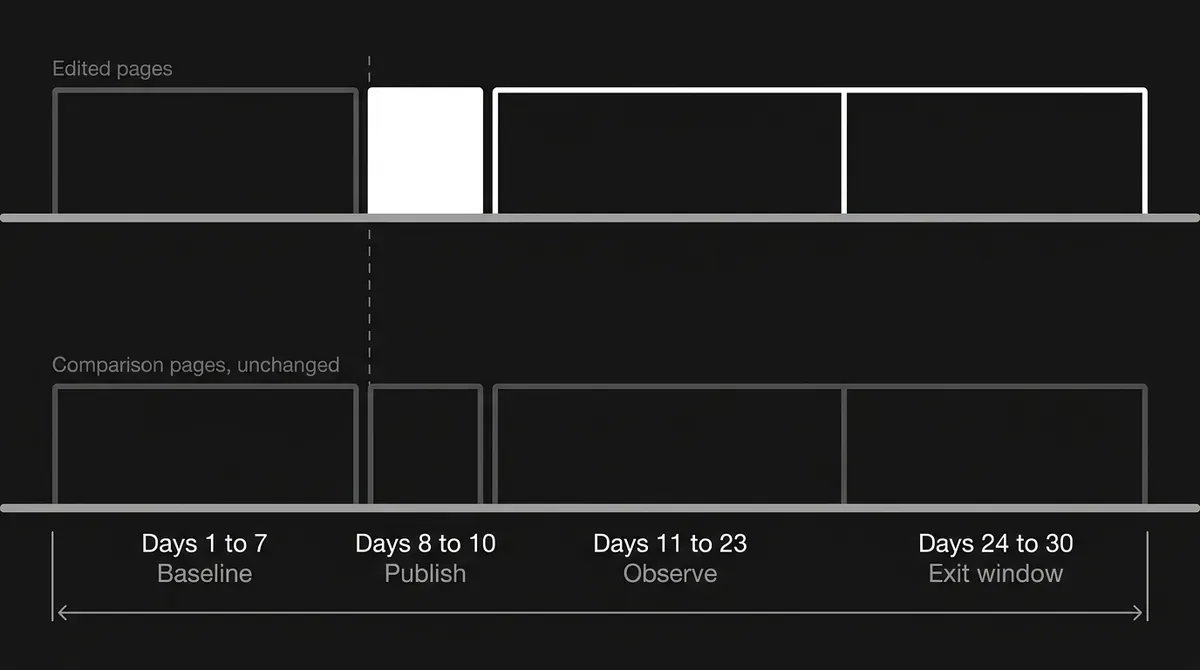
| Pages | Eight existing, relevant pages; edit four, leave four unchanged for comparison |
| Collection | One scheduled check per prompt per engine per day, if your plan supports it |
| Days 1 to 7 | Unchanged baseline |
| Days 8 to 10 | Publish the approved page changes |
| Days 11 to 30 | Observe; Days 17 to 23 are a persistence check |
| Days 24 to 30 | Exit window, compared with Days 1 to 7 |
If you don't have eight suitable pages, shrink the scope and accept that your conclusion will be more descriptive. The setup session before Day 1 is real work, so count those hours in your budget. If you want to see where tracking tools sit before you commit, the GEO tools comparison covers the options.
Step 1. Write a pilot charter and cap the investment
Write down the decision the month should support, the change you're testing and the most you'll spend, before anyone opens a dashboard. One page is enough. It should name the decision owner, the buyer segment and topics, the engines, which pages you'll edit and which stay as comparison, the dates, the maximum software spend and staff hours, what would make you continue, extend or stop, and what's out of bounds, such as paid promotion or a redesign.
A hypothesis might read: "For a fixed set of non-branded buyer questions about our main use cases, improving direct answers, verifiable evidence and decision-useful detail on four existing pages will increase owned-page citations compared with unchanged pages." This tests the whole improvement package. It won't tell you which single edit did the work, and that's fine for a first pilot.
DeepSmith combines AI visibility tracking with content production, and the plan you pick should follow the engines you need, not the biggest prompt allowance.
| Plan | Monthly price | Tracked prompts | Engines |
|---|---|---|---|
| Pro | $99 | 50 | ChatGPT |
| Grow | $199 | 100 | ChatGPT and Perplexity |
| Scale | $399 | 200 | ChatGPT, Perplexity and Gemini |
| Enterprise / Custom | Custom | Custom | Confirm the agreed engines |
For a two-engine pilot on ChatGPT and Perplexity, Grow is the lowest tier that covers both. Pro has room for 40 prompts but only one engine. If Google AI Mode is central to your hypothesis, ask about Enterprise or custom coverage instead of assuming Grow or Scale includes it. The free trial is seven days, shorter than your pilot, so plan paid access for the full month and check trial entitlements and billing timing before you launch.
An illustrative budget, not a customer benchmark: one $199 subscription plus 20 staff hours at $75 an hour is $1,699, and $1,500 of that is labor. Swap in your own rate and hours.
Done when: you can state the hypothesis, decision rule, dates, engine scope and maximum investment on one page.
Common mistake: signing up for a trial without checking engine coverage, or asking a one-month test to prove lifetime revenue.
Step 2. Freeze a buyer-topic set and map each prompt to a page
Pick real buyer questions around one opportunity from sales calls, customer research and support conversations, including questions where you don't show up today, then leave the list alone. DeepSmith's Discover Prompts can suggest candidates from your product, persona and buyer-stage context. Treat those as suggestions to review, since they don't tell you how popular a question is.
Spread the 40 prompts across category questions, use cases, alternatives and comparisons, and buying criteria, and avoid near-identical rewordings.
Use non-branded questions for the main test. A question with your company name in it can produce an easy mention without showing that engines find you when people shop the category. If you have room, add branded questions as a separate, labeled diagnostic.
Keep a simple prompt register with the exact wording, the page each prompt is tied to, its group and why it matters commercially. Eight pages with five prompts each gives you 40, though engines are free to cite a page you didn't map.
Match comparison pages to edited pages on intent, topic and baseline visibility, and assign groups at random within each pair. Don't put your weakest recent performers in the edited group, because pages tend to drift back toward typical performance and that drift will look like your edits working.
Done when: every prompt has a business reason, a group assignment and a mapped page or a note that there's a gap.
Common mistake: changing prompts after you've seen results, or treating prompt counts as search volume.
Step 3. Define the scorecard and exit criteria before collecting outcomes
Choose one main metric, a few supporting ones, and rules for when the data is good enough to trust. Write the thresholds down before you change anything.
| Metric | Role |
|---|---|
| Owned-domain citation rate on the frozen non-branded prompts | Primary outcome |
| Citation rate for the edited pages | Attribution check |
| Brand mention rate | Supporting outcome |
| Results by engine and topic | Diagnostic, so a total doesn't hide a loss |
| Referral sessions and key events | Business signal |
| Accuracy and sentiment review | Guardrail |
| Software spend and staff hours | Feasibility |
A homepage citation counts toward the owned-domain metric but doesn't show uptake of the page you edited, so keep both views.
For one prompt, engine and window, the pilot's citation rate is the valid answers with at least one qualifying owned-domain citation, divided by the valid collected answers, times 100. An answer counts once even if it links to your domain three times. For the headline number, work out a rate for each prompt and engine pair, average the prompts within each engine, then average the engines with equal fixed weights, so one engine doesn't take over.
DeepSmith reports mention rate, citation rate and share of voice, but the pages we reviewed don't publish the exact formulas, so don't describe your pilot formula as how the dashboard calculates things. Use one dashboard definition consistently and keep the answer-level data you need for your own calculation.
Write the handling rules now:
- A valid answer with no citations, or only competitor citations, stays in the denominator and scores zero.
- A collection failure, timeout or empty response is missing data, not a zero, and a failed citation extraction is a measurement problem, not a zero.
- Never turn no-citation answers into missing data just to improve the rate.
Then set your continuation gates. These are suggestions, not published benchmarks:
- At least 90% of expected observations are valid, and each prompt-engine pair has data on at least six of seven days in the baseline and exit windows.
- Nothing material changed in the prompts, engines, settings or brand matching, and the edited pages are accessible.
- The comparison-adjusted change in the main rate reaches a threshold you set in advance, for example 5 percentage points.
- Both late weekly windows point the same direction, and the gains show up on more than one page and topic.
- Accuracy, sentiment, budget and effort are still acceptable.
Passing these supports funding another round. It doesn't prove significance or cause. Don't lower the threshold on Day 30.
Done when: the scorecard says what counts, what's missing, how the weights work and what each outcome triggers.
Common mistake: choosing the winning metric after the test. If citations were the primary outcome, a rise in mentions isn't a citation win.
Step 4. Set up collection and capture seven unchanged baseline days
Get repeatable tracking running, check the answers underneath are being read correctly, and confirm your pages are technically eligible before you edit anything.
Write down the engines your plan covers, the schedule and timezone, your brand name, aliases and owned domains, and a fixed competitor list (three to five is a reasonable start). Record any market, language or device settings the tool exposes. Not every platform gives exact control over location or personalization, so think of a scheduled check as a controlled look from the tool's setup, not a census of what your buyers see. If you're still comparing trackers, the best AI visibility tools roundup lists them.
Where DeepSmith does the work
DeepSmith schedules your tracked prompts, captures the full answers, and tracks mentions and citations independently. You get prompt-level results, platform breakdowns, cited-page attribution and competitor citation views, which is what a baseline and exit comparison need without a manual collection system. Reporting windows come in 7, 30 and 90 days, and a 30-day dashboard comparison against the previous period isn't the same as your Days 1 to 7 versus Days 24 to 30 comparison, so keep your own periods and groups.
For the record, keep the timestamp, engine, full answer text and the exact cited pages. DeepSmith's answer retrieval returns up to 200 answers at a time, newest first, with prompt, platform and date filters, so one unfiltered pull won't hold a whole pilot.

Check that your pages can be found
For Google AI Overviews and AI Mode, a page has to be indexed and eligible to show in Google Search with a snippet. Google says there are no special AI schema or extra technical requirements, and that meeting the requirements doesn't guarantee crawling or indexing. Check that each pilot page loads with the intended content, isn't blocked by accident, puts the answer in visible text and has sensible canonical handling. To check one page at a time, run a GEO check on a page first.
For ChatGPT search there are three bots. OAI-SearchBot supports appearance in ChatGPT search, GPTBot relates to possible model training, and ChatGPT-User handles certain user-started visits. Allowing search access doesn't mean allowing GPTBot, and the OpenAI crawler documentation is the place to check your robots rules.
Before you trust the chart, read 24 baseline answers by hand across both engines and groups, including some with your citations, some with competitor-only citations and some with none. Fix matching problems before you edit.
Done when: you have seven unchanged days, the coverage gate passes, and a person can trace the scorecard back to real answers.
Common mistake: editing pages during the baseline, counting failed collections as losses, or treating a bot visit as proof that an engine used the new content.
Step 5. Publish a small, documented improvement package
Change the chosen pages in a tight window and leave the comparison pages alone. Use existing pages, because a brand new page brings indexing delays that make a short comparison hard to read.
A suggested package: answer the mapped buyer question clearly near the start of the section, add useful evidence where it really supports the answer, explain criteria and trade-offs concretely, use clear headings and lists where they help, remove unsupported or outdated claims, and keep access and visible text intact. Evidence can be your own data or a worked calculation, never decorative statistics or made-up quotes. The original GEO paper, Generative Engine Optimization, gives a reason to test evidence-rich content, but it doesn't show one page structure wins across today's engines. If your tool gives pages a readiness score, how GEO tools score content explains what's inside one, so you don't read it as a prediction.
Keep a change log with the page and its prompts, the before and after versions, the exact publication time, what changed and why, who checked the claims, and any access or indexing problem. Avoid site-wide changes during the month, and log the ones you can't avoid.
Where DeepSmith fits
Opportunity Agents read your visibility and coverage data and return content ideas with the data point that justifies each one. Use that to choose a bounded change, not to grow the pilot's backlog. Content Studio can produce researched, brand-grounded content if your change needs a new or replacement article, and a person still checks it. It doesn't edit your live pages, and an article doesn't guarantee a citation.
Google says recrawling can take a few days to a few weeks. You can ask Google to recrawl individual pages, but repeated requests won't speed it up.
Done when: every planned change is live, reviewed, logged and accessible by the end of the publication window.
Pro tip: finish all the edits together. A big rewrite on Day 27 leaves almost no time to observe and changes the question the month was meant to answer.
Step 6. Observe without changing the test
During Days 11 to 30, watch whether collection is healthy and whether your edits are being seen, and resist the urge to adjust the test. Each week, check for missing observations, confirm citations are being picked up correctly and the edited pages are still live, and write down the first citation each edited page gets. Log outages, setting changes and site incidents, and keep new prompt ideas in a separate list outside the frozen set.
Checking operations all month is fine. Declaring victory because the metric crossed your threshold for a day isn't, since repeated early looks need care. Stop early only for a serious factual, legal, technical or budget problem.
Keep traffic separate from citations. OpenAI documents automatic source tagging on referral links from ChatGPT search, so your analytics can show sessions, landing pages and key events. An answer citing your page, a person clicking and a person doing something useful are three different things. For the analytics and Search Console side, GEO tool integrations walks through what to look for. Search Console may also show dedicated generative AI performance views, which you can use as supporting evidence but not as a prompt-level citation metric.
Done when: you have a full observation record and can explain gaps without rewriting the hypothesis.
Common mistake: checking consumer apps over and over until a good answer shows up, then comparing that picked answer with an unpicked baseline.
Step 7. Compare matched windows and calculate the result
Compare the frozen baseline and exit windows using your scoring rules. Start with validity: did the coverage gate pass, did the prompts and settings stay put, and can the positives be traced to real answers? If the measurement isn't valid, say so first. An invalid test isn't evidence that GEO failed.
Compare Days 1 to 7 with Days 24 to 30, since each holds a full seven-day cycle, and use Days 17 to 23 as your persistence check. Comparison-adjusted change is the edited group's change minus the comparison group's change. It's a descriptive calculation, and it only becomes a cause estimate if the pages were on similar trends and didn't affect each other, which a small pilot may not satisfy.
A worked example with invented numbers: 20 prompts per group, two engines, seven complete days, so 280 observations per group per window.
| Group | Baseline | Baseline rate | Exit | Exit rate | Change |
|---|---|---|---|---|---|
| Edited pages | 28 of 280 | 10.0% | 56 of 280 | 20.0% | +10.0 points |
| Comparison pages | 42 of 280 | 15.0% | 49 of 280 | 17.5% | +2.5 points |
The comparison-adjusted change is 7.5 percentage points, 10.0 minus 2.5. The edited group's rate also doubled, but lead with the points and counts. This clears an illustrative 5-point threshold, and that alone isn't a win. Persistence, page attribution, coverage, quality and cost still have to pass.
Don't overstate the sample. The suggested design is 40 prompts on two engines for 30 days, which is 2,400 planned observations, but that isn't 2,400 independent experiments. A 2026 study, Don't Measure Once, reported day-to-day overlap in cited sources of roughly 0.34 to 0.42 on a 0 to 1 scale across four campaigns, so expect noise and don't credit every shift to your edit. With a handful of edited pages, a directional conclusion is easier to defend than a significance claim.
Read the pattern before you decide:
- Mentions rise but owned citations don't: visibility may be up, but the citation hypothesis hasn't passed.
- One engine improves and another drops: an engine-specific signal, not a cross-engine win.
- Zero baseline citations become a few: a useful discovery signal, so report counts instead of relative growth.
Done when: your readout has raw counts, rates, percentage-point changes, comparison context, engine and topic slices, and a plain statement of uncertainty.
Common mistake: treating every repeated answer as an independent sample, or presenting the adjusted number as proof the content caused all of the change.
Step 8. Decide whether to continue, extend or stop
Apply the decision rule you wrote on Day 1 and approve only the next small investment.
| Decision | Use it when |
|---|---|
| Continue to a larger validation | Measurement was valid, the gain is practical and held in the late windows, edited pages got cited, and quality and effort are acceptable |
| Extend to resolve uncertainty | Discovery was late, an incident cut coverage, or the result is truly unclear |
| Stop this approach | Valid measurement and fair exposure show no practical gain, or costs outweigh the signal |
| Repair and rerun | Broken tracking, a contaminated baseline or inaccessible pages invalidated the test |
An extension needs a reason and a new fixed decision date. Extending until the chart turns green isn't a plan.
Then write a short Day-30 packet: the decision, what went live and when, how valid the collection was, baseline and exit counts with the comparison-adjusted change, breakdowns by engine, topic and page, a few full answers including ones that cut against your reading, the cost in software and hours, and what you still don't know. A summary that might fit, if the evidence supports every part: "We saw a directional citation improvement on the frozen questions under stable collection conditions, with uptake on the edited pages. This supports another bounded validation, not a claim of proven revenue impact." For framing it in business terms, see how to report AI visibility to leadership.
Done when: leadership knows the decision, the evidence behind it and what the month didn't establish.
Common mistake: treating an extension as the default, hiding an inconclusive result, or growing into a permanent workflow before the pilot has earned it. If it does, setting up a GEO workflow is the next thing to read.
What to do next
Ask for one bounded next step, not a permanent program: a larger validation, a short extension tied to one question, or a new hypothesis. If you're still weighing tools against outside help, GEO software or a GEO service can help you decide.
Start a DeepSmith free trial to scope your buyer prompts and look at the answers behind your baseline. The trial runs seven days, so plan paid access for the full 30-day test.
Related guides
- GEO for Ecommerce: What Product Pages Need to Be Recommended by AI: Learn what product pages need, such as clear specs, reviews and structured data, to be considered for AI recommendations.
- GEO for Startups: What to Do First With a Small Team and Budget: Get a prioritized first-steps list for GEO that fits one or two people and a small budget.
- 8 GEO Mistakes That Waste a Tool Budget: Spot eight ways teams waste money on GEO software, from buying before a baseline to tracking prompts nobody acts on.
- How to Brief an Agency on GEO and Hold Them to Results: Write a brief that sets scope, reporting and success measures, and agree on how you will hold the agency to them.
- How to Do GEO Without Paying for a Tool: Do the core GEO work by hand with free methods: manual prompt checks, page edits and a simple log.


