If you're trying to decide between GEO software and a GEO service, the question usually comes up because someone asked what your AI search plan is, or because you searched your main use case in ChatGPT and saw a competitor named instead of you. Both options can help with that, but they buy you different things. Software gives you a system your own team runs. A service gives you people who do the work for you. This page is published by DeepSmith, so in this GEO agency vs tool decision we'll tell you plainly where we think DeepSmith is the better fit, and we'll also tell you where a service is the honest answer.
The short version is this. Buy software when someone on your team can own the priorities and judge the content, and the thing holding you back is getting the work done. Hire a service when what you're missing is specialist knowledge or hands-on capacity your team doesn't have. Combine them when you want to run your own system but need outside help for one specific gap. If you're a marketing lead with a clear sense of your buyers and a backlog you can't get through, we'd start with DeepSmith before assuming the only alternative is a full monthly retainer.
Here is how the three routes compare on the points that matter most. The service prices come from two real examples, DoodleWeb and WebFX, so they show what some providers publish and are not a market average.
| Decision criterion | DeepSmith (software) | Managed GEO service | Hybrid |
|---|---|---|---|
| What you buy | A platform for AI search measurement, evidence-backed ideas, content production, publishing, and repurposing | An agreed scope of specialist work, which can include research, technical changes, content, authority building, and reporting | Your own platform plus outside help for a defined gap |
| Best fit | A marketing owner can pick priorities and check product accuracy, but production is the bottleneck | The team lacks the expertise or delivery capacity for the actual work | The team can run the program but has one specialist gap |
| Published price examples | Pro $99/month, Grow $199/month, Scale $399/month, Enterprise custom | DoodleWeb Core $1,200/month, DoodleWeb Custom from $2,500/month, WebFX from $3,000/month | Software plus the separately scoped service |
These are different units of work. A drafted answer page, an article allowance, a tracked prompt, and a technical fix are not the same thing, so a lower price is not automatically a better deal.
In-house skills: ownership versus execution
The most useful question isn't how big your content team is. It's whether someone in the business can make good decisions about your buyers, your product claims, and what to publish first.
Here are the abilities worth checking first.
- Knowing which buyer questions matter to the business.
- Knowing your product well enough to catch a wrong or vague claim.
- Making editorial calls on what goes live.
- Reading visibility evidence, since mentions, citations, and traffic answer different questions.
- Fixing technical issues like crawl access, indexing, page speed, and structured data.
- Doing off-site work like digital PR and earning mentions on other sites.
If the first three are covered and the main problem is that producing the content takes too long, software fits. Content Studio, Deep IQ, and Opportunity Agents in DeepSmith take on the repetitive parts, so the work left for you is judgment, not formatting. If the last three are where you're stuck, a service is the better route for that work, because a software subscription doesn't hand you a technical SEO practitioner or a digital PR team. If you're missing both, a managed service can be a sensible first purchase, and DeepSmith becomes interesting later when you want a content and visibility system of your own.
We haven't found a reliable rule like "you need five hours a week," so we won't give you one. A better test is to ask who would approve a draft on Monday morning. If you can name that person, you have an owner.
Budget: total cost, not sticker price
An entry subscription and an entry retainer are not the same kind of purchase, so comparing the two numbers alone can mislead you. What helps is adding up what you'll still have to do after you pay.
For the software route, that's the subscription, plus the internal time you spend, plus any outside specialist work, plus any setup costs. For the service route, it's the retainer or project fee, plus your internal time, plus anything charged separately for implementation or tools, plus setup costs. For a hybrid, it's the platform plus the outside scope, minus whatever overlap you actually remove. Not every vendor has every one of those charges, so use this as a list of questions to ask.
Here is the three-month base cash cost for each published price, using monthly billing and leaving out tax, internal time, setup fees, and extra scope.
| Option | Calculation | Three-month base cost | What it doesn't tell you |
|---|---|---|---|
| DeepSmith Pro | $99 x 3 | $297 | Total operating cost, or equivalence to a service |
| DeepSmith Grow | $199 x 3 | $597 | Coverage beyond ChatGPT and Perplexity |
| DeepSmith Scale | $399 x 3 | $1,197 | Coverage of all ten engines |
| DoodleWeb Core | $1,200 x 3 | $3,600 | Its real minimum commitment, since its published terms conflict |
| DoodleWeb Custom | $2,500 x 3 | From $7,500 | The full cost of a customized engagement |
| WebFX | $3,000 x 3 | From $9,000 | Its minimum commitment or final proposed price |
DeepSmith's published subscription prices are lower than the recurring fees of these two services. That's a fact about entry price, and it doesn't prove the services deliver equivalent work or that DeepSmith costs only its subscription.
A bigger budget doesn't by itself justify a full retainer. Match the outside spending to the capability you're actually missing. If you're weighing this as a small company and you're reading about geo services for startups, our roundup of the best GEO tools for startups gives a wider look at the lower-cost end.
Speed: three different clocks
Three separate clocks run here, and they don't tick together.
- Time to activation, which is when the account or engagement becomes usable.
- Time to implemented work, which is when content or site changes are actually produced and live.
- Time to a business result, which is when you earn useful citations, qualified visits, leads, or revenue.
DeepSmith sets up a working workspace in minutes and offers a seven-day free trial, which is a good way to test the workflow and the output quality. It doesn't promise citation gains in a week, and you shouldn't expect a trial to prove that. DoodleWeb publishes content cadences, such as one answer page draft per working day on Core, which speaks to how much work a service can turn out. It doesn't mean every draft goes live or gets cited right away. WebFX doesn't publish a specific time-to-results commitment on the service page we reviewed, so we won't make one up for it.
Software can be the faster purchase when your team already knows what it wants to do, because there's no procurement or onboarding wait. A service can be the faster way to get work done when missing expertise is the actual delay. Neither one controls when an AI engine retrieves or cites your content, and a service's production pace is not a citation timeline.
One more thing helps here. Answers from AI engines change from run to run. An April 2026 research preprint, Don't Measure Once: Measuring Visibility in AI Search, says that one-off checks are unreliable and that repeated measurement is needed to see visibility as a spread instead of a single point. So a screenshot of a competitor showing up in ChatGPT is a fine reason to start looking into this, but it isn't a baseline, and one good-looking answer later isn't proof you've improved. Whichever route you pick, ask how it measures the same questions again and again over time. Google's own AI optimization guide adds a useful check on vendor claims, since it says existing SEO practices still apply, no special AI file or markup is needed to appear, and third-party tools can't see inside Google's systems. That guidance is about Google only.
DeepSmith for lean content teams
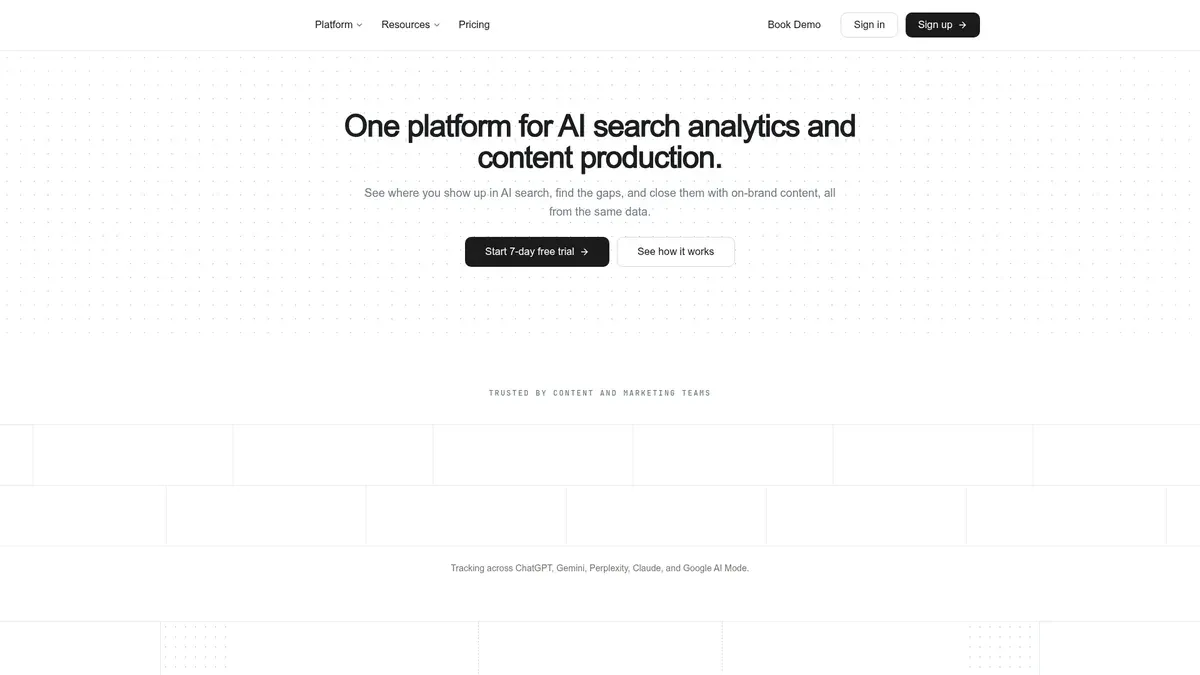
DeepSmith fits marketing leads who can own strategy and product judgment but need a production engine to turn AI search gaps into finished articles. It's one platform for AI search analytics and content production, so what you learn from tracking feeds directly into what gets written.
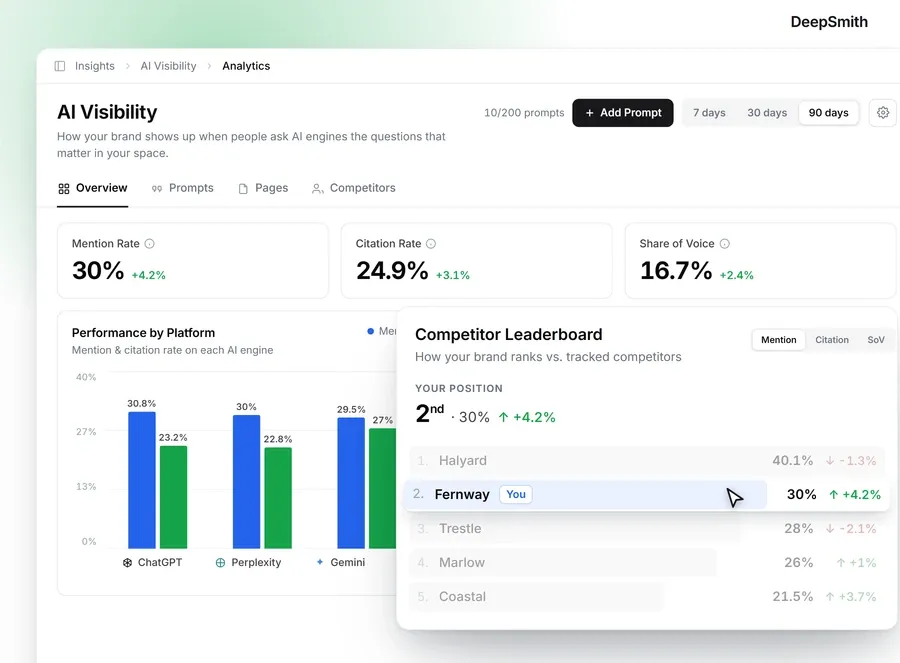
On the measurement side, you choose the buyer questions to track and DeepSmith checks them on a schedule. Discover Prompts can suggest a starter set from your product, persona, and buyer-stage context. You get mention rate, citation rate, share of voice, trends, competitor results, and the full AI answers behind them. You can also see which of your pages get cited and which prompts drive those citations.
Content Map turns your site and your competitors' sites into one map of topics and buyer stages, so coverage gaps show up as measurements. Opportunity Agents read your visibility and Content Map data and return ideas with the specific data point that justifies each one, which makes the backlog easier to defend. Then Content Studio takes an idea through New Ideas, Planned Content, and Produced Content. The Writer handles research, drafting, SEO and AEO optimization, internal and external linking, a cover image, and publish-ready metadata. Autowrite can run that on a schedule so the team doesn't have to start every article by hand. Deep IQ stores your positioning, product facts, personas, Brand Voice, and Content Types, so each article starts from your context and not from a blank prompt.

You can publish directly to WordPress, Webflow, Strapi, Sanity, or Contentful, or use Markdown and HTML export. The REST API and MCP server are read-only, so they let you pull data out but do not create or publish content, and webhooks notify your other systems without publishing anything themselves. The numbers in those two screens are demo data, not anyone's results.
What the plans include
| Plan | Monthly | Billed yearly (per month) | Articles per month | Tracked prompts | Seats | Engines |
|---|---|---|---|---|---|---|
| Pro | $99 | $80 | 20 | 50 | 5 | ChatGPT |
| Grow | $199 | $160 | 40 | 100 | 7 | ChatGPT, Perplexity |
| Scale | $399 | $299 | 90 | 200 | 10 | ChatGPT, Perplexity, Gemini |
| Enterprise / Custom | Custom | Custom | Custom | Custom | Custom | All ten engines |
DeepSmith covers ten engines in all: ChatGPT, Gemini, Perplexity, Claude, Google AI Overviews, Google AI Mode, Grok, Meta AI, Microsoft Copilot, and DeepSeek. Enterprise covers all ten. There's a seven-day free trial and no long-term contracts.
Pro starts at $99 a month and includes both tracking and production, though your total cost still includes the judgment and any specialist work you keep. Pro tracks ChatGPT only, so it suits a team that wants to start with one engine and 50 prompts, and you can move up a plan when you want more engines. The limits are plan allowances, not promises about results.
DeepSmith is also not a managed digital PR or website engineering retainer. If those are your real blockers, a service or a hybrid is the better answer, and that's a difference in scope, not a flaw. It also doesn't remove your need to supply product knowledge and make editorial calls, and Autowrite doesn't make search outcomes automatic.
DoodleWeb: a managed service example
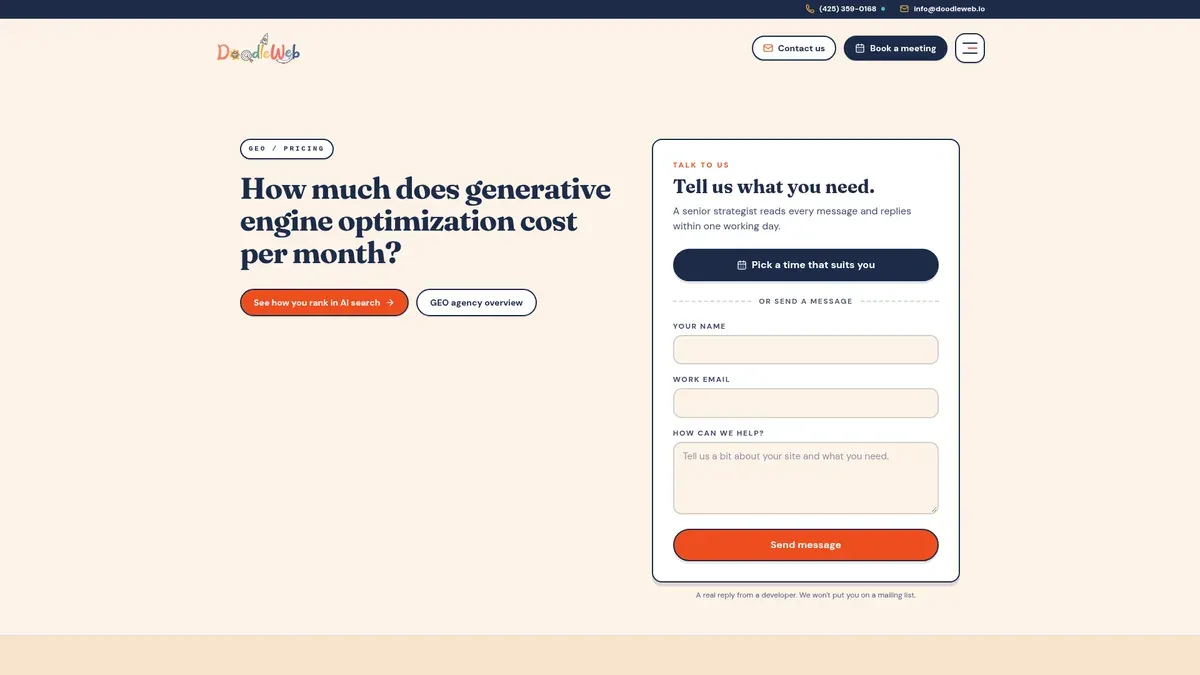
DoodleWeb is a useful example of buying hands-on work instead of software access. Its published offer includes tracking, content production, technical upkeep, and publishing to your CMS after you approve. This is an example, and we haven't verified its results.
| Offer | Published price | Scope | Terms to note |
|---|---|---|---|
| Done for you Core | $1,200/month | One domain, up to 20 buyer questions, one fact-checked answer page draft per working day | The plan card says 30 days' cancellation notice, while an FAQ describes a 90-day initial term for every plan |
| Done for you Custom | From $2,500/month | Up to 100 buyer questions, two answer page drafts per working day, up to two domains or languages | Three-month initial term |
Core checks your questions daily across ChatGPT, Perplexity, Gemini, Claude, Microsoft Copilot, and Google AI Overviews. It includes approval before anything is published, upkeep of schema and crawler-related files, directory and listing submissions, and a monthly citation report. Custom adds Google AI Mode, competitor tracking, comparison and city pages, weekly LinkedIn content, and a weekly YouTube answer video. We couldn't establish a separate setup fee, which isn't the same as there being none. Three months of Custom at its starting price is at least $7,500 before any extra scope.
On timing, the pricing page says first movement on long-tail prompts typically appears within 30 days, and the homepage says initial citations typically appear within 30 to 60 days. Its own answer engine optimization page says there's no guaranteed citation timeline. It also advertises a 90-day AI Search Visibility Guarantee. The material we reviewed doesn't spell out the eligibility rules, so read it as a commercial promise and not a promise of a particular citation or lead. Treat these as DoodleWeb's own expectations, not an industry benchmark.
DoodleWeb's strength is implementation, since you get someone drafting, making changes, and publishing. The limits next to that are the $1,200 recurring price, the 20-question cap on Core, publication that depends on your approval, and the unclear Core commitment terms. If you want someone else to run a one-domain program for you, that can be a good fit. If you're a marketer who can own priorities and judge content, you may not need to outsource the whole recurring workflow just to fix a production bottleneck.
WebFX: a broader GEO and SEO service
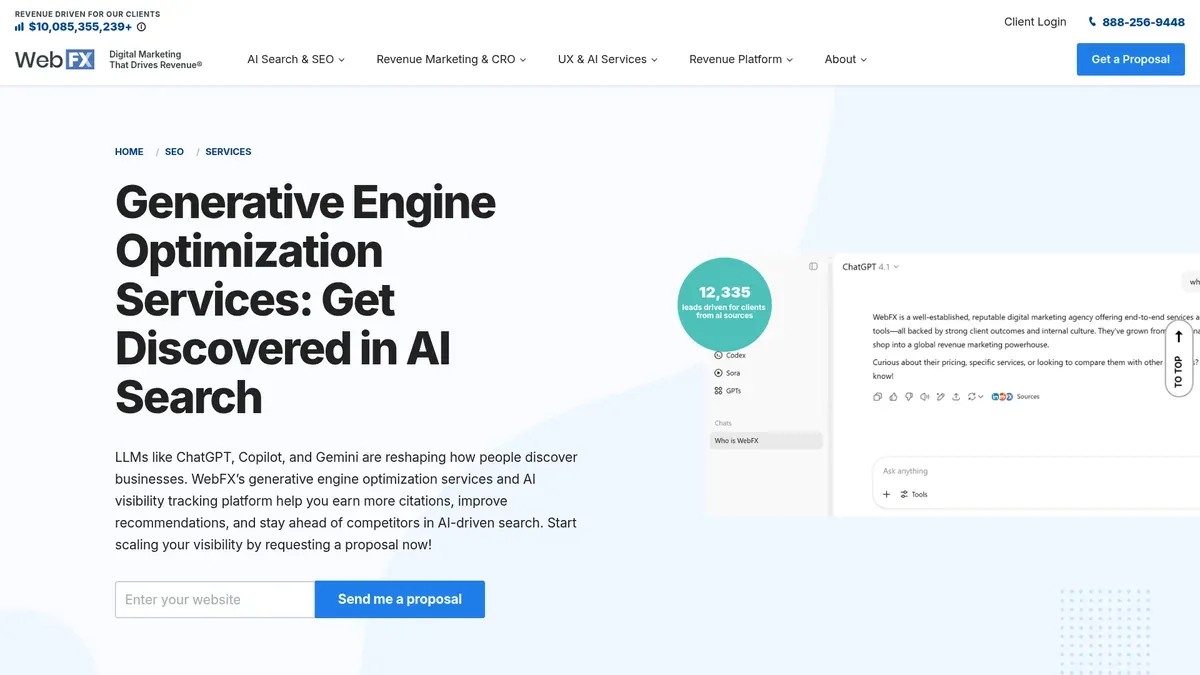
WebFX is the example to look at when you need a broader search program and not just content production. Its GEO service pairs AI visibility work with SEO, technical changes, authority building, and its own tracking technology. Pricing starts at $3,000 a month, and the final price depends on scope and a custom proposal. We couldn't establish setup fees, minimum commitment, or cancellation terms from the page, so we won't call the starting rate all-inclusive or month to month.
The published scope covers GEO and SEO audits, AI query research, ongoing optimization, authority-building content, schema where appropriate, digital PR with third-party mentions and backlinks, page-speed improvements, and reporting. Several of those are described as work that may be included, so don't read each one as a promised deliverable at the starting price. WebFX says its OmniSEO technology tracks more than ten AI platforms, which is the provider's own claim and not an audited one. It also says no GEO agency or freelancer can guarantee placements in AI answers, which is a fair thing to hear from any provider.
The genuine strength here is breadth, since technical SEO, content, off-site authority, and tracking come from one provider. WebFX points to businesses that already have an established SEO program as good candidates. The limit next to that is cost and scope, because it's a scoped service from $3,000 a month, not a cheap stand-in for an internal content platform. If you need technical fixes and digital PR, it may suit you more directly. If your problem is a stalled content backlog and a marketer can own strategy, DeepSmith covers the production side without making you buy that wider scope.
Hybrid GEO programs
A hybrid means you keep a software platform as your operating system and bring in outside help for work that needs more expertise or capacity. It's a way of buying, not a third technology. The strongest version has a clear dividing line, such as DeepSmith running tracking and content while a specialist handles technical fixes or digital PR.
Be careful about overlap. DeepSmith Grow at $199 plus DoodleWeb Core at $1,200 adds up to $1,399 a month before anything else, and since DoodleWeb already includes tracking and content production, you'd be paying for much of the same work twice. That's arithmetic, not a bundle, and we wouldn't suggest it as a default. We found no public fixed price for a narrow add-on like technical cleanup, so we won't guess one.
If you're comparing the kinds of tools that could sit inside a hybrid, what a GEO tool is covers the categories, and tracking-only versus tracking-plus-content tools helps you decide how much of the content work the software should take on.
Which should you choose
Here's how we'd match common situations to a route.
| Your situation | Where we'd start | Why, and the limit |
|---|---|---|
| Startup founder or marketing lead with product knowledge, a modest budget, and a backlog | DeepSmith on the plan that matches the engines and volume you need | You keep the strategy and buy a connected production system. Not every startup needs an agency |
| Team that needs technical diagnosis and can't make the site fixes | A service or specialist scoped to that work | A subscription doesn't supply a person for every technical job. DeepSmith can still serve the ongoing content need |
| Established SEO program that needs broader AI search, digital PR, and authority work | A broader service such as WebFX | Its published scope covers those areas, and from $3,000 a month it's a different purchase from a content platform |
| Buyer who wants someone else to draft and publish a defined one-domain program | A managed offer such as DoodleWeb Core | It offers hands-on work at $1,200 a month, within its question limit, approval step, and unclear Core terms |
| Team that wants to own its visibility data and content but lacks one specialty | DeepSmith plus targeted outside help | You keep the system and buy only the missing skill |
| Nobody can own priorities, judge product claims, or approve publishing | A service, and fix the ownership gap first | No self-serve subscription is a complete answer, and a service still needs someone accountable on your side |
If you're a marketing lead with ownership of strategy but a production bottleneck, start with DeepSmith. Choose a service when you have a concrete need for specialist labor, and combine them when the outside help adds to the platform instead of repeating its work.
If you're a founder looking at geo services for startups, the same logic applies. Ask who on your side will own the decisions before you ask what it costs, because a retainer without an owner on your side and a subscription without an owner both stall for the same reason. And when you do a geo agency vs tool comparison, put the retained internal work in the sum, so you're comparing the whole job and not two price tags.
You can start a seven-day DeepSmith free trial to test the visibility-to-content workflow with your own brand. It won't prove citation growth in a week, but it will show whether the output fits your team.
Related guides
- How GEO Tools Score Content: What Is Inside an AI Readiness Score: See what signals typically feed an AI readiness score, such as structure, evidence and entity clarity, and how much weight to give the number.
- Foglift Alternatives: 8 Best AI Visibility Scanners for 2026: Compares eight AI visibility scanners against Foglift (DeepSmith, OtterlyAI, Peec AI, Profound, Scrunch, LLMrefs, AthenaHQ, Semrush) on engine coverage, refresh cadence, and pricing, for buyers who liked the.
- Getairefs Alternatives: 8 Best AI Visibility Trackers for 2026: Ranks eight AI visibility trackers as Getairefs replacements (DeepSmith, AthenaHQ, Profound, Scrunch, Peec AI, OtterlyAI, Rankscale, Semrush), comparing engine coverage, prompt limits, real pricing, and reporting, for teams.
- Getmint Alternatives: 8 Best Answer-Engine Visibility Tools for 2026: Compares eight answer-engine visibility tools as Getmint replacements, each with a best-fit use case, weighing engine coverage, prompt limits, pricing, and reporting cadence, aimed at buyers whose current.
- Getvisoryn Alternatives: 8 Best AI Mention Monitoring Tools for 2026: Reviews eight AI mention monitoring tools as Getvisoryn replacements (DeepSmith, Scrunch, Profound, OtterlyAI, Peec AI, Rankscale, Goodie, ZipTie), comparing pricing, engine coverage, and what a buyer can actually.