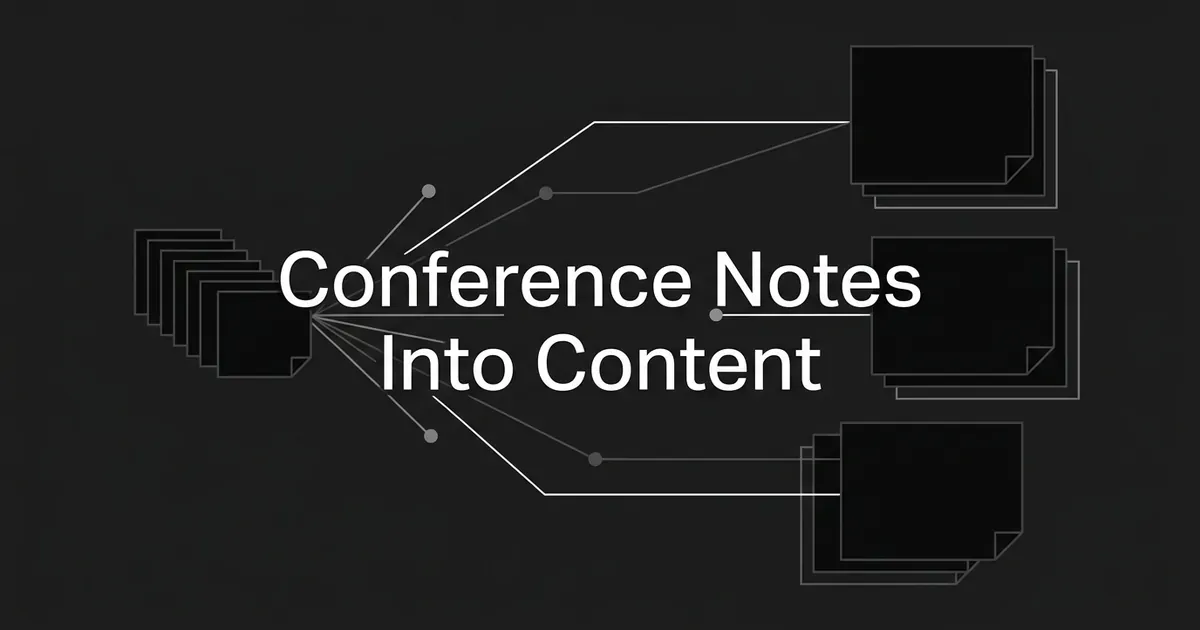
A lot of marketing teams come back from an industry conference with a phone full of photos, a notebook of half-finished thoughts, and no clear idea what to do with any of it. This guide is for the marketing lead who attends or covers someone else's event and wants to turn it into live coverage, a recap, and a few follow-up pieces. It does not cover hosting your own webinars or networking at the event. By the end you'll have a plan for conference content repurposing that you can set up before you travel and finish in the weeks after.
The short version is to choose the questions your buyers care about before the event, take notes that you can trace back to a speaker, publish only what you've checked, and then sort what's left into one timely recap and a handful of narrower answers. The steps below follow that order. The workflow is a recommended approach, not an industry standard, and the timings are planning examples rather than benchmarks.
Step 1. Map buyer questions to the event agenda
Start with your buyers, not the schedule. Write down the questions your customers actually ask, then read the published agenda and mark the sessions that might answer them or give a useful point of view. For each session you plan to cover, write down the official title, the presenter, the time, the buyer question it connects to, the angle you might take, and the format you'd use if it pans out.
It also helps to separate two kinds of sessions, since event coverage content marketing works best when you know which is which. Some might produce a piece of news, like an announcement, and some might help with a question that people will still be asking next year. The first kind suits a quick post. The second kind suits a longer how-to later.
You can build a shared document ahead of time with the confirmed session details filled in, but leave the findings blank until you've actually heard the talk. Drafting the conclusions before a session invites you to write things the speaker never said.
DeepSmith can help with the choosing part. AI Visibility shows the prompts you track and where your brand is or isn't cited, and Content Map and Opportunity Agents help you see which topics your site covers thinly. That tells you which question is worth chasing. It doesn't tell you what a speaker will say, and it doesn't import conference notes, so the listening stays with you. Which AI engines you see depends on your plan: Pro tracks ChatGPT, Grow adds Perplexity, Scale adds Gemini, and Enterprise covers all ten.
You're done with this step when every session you picked has a buyer question and a likely use, and one person owns the coverage and another owns the editing.
Common mistake: trying to attend everything, or promising an "everything we learned" post before you know what you'll learn. A post like that has no reader problem to solve. TopRank's live-blogging advice suggests setting a schedule, setting up drafts in advance, and coordinating who covers which topics, which is the same idea.
Step 2. Check the organizer's rules and prepare a capture kit
Before you go, find the event's attendee terms, its photography and media policy, any speaker opt-out signs, and any embargoes on specific sessions. Make a simple permissions column for photos, audio and video, slides, and social posting. If something's unclear, ask the organizer or the speaker before you capture or reuse it.
Then set up the practical side. That means a shared folder, a session-note template, a plan for devices and power, any approved visual assets, and one person who can approve posts. Sourcefabric's guide to live blogging also suggests preparing the event accounts and hashtags you'll monitor and agreeing on who contributes, who edits, who publishes, and who handles social.
Policies really do differ from one event to the next. The Minerals, Metals & Materials Society revised its recording policy on March 3, 2024, and it prohibits recording presentations, posters, and exhibits without consent from both the society and the presenter, including photos of slides. The American Society for Biochemistry and Molecular Biology uses marks on presentations. One mark prohibits photography and sharing, and another allows certain uses under a noncommercial Creative Commons license with attribution. Without a visible mark, it says capturing a presentation or posting images on social media needs the author's express consent. Those are examples, not universal rules, and a noncommercial license doesn't automatically cover a company's marketing use.
On the legal side, the U.S. Copyright Office says fair use is decided case by case using four factors, and it says there is no set number of words, lines, or pages that is automatically allowed. News reporting can be relevant, and commercial use isn't automatically ruled out, but attribution alone doesn't make reuse lawful. Describe ideas in your own words, and get permission before you reproduce a deck, a lot of slide content, someone else's photo, or a recording. This is an editorial checklist, not legal advice.
You're done when the person covering the event knows what they can capture and post, and there's one place to save notes, source details, approvals, and permissions.
Common mistake: treating your ticket, a public hashtag, a deck shown on stage, or the organizer's livestream as permission to republish. An organizer may record its speakers under its own agreements, and that doesn't give you the right to record or redistribute the same material.
Step 3. Turn conference notes into content you can trace
The habit that makes it possible to turn conference notes into content later is keeping three things apart in every note: what the speaker said, what evidence they showed, and what you think it means. When those blur together, you end up with a sentence that mixes a speaker's claim with your brand's opinion and can't be checked.
A useful note has these parts:
- The event, the session title, and the date
- The speaker's name and affiliation as listed
- The claim, either as an exact quote or as a paraphrase you've labeled as one
- A time or slide reference so you can find it again
- The study or data source the speaker cited
- The buyer question it helps answer
- A possible application
- The permission status
- A follow-up question or action
Firsthand observations are the part nobody else can copy, so label them clearly. Put a statement in quotation marks only if you're sure it's word for word. If a name, a percentage, or an announcement is uncertain, mark it to verify and don't post it from memory.
At the end of each session, write down one specific action or content opportunity. The Content Marketing Institute's conference-overload guide recommends one action per session, short templates, and picking only a few priorities afterward. Those are ways to avoid being overwhelmed, not production quotas. Also write down contradictions and open questions, because they often make good follow-up leads.
You're done when a colleague can pick up a claim and see the speaker, the session, the supporting material, the permission status, and the possible use, without asking you to reconstruct the talk.
Common mistake: keeping a running transcript-style dump, or repeating an onstage statistic as if it were independently established.
Step 4. Publish a selective live report
Not every event needs live coverage, and live blogging events is only one option. Decide whether a live blog, a few separate social updates, a daily dispatch, or nothing at all serves your readers best. A small team doesn't need a minute-by-minute feed to do good event coverage content marketing, and a carefully checked daily summary can be more useful than a rushed stream.
If you do go ahead with live blogging events, each update works best with a clear heading, the session or time, a short takeaway, the attribution, and a sentence on why it matters to your reader. Check the quotes, figures, and permissions before you post, and have an editor look at updates when you can. Keep all the updates in one place, or name them consistently, so people can follow along. At the end of the day, pull the strongest verified points into a short roundup. TopRank's advice covers much of this: schedule ahead, have a basic editing process, do end-of-day or end-of-event roundups, and promote after you publish.
Adapt those newsroom habits to your position. As a third-party attendee you have narrower access and fewer rights than the organizer does, so the rights checks from step 2 still apply to every photo, clip, and slide.
You're done when someone who wasn't there can follow each update without needing a slide image or an inside reference, and every published claim has been checked for accuracy and permission.
Pro tip: If something is too complicated or uncertain to report reliably in the moment, save it as a question for the recap or a follow-up article. Don't turn an unverified claim into a headline just to keep the live feed moving.
Common mistake: letting speed win over checking, filling the feed with promotional play-by-play, or posting a photo or clip only because your phone captured it.
Step 5. Debrief and rank the raw material
Book time in the week after you get back. The Content Marketing Institute suggests blocking one hour that week for reflection and another hour a month or two later to look at your notes again. Its contributors also suggest rewriting notes within a few days and breaking ideas into single actions. These are practitioner suggestions, not proof of the best deadline, so adjust them to your team.
In that debrief, match claims against authorized slides or primary sources where you can, and look for themes and disagreements across sessions. Then sort every candidate idea into one of four buckets:
- Publish now: time-sensitive and verified.
- Investigate: valuable, but it needs corroboration or clarification.
- Evergreen: it answers a buyer question that will still matter later.
- Archive: interesting, but weakly tied to your audience or not well supported.
If you want a score, you can rate each idea on buyer relevance, quality of evidence, how distinct the angle is, timeliness, and effort. Pick a scale that works for your team, because there isn't a validated threshold to borrow.
You're done when you have a short ranked backlog instead of a folder of notes, and each chosen idea has its missing evidence and next action written next to it.
Common mistake: treating everything said on stage as equally important, or letting the recap deadline push you into conclusions you can't support. The Word Factory makes a related point about conference blogging: readers want a useful angle, like practical tips, something new, or an informed reflection, and they don't want proof that you attended.
Step 6. Write the recap and develop distinct follow-ups
Organize the recap around themes and what they mean, not the order of the schedule. For each theme, say which session it came from, why it matters to your audience, what's still uncertain, and what a reader can do next.
Then give your strongest subtopics their own jobs. One might become an implementation checklist. Another might compare two approaches, explain one technical claim, react to an announcement with evidence, or update an article you already have. Add original insight, such as your own testing, product context, or a second source. If the evidence is thin, narrow the piece or hold it back and don't pad it.
Here's a made-up example of how the pieces can split. Say a talk covered how buyers evaluate software. It could give you a same-day post with one attributed observation, a section in the recap that compares viewpoints, and a later guide that answers one specific buyer question. None of that stands for a real speaker's claims, so don't copy it into a real post.
The Content Marketing Institute describes atomization as carrying a strong theme into several strategically different pieces, and it suggests pulling out sub-messages instead of recreating the whole original each time. One of its contributors says a strong idea can become five to 10 purposefully formatted pieces. Treat that as a possibility and not a target, since nothing shows what a conference typically yields.
You're done when the recap has a clear synthesis, and each follow-up serves a different reader question and has its own source-checking task.
Common mistake: calling three near-identical summaries "conference content repurposing," presenting one speaker's opinion as a proven trend, or building an evergreen page around an announcement that will go out of date.
Step 7. Put the pieces on a manageable calendar
For every idea you chose, write down the audience question, the angle, the format, the source or verification task, the owner, who reviews it, the channel, and a target date. A reasonable sequence is live observations during the event, a checked recap soon after, and then separate follow-ups as their extra research gets finished. Base dates on how newsworthy the topic is, what your team can handle, and whether the evidence is ready. Leave room for a later revisit to update what held up and correct what changed. It also helps to mark which items are new articles and which are social or newsletter versions of an article.
Follow-ups that belong to one theme can be planned as a small cluster. If you've struggled to keep an editorial calendar going, a lighter one is fine, and you can keep it in a spreadsheet like a lot of teams do. If you use DeepSmith, once a person has checked the findings and shaped an original idea, you can add it to New Ideas, give it a date in Planned Content, and produce it with the Writer or Autowrite in Content Studio. Deep IQ supplies your stored brand, product, voice, persona, and format context, and Produced Content is where you review and edit before publishing. DeepSmith doesn't transcribe a conference, take in your field notes, get reuse permission, or check what you saw for you, so those jobs stay with the editor and the source material. Even with a finished article, read the conference claims and any rights-sensitive material yourself.
You're done when a teammate can tell what publishes next, who has to approve it, what evidence is still missing, and how each item differs from what you've already published.
Common mistake: filling the calendar with volume goals before you have distinct questions and enough evidence. There's no universal rule for how many posts a conference should produce or how fast a recap must go out, so don't borrow one.
Step 8. Distribute, measure, and refresh
Each article should be adapted to what the channel does best. A LinkedIn post can focus on one implication and invite discussion. A newsletter section can say what changed and point to the fuller analysis. A short social sequence can unpack a few takeaways that each stand on their own. Don't paste the same paragraph everywhere, because channel-specific versions work better. The Content Marketing Institute suggests changing the hook or format, building around one standout takeaway, and deciding what to reuse based on what performs. Promote the live and recap content after you publish it, since discovery rarely happens on its own.
Keep a small scorecard tied to the goal you started with. For pages on your site, look at landing-page sessions and where the visitors came from. Google Analytics 4's landing page report is scoped to sessions, and you can look at traffic acquisition by session source and medium alongside the landing page. For search, watch the relevant pages and queries over time in Search Console. For each channel, compare the reach and engagement you can see with actual visits and the on-site actions you wanted, and define any newsletter or conversion measure in your own analytics setup. Give related pieces a sensible amount of time before you judge them, because a new article may not get evergreen search traffic right away.
If you also watch AI answers, keep mentions and citations separate, and use the same set of prompts over the same time window. Bing's AI Performance documentation describes page-level citations and grounding queries, and it says the data is a sample and not a complete log of answers. It also says citation counts don't show a page's importance or ranking within an answer. So don't credit a change in citations to your conference coverage without stronger evidence. Google's guide to generative AI features on Search points the same way, recommending distinctive, helpful content instead of rewriting just for AI systems.
DeepSmith can help here in two ways. Repurpose and the Apps Library produce social and email versions in your brand's context, and you should still adapt them to the platform and recheck any event-specific facts and permitted assets. AI Visibility can monitor the prompts, page citations, and competitors you've set up, which can suggest where a more focused follow-up might help. It doesn't live-blog sessions, edit conference video, secure permissions, or promise more citations.
You're done when each format has a channel, you've written down what you measured, and your next round of choices reflects which reader questions got a useful response, and not just which live update got attention.
Common mistake: treating social impressions as business results, saying that repurposing guarantees AI citations, or changing your prompt set and calling the result an improvement.
What to do next
Pick one event you'll attend in the coming months and do three small things before you go. Map a few buyer questions to its agenda, write down its permission rules in a simple column, and set up a session-note template. Then put the debrief on your calendar for the week you return, so it happens before the notes go stale.
If you want a place to turn the ideas you've checked into on-brand articles and distribution, you can start a 7-day DeepSmith free trial and try the workflow on a real idea.