You hit publish on the article. Then the week takes over, and the LinkedIn post, the newsletter section, and the thread never happen. If that sounds like your last six months, that's normal. It's a workflow gap, not a willpower gap.
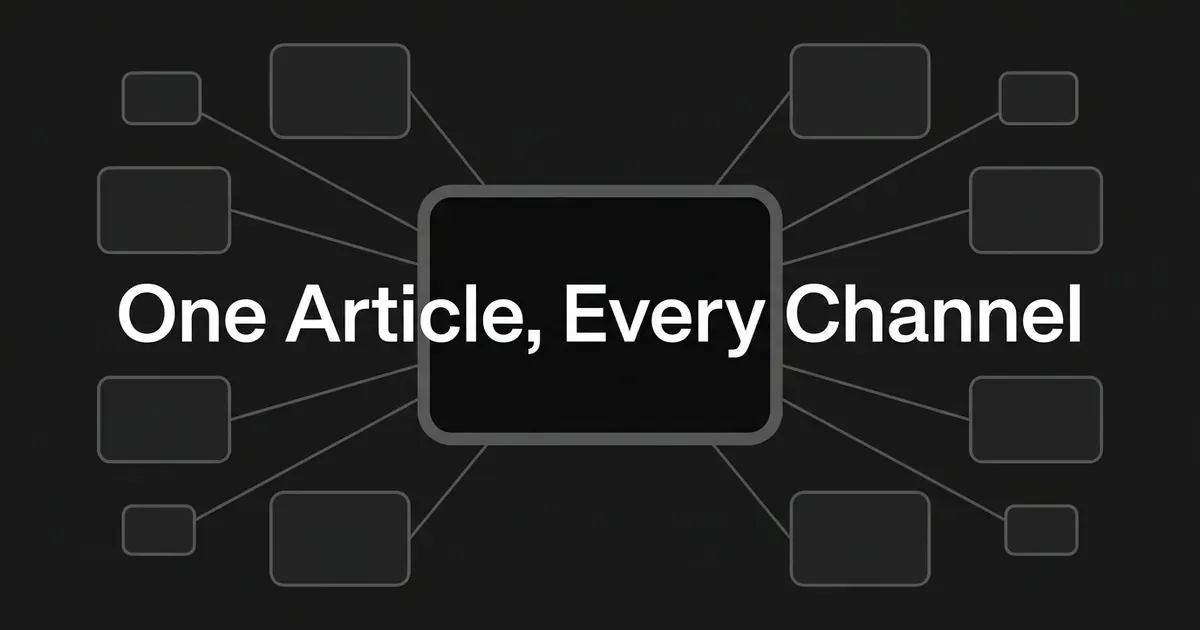
Here's the short version of the fix. When you repurpose content with AI agents, you don't ask a model to "write me ten social posts." You break the article into traceable pieces, decide what each piece is for, give each channel its own small job, check every draft against the source, and keep a person on the exceptions.
This guide walks you through building that system, one step at a time. By the end you'll have a workflow that turns one approved article into a set of channel-ready assets, in your voice, without inventing claims you never made.
Step 1: Pick one article that is worth atomizing
Your AI content repurposing workflow is only ever as good as the article you feed it. Not every article deserves this. Start with one that has real substance to give.
Look for an article with a clear central idea, several distinct sections, and some combination of examples, definitions, objections, or a framework. It should still be accurate. It should matter to an audience you're trying to reach right now. Bonus points if it can serve more than one buyer stage without twisting the message.
Set one rule before you go further: the source has to be final. Never atomize a draft whose claims, positioning, or product details are still moving. Every asset you generate inherits whatever is wrong with the source.
How you'll know it's done. You have a source record with a stable title and version, an owner, a review date, a freshness status, the list of claims that must not change, and a plain sentence saying why this article is worth reusing.
Where this goes wrong. Automation makes repurposing cheap, so teams repurpose everything. Thin articles, outdated articles, and very time-bound articles don't hold enough distinct value to split apart. Page views alone aren't proof either. Relevance, freshness, and audience need matter just as much.
Pro tip: Start with one strong evergreen piece and make the workflow reliable before you expand the asset menu. One article done properly teaches you more than thirty done badly.
Step 2: Turn that article into a source-of-truth ledger
This is the step most teams skip, and it's the step that makes everything after it safe.
Instead of handing the raw article to a model and asking for posts, ask an extraction agent to turn it into structured records first. That step has a name: agentic content atomization. You're breaking a big asset into small, traceable units the rest of the system can work from.
The atoms are not random sentences. They're the useful pieces: the central thesis, each supporting argument, definitions, steps, examples, objections and their answers, quotable lines, data points with their context, approved calls to action, and any product claims.
Around those atoms, capture the control fields:
| Ledger field | What to capture |
|---|---|
| Source identity | Title, version, owner, review date, status |
| Central thesis | The one sentence the whole article supports |
| Audience and stage | Who it's for and where they are in the buying process |
| Atomic ideas | One record per claim, step, definition, example, or objection |
| Evidence | The source passage or approved reference behind each atom |
| Claim type | Fact, opinion, recommendation, example, product claim, prediction |
| Required qualifiers | Conditions, dates, limits, exclusions, caveats |
| Approved terminology | Product names, feature names, preferred phrases |
| Prohibited claims | What downstream assets must never introduce |
| Calls to action | Approved actions, and who each one is for |
Give every atom an ID, and make every draft that uses it carry that ID. Your reader never sees it. Your reviewer needs it. That single field is what turns "trust this fluent rewrite" into "check this post against line 40 of the article."
Write the extraction prompt to forbid additions explicitly. No new facts, no new examples, no new statistics, no customer outcomes, no product capabilities, no quotations that don't appear in the source.
How you'll know it's done. A reviewer can answer these from the ledger alone: What's the article's main point? Which passage supports this idea? Is it a fact, an opinion, or an example? What qualifiers travel with it? What's off limits? Which formats can use it without changing its meaning?
Where this goes wrong. Using the raw article text as the only control layer. Raw text makes it easy for the next agent to blend two adjacent ideas, drop a caveat, treat an example as a fact, or invent the connective claim that ties them together. The other failure is compressing so hard that dates, conditions, and exceptions vanish.
Step 3: Map each atom to a channel, an audience, and a job
Atoms without a destination are just fragments. Agentic content atomization only pays off once every atom has somewhere to go, so decide what the set is supposed to accomplish before you generate anything.
The one article many formats idea is real, but volume alone is not the goal. Ten near-identical posts doing the same job is worse than four that each do something different.
Write a short brief for every planned asset. Name the channel, the format, the audience, the buyer stage, the job it's doing, the single takeaway, the source atoms it's allowed to use, the length limit, the CTA if there is one, the review owner, and how you'll measure it.
Different source material wants different destinations:
| Source material | Downstream assets | The job |
|---|---|---|
| Central thesis | Opening social post, newsletter lead, exec briefing | State the problem and why it matters |
| A process or framework | Carousel outline, thread, checklist, video script | Teach the sequence |
| Definitions | FAQ entries, glossary snippets, educational posts | Remove confusion |
| Examples | Story-led post, email section, sales slide | Make the idea concrete |
| Objections | Q&A post, objection handler, community reply | Reduce friction |
| Data or evidence | Chart brief, statistic-led post, visual caption | Support a claim with its context |
| Conclusion | Recap post, newsletter close, CTA | Move the reader to the next step |
Each channel also needs its own adaptation rule. A professional network post leads with an operational lesson. A newsletter section adds context and a transition. A thread splits a sequence into one idea per unit. A video script needs a spoken hook and a clean close. A carousel needs one concept per panel.
You're not teaching the system to post. You're teaching it what a good asset for that channel looks like.
How you'll know it's done. Every planned asset has one audience, one purpose, one takeaway, and one approved source group. No two assets are doing the same job in different clothes.
Where this goes wrong. Asking for "30 posts" without defining audience, channel, purpose, or source boundaries. You get repetition, channel mismatch, and message fatigue. The other common miss is pushing awareness material into a conversion moment without adding the context that stage needs.
Step 4: Build the workflow from simple, composable patterns
Take a breath here, because this is where people over-engineer.
A fixed sequence of extract, transform, evaluate, approve is technically a workflow, not an agent. Agents earn their keep when the system genuinely has to decide something: which transformations a given article needs, which atoms to select, where to route a piece, how to recover from a failure, when to stop and ask a human. Anthropic draws the same line between workflows with predefined code paths and agents that direct their own process and tool use.
For most marketing teams, a predictable workflow with a few agentic decisions is safer and easier to run than an autonomous agent with a long leash.
Here's a design that holds up:
- Extractor builds or refreshes the ledger.
- Planner picks the useful atoms and proposes the asset set.
- Router classifies each asset by channel, format, audience, and stage.
- Channel workers draft each asset from its approved atoms and channel template.
- Fidelity evaluator checks every claim against the ledger.
- Voice evaluator checks terminology, tone, positioning, and prohibited claims.
- Channel-fit evaluator checks whether the asset is native to its format.
- Revision worker fixes the specific failure without rewriting what already passed.
- Human checkpoint handles exceptions and final approval.
- Exporter packages approved assets with their metadata and source IDs.
Four patterns do most of the work here. Prompt chaining handles the clean decomposition: extract, classify, select, draft, evaluate, revise. Routing sends different content types to specialized instructions, so a process article goes to a checklist worker and a product article goes to a claim-sensitive one. Parallelization runs independent channel drafts at the same time from the same ledger, and runs your three evaluators side by side. An evaluator-optimizer loop pairs a generator with a critic that returns actionable feedback, with a hard cap on revision attempts.
Add routing or an orchestrator only when a real variation in your source or output demands it. Don't add a router to make the architecture look agentic.
If you'd rather not build the fan-out yourself, this is the part a production platform already covers. In DeepSmith, every finished article arrives with social posts written and ready to copy, and the Apps Library turns that same article into platform-native versions for LinkedIn, X, Medium, Substack, newsletter and nurture email, Reddit, and more, each adapted to that channel's tone and length. Same idea as the workflow above, minus the plumbing.

How you'll know it's done. You can draw the workflow on one page: each stage, its inputs and outputs, the tools it may use, its failure state, its retry rule, the human checkpoint, and the stop condition.
Where this goes wrong. Starting with a complex multi-agent framework. A simple sequence of extraction, fan-out, evaluation, and approval is far easier to test and debug, and it's usually all you need.
Step 5: Give every worker a narrow brief and nothing extra
More context is not better context. Each worker should get only what its job needs.
That means the relevant source atoms and their qualifiers, the target audience and buyer stage, the channel and format contract, brand voice rules, terminology and product rules, prohibited claims, CTA rules, and the output schema. That's it.
Don't pass the whole article, every earlier draft, and every tool result to every worker by default. Long context buries the constraints that matter and pulls in material that contradicts the brief. Anthropic's guidance on context engineering makes the same point: high-signal context beats exhaustive context.
Ask for structured output rather than loose prose. Fields like asset_id, source_version, source_atom_ids, channel, format, audience, buyer_stage, hook_or_opening, body, call_to_action, claims_used, qualifiers_preserved, risk_flags, and review_status give you something you can validate and query later.
Write your tool contracts the way you'd explain them to a new teammate. Clear inputs, clear outputs, named parameters, stated limits, and useful error messages. Tools should return focused information, not raw API noise for the next agent to wade through.
Keep workflow state outside the prompt too. Track completed assets, failed validations, open questions, approved decisions, and the current source version in a state record. A failed run should resume from that record, not from an agent's memory.
Voice is the other half of context, and it's where most repurposing quietly fails. A style guide PDF doesn't reach the model. Structured rules do: tone, sentence length, formality, words to use, words to avoid, how you handle uncertainty, how you talk about competitors, approved CTAs, and examples of good and bad copy.
This is the layer DeepSmith calls Deep IQ. Your company positioning, products, buyer personas, brand voice, visual guidelines, and content types are stored once as structured records, and every module works from that same context. The teaching point isn't "AI keeps your voice automatically." It's that you store the brand context once, feed the identical context to every downstream worker, keep claim controls separate from tone controls, and review the exceptions.
How you'll know it's done. A worker can finish its task without needing unrelated sections of the article or an assumption nobody wrote down.
Where this goes wrong. Passing too much raw source. Omitting the source version. Losing qualifiers during summarization. Mixing a current article with a superseded one. Dumping raw tool output into the next agent. Handing one general-purpose worker five different responsibilities.
Step 6: Validate every draft before a person ever sees it
Validation is its own stage. It is not a line buried at the bottom of a generation prompt.
Run these checks as separate passes:
Source fidelity. Does every factual statement trace to the ledger or approved brand context? Are numbers, dates, names, and comparisons transcribed correctly? Did the asset keep the qualifiers? Did an example quietly become an asserted fact? Did the draft fuse two ideas into a conclusion the article never drew?
Brand and product safety. Is approved terminology used consistently? Did the asset introduce a capability, an integration, a customer result, or a performance promise nobody approved? Does the positioning still match your current brand context?
Channel fit. Does the format suit the destination? Is there one clear idea, or an article paragraph stuffed into a smaller box? Does the opening work for that audience? Does the CTA match the stage?
Originality and usefulness. Does the asset add context or a genuinely better presentation, or is it a low-value duplicate? Google's guidance on generative AI content is worth reading here: usefulness, accuracy, quality, relevance, and originality are what separate helpful automated content from scaled filler.
Risk. Are third-party materials identified and attributions preserved? Could the asset mislead by omission? Does the context call for a disclosure about how it was made?
Have the verifier return a pass, fail, or needs-review status, naming the affected field and the specific correction. Don't build a verifier so rigid it rejects good wording just because it differs from the source sentence.
Common mistake: Fluency gets mistaken for factuality. A polished post can still introduce a new statistic, erase a condition, overstate a feature, or imply a customer result you never had. The most dangerous repurposing error is not clumsy wording. It's a small claim change that sounds harmless alone and quietly rewrites what the original article promised.
How you'll know it's done. No asset reaches the approval queue without a validation record. Every failure either has a successful revision or a named human it was escalated to.
Step 7: Approve, export, and measure what the set actually did
Put a human checkpoint between generation and public distribution. Always, and especially for product, pricing, legal, or security claims, time-sensitive facts, customer stories and quotes, competitive comparisons, and anything that failed validation twice.
For every approved asset, store the asset ID, source article and version, source atom IDs, channel and format, audience and stage, owner, approval status and reviewer, planned date, CTA and destination, validation results, and revision history.
Store the source version alongside every asset. When the article changes materially, mark the assets built from it for revalidation rather than letting an old claim keep circulating.
Be honest about what "automated" covers. Your AI content repurposing workflow can generate, validate, package, queue, and remind. Deciding what goes live stays with your team. DeepSmith creates the channel assets, ready to copy; posting and scheduling are still your step. When you set out to automate content distribution, name the step that stays human rather than assuming the system swallowed it.
Then measure more than volume. Track assets generated per article, the share that pass validation with no revision, review time per asset, revision rate by channel and worker, factual-error rate, brand-voice exception rate, near-duplicate rate, and the time from article approval to asset-ready. Layer on engagement, clicks, and pipeline where you can attribute them.
Use what you learn. If a format keeps failing validation or nobody engages with it, cut it from the matrix. More assets is not automatically better.
How you'll know it's done. The output is a reviewable, traceable asset package, not a folder of anonymous drafts. You know what was generated, from which source, for whom, why, who approved it, and how it will be measured.
Where this goes wrong. Measuring impressions and draft counts only. A pile of low-value assets adds review burden and tires your audience out. Tie every asset to a purpose and an outcome.

What to do next
Pick one article this week. Just one. Build its ledger by hand if you have to, plan four assets instead of forty, and run them through a single validation pass. You'll learn more from that one loop than from a month of architecture diagrams.
Once it works, widen the asset menu. Then automate content distribution in stages, starting with the parts that already proved themselves. That's the one article many formats promise delivered by a system, not by a heroic week.
If you'd rather not wire the fan-out together yourself, DeepSmith keeps article production and repurposing in the same brand context, so the channel assets come out of the same stored voice, persona, and product facts as the article did. You can start a free trial and see the whole flow on your own content before you commit.
You're closer to this than you think. You already have the articles. You just need the system that finishes the job.