

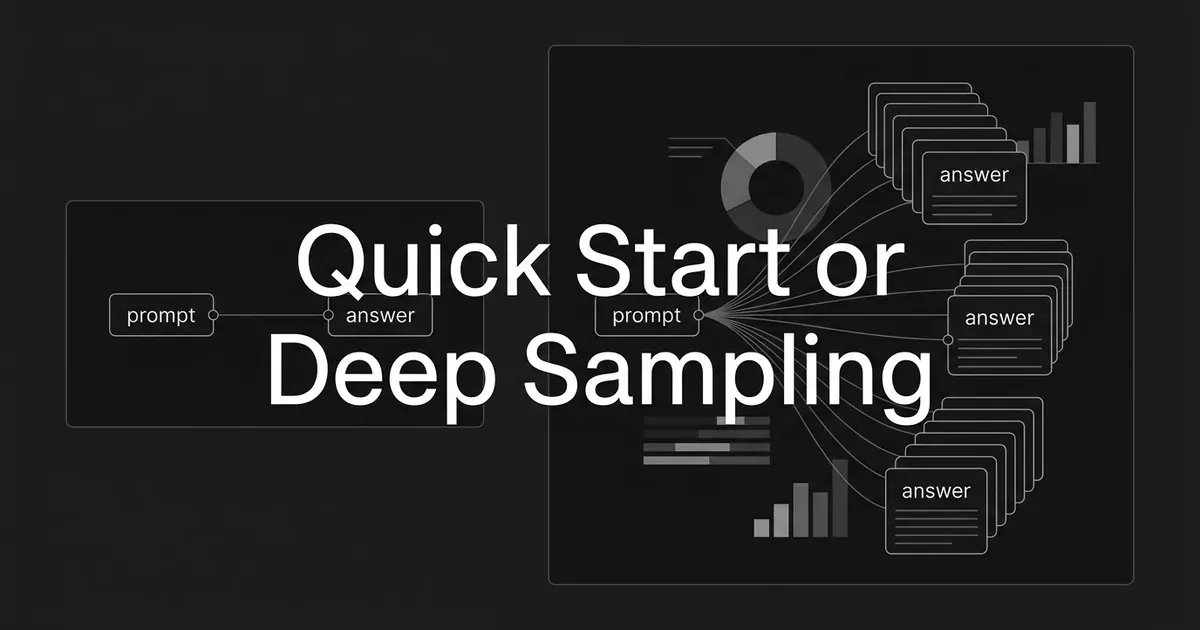
HubSpot AEO and Evertune sit at opposite ends of AI visibility tracking. HubSpot AEO is a $50 a month, no-card tracker on three engines, and Evertune samples each prompt 100 times per model across 11 AI models but sells only through a demo. DeepSmith is a strong alternative to both for teams that want tracking and finished, publishable articles on one self-serve plan, from $99 a month with a 7-day free trial.
HubSpot AEO vs Evertune comes down to whether deeper measurement is worth giving up a quick, cheap start. HubSpot AEO lets you sign up, add prompts and see results the same day. Evertune asks you to book a demo, then charges $800 a month for the listed plan. DeepSmith sits beside both with tracking and article production in one self-serve product.
HubSpot AEO vs Evertune: the short answer
- Choose DeepSmith if you want to track AI answers and publish the articles that close the gaps from one account, with plans at $99, $199 and $399 a month and a 7-day free trial.
- Choose HubSpot AEO if you want the lowest published entry price, $50 a month with a 28-day no-card trial, and three engines (ChatGPT, Gemini and Perplexity) are enough for now.
- Choose Evertune if you need each prompt sampled repeatedly across 11 AI models, up to 100,000 tracked prompts, and a path from visibility gaps to content, affiliate placements and ads, and you are fine buying through a demo.
| Criterion | DeepSmith | HubSpot AEO | Evertune |
|---|---|---|---|
| Entry price (monthly) | $99 (Pro) | $50 (standalone) | $800 (Pro, demo request) |
| Annual price (per month) | $80 | $45 | Not listed |
| Prompts at entry tier | 50 | 25 | 100,000 |
| Engines at entry tier | ChatGPT | ChatGPT, Gemini, Perplexity | 11 AI models |
| Most engines on any plan | 10 (Enterprise) | 3 | 11 AI models |
| Free trial | 7 days | 28 days, no card | None listed |
| Citation tracking | Yes | Yes | Yes |
| Content generation | Yes | Partial, Marketing Hub only | Yes |
| CMS publishing | Yes | Partial, HubSpot blog only | No |
| AI crawler analytics | - | Not listed | Yes, Enterprise only |
| Public API | Yes | Partial, beta read-only | Not listed |
| SOC 2 report | Yes | Yes, HubSpot platform-level | No |
| Multiple brands in one account | Yes | Partial | Not listed |
| G2 rating | 4.8/5 | 4.4/5 | Unrated |
Pricing and features as of September 2026, from each vendor's site and public reviews.
HubSpot AEO

HubSpot AEO is HubSpot's answer engine optimization tool, launched in April 2026 and still labelled beta. It runs your tracked prompts daily on ChatGPT, Gemini and Perplexity, then reports a brand visibility score, sentiment, share of voice against named competitors and the domains and URLs the answers cite. The standalone plan is $50 a month ($45 billed annually) for 25 prompts and 2,500 answers a month, and you do not need any other HubSpot subscription to buy it.
It is built for marketers who want a low-cost, self-serve first step, and for existing Marketing Hub Professional and Enterprise customers, who get it included along with CRM-based prompt suggestions and blog drafting. The standout is the price and the 28-day no-card trial, backed by clear citation reporting that goes down to your own pages.
The limits are real, though. Only three engines are tracked, and the 25-prompt base allowance is small, with extra capacity sold at $20 a month per 10 prompts. HubSpot's pages don't say how answers are collected or which model versions run, and blog generation needs Marketing Hub. On G2 it holds 4.4/5 from 145 reviews as of September 30, 2026. Reviewers praise easy setup and a clear competitor view, and they ask for Claude coverage, a higher prompt cap and less generic recommendations.
Evertune

Evertune is a New York based AI search marketing platform founded in 2024 by early team members of The Trade Desk. It measures how AI models mention and rank a brand against competitors, and then connects the gaps to content, site fixes, affiliate placements and ChatGPT and programmatic ads. Prompts are drawn from EverPanel, a consumer prompt panel Evertune says holds over 150 million prompts or conversations.
It is aimed at mid-market and enterprise brands, and the agencies that serve them, that want high-volume data and are willing to go through a sales process. The standout is the method. Evertune says every prompt is asked 100 times per model, and it separates base-model answers collected through provider APIs from answers in consumer apps. The Pro plan is listed at $800 a month with 100,000 tracked prompts and 25 articles a month, and Enterprise is custom.
The limits sit mostly around buying and proof. Both plans say "Request a demo", there is no free plan or standard trial, and the pricing page does not give an annual price, a seat count or what counts as one prompt. G2 showed zero reviews on September 30, 2026, so the proof points are Evertune's own case studies. Its content leaves the platform as Markdown or HTML, and its advertising modules are still in beta.
DeepSmith: the alternative that publishes and repurposes on a self-serve plan

Both tools stop short of the same step for a team without a big budget or a HubSpot suite. HubSpot AEO tracks and recommends, and drafting a post needs Marketing Hub Professional, which starts at $800 a month billed annually plus a $3,000 onboarding fee. Evertune writes drafts in its Content Studio, but its records show a download as Markdown or HTML, with no CMS connector. Neither record shows publishing and channel repurposing in full, and that is the part DeepSmith covers.
DeepSmith tracks how AI engines answer your questions and produces the on-brand content to close the gaps from the same data. Its AI Visibility module reports mention rate, citation rate and share of voice as separate metrics, with a per-engine breakdown and a competitor leaderboard.

Opportunity Agents read your visibility data and return content ideas with the evidence attached. The Writer turns a planned idea into a finished article with research, internal and external links, a cover image and publish-ready metadata, grounded in Deep IQ, which stores your company, products, personas, voice and content types. Autowrite can then write a scheduled article without anyone in the app. Finished articles publish straight to WordPress, Webflow, Strapi, Sanity or Contentful, or to your own webhooks, and every article arrives with social posts already written, with the Apps Library adapting it for LinkedIn, X, newsletters and more.

The cost is published. Pro is $99 a month, Grow is $199 and Scale is $399 ($80, $160 and $299 billed annually), with 20, 40 and 90 articles a month and 50, 100 and 200 tracked prompts. There are no long-term contracts, and the 7-day free trial gives you real data and real drafts before you pay. Each workspace is billed on its own, so an agency can run several brands from one account. Engine coverage rises by plan, from ChatGPT on Pro to Perplexity on Grow and Gemini on Scale, with all ten engines on Enterprise.
Engine coverage
Evertune covers more engines than HubSpot AEO, though the gap is smaller than the numbers suggest. HubSpot AEO tracks ChatGPT, Gemini and Perplexity on every plan, and reviewers on G2 ask for Claude. Evertune lists 11 AI models, including Google AI Overviews and Google AI Mode, which HubSpot's pages do not name.
The help center adds a detail that the FAQ leaves out. Claude, Meta AI and DeepSeek are sampled only as base models through APIs or open weights, not in their consumer apps, because those apps sit behind a login. Perplexity and Copilot are tracked in the consumer app only, and Grok is not covered at all. Evertune also does not publish which of the 11 models each plan includes. For a buyer, that means you should ask in the demo which consumer experiences you would actually see.
What DeepSmith does: DeepSmith names ten engines: ChatGPT, Gemini, Perplexity, Claude, Google AI Overviews, Google AI Mode, Grok, Meta AI, Microsoft Copilot and DeepSeek. Coverage grows by tier, from ChatGPT on Pro to all ten on Enterprise, so you can start narrow and widen as the plan does.
Tracking depth and data method
Evertune wins on method, and it is the main reason to take the demo. It asks each prompt 100 times per model and states a margin of error of about 1 point overall and 2 at topic level. Those figures are Evertune's own, but the method addresses a real problem, which is that AI tools do not always give the same answer to the same question. It also scores each cited source on topic relevance, brand relevance and sentiment, and it tracks where your brand ranks inside an answer. AI visibility scores move from day to day, so more samples per prompt is a sensible way to get a steadier number.
HubSpot AEO runs each prompt daily and reports visibility, sentiment, share of voice and citations by domain, URL, content type and channel. It also lists your top owned citations. It does not say how answers are collected or which model versions run, and HubSpot itself calls the first few weeks of data directional. For most small teams that is a fair place to start, and the evidence for a steadier number matters more as the prompt set and the stakes grow.
What DeepSmith does: DeepSmith checks your tracked questions on a schedule and reports mention rate, citation rate and share of voice for each prompt, with full answer history. Its Pages view shows which of your pages AI actually cites and which prompts drive those citations, so the data points at a page you can change.
Pricing and value
In an Evertune vs HubSpot AEO price check, HubSpot AEO wins on cost to start, and the gap is large. It is $50 a month with a 28-day trial that needs no card, against $800 a month for Evertune Pro with no trial at all. A first-month-free offer exists only for teams switching from Profound.
The price comparison changes once you want content. HubSpot AEO's standalone plan does not include blog generation, and Marketing Hub Professional, which does, runs $890 a month on monthly billing or $800 annually, plus $3,000 for onboarding. Each generated post also uses 1,000 HubSpot Credits. Evertune's $800 includes 25 articles a month and 100,000 prompts, but its terms allow per-prompt fees, overages and an advertising fee set as a percentage of spend, and those rates are published only on order pages. Whether $800 is billed monthly or on an annual commitment is not stated.
What DeepSmith does: DeepSmith publishes every price. Pro is $99 a month with 20 articles and 50 prompts, Grow is $199 with 40 articles and 100 prompts, and Scale is $399 with 90 articles and 200 prompts. You can try it free for 7 days, and there are no long-term contracts to unwind afterwards.
From insight to action
Evertune is stronger here than HubSpot AEO's standalone plan. Its Insights Agent prioritizes actions weekly, Content Studio builds briefs and full drafts from visibility gaps, and Site Audit ranks page-level fixes for up to 1,000 pages. Partner Connect maps the pages that AI cites to affiliate networks and programmatic platforms, and a ChatGPT Ads Manager is in beta. The path ends at an export, though. There is no CMS connector, so a draft reaches your site by download or copy and paste.
HubSpot AEO gives prioritized recommendations with a content type, a channel and a projected citation lift, plus a site audit. The drafting step sits behind Marketing Hub, where a recommendation becomes a blog post that opens in the HubSpot editor. That works well for teams already on HubSpot's blog, and for anyone publishing elsewhere it ends in a copy and paste.
What DeepSmith does: DeepSmith carries the work the whole way. An Opportunity Agent turns a visibility gap into an idea, the Writer produces the finished article, and Produced Content publishes it to your CMS. The same article then becomes social posts and channel versions through Repurpose and the Apps Library. For a team that wants to turn visibility gaps into a content backlog and ship it, that is the loop in one place.
Security and access
HubSpot AEO has the stronger answer for a security review. HubSpot's platform holds a SOC 2 Type II report, and SAML SSO comes with the Enterprise tier, although the AEO product is not named in the report's scope. There is also a beta read API and a HubSpot connector for Claude and ChatGPT. Evertune lists SSO on Enterprise only. Its own January 2026 comparison page says SOC 2 Type II is in progress, and no customer API or MCP server is described.
What DeepSmith does: DeepSmith is SOC 2, GDPR and ISO certified. It has a read-only REST API and an MCP server with 23 read-only tools that work with Claude, Cursor, VS Code and other assistants, so you can query your visibility data from an assistant without exporting anything.
Which should you choose
- DeepSmith: you want tracking and production in one self-serve plan, you publish to a CMS other than HubSpot's, or you run several brands or clients and want each in its own workspace. It suits marketing leads who need to produce more articles without adding headcount.
- HubSpot AEO: you are comparing AI visibility tools with a free trial, three engines cover the assistants your buyers use, and you want the lowest cost to learn how tracking works. It also fits teams already on Marketing Hub Professional or Enterprise, where AEO is included.
- Evertune: you are a mid-market or enterprise brand, or an agency, that needs repeated sampling, a very large prompt set, bot analytics and affiliate or ad activation, and you can run a sales process to get it.
Start a free DeepSmith trial to see your own tracking data and a first draft before you pay.


