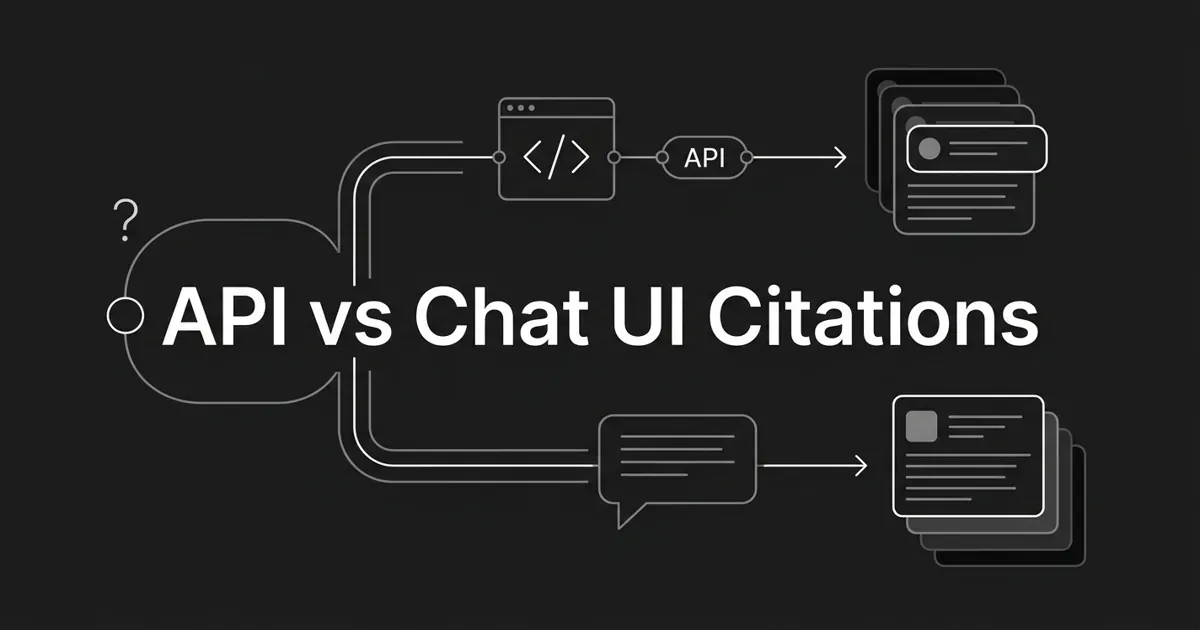
A marketing team decides to measure where AI engines cite its brand. One person opens ChatGPT in a browser, types a question, and screenshots the sources. A developer on the same team wires up the ChatGPT API, sends what looks like the same question, and logs the citations that come back. The two lists rarely match. The gap between API vs chat citations is not a bug, and it is not random. It is the predictable result of two different products answering the same question through two different pipelines.
That gap matters because the query method is a measurement choice, not a preference. A brand that appears as a cited source in the chat interface can be absent from the API response, and the reverse happens just as often. Anyone building a picture of AI citation query method behavior has to understand why the surfaces diverge before trusting either one as ground truth. This comparison explains the mechanisms that separate the API from the chat interface for the major engines, and what those mechanisms imply for how a team tests and reports on citations.
The scope here is deliberately narrow. This piece explains the API-versus-interface gap as it affects which sources an engine returns. It does not attempt to build a full measurement stack, and it does not catalog why one engine's source-selection logic differs from another's. It stays on the single question a lot of teams get wrong: why the sources an AI cites through its API differ from what a person sees in the chat window.
The two surfaces at a glance
The vendor's chat application and the vendor's API are not the same product, even when they nominally run the same model. They can use different retrieval pipelines, different system prompts, different tool configurations, and, in some cases, different model checkpoints. The following table summarizes the axes on which the two surfaces tend to diverge, using ChatGPT as the reference case; the pattern generalizes to Perplexity, Gemini, and Claude with engine-specific details.
| Dimension | Chat interface (e.g. ChatGPT.com) | API (e.g. ChatGPT web search tool) |
|---|---|---|
| Web retrieval | On by default via a UI toggle | Off unless a search tool is added to the request |
| Retrieval depth | Full browsing subsystem that can follow links and read full pages | Lighter, simpler retrieval tool documented as a subset of the chat system |
| System prompt | Long engine-managed preamble plus memory and custom instructions | Whatever system message the developer sets, often empty or terse |
| Sampling controls | Fixed engine defaults, not surfaced | Developer-set temperature, top_p, context size, domain filters |
| Citation rendering | Automatic source chips or footnotes | Structured annotation data the developer must render |
| Model version | Auto-routed default with fallbacks | Pinned to a specific, billed model identifier |
Each row is a reason the cited sources can shift. Read together, they explain why a near-identical prompt produces two different evidence sets, and why hand-checking one prompt in a browser is not the same as measuring citations at scale.
Why API cites differently: the core mechanism
The clearest way to understand why API cites differently is to separate retrieval from generation. A citation only exists when the engine has retrieved a source and then chosen to attribute part of its answer to that source. Both steps behave differently across surfaces.
On retrieval, the default state is the first divergence. ChatGPT's chat interface exposes a web search toggle, and for many queries it searches by default. The ChatGPT API, by contrast, exposes web search as a tool that has to be enabled explicitly in the request. Before that dedicated tool existed, the only way to trigger a live web fetch from the API was through function calling. A bare API call therefore returns an answer built from the model's training data, with no live sources at all, even when the same model on the chat interface returns a searched and cited answer. That single configuration difference accounts for a large share of the observed gap.
When retrieval is enabled, the retrieval systems themselves are not equivalent. The chat interface uses a more capable browsing subsystem that can click links, follow redirects, and read full web pages. The API's web search tool is documented as simpler and lighter, described in the vendor's own materials as the fine-tuned models and tool used by search in the chat product rather than the full browser agent. A source pulled by the interface may come from text deep inside a downstream page, while a source pulled by the API may come from whatever snippet the lighter tool judged sufficient. The pool of candidate sources is not the same, so the citations drawn from it are not the same.
Generation adds a second layer. The chat interface wraps every user message in a long, engine-managed preamble that includes tool guidance, memory, and any custom instructions the user has set. The API applies only the system message the developer supplies, which is frequently empty or terse. Because the framing around the question changes how the model weighs and selects evidence, the two surfaces can cite different sources even when they retrieve from an identical candidate pool.
ChatGPT API vs UI sources
The ChatGPT API vs UI sources question is the one most teams hit first, because ChatGPT is where most brand hand-checks start. Several specifics are worth holding separate.
The API returns citations as inline markers plus a structured annotation object that carries the source URL, its title, and the location within the answer. This is machine-readable evidence, which is useful for measurement, but it only appears if the web search tool ran. The chat interface renders sources automatically as clickable chips, so a person always sees them when they exist.
Scale introduces a further constraint. The OpenAI Batch API does not support web search; the guidance is to fetch web data beforehand and embed it as context. Any team trying to reproduce citations across hundreds of prompts through the cheaper batch path loses live retrieval entirely, and with it any citation that depends on a fresh search. Live endpoints remain the only way to capture searched citations, which adds cost and quota pressure to large measurement runs. Pricing for the web search tool has historically sat around five dollars per thousand search queries, though the current documentation spans several endpoint families with rates that vary by surface, so the live pricing page is the only reliable reference.
Model version is the quietest driver of divergence. ChatGPT users on the interface see an auto-routed default, sometimes with fallbacks to other checkpoints. The API bills each call against a specific, named model identifier, and older search-preview models have been scheduled for retirement. A measurement run that does not record the exact model id and the date cannot be reproduced, because the interface may already be serving a newer fine-tuned checkpoint than the public API tier ships. ChatGPT search itself launched on October 31, 2024, and the surfaces have continued to drift apart since.
Perplexity API vs the Perplexity interface
Perplexity is a useful second case because its API is split into two products, and neither one reproduces the interface exactly. Sonar returns a grounded prose answer with inline citations, close in shape to what the interface produces. The Search API returns a structured array of results with no generated answer at all. A team that queries the Search API and expects interface-style citations will find only raw results, because the LLM layer that turns results into an attributed answer is simply not part of that product.
The Perplexity API also exposes controls the interface hides. Search context size can be set to low, medium, or high, with high as the default, and it governs how much retrieved material the model considers. A domain filter supports both allow and deny modes, letting a developer include or exclude specific sites. None of these knobs are surfaced in the consumer interface, which runs its own fixed configuration. Setting them for a controlled test produces a defensible, repeatable result that nonetheless looks nothing like what a typical user sees.
Perplexity's own documentation acknowledges that API results may differ from the interface, and both its developer community and independent user reports describe the same pattern: the web and application experiences run enhanced prompt engineering and richer retrieval than the API delivers, even on comparable tiers. The direction of the gap is consistent. The interface tends to be the richer, more heavily engineered surface, and the API is the leaner, more controllable one.
Gemini API grounding vs the Gemini app
Google's split follows the same logic with different vocabulary. The Gemini API exposes grounding with Google Search as a tool the developer adds to a request; the model then decides dynamically whether to search based on the prompt. When it does, the response includes grounding metadata that carries the source URLs, search suggestions, and a search entry point.
The critical detail is that this metadata is raw. The API hands back the structured grounding data, and the developer's application has to render it into visible citations. The Gemini app renders sources natively. The consequence is a specific and common failure mode: the same grounded answer looks cited inside the Gemini app and completely uncited inside any custom integration that forgets to render the grounding metadata. A brand can be present in the payload and absent from the screen, which distorts any measurement that counts only what is displayed.
Pricing mechanics differ by model generation and affect cost projections rather than citation behavior. For newer Gemini generations, projects are billed for each search query the model chooses to run, so a single prompt that triggers several searches bills several times. For older generations, billing is per prompt regardless of how many searches ran. The distinction matters for budgeting a measurement program, not for which sources appear.
Claude's two API tracks vs Claude.ai
Claude introduces a distinction that third-party coverage frequently gets wrong, and keeping it straight is necessary to reason about citations at all. Anthropic offers two separate features that both produce something called a citation.
The Citations API, introduced in January 2025, grounds Claude's answers on documents the developer supplies, such as uploaded files or internal content. It does not search the web. It returns passage-level citations with character offsets and is designed for retrieval-augmented generation over a known document set. The Web Search tool is a distinct feature that grounds answers on the live web, returns a source-location annotation carrying the URL, title, and cited text, and supports allowed and blocked domain lists, though only one of the two can be used per request. It also caps the number of searches per request through a usage parameter.
The Claude.ai chat interface productizes both. Web search runs behind an interface toggle and renders inline source links, while document citations render as footnotes. The practical implication for measurement is sharp: neither API feature alone reproduces the full Claude.ai experience, because the interface combines web grounding and document grounding in one surface. A team measuring Claude citations through only the Web Search tool captures the web half and misses the document half, and a team measuring only the Citations API captures neither web source.
The toggles that drive divergence
Across all four engines, the same short list of controls explains most of the variance between an API result and an interface result. Treating them as a checklist makes any measurement setup reproducible.
- Retrieval state. Whether a web search or grounding tool is enabled at all. This is the largest single lever, because a request with retrieval off cites nothing external.
- Retrieval depth. Full browsing subsystem versus a lighter search tool. The interface generally reads deeper, so it can surface sources the API never reaches.
- System prompt. The engine's long managed preamble versus a developer's terse or empty system message. The framing changes how evidence is weighed.
- Sampling parameters. Temperature and top_p on the API versus fixed interface defaults. A deterministic test at temperature zero does not resemble the variable output a user receives.
- Search context size and domain filters. Developer-set on the API, fixed on the interface. These directly change the candidate source pool.
- Model identifier. A pinned, billed model on the API versus an auto-routed default on the interface, which may already be a newer checkpoint.
- Citation rendering. Automatic in every chat interface, manual in any custom integration that must render annotation data itself.
A team that records each of these for every measurement run can explain any divergence it observes. A team that records none of them is left with two lists of sources and no way to reconcile them.
What measuring AI citations API results actually requires
The reason all of this matters is that measuring AI citations API results and hand-checking the chat interface answer different questions, and conflating the two produces unreliable reporting. The interface reflects what real users see. The API reflects what a specific, configured endpoint returns. The AI citation query method a team picks, interface or API, decides which of those two realities its numbers describe, so a credible measurement program has to be explicit about which one it is capturing.
Two failure modes sit at opposite ends. Hand-checking one or two prompts in the chat interface feels authoritative because it mirrors the user experience, but it is not a measurement system: it is a single sample of a variable process, and it does not scale to the prompt volume needed for a reliable view. Measuring purely through the API scales well but can return a sanitized picture, because the API endpoint may miss retrieval behavior the interface performs. The stronger methodology captures both and reconciles them rather than trusting either in isolation.
Several practices make the results defensible. Repeatability comes first: AI engines do not return the same answer on every call, so a single query is a coin flip. Running each prompt several times, on the order of three to ten samples, exposes the variance and produces a rate rather than an anecdote. Transparency comes second: recording the extraction method, the tools enabled, the model id, the location, and the exact prompt phrasing is what makes a result reproducible. Coverage comes third: tracking source attribution at the URL level, and competitor share of the same answer, turns raw citations into a competitive picture.
The definitions underneath the numbers have to hold as well. A mention, where an engine names a brand without linking to it, is not the same as a citation, where the engine links to the brand's own pages as a source. Counting one as the other inflates share-of-voice figures and hides the gap between being talked about and being used as evidence. The engines themselves also draw from different source pools; an analysis of hundreds of millions of citations across the major engines found that each one leans on a distinctly different mix of domains, which is a further reason a single-surface, single-engine spot check cannot stand in for a measurement program.
Where DeepSmith fits
The API-versus-interface problem is fundamentally an instrumentation problem, and it is the reason a standardized tracking layer exists. DeepSmith is one platform for AI search analytics and content production. On the analytics side, it tracks how AI engines answer the questions that matter in a brand's space and reports mention rate, citation rate, and share of voice, with a per-platform breakdown and a competitor view.
The relevant point for this comparison is consistency of capture. Rather than depending on a marketer opening a browser to eyeball one answer on one day, DeepSmith checks a defined set of prompts on a schedule and records what each engine actually returns, so the collection method stays constant from run to run and from engine to engine. That standardization is what separates a trend a team can act on from a screenshot that may not reproduce an hour later. Engine coverage rises by tier: the entry plan tracks ChatGPT, higher tiers add Perplexity and then Gemini, and the top tier covers all supported engines, which currently include ChatGPT, Gemini, Perplexity, Claude, and Google AI Mode.
DeepSmith does not control or guarantee whether an engine cites a brand; no tool does. What it offers is a consistent measurement surface plus a production pipeline to act on what the measurement reveals, so a team that finds a citation gap can produce the on-brand content to close it inside the same platform. A 7-day free trial runs on real data and real drafts, with no long-term contract.
Which query method should you use
The choice between API vs chat citations comes down to what a team is trying to learn, and the honest answer is usually a combination rather than one or the other.
- A team validating a single high-stakes answer should check the chat interface directly, because that is exactly what a prospect will see. This is a spot check, not a measurement, and it should be treated as one data point.
- A team building a repeatable citation baseline should instrument the API for scale, but only after recording every toggle above, and should reconcile the API view against periodic interface checks so the numbers stay honest.
- A team without engineering capacity to build and maintain collection is usually better served by a dedicated tracking platform that standardizes capture across engines and query methods, rather than assembling a fragile in-house pipeline that drifts as each vendor changes its API.
- A team that needs to act on the findings, not just report them, benefits from a platform that pairs measurement with content production, so a discovered gap turns into published, on-brand content instead of another line in a spreadsheet.
For most content and marketing teams, the practical path is to stop treating a chat-window screenshot as proof and to adopt a consistent, repeatable method. Teams evaluating that path can start a DeepSmith free trial and see standardized citation tracking against their own prompts before committing.