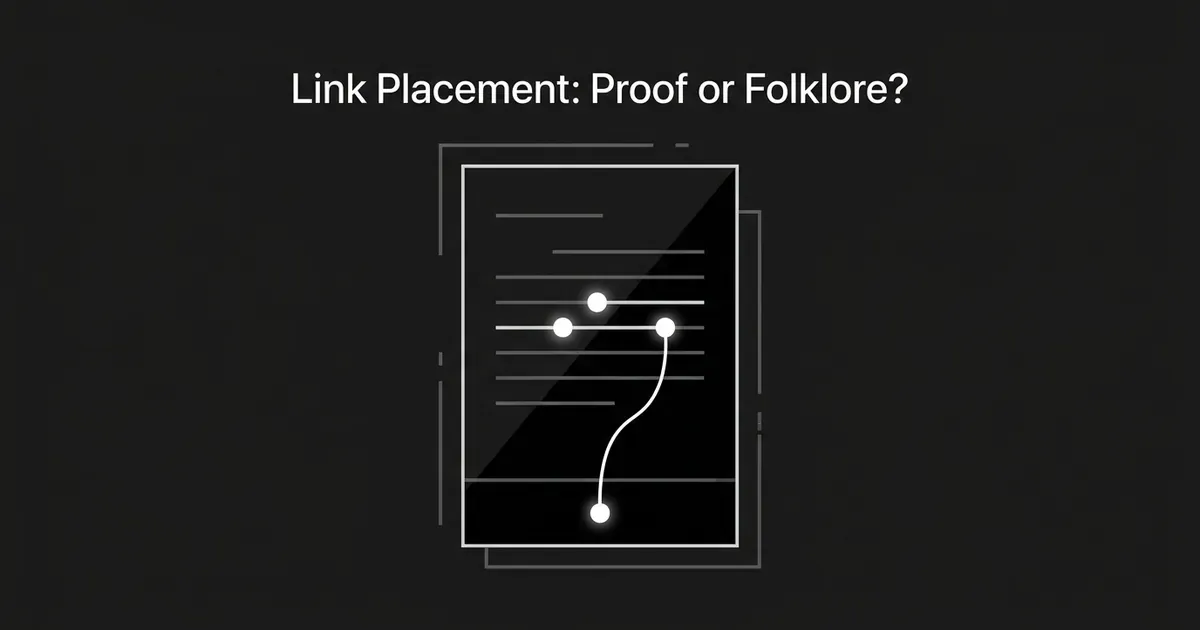
You have probably heard the rule: a link buried in a footer counts for less than one sitting inside a paragraph, and if two links on the same page point to the same URL, only the first one carries weight. This is the contextual link ranking factor claim and the first link priority SEO claim, and editors repeat both as if they were settled.
Here is the verdict up front. Google confirms that it uses link analysis and PageRank to help understand pages and decide what is helpful for a search. That part is confirmed. Whether link placement matters, meaning whether a contextual link outranks a footer link, or whether the first link to a URL counts more than a later one, is not confirmed and not denied by Google's own public documentation. The evidence grade here is unresolved: not proven, not debunked, just not addressed by the sources that exist to answer it.
That distinction matters more than it sounds like it should. A claim that is unresolved is different from a claim that is false, and treating the two the same way leads editors to either follow a rule nobody has verified, or throw out a reasonable practice because nobody can cite a source for it yet.
What the claim says and where it comes from
The link placement matters claim is really two separate ideas that get merged into one rule of thumb. The first is the contextual link ranking factor claim: that a link's position on the page changes how much ranking value it passes, with a link inside the body text, next to related words, supposedly counting more than the same link sitting in a footer or sidebar. The second is first link priority SEO, the idea that when a page links to the same destination more than once, only the first occurrence in the HTML gets counted, and every later link to that same URL is ignored.
Both ideas have circulated in SEO circles for years, often tied back to old patent filings or to link-building advice from a decade ago. A patent filing describes something an engineer thought worth protecting, not necessarily something the live ranking system still does, or ever did in production. Neither claim traces to a current statement from Google about how its ranking systems actually weigh link position. That gap is the whole reason this piece exists: to separate what Google has actually said about links from what the industry has repeated so often it sounds confirmed.
It is worth naming why this particular pair of claims is so sticky. Editors need a rule to apply at the moment they are placing a link, and "put it wherever it reads naturally" feels too vague to count as guidance. A specific number, the first link counts and the rest do not, or a contextual link outweighs a footer link, is satisfying precisely because it sounds decisive. Satisfying and sourced are not the same thing, and this piece treats them as separate questions throughout. It is the same pattern behind Google's old top three ranking factors claim, which still gets quoted as a fixed rule years after the original statement picked up caveats its repeaters tend to drop.
What Google confirms about links in general
Google's Search Central ranking systems guide says plainly that Google has systems built to understand how pages link to one another, and that this helps determine what pages are about and which ones might be useful for a given search. The same guide names PageRank as one of Google's core ranking systems, a system that has been part of Search since it launched and that shows up on any honest list of confirmed Google ranking factors. This guide was last updated December 10, 2025, so it reflects current guidance, not an outdated snapshot.
That is a real and specific confirmation. Google does analyze links. PageRank is still a live part of how Search works, and that confirmation is also the backbone of the evidence on whether backlinks still matter. If someone tells you links do not matter anymore, that claim is wrong, and this guide is the source that says so.
Google's separate guidance on link best practices adds detail about how links function day to day. It explains that links act as a signal when Google determines how relevant a page is, and that Google also uses links to find new pages worth crawling. It recommends that links be crawlable, meaning built as a proper HTML anchor element, and it defines anchor text as the visible text of a link, which should be descriptive, reasonably concise, and relevant to both the page it sits on and the page it points to. The guidance also notes that Google may fall back to an anchor's title attribute as anchor text when the anchor itself has none.
Google's SEO Starter Guide reinforces the same themes from another angle: good link text helps both users and search engines understand what is on the other end of a link before anyone clicks it, and links give context about a topic to both readers and crawlers. The guide also states that Google primarily finds new pages by following links from pages it has already crawled, which is the practical reason a page with zero inbound links is hard for Google to find at all.
Put together, these three points, link analysis and PageRank as real systems, crawlable links as a technical requirement, and descriptive anchor text as a quality signal, are the confirmed baseline. Everything past this point, specifically about placement on the page and order within the HTML, is where the documentation goes quiet.
Google Search Essentials, which organizes the company's guidance into technical requirements and spam policies among other sections, does not add anything specific to the placement question either. It is a useful map of where Google's other guidance lives, but it does not contain its own statement about contextual link ranking factor behavior or about first link priority. That matters here mainly as a negative result: it rules out one more place the answer might have been hiding.
What the primary sources actually say about placement
This is the section where the gap becomes obvious, because it is defined by what is missing rather than what is present. None of Google's ranking systems guide, its link best practices page, its SEO Starter Guide, or Google Search Essentials makes a statement about where on a page a link needs to sit to carry full value. None of them distinguishes a contextual, in-paragraph link from the same link placed in a footer or a sidebar. None of them says whether the first link to a destination URL is treated differently from a second or third link to that same destination elsewhere on the page.
That silence is not evidence that placement is irrelevant, and it is not evidence that placement matters either. It just means the question has not been answered by the sources that would be in a position to answer it, at least not in the pages reviewed here. No placement-specific study was assessed as part of this research pass, so this piece cannot borrow a third-party number to fill the gap without properly sourcing and checking it first, and doing that responsibly is a separate piece of work.
What the sources do support is a narrower, related point: crawlability and descriptive anchor text are the two things Google has actually told you to get right. A link that is not a real, crawlable anchor element might not function as a link to Google at all, regardless of where it sits on the page. That is a confirmed mechanical requirement, and it is a different question from whether position changes ranking weight once a link already works.
Why the placement claim stays unresolved
It helps to be specific about the two failure modes an editor can fall into here, because both are common and both cause real problems.
The first failure mode is treating an old, unverified rule as settled fact. Telling a writer "the first link always counts, so never link the same page twice" turns a folklore rule into an editing constraint with no source behind it. If that rule is wrong, you are now structuring every article around a fiction.
The second failure mode is the opposite overcorrection: deciding that because Google has not confirmed a placement effect, placement must not matter at all, so links can go anywhere with no thought given to where. That throws out something genuinely useful, which is that a link sitting next to the words that explain it gives a human reader context the moment they need it. Google's own guidance about links providing context to users supports that much, even without settling the ranking question.
The honest position sits between those two. Link placement matters in the sense that it affects whether a human reader understands why you are linking somewhere, and that is worth getting right on its own terms, independent of any ranking claim. Whether link placement matters to Google's ranking systems specifically, beyond the general link analysis and PageRank it already confirms, remains an open question this piece cannot close. It is also a separate question from internal links and click depth, which looks at how many clicks deep a page sits in your site rather than where a link sits within a single page, and deserves its own evidence review rather than getting folded into this one. The same goes for the broader question of whether content or links do more to earn Google's trust in a page: that is a sequencing question about where to invest effort, not a placement question about where on the page a link sits.
What to do with your links while this stays unsettled
Given what is actually confirmed, a few practical choices hold up without requiring a placement-specific guarantee.
Make every link crawlable. Build real HTML anchor elements for everything you expect Google to follow, including internal links, since Google's documentation treats this as a basic requirement for a link to function as a signal at all, not a nice-to-have.
Write anchor text that actually describes the destination. Google's guidance is specific here: descriptive, reasonably concise, relevant to both the page it sits on and the page it points to. That holds regardless of whether the link sits in the first paragraph or the last.
Put links where a human reader benefits from them, which usually is inside the relevant sentence, not bundled into a link list at the bottom of the page. This is a reader-experience decision backed by Google's statement that links provide context, not a confirmed ranking rule about position.
Do not build an editorial policy around first link priority SEO folklore. If you want to link the same destination more than once because two different sections each genuinely reference it, do that based on what serves the reader, not based on an unverified claim about which instance counts.
Keep a record of what you actually did, separate from what you believe about ranking. If your team currently enforces a one-link-per-destination rule, or always places the money link first and treats the rest as decoration, write that down as a house style choice rather than as something Google requires. That distinction protects you later: house style can change the moment you have a reason to change it, while a rule presented as a Google requirement tends to calcify, because nobody wants to be the one who breaks a "ranking factor." If you are also deciding how many internal links is too many on a page, treat that as its own budget question with its own evidence, not as an extension of the placement debate.
Run an internal link audit on a schedule instead of relying on placement folklore to catch problems. A periodic check for orphaned pages, broken anchors, and missing crawlable links catches real, confirmed issues that placement theories distract you from.
Resist the urge to run your own placement test and treat the result as proof either. A single page moving up or down after you change link position is confounded by everything else that changes on a real site in the same window, including Google's own index refreshes, so a before-and-after on one URL does not isolate placement as the cause.
If you are managing internal links across a large site and the manual tracking is the bottleneck, that is a workflow problem Deep IQ's internal linking step is built for. It scans your enriched sitemap and places internal links as pages are produced, based on which pages genuinely fit the surrounding claim, so the decision about which page to link stays grounded in real content rather than a guess made under deadline.
What would change this verdict
This verdict would move if Google published a specific statement about link placement or link order within the page, the way it has for crawlability and anchor text. It would also move if a credible, properly sourced study measured placement effects directly, with a clear methodology and attribution to whoever ran it, rather than being repeated as an unsourced rule. Until either of those things happens, the honest answer to "does link placement matter for ranking" stays: confirmed for link analysis and PageRank in general, unresolved for position and order specifically.
If you are rebuilding your own internal linking approach and want it grounded in what current context supports, DeepSmith's writing pipeline keeps that context in one place and applies it consistently across every article you produce, rather than leaving each writer to apply their own unverified rule of thumb.