You typed your best buying question into ChatGPT last week, and a competitor came back instead of you. That stings. Now you are shopping for netranks alternatives, and every vendor site says roughly the same three words: visibility, citations, share of voice.
Take a breath. This is a smaller decision than it looks.
Here is the good news. Most of these tools measure the same handful of things. What separates them is engine coverage, how much volume you get for the money, how deep they go on citations, and whether they help you fix the gap or only point at it. Once you know which of those four you care about, the list gets short fast.
This guide walks the eight best netranks alternatives for AI share of voice: DeepSmith, Profound, Scrunch, OtterlyAI, Rankscale, Goodie, Peec AI, and the Semrush AI Visibility Toolkit. For each one you get who it suits, what it does, published pricing, and one honest limitation. No hedging, no filler.
You do not have to pick perfectly today. You only need to pick the one that fits the next six months.
How we ranked these Netranks alternatives
Criteria are what make a roundup worth trusting, so here are ours up front. Every tool below was judged on the same seven questions.
- Repeatable prompt monitoring. Can you set a list of buyer questions and have them checked on a schedule, not by hand?
- Real measurement. Does it report mentions, citations, visibility, or share of voice, with trends you can show your boss?
- Competitor comparison and page-level attribution. Can you see who wins a prompt, and which exact page earned the citation?
- Engine coverage that matches your buyers. Not the longest engine list. The right one.
- A route from gap to fix. Does the tool stop at the chart, or does it help you act?
- Usable pricing and capacity. Published numbers, and enough prompts or credits to matter.
- Integrations, exports, and team fit. API access, Looker, CSV, seats, multiple brands.
One caution before the list. Share of voice is not a standard metric. Vendors use different labels and different denominators, so a score from one platform is not the same number as a score from another. Compare trends inside one tool. Do not stack two vendors' percentages side by side and call it a benchmark.
Quick comparison
| # | Tool | Best for | Published starting price | Coverage note |
|---|---|---|---|---|
| 1 | DeepSmith | Teams that need to measure AI visibility and produce the content that closes the gaps | Pro $99/mo, Grow $199/mo, Scale $399/mo, Enterprise custom | Ten engines in the platform, access tiered by plan |
| 2 | Profound | Enterprise brands wanting broad AI search plus agent analytics | Custom enterprise pricing | Lists Perplexity, ChatGPT, Claude, Gemini, Grok, Copilot, DeepSeek, AI Overviews |
| 3 | Scrunch | Citation provenance and API-led reporting | From $250/mo | AI monitoring and citations, engine list not published in the sources reviewed |
| 4 | OtterlyAI | Solo marketers and small teams on a budget | Lite $29/mo, Standard $189/mo, Premium $489/mo | Four engines in base tracking, more as add-ons |
| 5 | Rankscale | Credit-based monitoring with dashboards and API | Essential $20/mo, Pro $99/mo, Growth $385/mo | Promotes ChatGPT, Perplexity, Gemini, AI Overviews |
| 6 | Goodie | Visibility tied to revenue attribution and commerce | Explorer $399/mo, higher tiers sales-led | ChatGPT, AI Overviews, Perplexity at core, more on upper tiers |
| 7 | Peec AI | Prompt and model analytics with country flexibility | Starter $95/mo, Pro $245/mo, Advanced $495/mo | ChatGPT, AI Mode, AI Overviews, Copilot, Perplexity, Gemini |
| 8 | Semrush AI Visibility Toolkit | Teams already living inside Semrush | $99/mo per domain, billed annually | AI visibility across ChatGPT, Google AI, and other platforms |
1. DeepSmith
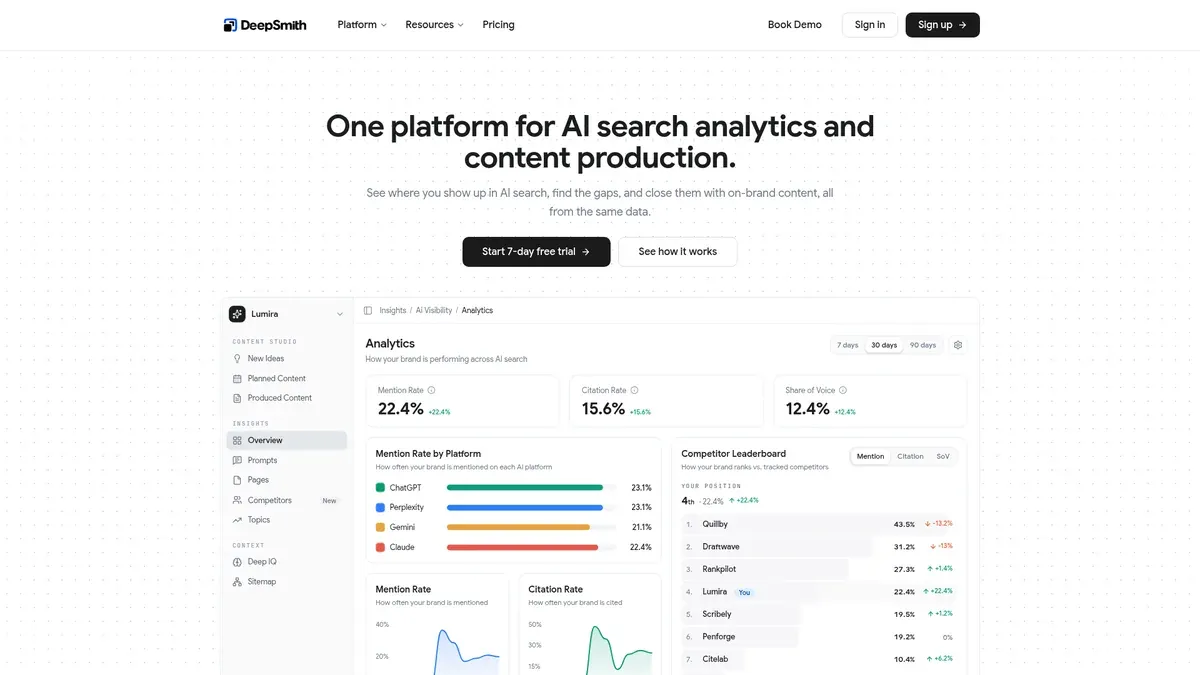
Best for: marketing leads and agencies who want measurement and production in one workspace, so a visibility gap turns into a published article instead of another line on a to-do list.
Most tools on this page stop at the chart. You learn that a rival is cited for your best prompt, and then you are on your own. DeepSmith closes that loop. It is an AI search analytics and content production platform, and both halves run off the same data.
Here is what the measurement side gives you. Mention rate, citation rate, and share of voice, with trends and a per-platform breakdown. A competitor leaderboard. The sources AI cites most often. Prompt views with per-prompt mention and citation rates plus full answer history. A Pages view showing which of your own pages get cited, what share of your total citations each one carries, and the prompts driving them. Competitor views show who wins a prompt, the exact page that won it, and how each rival performs engine by engine.

Then comes the part that makes this different. Content Map crawls your site and unlimited competitor sites into one shared taxonomy of topics and funnel stages, rechecked every 24 hours, so coverage is a measurement instead of a hunch. Opportunity Agents read that data and hand you ideas with the evidence attached: get cited for a tracked prompt, turn mentions into citations, take a competitor's citations, close a stage gap. Content Studio moves an idea through New Ideas, Planned Content, and Produced Content, with the Writer producing a researched, brand-grounded article that already carries SEO and AEO structure, internal and external links, a cover image, and metadata.
Autowrite is the piece that turns content from a task you run into a system that runs. Configure an article at planning time and it writes itself on its scheduled date, landing in Produced Content with nobody in the app. Repurpose and the Apps Library turn the finished piece into LinkedIn posts, X threads, newsletter sections, and more. Publishing goes straight to WordPress, Webflow, Strapi, Sanity, or Contentful, or to your own webhooks.

Deep IQ is the quiet piece that makes the output sound like you. It stores your positioning, product facts, claims to make and avoid, personas, brand voice, visual rules, and content types once, and every draft is grounded in it. No re-briefing per article, no voice drift at volume.
Pricing: Pro is $99 a month for 20 articles, 50 tracked prompts, 5 seats, and ChatGPT. Grow is $199 for 40 articles, 100 prompts, 7 seats, and adds Perplexity. Scale is $399 for 90 articles, 200 prompts, 10 seats, and adds Gemini. Enterprise is custom, covers all ten engines, and adds 1:1 onboarding and a dedicated account manager. Annual billing brings the effective monthly rate to $80, $160, and $299. There is a 7-day free trial with real data and real drafts before you pay, no long-term contracts, and no cancellation fees.
Honest limitation: DeepSmith is not a reporting-only dashboard, and the lower plans cover fewer engines than Enterprise. If your buyers live in ChatGPT and Perplexity, Grow already covers them and the tier limit never touches you. If you truly only want a tracker and will never produce from it, a specialist tool is a fair choice, and several good ones sit below.
2. Profound
Best for: enterprise brands that need broad engine coverage and agent analytics wired into a larger marketing and web stack.
Profound is built around visibility in AI-generated answers and zero-click search. Its integrations page lists Perplexity, ChatGPT, Claude, Gemini, Grok, Microsoft Copilot, DeepSeek, and Google AI Overviews, one of the broader published lists on this page.
The integration depth is the real story. Named connections include G2, Google Analytics, Vercel, Google Ads, OpenAI Ads, Akamai, Amazon CloudFront, Cloudflare, Fastly, Google Cloud CDN, Netlify, WordPress, and Google Search Console. G2 can surface answer engine citation data inside its own AI Visibility Dashboard. Google Analytics ties visibility to traffic and conversions. The CDN and Vercel hooks support tracking AI agents that hit your site, which most trackers here do not attempt.
Limitation: the official pricing page describes customized enterprise pricing and does not publish amounts, prompt limits, response limits, or trial terms. That is not a knock on the product, but you cannot budget from the website. Expect a sales conversation before you know your number.
3. Scrunch

Best for: teams where citation provenance and API access lead the decision, usually because someone is building reporting on top.
Scrunch centers on AI monitoring and citations. Its documentation describes citations by owner, top cited domains, URL-level drilldowns, prompt and response counts, citation consistency, and an Influence Score. You can separate your own sources from third-party and competitor ones, and filter by topic, persona, platform, funnel stage, branded versus unbranded prompts, and country. That is a lot of angles on one question: who is being quoted, and from where.
The APIs matter here. The Responses API captures full AI answers with citations, sentiment, competitors, and metadata for every prompt execution. The Query API returns aggregated visibility metrics and helps you analyze which web properties keep showing up in AI answers.
Pricing: the official pricing page states pricing starts at $250 a month. Other tiers and their limits were not published in the sources reviewed.
Limitation: the current engine matrix, prompt capacity, plan gates, and trial terms are not fully established in public documentation, and the help content itself warns that the interface may have moved ahead of the docs. If transparent plan capacity is your priority, this one needs a call first.
4. OtterlyAI

Best for: solo marketers and small teams who want a real tracker without a real budget.
Otterly is the friendliest entry point on this list. You get AI prompt research, search analytics, competitive benchmarking, domain and URL citation tracking, GEO and content audits, detailed reports, CSV exports, and multi-country tracking. Looker Studio, a public API, and an MCP server are there too, which is unusual at this price. The MCP server exposes brand reports, prompts, citations, recommendations, and audit checks to assistant-driven workflows.
Pricing: Lite is $29 a month for 15 search prompts. Standard is $189 for 100 prompts. Premium is $489 for 400 prompts. Enterprise is custom. Annual billing is advertised at 15% off. The product covers seven major engines: ChatGPT, Google AI Overviews, Google AI Mode, Gemini, Perplexity, Microsoft Copilot, and Claude.
Limitation: base tracking on the pricing page covers four engines, with Claude, Google AI Mode, and Gemini listed as add-ons. So the $29 headline is not a seven-engine plan. Price the engines and prompt volume you actually need, then compare.
5. Rankscale

Best for: teams that like credit-based usage, multiple brand dashboards, and shareable or white-label reporting.
Rankscale tracks visibility across ChatGPT, Perplexity, Gemini, and Google AI Overviews, and its Brand Visibility Dashboard pulls every brand and engine into one view. Search terms are unlimited. What you are buying is credits, and a typical AI engine query costs 0.25 credits per engine per prompt. Unused credits roll over up to stated multipliers on some tiers. Scheduling runs from hourly to monthly, all regions are covered, and Looker Studio, metric share links, white-label dashboards, and REST API access unlock by tier.
Pricing: Essential is $20 a month. Pro is $99 for 1,200 credits, up to 4,800 engine answers, 10 brand dashboards, and 50 page audits. Growth is $385 for 5,500 credits, up to 22,000 answers, 50 dashboards, and 200 page audits. An upper tier at $780 with 12,000 credits appears in marketplace listings, so confirm the tier name on the official page before you buy.
Limitation: credit math makes side-by-side comparison harder than it looks. Your real capacity depends on how many engines you run per term. Work out your expected monthly engine calls before you treat the $20 tier as equivalent to a high-volume multi-engine plan.
6. Goodie

Best for: teams that need visibility connected to revenue, and retailers who care about product-level AI shopping visibility.
Goodie tracks mentions, citations, sentiment, and competitive share, then pushes past reporting. Optimization Actions identify content, outreach, and technical fixes, and can execute improvements in the platform. Its Content Studio builds content structured for AI extraction with citation and authority markers. Analytics and Attribution ties AI visibility to revenue through Google Analytics. The Agentic Commerce Suite tracks products at SKU level across ChatGPT Shopping, Amazon Rufus, Perplexity Shopping, AI Mode Shopping, and other emerging AI commerce surfaces, which nothing else here does.
Pricing: Explorer is $399 a month with 100 prompts, 3,000 AI responses, core models ChatGPT, AI Overviews, and Perplexity, 10 optimization actions a month, and 3 seats, plus a 7-day free trial and MCP server access. Pro is sales-led with 250 prompts, 7,500 responses, added Gemini, Copilot, and Rufus, 30 optimization actions, and 5 seats. Enterprise is custom with 500+ prompts, up to 11 models, 60+ optimization actions, unlimited seats, and a dedicated strategist.
Limitation: $399 is a serious entry price next to the self-serve trackers, and the strongest commerce and multi-brand controls sit on the sales-led tiers. Worth it when revenue attribution or commerce visibility is the point. Expensive when basic monitoring is.
7. Peec AI

Best for: SEO and marketing teams who want prompt and model analytics with country and language flexibility, and clean project limits to map onto team scope.
Peec is straightforward in a way buyers appreciate. Pricing is based on tracked prompts and models analyzed, and the pricing page lists ChatGPT, AI Mode, AI Overviews, Microsoft Copilot, Perplexity, and Gemini as available models. Queries run across any supported country or language at no extra cost, which matters a lot if you sell in five markets. Looker integration, API access, MCP integration, and SSO appear in the enterprise access context.
Pricing: the brand Starter is $95 a month for 50 prompts, 1 project, and 3 models, with daily tracking. Pro is $245 for 150 prompts, 2 projects, and 3 models. Advanced is $495 for 350 prompts, 5 projects, and 5 models with advanced reporting. Enterprise is custom.
Limitation: prompts and models are separate cost drivers, so a team that wants many engines at high volume should model the combined price rather than anchor on the Starter headline. Peec is the better pick than a full production platform when focused analytics is genuinely all you need.
8. Semrush AI Visibility Toolkit

Best for: organizations already running on Semrush that want AI visibility sitting next to their existing SEO reporting.
Semrush tracks AI mentions, sources, and citations, reports overall visibility and share of voice across AI platforms, surfaces relevant prompts, compares competitors, reads sentiment, suggests content opportunities, and connects Google Analytics for AI traffic and conversions. If your weekly report already lives in Semrush, that shared context saves real reporting time.
Pricing: the Toolkit is $99 a month per domain, billed annually, with one folder and one domain for Brand Performance analysis. A custom prompt add-on starts at $45 a month for 25 custom prompts with daily AI rankings. A separate pricing page shows AI Visibility starting at $45 a month inside broader plan packaging, so check which product you are buying.
Limitation: the official knowledge base states there is no free trial, and the cited $99 plan is one folder and one domain. For an agency or a multi-brand company that gets expensive quickly, and you are buying reporting rather than a production workflow.
How to choose without overthinking it
You will not get this wrong if you match the tool to your actual constraint. Read the line that sounds like you and stop there.
Pick DeepSmith if your problem is not knowing, it is doing. You already suspect competitors are winning AI answers, and what you lack is the content to take those citations back. Measurement plus production on one dataset means the gap you find on Monday is a published article by Friday.
Pick Profound if you are enterprise, integrations and agent analytics matter more than published pricing, and you have a procurement process anyway.
Pick Scrunch if citation provenance is the whole job and someone on your team will build on the API.
Pick OtterlyAI if you are one person with a small budget who needs to start measuring this month.
Pick Rankscale if credit-based usage fits how you work, or you need white-label dashboards for clients.
Pick Goodie if you have to prove revenue, or you sell products that need to show up in AI shopping.
Pick Peec AI if you want focused analytics across several countries and languages without paying for a production suite.
Pick Semrush if your team already lives there and consolidating the report is worth more than a standalone tool.
Still torn between two? Choose the one whose limitation you can live with. That question decides faster than any feature grid.
Start with real data, not a demo
You do not need a six-week evaluation. You need one week of your own numbers.
Start your 7-day DeepSmith free trial and watch what happens when measurement and production share the same data. Real prompts, real citation numbers, real drafts, before you pay. No long-term contract, no cancellation fee.
Pick your ten most important buyer questions. Track them for a week. Whatever you decide after that will be a decision, not a guess.