The choice between DeepSmith vs Netranks comes down to where the constraint sits in a content operation. Netranks is a specialist AI-search visibility platform: it measures how brands appear across generative engines, maps which sources earn citations, and prescribes what to change. DeepSmith measures the same class of metrics and then produces the article that acts on the finding, inside the same workspace. Teams that already have writers, editors, and a working CMS tend to need the first. Teams whose publishing cadence is the bottleneck tend to need the second.
Both products belong to the category of ai share of voice tools, and both report mention rate, citation rate, and relative visibility against a competitor set. The divergence begins after the measurement, at the point where a diagnosis has to become a published page.
DeepSmith vs Netranks at a glance
| Capability | DeepSmith | Netranks |
|---|---|---|
| Mention and citation tracking | Yes | Yes |
| Share of voice against competitors | Yes, with sentiment | Yes, with sentiment and positioning |
| Engines covered | Ten: ChatGPT, Gemini, Perplexity, Claude, Google AI Overviews, Google AI Mode, Grok, Meta AI, Microsoft Copilot, DeepSeek, rising by tier | ChatGPT, Gemini, Claude, Perplexity, DeepSeek, Google and Google AI Overviews |
| Per-prompt answer history | Yes | Yes, via Prompt Surveys |
| Competitor leaderboard | Yes | Yes, up to roughly 250 competitors segmented by engine, market, or topic |
| Page-level citation attribution | Yes | Yes |
| Predictive impact scoring | Implicit in visibility and citation metrics | Yes, via the Answer Impact Model |
| In-product article drafting | Yes, the Writer produces a finished article | No |
| Scheduled hands-off production | Yes, via Autowrite | No |
| Internal and external linking in the draft | Yes | Not applicable |
| Cover image and metadata generation | Yes | Not applicable |
| Brand-grounded generation context | Yes, via Deep IQ | Not applicable |
| Native CMS publishing | WordPress, Webflow, Strapi, Sanity, Contentful, webhooks, with Markdown and HTML export | Not surfaced |
| Repurposing and distribution | Repurpose plus Apps Library across LinkedIn, X, Medium, Substack, email, Reddit, and more | None in-product |
| Multi-brand workspaces | Yes, isolated context, content, and billing | Not surfaced |
| Entry price | $99 per month, or $80 per month billed annually | Around $159 per month per third-party directories |
| Top published tier | $399 per month, or $299 per month annually, plus custom Enterprise | $1,199 per month, plus custom Enterprise |
| Free trial | 7 days, with real data and real drafts | Offered; some directories also list a free plan |
| Best fit | Teams that must publish more without adding headcount | Teams with production already solved that want a deep diagnostic layer |
Netranks: a measurement and optimization specialist

Netranks is built to answer one question thoroughly: where does the brand stand in generative answers, and what should change. The product tracks mention rate and citation rate, calculates share of voice relative to a competitor set, records how the brand is described rather than only whether it is named, and maps the third-party publications and competitor pages that win citations for tracked prompts. Traditional rank tracking sits alongside the AI metrics, with change alerts, dashboards, and exportable reporting.
Two capabilities distinguish the measurement layer. The first is Prompt Surveys, a high-scale repeatable prompt-running method intended to smooth out the non-determinism of large language models so that a movement in the numbers reflects a real change rather than sampling noise. Anyone who has queried the same prompt twice and received two different brand sets understands why this matters; stable signal is a prerequisite for any decision made on the data.
The second is the Answer Impact Model, a proprietary predictive layer that forecasts ranking outcomes before content ships. Predictive scoring of this kind is difficult to validate externally, and the honest position is that its accuracy is not something a buyer can verify from the outside. It nonetheless represents a genuine attempt at a capability most trackers do not offer at all: an ex-ante estimate rather than an ex-post report.
Netranks is a Netherlands-based company founded in 2025, led by founder and chief executive Berat Sonmez.
Where Netranks is strong
- Depth of measurement, including sentiment, positioning, and source attribution alongside the standard rate metrics.
- Signal stability at volume, through Prompt Surveys designed for repeatable high-frequency runs.
- Competitor benchmarking at scale, up to roughly 250 competitors segmented by engine, market, or topic.
- Industry-specific content-feature models on the upper tiers, which allow vertical tuning rather than a single generic scoring model.
- API access at the Enterprise tier, for organizations piping visibility data into in-house reporting systems.
Where Netranks stops, and when a Netranks alternative is warranted
Netranks does not draft articles, publish to a content management system, or generate derivative distribution assets inside the product. Recommendations and content-remediation guidance are the output; execution is handed to a writer, an agency, or a separate tool. That is a design choice rather than a defect, and for organizations with a functioning editorial team it is the correct one. It becomes a constraint only when the diagnosis outpaces the capacity to act on it.
Pricing transparency is limited above the entry tier. Third-party directories list the tiers, but specifics on Netranks' own site generally require a sales conversation, which lengthens evaluation for smaller buyers.
DeepSmith: the same metrics with a production layer attached

DeepSmith is an AI search analytics and content production platform in one workspace. Setup ingests the brand's website once, and seven modules then operate off that shared context.
The AEO module is the analytics half, and it covers the metrics a buyer would expect from any serious tracker: mention rate, citation rate, share of voice, sentiment, and visibility trend, with a per-platform breakdown, a competitor leaderboard, and the sources AI engines cite most often. The Prompts view holds per-prompt mention and citation rates with full answer history, and Discover Prompts generates a starter prompt set from stored product, persona, and buyer-stage context. The Pages view attributes citations to specific pages and reports each page's share of total citations along with the prompts driving them. Competitor Citations shows which competitor pages win the same prompts, broken out by platform.

The production half is what separates the two products. Content Map crawls the brand's site and its competitors' sites onto one topic taxonomy and surfaces coverage gaps and untapped topics, and Opportunity Agents read that map and the visibility data to return ideas with the data point that justifies each one attached. Content Studio moves an idea through New Ideas, Planned Content, and the Writer, which turns one planned idea into a finished, brand-grounded article that is researched, internally and externally linked, and delivered with a cover image and publish-ready metadata. Autowrite runs the same pipeline on a schedule with no one in the application. Produced Content handles review, revision, and publishing to WordPress, Webflow, Strapi, Sanity, Contentful, or a custom webhook, with Markdown and HTML export as a fallback.
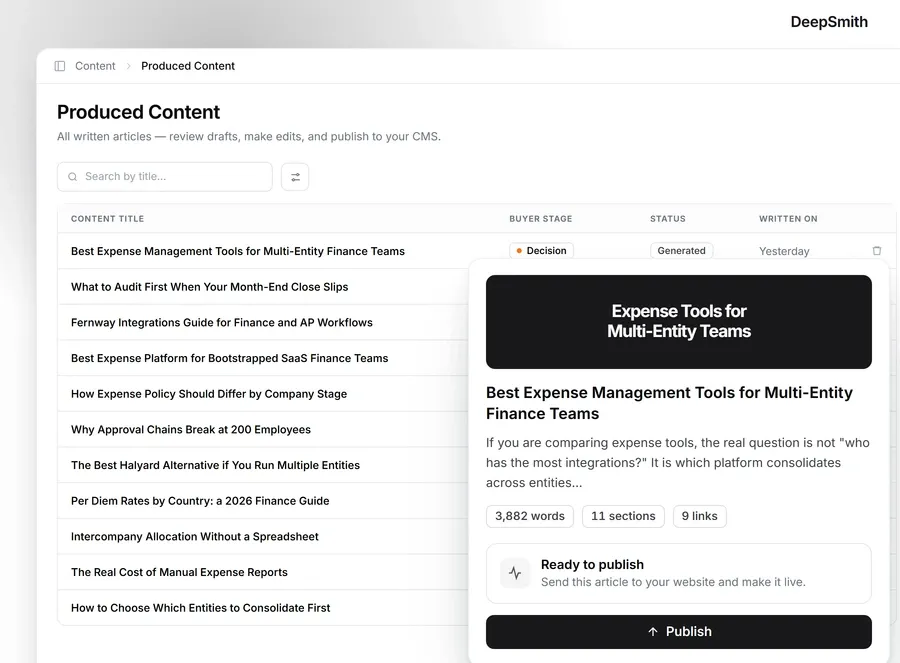
Two supporting layers make that output usable rather than merely fast. Deep IQ stores positioning, product profiles, buyer personas, brand voice, visual guidelines, and content-type templates as structured context, so every draft is generated against the same brand definition instead of a briefing rewritten per article. Content Map is the other: every published page is classified onto a granular topic and a funnel stage, and sitemaps are re-checked every 24 hours so new pages fold in without a re-import, which is what makes automated internal linking and ideation dedup possible.
Distribution is attached to the article rather than deferred. Every finished piece arrives with social posts written, and the Apps Library converts one article into platform-native versions for LinkedIn, X, Medium, Substack, newsletter and nurture email, Reddit, Facebook, Instagram, Slack and Discord, WhatsApp, and other channels.
Where DeepSmith stops
DeepSmith produces publish-ready articles rather than guaranteed outcomes. Autowrite can publish without human involvement, and a reviewer can also approve from Produced Content, but no responsible reading of the product promises quality with zero oversight. The platform tracks mention and citation across ten named engines; it does not control or guarantee rankings, citations, traffic, or revenue. Engine coverage is tier-gated, and there is no published free tier, though the 7-day trial runs on real data and real drafts before any payment.
DeepSmith also does not offer a named predictive ranking model in the manner of the Answer Impact Model. Its signals are observational, what happened, on which pages, driven by which prompts, which is measurement a buyer can verify rather than a forecast whose accuracy cannot be checked from the outside.
Netranks share of voice compared with the DeepSmith measurement layer
On the core metrics, the two products are closer than the positioning suggests. Netranks share of voice reporting adds sentiment and positioning to the standard mention and citation rates, segments competitors by engine, market, and topic at considerable scale, and layers predictive scoring on top. DeepSmith reports mention rate, citation rate, share of voice, sentiment, and visibility trend with per-platform breakdowns, a competitor leaderboard, page-level citation attribution, and full per-prompt answer history.
A team evaluating measurement alone would weigh two differences, and neither is engine coverage. Netranks offers an explicit predictive layer, which DeepSmith does not. Netranks scales competitor benchmarking further, to roughly 250 competitors, which matters in fragmented categories and rarely matters in concentrated ones. On engines, the six sources Netranks lists sit inside the ten DeepSmith tracks, so the real question there is which DeepSmith tier a buyer lands on rather than whether an engine is covered at all.
Against that, DeepSmith's measurement is wired directly into a production queue. A gap surfaced in the Prompts view can become an idea, a planned article, and a published page without leaving the workspace, and Content Map means the resulting article links into existing coverage automatically. The value of that wiring is proportional to how often measurement actually changes what gets published, which in most mid-market content operations is the step that fails.
Engine coverage and what the difference means
Netranks lists six sources: ChatGPT, Gemini, Claude, Perplexity, DeepSeek, and Google with Google AI Overviews. DeepSmith names ten: ChatGPT, Gemini, Perplexity, Claude, Google AI Overviews, Google AI Mode, Grok, Meta AI, Microsoft Copilot, and DeepSeek, with coverage rising by tier. The Pro plan tracks ChatGPT, Grow adds Perplexity, Scale adds Gemini, and Enterprise and Custom cover all ten.
The practical implications are narrower than the counts suggest. Every source on the Netranks list, DeepSeek and Google AI Overviews included, is inside the DeepSmith list, so this is not a coverage gap in either direction for the engines both products name. For most English-language B2B categories, the engines that move pipeline are a subset of either list anyway, and the extra sources matter mainly where audience geography or vertical pushes buyers onto Grok, Meta AI, or Copilot. Tier-gating is the real constraint on the DeepSmith side: a team that needs Gemini data from day one is on the Scale plan, not the entry plan, and full ten-engine coverage sits on Enterprise or Custom, which changes the cost comparison materially.
Pricing compared
DeepSmith publishes four tiers openly. Pro is $99 per month, or $80 per month billed annually, with 20 articles, 50 tracked prompts, 5 seats, and ChatGPT coverage. Grow is $199 per month, or $160 annually, with 40 articles, 100 prompts, 7 seats, and Perplexity added. Scale is $399 per month, or $299 annually, with 90 articles, 200 prompts, 10 seats, and Gemini added. Enterprise is custom, with all ten engines, 1:1 onboarding, and a dedicated account manager. A 7-day free trial provides real data and real drafts, and there are no long-term contracts or cancellation fees.
Netranks pricing, per third-party directories, starts at roughly $159 per month for the Visibility tier, which covers 2 tracked questions, 1 engine, daily visibility snapshots, and 4 page optimizations per month. The Optimization tier is listed at $799 per month with 5 tracked questions, 2 engines, an industry-specific model, and 10 page optimizations. Optimization Pro is listed at $1,199 per month with 10 tracked questions, 3 engines, the Answer Impact Model, full-site detail analysis, and automatic question-to-content matching. Enterprise is custom and adds API access. A free trial is offered, and some directories list a free plan, which is worth verifying directly before treating it as available.
Two structural points matter more than the headline numbers. The first is that the tracked-question counts sit at different orders of magnitude: 2 to 10 tracked questions on the published Netranks tiers against 50 to 200 tracked prompts on the DeepSmith tiers, which reflects different assumptions about prompt-portfolio breadth. The second is that any comparison of total cost has to include what is bought elsewhere. A Netranks subscription plus a writer or agency retainer is a different line item from a platform that includes production, and the honest comparison is stack against stack, not tool against tool.
How to run the evaluation
A comparison of ai share of voice tools resolves faster when the evaluation is sequenced rather than run as a feature-by-feature audit. Four questions do most of the work.
Which step currently fails? Content operations tend to break at one of three points: nobody knows where the brand stands, everybody knows and nothing gets written, or articles get written and never reach distribution. Netranks addresses the first point with more depth than most trackers. DeepSmith addresses the second and third. Buying against the wrong failure point produces a tool that reports a problem the organization already understood.
How many prompts does the category actually require? A narrow product with a concentrated buyer set may be adequately covered by a handful of tracked questions. A broad category with many use cases and many competitors needs a wider prompt portfolio, and the published tiers differ sharply here, from single-digit tracked questions on the Netranks plans to 50 to 200 tracked prompts on the DeepSmith plans. This variable moves the effective cost per plan more than the sticker price does.
What happens to a finding on the day it appears? This is the question that separates the two products, and it is answerable only by looking at the existing workflow. If a visibility gap already has an owner, a brief template, a writer, and a slot in a calendar, an analytics specialist fits cleanly. If the gap enters a backlog that is already months deep, the reporting layer is not the constraint.
What has to be verified before signing? Netranks pricing above the entry tier comes from third-party directories rather than the vendor site, and directory listings of a free plan should be confirmed directly. Engine coverage should be confirmed against the specific plan under consideration, since coverage is tier-gated on the DeepSmith side. Both vendors offer a trial, and running the same set of five to ten real buyer prompts through each product is a more informative test than any feature matrix, including this one.
Which should you choose
Choose Netranks when measurement is the bottleneck. Organizations with writers, editors, and a functioning CMS already in place, whose gap is diagnostic rather than operational, get more from a specialist analytics layer than from a platform that also writes. The case strengthens when predictive scoring before publication genuinely changes the editorial decision, when competitor benchmarking needs to run across a very large set, or when Enterprise API access is required to pipe visibility data into internal systems.
Choose DeepSmith when the diagnosis and the execution both stall. The case is strongest where output volume is the constraint, where voice consistency degrades as volume rises, where internal linking and metadata are done manually and therefore skipped, where distribution assets are the step that never happens, or where multiple brands or client workspaces have to run under one account with isolated context and billing. The lower entry price is a secondary consideration; the primary one is whether a finding turns into a published page without a handoff.
Treat the question of deepsmith or netranks as a question about sequence. Measurement without production capacity produces a backlog of known gaps. Production without measurement produces volume aimed at the wrong prompts. A team that has one of the two already solved should buy the other, and the answer to deepsmith or netranks follows directly from which half is missing.
Consider running both when the budget supports it. The products are not mutually exclusive. A team already invested in Netranks can add DeepSmith for production and distribution, and a team on DeepSmith can layer the Answer Impact Model as a second-opinion predictive input. Stacking makes sense when the combined cost is still below the cost of the headcount it displaces, and not otherwise.
For teams that arrive at this comparison looking for a Netranks alternative that closes the loop between measurement and publication, DeepSmith's 7-day free trial produces real visibility data and real drafts before any payment, which is the fastest way to test whether the production layer is the missing piece. Start a free DeepSmith trial.