

Otterly.AI is the cheaper, self-serve monitor that adds page audits and ranked recommendations, while Scrunch costs more to start and reaches further into the site by serving AI-optimized pages to agents, but only on Enterprise. Teams that want to see and audit at a low price lean Otterly.AI, and teams with a big site and an enterprise budget lean Scrunch. DeepSmith is a strong alternative when the goal is new, publish-ready articles, since it tracks the gaps and then writes and publishes the content that closes them.
Choosing between Otterly.AI vs Scrunch mostly comes down to what you want done once you know a page is weak. Both audit pages for AI search. Otterly.AI stops at monitoring, audits and recommendations, with a $29 entry plan. Scrunch goes into the site layer and can serve a separate version of a page to AI agents at the edge, on a $250 entry plan and an Enterprise contract for the edge part. DeepSmith sits next to both and covers the step after the audit, which is producing the content.
Otterly.AI vs Scrunch: the short answer
- Choose DeepSmith if you want the gaps found in AI answers turned into new articles that are written, grounded in your brand context and published to your CMS, with tracking and production on one plan starting at $99 a month.
- Choose Otterly.AI if you want the lowest published entry price ($29 a month, no card for the 7-day trial) for daily tracking, page audits and ranked recommendations that your own team will act on.
- Choose Scrunch if you run a large site, can buy Enterprise, and want AI-optimized page versions served to agents at the edge instead of only a list of fixes.
| DeepSmith | Otterly.AI | Scrunch | |
|---|---|---|---|
| Entry price (monthly) | $99/mo (Pro) | $29/mo (Lite) | $250/mo (Core) |
| Annual price (per month) | $80/mo | $25/mo | Not listed |
| Prompts at entry tier | 50 | 15 | 125 |
| Engines at entry tier | 1 (ChatGPT) | 4 | 4 |
| Most engines on any plan | 10 | 7 (3 are paid add-ons) | 9 (Enterprise) |
| Free trial | 7 days | 7 days, no card | 7 days, card required |
| Page audits for AI readability | - | Yes | Yes |
| AI crawler analytics | - | Yes, Standard and above | Yes |
| Writes full articles | Yes | Not listed | Partial, scope unclear |
| Publishes to a CMS | Yes | Not listed | Not listed |
| Public API | Yes, read-only | Yes, Standard and above | Yes, Enterprise |
| SOC 2 | Yes | Not listed | Yes, Type II |
| G2 rating | 4.8/5 | 4.7/5 | 4.6/5 |
Pricing and features as of September 2026, from each vendor's site and public reviews.
Otterly.AI

Otterly.AI is a self-serve AI search monitoring tool from an Austrian company that launched in October 2024. It runs your prompt set every day on ChatGPT, Google AI Overviews, Perplexity and Microsoft Copilot, and reports mentions, citations, position, sentiment and share of voice against competitors. Around that it adds a GEO Audit that checks 19 AI crawlers, a Content Audit, ranked recommendations and Agent Analytics for AI bot traffic. It suits small and mid-sized marketing teams and agencies, since every plan has unlimited seats and Standard and above has unlimited workspaces.
The standout is the price and the way the tool is packaged. Lite is $29 a month ($25 billed annually), Standard is $189 and Premium is $489, and the trial needs no credit card. The pros are the low entry cost, the audit allowances (1,000 URL audits a month even on Lite) and API, MCP and Looker Studio access from Standard.
The cons are mostly about limits. Google AI Mode, Gemini and Claude cost extra, Lite has only 15 prompts and the jump to Standard is large, and Otterly.AI documents no article writing or CMS publishing. It also cites only its AWS host's SOC 2, not one of its own. On G2 one listing shows 4.7/5 from 54 reviews and a second shows 4.8/5 from 42 (checked September 2026). Reviewers like the setup and the support, and some ask for more flexible filters and more actionable recommendations.
Scrunch

Scrunch was founded in 2023, is based in Salt Lake City and became part of Sitecore in 2026. It tracks prompts across up to nine AI platforms and reports brand presence, position, sentiment, citations and competitor share. Beyond that it offers Agent Traffic analytics, site audits with page recommendations, a page optimizer, and the Agent Experience Platform (AXP), which detects AI agents and serves them lean versions of your pages at the edge while people see the normal site. It is aimed at mid-market and enterprise marketing, SEO and web teams, plus agencies.
The standout is that last layer. Core costs $250 a month for 125 prompts, five seats and four engines, and the trial is seven days with a card required. Scrunch also states it is SOC 2 Type II audited. The Akamai case study says pages using AXP earned 85% more citations than comparison pages, though that is a vendor-run comparison and not a controlled test.
The real limitation is where the good parts sit. Claude, Gemini, Meta AI, Google AI Mode and Grok, AXP, the query APIs, Looker Studio and SAML SSO are all Enterprise features with no public price. Annual prices are not published either. G2 shows 4.6/5 from 73 reviews (checked September 2026), with praise for ease of use and support and complaints about engine gating, setup friction and limited exports.
DeepSmith: the alternative that tracks and writes

Otterly.AI recommends fixes and Scrunch reworks pages that already exist. Neither one writes a new article for a gap it finds. Otterly.AI documents no article writing or CMS publishing, and Scrunch's pricing grid lists content generation with no description, while its own comparison page has said it does not offer AI-generated content. If your gaps are topics you have no page for yet, an audit has nothing to audit.
DeepSmith is an AI search analytics and content production platform in one. The AEO module checks the questions you define on a schedule and reports mention rate, citation rate, share of voice and sentiment, the pages AI cites and which competitor pages win the citations instead. The Opportunity Agents then read that data and return content ideas, each with the data point that justifies it. In Content Studio, the Writer turns a planned idea into a finished article that is researched, linked inside and outside your site, and given a cover image and metadata. Autowrite can do it on a set date with no one in the app. Every article is grounded in Deep IQ, where your company, products, personas, voice and content types are stored once, and Produced Content publishes straight to WordPress, Webflow, Strapi, Sanity or Contentful.

The tracking side reports page-level citations, so you can see which of your pages AI engines already use. DeepSmith's plans don't include crawler log analytics, and the part that serves the gap is the production side below.

Plans are Pro at $99 a month ($80 billed annually) with 20 articles, 50 tracked prompts and ChatGPT tracking, Grow at $199 with 40 articles, 100 prompts and Perplexity added, and Scale at $399 with 90 articles, 200 prompts and Gemini added. Enterprise covers all ten engines. There is a 7-day free trial and no long-term contract, and DeepSmith is rated 4.8/5 on G2 and is SOC 2, GDPR and ISO certified. The API and MCP server are read-only, so you can pull visibility and content data into your own tools.
Engine coverage
Scrunch has the wider engine list, and Otterly.AI is the one you can actually reach seven engines with on a self-serve plan.
Both start at four engines: ChatGPT, Google AI Overviews, Perplexity and Microsoft Copilot. Scrunch adds Claude, Gemini, Meta AI, Google AI Mode and Grok for nine in total, but only on Enterprise. Otterly.AI sells Google AI Mode, Gemini and Claude as add-ons on any plan, at $9, $59 or $149 a month each for AI Mode and Gemini and $29, $109 or $439 for Claude, depending on the plan. On Standard that adds $227 a month on top of $189. Otterly.AI does not offer Grok, Meta AI or DeepSeek.
Which one fits depends on whether you need the extra engines enough to take on an Enterprise sale. If your buyers mostly use the common engines, four to seven is likely enough, and the Enterprise sale is hard to justify for the extra ones alone.
Tracking depth and data method
Otterly.AI is fresher and Scrunch is deeper, so this one splits.
Otterly.AI tracks every prompt daily on all plans and says it submits prompts to the consumer-facing AI websites, with Claude as the exception through an API. It stores each answer and lets you export the raw responses as CSV or JSON. It does not state how long it keeps answer history, and it gives a vendor-built Estimated Intent Score instead of prompt volumes. Scrunch collects new prompts daily for the first 14 days and then refreshes about every 72 hours by default, using a mix of browser automation and official APIs. It adds personas, funnel stages, a limited query fan-out view and AI Search Trends with estimated prompt volume. Its Help Center describes up to 12 months of answer history, but another page has said 90 days for API access, so ask before you rely on it.
For a team that wants to see change quickly, daily checks help. For a team that wants to see how different buyer types get different answers, Scrunch's persona setting is more useful, with the catch that Core allows one persona, one country and one language.
Competitor and citation analysis
This is close to a tie, with each tool stronger in a different place.
Both record the domains and URLs that AI answers cite, which of your own pages earn citations, and share of voice against named competitors. Otterly.AI adds a Gap Analyzer that lists prompts where a competitor is named and you are not, plus a Citations report with top winners and losers. Scrunch splits citations by owner type (your brand, competitors, third party, social), allows custom citation segments and suggests competitors from the responses, with five competitors on Core. Otterly.AI does not state its per-report competitor limit.
What DeepSmith does: its Competitor citations view shows who wins citations for your prompts, on which exact pages, and how each competitor does on each platform. The Pages view ties those citations back to your own pages and the prompts driving them, and the Opportunity Agents use the same data to decide what to write next.
Site audits and edge delivery
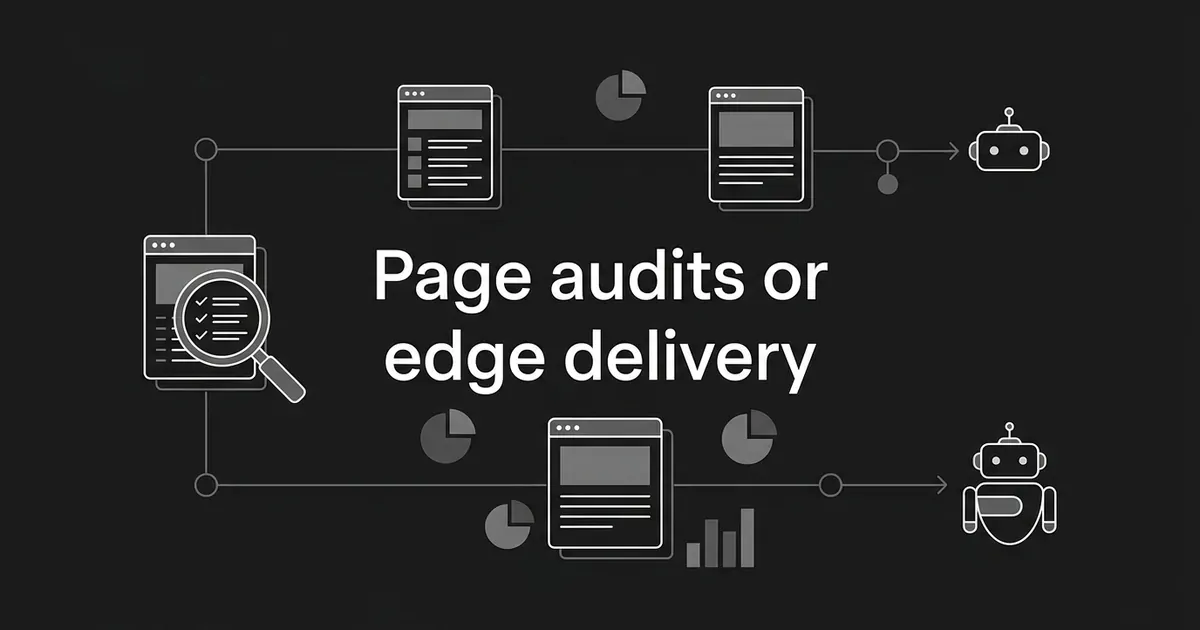
Otterly.AI wins on audit volume at the entry tier, and Scrunch wins on what it can do with the result. For Otterly.AI vs Scrunch site audits and edge delivery, that is the real dividing line.
Otterly.AI's GEO Audit tests whether robots.txt allows each of 19 AI crawlers and whether your server actually serves them. Its Content Audit scores a page on 15 structural checks and 13 AI readiness dimensions, and Lite includes 1,000 URL audits a month. Agent Analytics classifies AI bot and AI-referred visits from your logs, though only on Standard and above. Scrunch's Core plan has five site audits a month, 25 site map pages and one page optimization a month, plus Agent Traffic analytics that breaks bot visits into training, indexing and retrieval. The step Otterly.AI does not take is AXP, where Scrunch serves optimized versions of your pages to detected agents. That layer needs Enterprise and can require CDN or edge configuration, so it is a project and not a switch.
If the weak spot is how AI crawlers read your pages, either tool will find it. If the fix is to change what agents see without rewriting the site, only Scrunch does that.
What DeepSmith does: it works on the other kind of gap, where the topic has no page at all. Content Map compares your site topic by topic against competitors and flags coverage gaps and untapped topics, and the Writer produces the missing page so there is something to be cited.
Pricing and value
Otterly.AI is cheaper to start, and the two are closer than the headline prices suggest once you compare plans with similar prompt counts.
Otterly.AI Lite is $29 a month for 15 prompts, with no API or Agent Analytics. Standard is $189 for 100 prompts with unlimited workspaces, unlimited recommendations, API, MCP, Looker Studio and Agent Analytics. Scrunch Core is $250 for 125 prompts, five seats and one workspace, and it leaves out API, MCP, Looker Studio and AXP. So the fair comparison for a team that needs more than a few prompts is Standard at $189 against Core at $250, and Otterly.AI comes out lower and includes more data access. Scrunch has no annual price listed, nothing published for overages, and Agency Core is $500 a month with its limits not published. Otterly.AI's trial needs no card, while Scrunch's needs one and converts to paid unless you cancel.
What DeepSmith does: it puts tracking and production on one published price. Pro is $99 a month with 50 prompts and 20 articles, Grow is $199 with 100 prompts and 40 articles, and the 7-day trial and monthly billing carry no long-term contract.
From insight to action
Scrunch goes further than Otterly.AI, though neither one gets to a published article.
Otterly.AI turns its data into ranked recommendations across ten types, on-page and off-page, with three a week on Lite and unlimited on Standard and above. Content Audit mentions content briefs, but no page says what a brief contains. Scrunch's Content Gaps feature detects missing content for tracked prompts and turns a gap into a content brief, and its page optimizer produces optimized versions of existing pages that AXP can serve. Neither record shows a CMS publishing connection.
What DeepSmith does: it closes the loop from the gap to the live page. An Opportunity Agent returns the idea with its evidence, the idea is planned and written by the Writer in your Deep IQ voice, and the finished article goes to your CMS in one action, with social posts for the article already written. You review for strategy and editorial judgment instead of rebuilding structure, links and metadata.
Which should you choose
- DeepSmith fits marketing leads and content teams who want the whole loop in one place: find where AI answers leave them out, produce the articles that close each gap, and publish without a hand-off between tools. It suits teams growing output without growing headcount, and agencies running several brands.
- Otterly.AI fits a small or mid-sized team that wants daily tracking, audits and ranked recommendations at the lowest published price, and has writers or an agency ready to act on the findings. The choice between Otterly.AI or Scrunch tips to Otterly.AI when budget and self-serve setup matter most.
- Scrunch fits a large site with an enterprise budget and web or engineering support, where serving agent-ready page versions at the edge is the goal. The choice between Scrunch vs Otterly.AI tips to Scrunch when the site layer matters more than price.
Start a free DeepSmith trial at https://app.deepsmith.ai/auth/sign-up to see which gaps AI answers leave in your content and get the articles that close them.


