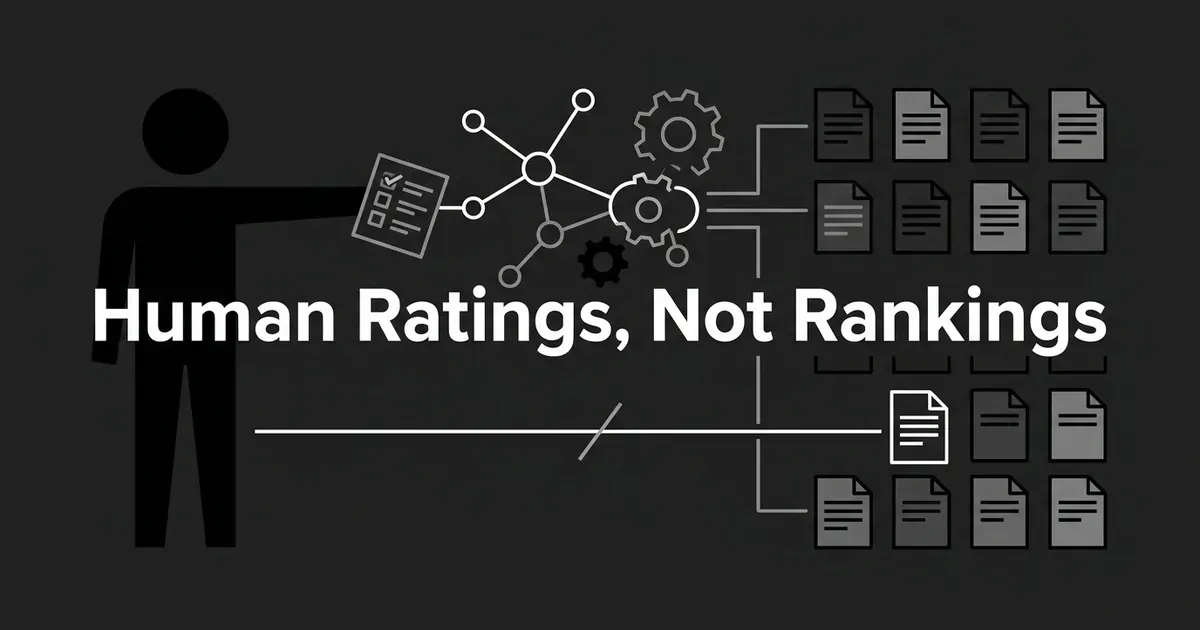
Are Google's quality rater guidelines a ranking factor? No, not as a direct input that moves an individual page up or down. Google's own documentation, updated October 5, 2026, says search raters have no control over how pages rank and that rater data is not used directly in Google's ranking algorithms. The direct-ranking version of this claim is debunked. But that is not the end of the story. Google uses human ratings to evaluate proposed changes to Search, and public evidence from a 2023 antitrust trial documents rating data being used to train specific ranking systems. The quality rater guidelines, often shortened to QRG, sit at the center of that process, and the distinction worth holding onto is where ratings matter: in developing and judging a ranking system, not in deciding any one page's live position.
This matters for anyone writing a content brief. "Follow the quality rater guidelines" gets repeated in SEO conversations as if it were a checklist with a guaranteed payoff. It isn't one. Once you see how the rating program actually works, you can use the guidelines for what they're good for, understanding what Google wants its systems to recognize, without promising a client or a boss a ranking result the guidelines were never built to deliver.
What does the QRG ranking-factor claim actually mean
The claim usually shows up in one of two forms. The weak form says human ratings have some bearing on how Google ranks results. That one holds up. The strong form, the version worth calling the QRG ranking factor claim, says a page's quality rater score, or the content choices mapped to the guidelines, directly move that page up or down in search results. That one does not hold up, and Google has said so repeatedly and specifically.
The confusion comes from treating a rubric as if it were a specification. The quality rater guidelines are instructions and examples that give thousands of raters a shared basis for judging search results and pages. They are not a published list of ranking features or weights, and they are not a formula anyone can run against a page to predict a position. Search quality raters, sometimes called Google human raters, are the people who carry out those assigned judgments, and a human rating is a judgment about one page, result, or query, made inside an assigned task. None of those three things is the same as "a direct instruction to promote or demote the rated URL."
Keep a second distinction next to the first one. Aggregated evaluation results, the measurements Google uses to assess whether a proposed change is working, are not the same as training or fine-tuning data, the examples used to adjust a model. Both exist. Neither one is a page's live rank. A useful way to hold the whole picture: the guidelines describe the outcomes Google wants its systems to recognize. They don't disclose the full machinery that produces those outcomes.
It's one entry in a long list of claimed ranking factors that get more credit than the evidence supports. Keyword density gets treated the same way, propped up by habit more than data. Content length carries a similar reputation, despite no confirmed direct effect. Dwell time gets the same treatment, named as a ranking signal without a confirmed mechanism. Meta descriptions round out the list, still debated despite no proof of a direct ranking effect.
What Google explicitly says about human raters and rankings
Start with the plainest version. Google's current Search Central documentation, updated October 5, 2026, states it directly: "Search raters have no control over how pages rank." A few lines later, the same documentation adds, "Rater data is not used directly in our ranking algorithms." Google compares the process to a restaurant reading feedback cards from diners: the cards help the restaurant understand whether its food and service are working, but no single card rewrites the menu on its own.
The guidelines document itself backs this up from the other direction, inside the instructions given to the raters who do the work. Section 0.1 of Google's General Guidelines, the edition dated September 11, 2025, tells raters: "No single rating can directly impact how a particular webpage, website, or result appears in Google Search, nor can it cause specific webpages, websites, or results to move up or down on the search results page." That line is written for the rater, not for an SEO audience, which is part of why it carries weight. Google isn't just denying the claim publicly; it's telling the people doing the rating that their individual judgment doesn't work that way either.
This isn't a new position adopted under pressure. Danny Sullivan, who writes many of Google's public search explanations, said the same thing in an October 2021 piece: raters assess whether a proposed improvement meets Google's goals, and ratings don't directly affect how a page or site appears in Search. He said it again in August 2020, explaining that pages aren't assigned ratings as a way to determine how well to rank them. Google also revised the guidelines in November 2023, simplifying definitions and adding examples, and said the changes were not a major shift, a reminder that a revision to this document is not by itself evidence of a ranking-algorithm change. Four separate statements, spanning more than three years, land on the same distinction.
How ratings evaluate proposed Search changes
If a single rating doesn't move a page, what does a rating actually do? It feeds a structured testing process, and seeing the shape of that process is what makes the "evaluation, not ranking" distinction concrete instead of abstract.
A proposed change to Search starts as a question Google wants answered: does this change make results better or worse? To answer it, Google samples a set of searches, sometimes a few hundred for a given test, and assigns rating tasks against those searches using the shared rubric in the guidelines. Two task types do most of the work. Page Quality asks how well a page achieves its purpose, and raters work through a task that includes a URL and a structured way to record what they find while exploring the page and its surrounding site. Needs Met asks something different: how useful is this particular result for this particular search, rated on a scale that runs from failing the need to fully meeting it. A page can score well on one and poorly on the other, because they're answering different questions.
Google's November 2023 overview of the rater program describes this comparison step in detail. Often, raters see two versions of a result set side by side: the current system's output and the output from a proposed change. They say which one they prefer and explain why. That comparison produces evidence about the change, not a ranking order for the URLs involved. Google then aggregates those judgments, alongside review from engineers, data scientists, and separate legal and privacy checks, before deciding whether to move forward. Live traffic experiments run in parallel, usually starting with a small slice of real users, often around 0.1 percent, to see how actual behavior, not rater judgment, responds to the change. Google's testing and evaluation page has reported figures like 719,326 search quality tests and 124,942 side-by-side experiments in a single year, alongside 16,871 live traffic experiments, numbers large enough to make clear that no individual rating task from any one of its Google human raters is carrying the weight of a launch decision on its own.
None of that process assigns your page a score that follows it into search results. It assigns the proposed system a verdict about whether it's working.
Where human ratings enter model training
Here's where the picture gets more interesting than "ratings are purely for feedback." A November 2023 trial exhibit, filed as rebuttal testimony from Professor Douglas W. Oard in the Google search antitrust case, documents something more specific: rating data being used in the training and fine-tuning of named Google ranking components. The exhibit describes RankBrain as fine-tuned on rating data, and says the same of DeepRank. It describes other systems, including a ranking integration called Term Weighting, as trained on rating data, and describes a system called Navboost as learning its parameters by trying to maximize ratings across a set of query rankings.
That's a genuinely different claim from "Google reads the feedback cards." Training and serving are two different operations, and keeping them separate is the whole key to understanding this. In a typical supervised learning setup, humans assess example outputs, those assessments supply labels or targets, a training process adjusts a model so its predictions better match the desired assessments, and the trained model then scores or interprets cases well beyond anything a human looked at directly. A rating can shape a model that later affects how millions of pages get ranked, without that rating ever becoming a permanent score attached to the one page it was about.
This is strongly supported by the public record, but it has real limits. The reviewed sources don't publish a complete mapping between every category in the quality rater guidelines and every label used in training these systems. They don't disclose what share of rating tasks feed evaluation versus training versus something else, or the current, 2026 architecture of any model named in a 2023 court exhibit. Treat the training evidence as proof that ratings do real work inside Google's systems, not as a hidden formula you can reverse-engineer from a PDF.

What the evidence means for AI search and your content process
The same evaluation habit extends to Google's newer AI search surfaces. Google's own paper on AI Overviews and AI Mode in Search says these features sit on top of core web ranking systems, and that Google used its search quality rating program and side-by-side analysis in testing them, the same tools described above, applied to a newer feature. The paper also describes AI Mode as built on core ranking and safety systems, tested internally and with opt-in users.
What that establishes is continuity: Google is reusing a human evaluation process it has run for years, now against AI-generated answers as well as traditional results. What it does not establish is a QRG-based checklist for earning an AI citation. Nothing in the public record says a page clears some human-rated threshold before it can appear in an AI Overview, and treating "resembles what a rater is asked to look for" as the same thing as "confirmed path to citation" repeats the exact category error this whole piece is about, just applied to a newer feature.
For a content process, the practical move is to stop assigning guaranteed ranking effects to individual guideline paragraphs. When a brief says "this follows the quality rater guidelines," that's a narrower and more honest claim than "this is a confirmed ranking factor," and it's the claim the evidence actually supports. Use the guidelines to understand what Google wants its systems to recognize as helpful. Don't present that understanding as a lever with a known, direct effect on where a page lands, because the people who wrote the guidelines have said, more than once, that it doesn't work that way.
This piece stays on the rating-to-ranking mechanism, not on writing guidance. A companion piece covers what the guidelines say about good content instead. Credibility markers like author bios are their own subject. The wider question of content-level E-E-A-T signals is a separate piece too.
The verdict and what would change it
The direct-ranking claim is debunked: no reviewed source supports a single rating moving a page up or down, and Google's own documentation and rater instructions say the opposite in plain language, repeated across years. The indirect-influence claim is strongly supported: public trial evidence documents rating data training specific ranking components, and Google openly describes using aggregated ratings to evaluate proposed changes before they ship. Both things are true at once, because they're answers to different questions. One is about a page's live position. The other is about how a ranking system gets built and judged over time.
What would actually overturn the first verdict is a new, authoritative disclosure that live ranking consumes an individual rater's score as a direct per-page input, something no public source currently claims. More evidence that human labels train models wouldn't move the needle on that question, because training influence is already part of the accepted picture. What would sharpen the second half of the answer is current technical documentation connecting specific rating tasks to specific training objectives and deployed models, detail Google hasn't published.
Next time a brief or a client invokes the quality rater guidelines as a reason a page should rank, it's worth separating the two claims out loud: the outcome the guidelines describe, and the mechanism someone is assuming produces it. Treating the QRG ranking factor claim as settled fact is the mistake; treating it as a myth with no basis at all is the opposite mistake. Those are rarely the same sentence, and keeping them apart is most of what this whole question comes down to.