You opened your AI visibility dashboard, saw a number move, and thought: now what?
That feeling is why most people start hunting for Rankscale alternatives. The tracking works. The next step is missing. You can see that a competitor got cited on a prompt you care about, and you still have to go build the page that wins it back.
Good news: the market has grown up. There is a real spread now, from a $29 monitoring tool to enterprise platforms that watch how AI agents crawl your site. Some of these tools measure. A couple measure and then help you act.
This guide walks through the best Rankscale alternatives for 2026: eight AEO rank trackers, what each costs, and who each one actually suits. Take it one section at a time. You only need to pick one.
How we picked these tools
A roundup is only useful if you know the rules it was scored against.
AI-engine coverage. Which answer engines get monitored, and whether they are included or sold as add-ons.
Measurement depth. Visibility, position, mentions, citations, source URLs, sentiment, share of voice, and answer history.
Prompt scale and cadence. How many prompts, responses, credits, and projects you get at each price, and how often data refreshes.
Competitive intelligence. Whether you can see which competitors win your prompts, on which exact pages.
Actionability. Recommendations, audits, optimization actions, agents, or content production connected to the data.
Workflow fit. Exports, dashboards, API or MCP access, CMS publishing, and multi-brand support.
Commercial fit. Transparent pricing, annual discounts, free trials, and where you have to call sales.
One rule matters more than the rest. A tool does not count as an AEO tracker just because it says "AI" on the homepage. The useful ones measure what AI systems say, what they cite, and how you compare with rivals. Classic blue-link rank trackers are out of scope.
This is an editorial fit ranking, not a lab benchmark. No source we found ran a controlled head-to-head test proving one platform earns more AI citations than another. Treat the order as a starting point.
Quick comparison: 8 alternatives to Rankscale
| Rank | Tool | Best for | Entry price | Core coverage or limit | Main trade-off |
|---|---|---|---|---|---|
| 1 | DeepSmith | Visibility connected to content production | $99/mo, or $80/mo billed annually | Pro: ChatGPT, 50 prompts. Scale: ChatGPT, Perplexity, Gemini, 200 prompts | Full ten-engine coverage sits at Enterprise |
| 2 | Scrunch | Enterprise citation and agent intelligence | $250/mo Core | 125 prompts, 4 LLMs, 1 country, 5 competitors | Core has limited fan-out and no enterprise integrations |
| 3 | OtterlyAI | Self-serve monitoring and exports | $29/mo, $25/mo on the displayed annual price | 15 prompts on Lite, 4 base engines | Claude, Gemini, and AI Mode are paid add-ons |
| 4 | Peec AI | Multi-engine analytics and agencies | $95/mo Brand Starter | 50 prompts, 3 selected models, 1 project, daily tracking | Extra models cost extra, no content production |
| 5 | Goodie | Revenue-linked AEO and commerce | $399/mo Explorer | 100 prompts, 3,000 responses/mo, 3 core models | Pro and Enterprise prices are not publicly displayed |
| 6 | Profound | Enterprise marketing orchestration | $99/mo billed yearly | 50 prompts, ChatGPT only, 100 agent credits/mo | Starter is narrow, API needs Enterprise |
| 7 | AthenaHQ | Prescriptive advice and exec reporting | Free Essential, Starter $295/mo | 300 credits free, 3,600 on Starter (1 credit = 1 AI response) | API access and extra credits are paid add-ons |
| 8 | Semrush AI Visibility Toolkit | Existing Semrush users | $99/mo per domain billed annually | 1 folder, 1 Brand Performance domain, 25 tracked prompts | No standalone free trial, tight prompt allowance |
These are the published figures we found while researching. Pricing and engine lists change fast, so check the vendor before you buy.
1. DeepSmith
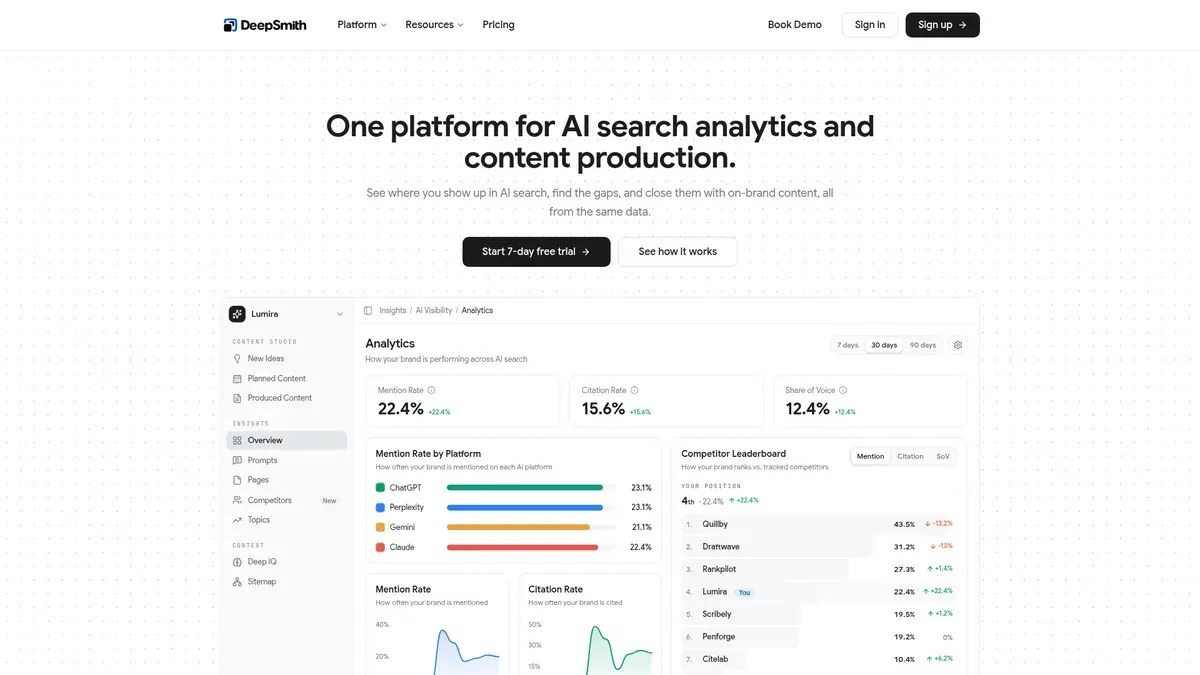
Best for: marketing leads who want AI-search measurement plus the content workflow to act on it, without stitching together a tracker, a research tool, a writer, a CMS process, and a repurposing step.
Here is the honest problem with a pure tracker. It tells you that you are invisible on twelve prompts, then it stops. You still have to write twelve articles, and that is the part that eats your month.
DeepSmith puts AI search analytics and content production in one platform. The AEO area reports mention rate, citation rate, share of voice, sentiment, and visibility trends, with a per-platform breakdown, a competitor leaderboard, and the sources AI cites most. Prompts carry per-prompt mention and citation rates plus full answer history, and Discover Prompts builds a starter set from your product, persona, and buyer-stage context. The Pages view shows which of your pages AI actually cites and which prompts drive them. Competitor citations show who wins your prompts, on which exact pages, and how each rival performs by platform.

Then the work continues. Content Map crawls your site and unlimited competitor sites, classifies every page onto a topic and a funnel stage, and surfaces coverage gaps and untapped topics. Sitemaps are re-checked every 24 hours, so new pages fold in without a re-import. Opportunity Agents read that data and hand you ideas with the evidence attached, so you can defend a backlog instead of guessing at it.
Content Studio moves ideas through New Ideas, Planned Content, and Produced Content. The Writer turns one planned idea into a finished, brand-grounded article with research, internal and external links, a cover image, and publish-ready metadata. Autowrite writes on a schedule with nobody in the app. Produced Content publishes straight to WordPress, Webflow, Strapi, Sanity, or Contentful, or to your own webhooks.

Worried it will sound like everything else on the internet? That is what Deep IQ is for. It stores your positioning, products, personas, brand voice, visual guidelines, and content types as structured context, so every draft carries your real product facts and your tone. Repurpose and the Apps Library then turn a finished article into LinkedIn, X, newsletter, Medium, Substack, and Reddit versions.
Pricing
| Plan | Monthly | Annual (billed yearly) | Articles/mo | Prompts | Seats | Engines |
|---|---|---|---|---|---|---|
| Pro | $99/mo | $80/mo | 20 | 50 | 5 | ChatGPT |
| Grow | $199/mo | $160/mo | 40 | 100 | 7 | ChatGPT, Perplexity |
| Scale | $399/mo | $299/mo | 90 | 200 | 10 | ChatGPT, Perplexity, Gemini |
| Enterprise | Custom | Custom | Custom | Custom | Custom | All 10 engines |
The ten engines are ChatGPT, Gemini, Perplexity, Claude, Google AI Overviews, Google AI Mode, Grok, Meta AI, Microsoft Copilot, and DeepSeek. There is a 7-day free trial, no long-term contracts, and no cancellation fees. Enterprise adds 1:1 expert onboarding and a dedicated account manager.
Key features
- AEO Overview: mention rate, citation rate, share of voice, sentiment, trends, competitor leaderboard, and source analysis
- Prompt monitoring with per-prompt rates, answer history, and Discover Prompts
- Pages view showing your cited pages and their share of total citations
- Competitor citation analysis by page and by platform
- Content Map for topics, funnel-stage depth, coverage gaps, and untapped topics
- Opportunity Agents that return ideas with the data point that justifies them
- Content Studio, Planned Content, Produced Content, the Writer, and Autowrite
- SEO and AEO built into production: keyword coverage, headings, schema, metadata, internal links
- Deep IQ for brand context and voice consistency
- Multi-workspace support for agencies
One honest limitation
Engine coverage is tiered. Pro tracks ChatGPT, Grow adds Perplexity, and Scale adds Gemini. All ten engines are an Enterprise capability. If you need every named platform on day one, that is a real constraint, and Enterprise is the conversation to have. For most teams it is not a blocker: you start on the engines your buyers actually use, and the money you would have spent on a second writing tool is already covered.
2. Scrunch
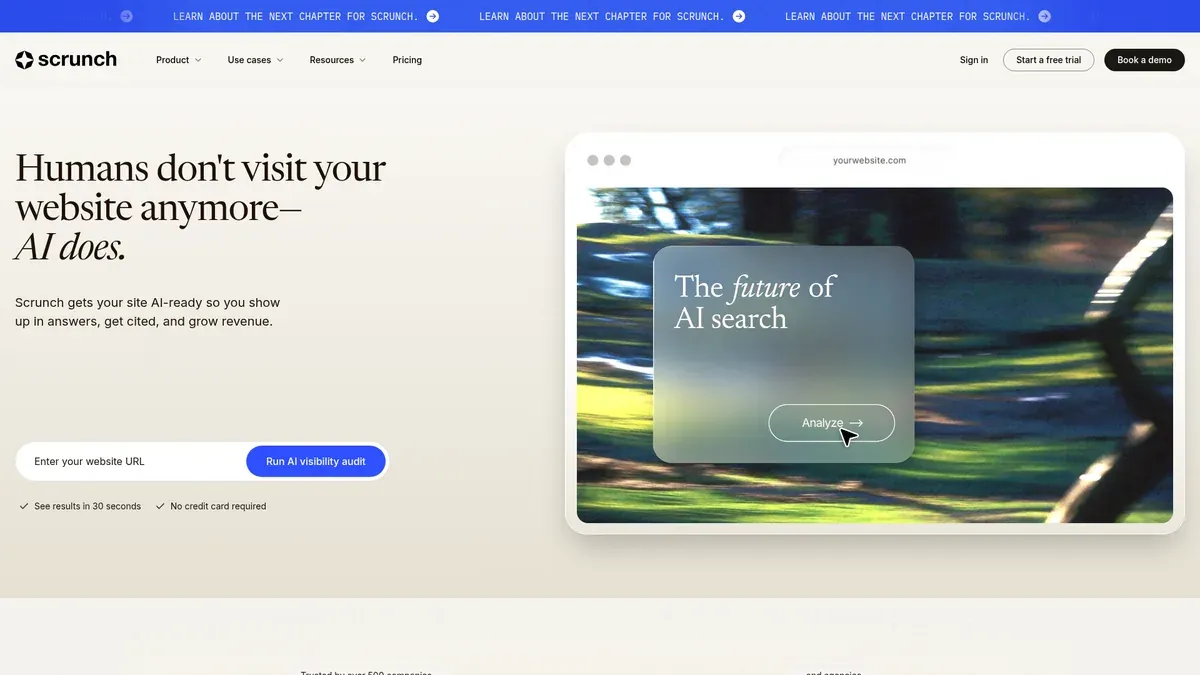
Best for: enterprise teams that need citation discovery, AI-search trends, agent behavior, site readiness, and API access for reporting pipelines.
Scrunch calls itself an AI customer-experience and AI-search visibility platform. Monitoring covers prompt results, authoritative citations, brand performance over time, changes with recommended actions, prompt volumes, topic discovery, topic share, and competitor benchmarking.
It also goes past answer monitoring. The Agent Experience Platform watches what AI agents say and do on AI platforms and on your own site, then points at optimization work. That is unusual depth if crawler behaviour matters to you.
The Scrunch Query API exposes brand presence, position, sentiment, competitor presence, citation rate, share of voice, and response counts, sliced by date, prompt, persona, platform, competitor, and source URL. The docs name Looker, Power BI, and Tableau as dashboard examples. Scrunch reports processing more than 6 million citations and 1.5 million prompts weekly, though those are company-reported figures, not an independent benchmark.
| Plan | Price | Engines | Prompts | Notable limits |
|---|---|---|---|---|
| Core | $250/mo | ChatGPT, Perplexity, Google AI Overviews, Copilot | 125 unique | 1 country, 3 personas, 2 languages, 5 competitors, 5 audits/mo, 25-page sitemap, 5 users |
| Enterprise | Custom | 9 named LLMs | Custom | Custom countries, personas, languages, competitors, workspaces |
Core includes a 7-day free trial with no credit card. Enterprise adds full site audits, product observability, advanced content generation, AXP, API access, SAML or OIDC SSO, Looker Studio, and a dedicated account team.
One honest limitation: Core is tightly bounded. One country, three personas, two languages, five competitors, a 25-page sitemap, and one page optimization per month. Most of the enterprise controls sit behind a custom quote, so Scrunch fits a buyer ready for that conversation better than a small team shopping self-serve.
3. OtterlyAI

Best for: solo marketers, small teams, and agencies that want transparent pricing, daily citation tracking, exports, audits, and API or MCP access without an enterprise contract.
If budget is the thing keeping you stuck, start here. OtterlyAI tracks brand mentions, brand coverage, domain citations, the URLs and domains cited in answers, link-position changes, and a Brand Visibility Index. Brand Report benchmarks competitors. Prompt Research surfaces prompts, topics, and intent patterns. Query Fan-out shows the related queries an engine may generate from one prompt.
On the optimization side you get crawlability checks, content audits covering structured data and AI-readiness, and prioritized GEO recommendations. ChatGPT Ads and Shopping Tracking covers ad and shopping-card appearances, and Agent Analytics identifies the AI crawlers touching your content.
| Plan | Monthly | Displayed annual | Prompts | Base engines | GEO audits |
|---|---|---|---|---|---|
| Lite | $29/mo | $25/mo | 15 | ChatGPT, Google AI Overviews, Perplexity, Copilot | 1,000/mo |
| Standard | $189/mo | $160/mo | 100 | Same four | 5,000/mo |
| Premium | $489/mo | $422/mo | 400 | Same four | 10,000/mo |
| Enterprise | From $1,000/mo | Custom | Custom | Premium plus custom | Custom |
Annual plans are advertised at 15% off. Claude, Google AI Mode, and Gemini are add-ons: AI Mode and Gemini are listed at $9, $59, or $149 monthly depending on tier, and Claude at $29, $109, or $439. Extra 100-prompt packages run $99 monthly. Standard and Premium include the Looker Studio connector, a public API, and an MCP server.
One honest limitation: the headline price is for four engines. Once you add Claude, Gemini, and AI Mode, the real monthly number moves, and prompt volume climbs steeply between tiers. It is a strong monitoring and reporting choice, and it does not produce articles.
4. Peec AI

Best for: marketing teams that want focused visibility, position, sentiment, source, citation, and share-of-voice analysis, and agencies juggling client projects.
Peec AI is an AI search analytics platform built for marketing teams. You can tag and organize prompts, add your own, take AI-suggested prompts with search volumes, compare brands, spot the sources that matter, and pull strategy advice.
One detail is worth your attention. Peec separates sources from citations. Sources are the URLs a model accessed while generating an answer. Citations are the subset actually shown or linked. That tells you not just whether you were linked, but whether the model read you at all. Peec also uses UI scraping rather than APIs for most tracked engines, a methodology note to weigh when you compare datasets.
| Brand plan | Price/mo | Prompts | Models | Projects | Countries | Refresh |
|---|---|---|---|---|---|---|
| Starter | $95 | 50 | Choose 3 | 1 | 1 | Daily |
| Pro | $245 | 150 | Choose 3 | 2 | 3 | Daily |
| Advanced | $495 | 350 | Choose 3 | 5 | 3 | Daily |
| Enterprise | Custom | Unlimited | All models | Unlimited | Unlimited | Daily or weekly |
Annual billing saves roughly 15%. Agency plans run from $245/mo for Essential (10,000 credits, 3 projects) to $795/mo for Scale (65,000 credits, 25 projects), where one credit equals one prompt tracked on one model for one day. Looker Studio arrives at Growth. API, MCP, and SSO are reserved for the Comprehensive tier.
One honest limitation: Brand plans cover three selected models, and every extra model is a paid add-on at $35 to $165 monthly. Peec also does not generate content by design, so tracker findings still need a separate production workflow.
5. Goodie

Best for: brands that want a closed loop from prompt research through visibility, optimization actions, and revenue attribution, especially in commerce.
Goodie describes itself as an end-to-end AEO platform. The workflow runs research, monitoring, optimization, and proof of revenue impact: prompt discovery, search-volume and intent analysis, visibility monitoring, mentions, citations, sentiment, competitive share, optimization gaps, prioritized actions, content generation, agent experience, and revenue attribution.
The commerce angle is where it stands apart. Goodie tracks how products appear in AI shopping experiences across ChatGPT, Amazon Rufus, Perplexity, and other surfaces, and states its architecture handles thousands of pages, SKUs, and prompts across multiple markets and languages. If you sell products and your buyers are already asking an assistant what to buy, that is the right lens.
| Plan | Price | Prompts | Responses/mo | Engines | Optimization actions/mo |
|---|---|---|---|---|---|
| Explorer | $399/mo | 100 | 3,000 | ChatGPT, Google AI Overviews, Perplexity | 10 |
| Pro | Not publicly displayed | 250 | 7,500 | Core plus Gemini, Copilot, Rufus | 30 |
| Enterprise | Not publicly displayed | 500+ | 15,000+ | Up to 11 models | 60+ |
Yearly billing is advertised at 20% off. Explorer is self-serve with a 7-day free trial and connects Google Analytics, Google Search Console, and Bing Webmaster Tools. Enterprise adds Vercel, WordPress, Cloudflare, an MCP server, and full API and export.
One honest limitation: Pro and Enterprise prices are not publicly displayed, so budgeting past Explorer means a sales conversation. Explorer also covers only three core models, so check exactly which engines your tier includes before you compare it with a broader tracker.
6. Profound
Best for: growing and enterprise marketing organizations that want AI visibility alongside prompt-volume research, agent analytics, AEO agents, and broader orchestration.
Profound positions itself as a full-stack marketing platform. Its named answer-engine coverage includes Perplexity, ChatGPT, Claude, Gemini, Grok, Microsoft Copilot, DeepSeek, and Google AI Overviews.
Answer Engine Insights analyzes how your brand shows up in AI conversations. Prompt Volumes surfaces demand and topic signals. The AEO Report covers visibility, source citations, brand sentiment, and content AEO. Agent Analytics tracks how AI systems crawl your site and reports AI-sourced traffic and attribution across domains. On top of that sit autonomous marketing agents, AEO-optimized FAQ generation, and Aim for prioritizing work. Documented integrations include Akamai, AWS, Cloudflare, Fastly, Google Analytics, Google Cloud Platform, Netlify, Vercel, and WordPress.
| Plan | Price | Prompts | Responses and credits | Engines | Seats |
|---|---|---|---|---|---|
| Starter | $99/mo billed yearly | 50 | 1,500 responses, 100 agent credits/mo | ChatGPT only | 1 |
| Growth | $399/mo billed yearly | 100 | 9,000 responses, 400 agent credits/mo | 3 engines | 3 |
| Enterprise | Custom | Tailored | Custom | Up to 9 engines | Custom |
Both paid tiers advertise two months free on yearly billing. Growth adds CSV and JSON exports. Enterprise brings API access, SSO/SAML, SOC 2, and dedicated Slack support.
One honest limitation: Starter is narrow. ChatGPT only, 50 prompts, one seat, no API, and no listed exports. Growth still tracks three engines on 100 prompts. Nine-engine coverage, multi-company support, and API access all require a custom plan, so Profound reads as an enterprise choice rather than a cheap broad tracker.
7. AthenaHQ

Best for: teams that want prescriptive recommendations, citation-source analysis, discrepancy detection, and reporting an executive will actually read.
AthenaHQ calls itself a command center for AEO and GEO. It tracks brand mentions across 11+ major LLMs, competitor visibility, mention frequency, share of voice, sentiment, citations, and citation-source opportunities. Alongside monitoring you get prompt and response analysis, an AI copilot called Ask Athena, and AthenaHQ Content, its recommendation engine.
The interesting claim is where the advice comes from. AthenaHQ says its recommendations are mapped to the passages and sources AI models actually pull from in your category, rather than generic best practice. Enterprise capabilities include multi-region support, persona targeting, executive dashboards, RBAC, audit logs, and SAML or OIDC SSO.
| Plan | Price | Credits | Engine coverage | Notes |
|---|---|---|---|---|
| Essential | Free | 300 | ChatGPT, Perplexity, Gemini, Google AI Overviews, Copilot | $25 free credit, unlimited members |
| Starter | $295/mo | 3,600 | 10 models, adding AI Mode, Claude, Grok, DeepSeek, Meta AI | $300/mo free credit, prompt-volume analysis |
| Enterprise | Custom | Custom | Expanded | Custom access controls, multi-region support |
One credit equals one AI response, which makes capacity easy to reason about. Annual billing is shown at 17% off. Integrations include Google Analytics 4, Search Console, Shopify, Webflow, and Framer, with Tableau, Power BI, and Looker at enterprise level.
One honest limitation: Starter's $295 does not include API access or extra credits. Those are paid add-ons and their pricing is not publicly displayed. The free Essential plan is a genuinely useful way to test the product, but its credits and engine coverage are much smaller than the paid tiers.
8. Semrush AI Visibility Toolkit

Best for: teams already living in Semrush who want AI visibility next to the SEO data and reports they already run.
The Semrush AI Visibility Toolkit measures how brands appear in AI-generated answers. Reports include Visibility Overview, Competitor Research, Prompt Research, Brand Performance, Prompt Tracking, and AI Search Site Audit.
Visibility Overview calculates an AI Visibility Score from your mentions relative to the median mentions of automatically identified top competitors. Competitor Research shows where rivals are cited and you are not. Prompt Research prioritizes topics by volume, difficulty, and intent. Brand Performance covers mentions, tone, attributes, share of voice, sentiment, and reputation narratives. The toolkit names ChatGPT, Google AI, Gemini, Perplexity, and Google AI Mode. Most reports update daily, Brand Performance weekly, and the site audit on demand.
| Product | Price | Coverage and limits |
|---|---|---|
| AI Visibility Toolkit Base | $99/mo per domain, billed annually | 1 folder, 1 Brand Performance domain, 25 tracked prompts, 300 daily AI Analysis queries, AI Search Checks for 100 pages, 10 CSV exports daily |
| Semrush One or SEO plus AI Search | Bundle pricing varies | Published bundles at $117.33, $165.17, $248.17, and $455.67 monthly billed annually |
| Enterprise | Custom | Unlimited projects, large-scale prompt tracking, multi-brand visibility, custom API |
Extra Brand Performance domains are $99 each and additional users start at $45/mo. The reporting layer connects to Google Analytics and Search Console, with PDF delivery and white-labeling by report tier.
One honest limitation: the standalone toolkit is constrained to one folder, one Brand Performance domain, and 25 tracked prompts before add-ons, and it does not currently offer its own free trial. The wider Semrush plan page advertises a 7-day trial, but that is not the same thing. It is the natural pick for an existing Semrush customer, and a harder sell as a first dedicated AEO purchase.
How to choose: match the tool to your actual situation
Still torn? Read the line that sounds like your week.
Most Rankscale AI competitors on this list measure well. Only a few also help you act.
Your tracker keeps handing you gaps you never get around to filling. Pick DeepSmith. The point is not a prettier dashboard. It is that a citation gap becomes an evidence-backed idea, then a planned article, then a published page, without you rebuilding the brief each time.
You need enterprise observability and BI access. Pick Scrunch. Go straight to Enterprise if you need multiple countries, wider model coverage, SAML or OIDC, or the Query API. Core is a good trial, not a good long-term home for a large team.
You have a small budget and want to start this week. Pick OtterlyAI. Start on Lite, learn what your prompts actually look like, and budget separately for the engine add-ons you end up wanting.
You are an agency with client portfolios. Pick Peec AI on an agency plan, where projects, client seats, and credits are the unit of work. Just plan a separate production path, because Peec does not write.
Revenue and commerce are the conversation with your CFO. Pick Goodie. Revenue attribution, optimization actions, AI shopping, and SKU visibility are its home ground. Ask for a Pro or Enterprise quote early, since those prices are not published.
You want agents, prompt volumes, and enterprise integrations. Pick Profound, and budget for Growth or Enterprise. Starter will not carry a team that needs broad coverage.
You need recommendations and a board-ready report. Pick AthenaHQ. Start free on Essential, then price Starter with the API and credit add-ons included, not excluded.
Your whole stack is already Semrush. Pick the AI Visibility Toolkit. The value is the continuity with reports and workflows your team already runs.
One more thing before you switch. When you weigh alternatives to Rankscale, look at the commercial model, not just the sticker price. Rankscale pricing runs on credits, where credits power monitoring and a typical query costs a fraction of a credit per engine per prompt. A credit model and a prompt-count model can look similar on a pricing page and behave very differently once you are tracking 100 prompts across four engines daily. Do the arithmetic for your real prompt list before you commit.
Ready to see where you stand?
You do not need a bigger team to compete in AI answers. You need one system that shows you the gaps and then closes them.
Start a DeepSmith free trial and get real data and real drafts before you pay. Seven days, no long-term contract, no cancellation fees. Set up your workspace, track your first 50 prompts, and see what AI says about you right now.