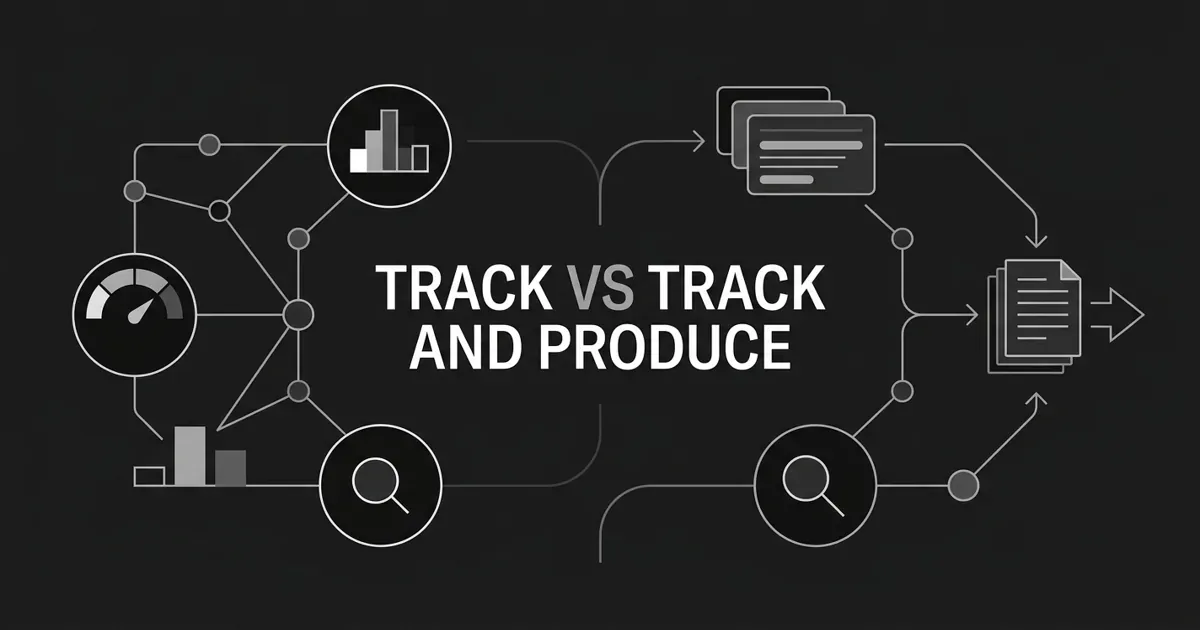
The choice framed as deepsmith vs athenahq is not a choice between two versions of the same tool. It is a choice between two adjacent jobs. AthenaHQ is a dedicated tracker: it measures how a brand appears inside AI answers and recommends what to fix. DeepSmith measures the same thing and then produces the on-brand articles that close the gaps it finds. Both belong to the category of generative engine optimization tools, and both track visibility across the major AI engines with credible depth. The decision therefore turns less on measurement quality, where the two are closer than most roundups admit, and more on where the work stops. A buyer who already trusts an existing content operation weighs this differently from one whose bottleneck is producing enough optimized pages to act on what the tracking reveals.
This comparison frames that decision by criterion: tracking, content production, engine coverage, pricing, and agency fit. It gives each option its accurate strengths and its real limitations, then closes with a recommendation by situation.
DeepSmith vs AthenaHQ at a glance
| Dimension | DeepSmith | AthenaHQ |
|---|---|---|
| Category | AI search analytics plus content production | Dedicated GEO/AEO tracker plus optimization actions |
| Core promise | See gaps, then close them with publish-ready content | Measure visibility and recommend optimizations |
| Engines (entry tier) | ChatGPT | ChatGPT, Perplexity, Google AI Overviews, Gemini, Claude |
| Engines (top tier) | Ten (Enterprise and Custom cover all ten) | Nine (adds Copilot, Grok, Meta AI) |
| Content production | Native Writer and Autowrite, publish-ready output | Briefs and drafts, reviewers report heavy editing |
| CMS publishing | WordPress, Webflow, Strapi, Sanity, Contentful, webhooks | Not documented at parity |
| Free access | 7-day free trial | Permanently free Essential tier |
| Cheapest paid plan | $99 per month (or $80 per month annual) | $295 per month |
| Best fit | Teams whose bottleneck is producing content | Teams that want tracking and already produce content |
The rows above compress the full analysis that follows. Two entries deserve early qualification. AthenaHQ leads on raw engine count at entry, which matters to buyers who need broad monitoring immediately, though the order reverses at the top tier, where DeepSmith covers ten engines to AthenaHQ's nine. DeepSmith also leads on production, which matters to buyers who need the measured gaps turned into published pages without a second tool.
The category: what generative engine optimization tools actually do
The tools in this space divide into three capability layers, and the division explains most of the difference between these two products. The first layer is measurement: mention rate, citation rate, share of voice, source attribution, and competitor benchmarking, tracked across engines on a schedule. The second is recommendation: on-page and off-page guidance about what to change, which pages to target, and where to seek off-site mentions. The third is production: drafting and publishing the articles designed to win the tracked prompts.
Most products in the category concentrate on the first layer. A smaller set adds the second. Fewer span all three. Understanding which layer a buyer most needs is the fastest way to resolve the deepsmith or athenahq question, because AthenaHQ is strongest in the first two layers and DeepSmith is distinguished by carrying the same data into the third. Readers weighing the wider field, rather than this single head-to-head, will find the trade-off between measurement-only trackers and full-stack platforms is the organizing distinction across the whole category.
AthenaHQ at a glance

AthenaHQ positions itself around the line "Agents to Win on AI Search," and its center of gravity is monitoring plus action. The product tracks prompt-level mention and citation rates, analyzes which sources AI engines draw from, and benchmarks a brand against competitors. Its Action Center converts that monitoring into recommendations: on-page changes, off-page targets such as relevant subreddits, angles for competing against pages that currently win citations, and an outreach generator. A set of action agents can perform some optimizations on existing pages, and the reporting layer leans toward executive dashboards and return-on-investment framing intended for board-ready presentation.
AthenaHQ also includes content tooling. It generates briefs and drafts, accepts brand-guideline input, and offers a repurposing function. This is the layer where independent reviewers are most critical. Several describe the generated drafts as generic and requiring substantial editing before they are publishable, and they characterize the sentiment, share-of-voice, and competitive analytics as comparatively basic against the depth of legacy SEO suites. Reviewers also note that some of the more advanced capabilities, including a recommendation engine and a citation engine, are gated to the Enterprise tier, and that the entry price sits higher than several category peers. These are observations from third-party reviews rather than vendor claims, and they should be read as directional signals about fit, not settled verdicts.
For a buyer whose need is a capable athenahq geo tool with broad engine coverage from its entry tier and strong reporting, sitting on top of a content process they already run, these limitations may not bind. The drafts do not need to be excellent if the team was never going to publish from them.
DeepSmith at a glance

DeepSmith is one platform for AI search analytics and content production, and on the production half it is a production engine, not a writing assistant: the output is publish-ready, not a first draft to rescue. The platform is organized into several modules that share one brand-context layer. The visibility module tracks mention rate, citation rate, share of voice, sentiment, and trend across engines, with a per-platform breakdown, a competitor leaderboard, and a view of which pages actually earn citations. A Content Map module turns the brand's site and its competitors' sites into one topic map, surfacing coverage gaps and the topics where a rival publishes and the brand has nothing.

The production modules are where the platform diverges from a pure tracker. A writer turns a planned idea into a finished, brand-grounded article with research, internal and external links, a cover image, and metadata built in during creation rather than added afterward. An Autowrite function can schedule articles to generate on set dates and land ready for review with no one in the app. A distribution layer converts each finished article into platform-native versions for channels such as LinkedIn, X, Medium, Substack, newsletters, Reddit, and more. Grounding for every module comes from a structured brand-context store holding product details, persona, brand voice, visual guidelines, and reusable content-type formats.

DeepSmith operates within stated boundaries. It tracks mention and citation across its covered engines but does not promise rankings, citations, traffic, or revenue outcomes, and its publish-ready output assumes configured brand context and a review step rather than guaranteeing quality with zero oversight. The honest framing is that DeepSmith does more of the workflow, not that it removes judgment from it.
Tracking compared
On the measurement layer, the two products are closer than their positioning suggests. Both track mention and citation at the prompt level, both attribute citations to specific pages, and both benchmark against competitors. The metrics that matter for a visibility program, mention rate, citation rate, and share of voice, are present in each. Buyers evaluating either tool should decide which of these metrics they will actually act on, because a tracker is only as useful as the decisions it drives.
Two differences are worth weighing. The first is engine breadth, examined in its own section below. The second is analytic depth. Reviewers describe AthenaHQ's competitive and sentiment analytics as comparatively basic, while DeepSmith's visibility views combine share-of-voice benchmarking with a competitor leaderboard and page-level citation attribution inside the same interface that feeds production. Neither product has the multi-year historical depth of an established SEO suite, since both are recent entrants to a young category, so trend analysis over long windows is a constraint for both rather than a point of separation. For teams whose priority is a defensible competitive benchmark, the practical test is whether the tool holds the prompt set and engine set constant between runs, which is what makes period-over-period comparison meaningful rather than an artifact of a shifting question set.
Content production compared
This is the clearest line of separation between the two, and the reason most deepsmith or athenahq decisions resolve here. AthenaHQ produces briefs and drafts as a secondary capability; DeepSmith treats production as half the product. The difference is not merely that DeepSmith generates more text. It is that the output is designed to be published, and the surrounding workflow, internal linking, metadata, cover image, and CMS handoff, is inside the same product.
Internal linking is the sharpest illustration. In a conventional workflow, cross-referencing a new article against an existing site is manual work that consumes real time per piece and is often skipped under deadline. DeepSmith scans an enriched sitemap and places contextually relevant internal links during drafting, which removes that step rather than recommending it. The platform then publishes directly to WordPress, Webflow, Strapi, Sanity, Contentful, or webhooks, with Markdown and HTML export as a fallback. AthenaHQ's publishing parity across content-management systems is not documented, which suggests the last mile, moving an approved draft into a live page, runs through the team's existing process.
The fair reading is that this separation only matters if production is the bottleneck. A team with a reliable writing operation gains little from an in-product writer and may prefer a focused tracker. A team that identifies more gaps than it can publish against gains the most, because the measurement is otherwise trapped as insight that never ships. The value of closing that loop scales with how much of the identified backlog would otherwise go unwritten, and with how quickly the team needs those pages live.
Engine coverage compared
Engine breadth is the dimension where AthenaHQ leads at the entry point. Its free Essential tier covers five models, ChatGPT, Perplexity, Google AI Overviews, Gemini, and Claude, and its paid tiers add Copilot, Grok, and Meta AI for nine total. DeepSmith scales coverage by plan: the Pro tier tracks ChatGPT only, Grow adds Perplexity, and Scale adds Gemini, while the Enterprise and Custom tiers cover all ten engines, ChatGPT, Gemini, Perplexity, Claude, Google AI Overviews, Google AI Mode, Grok, Meta AI, Microsoft Copilot, and DeepSeek.
The difference is therefore a tier question rather than a coverage absence. A buyer who specifically needs Copilot, Grok, or Meta AI can get all three from either product: on AthenaHQ from its paid tiers, on DeepSmith from Enterprise, which also brings Google AI Overviews and DeepSeek for ten in total. Below that line AthenaHQ covers more ground at a given price point, and for a buyer whose audience concentrates on the mainstream engines, ChatGPT, Perplexity, and Gemini, the gap narrows and the production capability becomes the deciding factor. AthenaHQ's entry breadth is a real advantage, but it is most decisive for teams that need the additional engines immediately and cheaply rather than for teams optimizing where attention currently concentrates.
Pricing compared
The pricing structures reflect the two products' different centers of gravity.
| Plan | DeepSmith | AthenaHQ |
|---|---|---|
| Free | 7-day free trial | Free Essential tier (5 engines, roughly 300 credits) |
| Entry paid | Pro, $99 per month (or $80 per month annual) | Starter, $295 per month |
| Mid paid | Grow, $199 per month (or $160 per month annual) | Not published |
| Top published | Scale, $399 per month (or $299 per month annual) | Not published |
| Enterprise | Custom | Custom |
Two structural differences stand out. AthenaHQ offers a permanently free monitoring tier, which is valuable for a team that wants to watch its visibility before committing budget; DeepSmith's free window is a 7-day trial that includes real data and drafts but does not persist. On paid entry, DeepSmith's Pro plan starts well below AthenaHQ's Starter plan, though the two are not like-for-like: the DeepSmith Pro tier tracks a single engine while AthenaHQ Starter covers nine, so the cheaper plan is narrower on tracking and broader on production. A buyer treating price as the primary axis of a deepsmith vs athenahq decision should hold the specific capabilities constant before comparing the numbers, because the plans bundle tracking and production in different proportions. AthenaHQ annual or promotional pricing is not publicly listed, so the annual comparison cannot be made with confidence.
Agencies and multiple brands
Agencies weigh a different set of criteria, because the unit of work is a client rather than a single brand. DeepSmith offers a multi-workspace structure in which each brand or client is isolated with its own context, content, and billing, which suits an agency running production across several accounts. AthenaHQ offers a pitch workspace oriented toward building prospect-facing AI-search performance reports, which suits agencies whose immediate need is winning and reporting to clients rather than producing content inside the tool.
The distinction mirrors the broader one. If the agency's deliverable is a monitoring and recommendation report, AthenaHQ's reporting and pitch tooling is aligned. If the deliverable includes producing and shipping content across many client brands, the isolated-workspace-plus-production model fits the operating reality more directly. Agencies deciding between the two are effectively deciding whether their product is a report or a published page.
Who each tool is best for
The recommendation follows from where each product's strength lands against a team's actual bottleneck.
Choose AthenaHQ when the primary need is a dedicated tracker with broad coverage below Enterprise pricing, when a permanently free tier for initial monitoring is valuable, when executive dashboards and return-on-investment reporting are what stakeholders ask for, or when the team already runs a content operation it trusts and mainly needs to know where to point it. AthenaHQ is a credible athenahq geo tool for teams whose gap is visibility, not production.
Choose DeepSmith when the bottleneck is production volume, when the goal is to turn measured gaps into publish-ready pages without stitching a tracker to a separate writer and a manual CMS handoff, when scheduled and unattended article generation keeps the calendar moving, or when distribution into channel-native formats matters to how content earns reach. A team evaluating DeepSmith as an athenahq alternative is usually one that has concluded measurement alone does not move the metric, and that the constraint is the number of optimized pages it can ship.
The practical tie-breakers are narrow. If internal linking is the production bottleneck, DeepSmith's automatic in-draft linking is materially faster than manual cross-referencing. If broad engine coverage from day one is non-negotiable and Enterprise pricing is out of reach, AthenaHQ Starter covers more engines than any published DeepSmith plan, at a higher monthly price; at Enterprise the position reverses, since DeepSmith covers all ten. If a permanently free monitoring tier matters more than a free trial, AthenaHQ Essential persists where the DeepSmith trial does not. None of these tie-breakers overrides the central question, which is whether the team needs a tool that measures or a platform that measures and produces.
Start with your bottleneck, not the feature list
The most reliable way to choose is to name the constraint first. A team that cannot see where it stands in AI answers needs measurement, and either product supplies it. A team that can see the gaps but cannot publish against them fast enough needs production, and that is where the two diverge. DeepSmith is built for the second case: measurement and publish-ready content in one workflow. Teams that want to test that loop against their own data can begin with a DeepSmith free trial and evaluate the tracking and the drafts on real pages before committing.