Every new logo should feel like a win. If it mostly feels like starting over, you are not alone. Most agencies rebuild the whole process for each account: a new brief format, a new voice doc, a new spreadsheet, a new set of habits that live in one strategist's head.
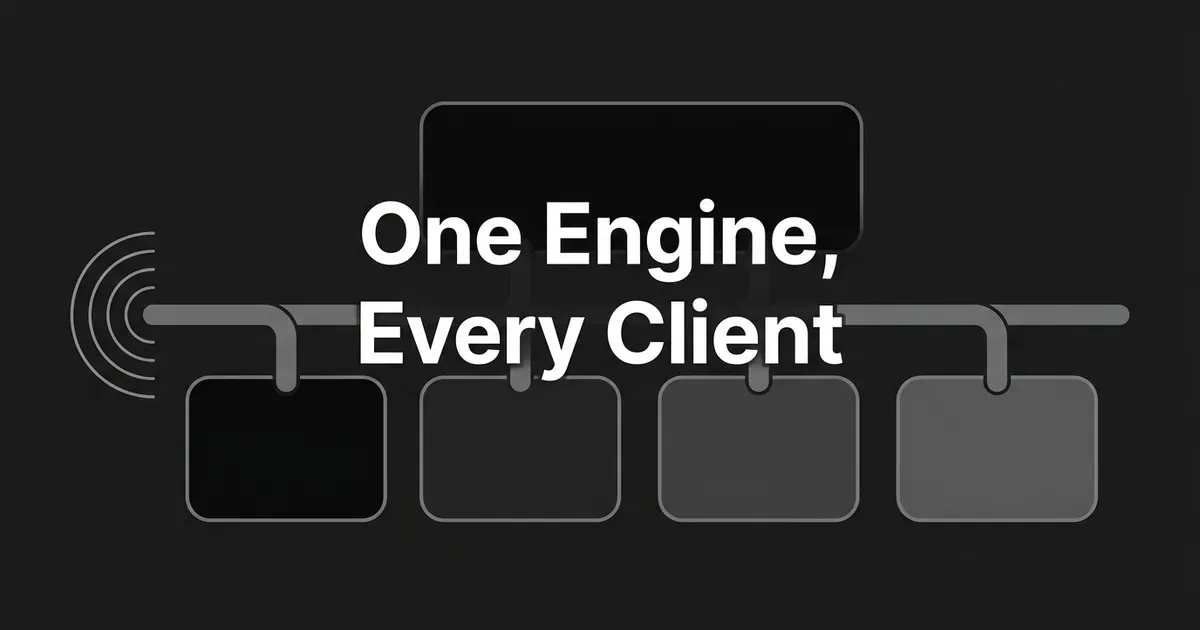
Here is the good news. You do not need a new process per client. You need one process with a client-specific layer bolted onto it. That is the whole idea behind a content engine for agencies, and this guide walks you through building one in eight steps.
By the end you will have a shared workflow that every account runs on, isolated context so no client's voice bleeds into another's draft, and one quality gate you can apply everywhere. Let's start.
Step 1: Write your shared operating contract before you touch a tool
Take a breath. Before configuring anything, write down the path every single piece of content follows, no matter which client it belongs to.
Keep it short. Nine stages is plenty:
- Pick a buyer question, content gap, or visibility opportunity.
- Confirm the client and the buyer stage.
- Choose the content type.
- Research the topic using approved sources.
- Produce the article using that client's stored context.
- Run the shared QA checklist.
- Publish to the client's destination.
- Generate distribution assets.
- Record the result and pick the next piece.
Then list the fields that are the same for everyone: content type, audience, buyer stage, the core question, evidence needed, internal-link requirement, external-source requirement, metadata rules, distribution formats, QA status, and refresh trigger.
Notice what is not on that list. No positioning. No product claims. No voice. Those belong to the client, not to the contract.
This is what people mean by a governance framework, and it is less scary than it sounds. A style guide, a few templates, an approved terminology list, a documented workflow, clear ownership, and one review stage. That is it.
Done looks like: a repeatable content system agency owners can hand over. A strategist who joined last week reads the contract and can tell you what starts a content item, what must be true before writing begins, what gets checked before publish, and which fields are global versus client-owned. If your process only exists in someone's memory, it is not a system yet.
Where people go wrong: standardizing the wrong half. It is tempting to write one shared brand prompt and reuse it everywhere, because it feels efficient. It is the fastest way to get one client's proof points into another client's draft. Standardize the workflow. Never standardize the identity.
Step 2: Give every client its own workspace
One client, one workspace. No exceptions, even when two accounts sell to the same market.
The workspace is your boundary. Everything account-specific lives inside it: brand context, products and services, buyer personas, competitor set, tracked prompts, content ideas, planned content, produced content, and reporting.
This is where a lot of agency content operations quietly break. Two clients in similar industries get merged into one setup to save admin time, and within a month a strategist is guessing which competitor list belongs to which brand.
Similar industries do not mean identical positioning, products, terminology, or competitors. Keep them apart.
DeepSmith is built for exactly this shape. One account runs multiple client workspaces, each fully isolated with its own context, content, and plan. Plans are billed and limited independently by workspace, so you can put a smaller client on Pro at $99 a month and a heavier account on Scale at $399, rather than buying the top tier for the whole roster.
Give your workspaces a naming convention so nobody has to guess. Something like Client name | market | workspace owner works fine. That is an agency habit, not a product rule, so pick whatever your team will actually follow.
Done looks like: you can answer yes to all of these. The client has its own workspace. Its content queue is separate. Its tracked prompts are separate. Its competitors are separate. Its brand context is separate. Anyone on the team can name which workspace owns any draft on the board.
Where people go wrong: treating the boundary as automatic. A workspace only helps if your team stops copying client facts between accounts by hand. Make "which workspace am I in" an explicit first step before ideation, writing, publishing, and reporting.
Step 3: Load and validate each client's source of truth
This is the step that decides whether you can scale content across clients or spend every week re-briefing writers.
Build the client brief once. Then improve it, rather than rewriting it per article.
Capture four blocks:
Identity and positioning. Company description, category, positioning, differentiators, claims the client wants to make, claims they refuse to make, and approved sources.
Products and services. For each one: category, features, value props, use cases, the buyer problem it solves, competitors, product terminology, and evidence for any important claim.
Buyer personas. Goals, buying triggers, requirements, challenges, objections, desired outcomes, the value props that actually land, and buyer stage.
Voice and content rules. Tone, formality, sentence and paragraph preferences, words to use, words to avoid, technical depth, and examples of writing the client already loves. Then the content rules: supported content types, preferred structure, trusted sources, internal-linking rules, metadata conventions, visual guidelines, and who needs to review sensitive topics.
That is a lot to hold in a folder of docs. This is where DeepSmith's Deep IQ does the work: it stores positioning, product profiles, buyer personas, brand voice, visual guidelines, and content types as structured records inside each client's workspace, set up from the client's website during onboarding and refined as you learn more. Every draft in that workspace is grounded in those records, so you are not pasting a voice guide into a prompt every time.

Now validate it before you produce anything. Ask the system, or the writer, six questions:
- Summarize this client's positioning.
- What are the products and their main use cases?
- Which claims are prohibited or unsupported?
- Who is the target persona, and at what buyer stage?
- What voice should this sound like?
- Do those answers match the approved brief?
If an answer is wrong, fix the source of truth. Do not paper over bad context by stuffing more instructions into every individual request. That habit does not scale, and it is the thing quietly eating your margin.
Done looks like: you hand the same topic to two different client workspaces and get two genuinely different drafts. Different positioning, different product facts, different persona, different voice. The topic can be shared. The answer cannot.
Where people go wrong: treating a website crawl as a finished brand brief. The site is a starting point. Positioning, claims to avoid, buyer objections, terminology, and voice almost always need a real conversation with the client before they are right.
Step 4: Map buyer prompts and pick opportunities per client
Now you decide what to write, and you decide it from evidence rather than a hunch.
Start with the questions buyers actually ask, not a keyword list alone. Spread them across three stages so your tracked set does not pile up in one place:
- Awareness: the buyer is learning about a problem or a category.
- Consideration: the buyer is comparing methods, vendors, or approaches.
- Decision: the buyer is weighing specific products, pricing, implementation, or risk.
For each client, build a prompt set that covers category questions, problem questions, how-to questions, comparisons, alternatives, product questions, objections, implementation and risk questions, and competitor questions where they make sense.
Then choose what to produce from real signals:
- Prompts where the client is never mentioned.
- Prompts where the client is mentioned but not cited.
- Prompts where a competitor takes the citation instead.
- Client pages nobody is citing.
- Topics where a competitor's coverage is deeper.
- Topics where the client has nothing at all.
- Existing pages that need a refresh rather than a new article.
That mention-versus-citation distinction matters more than it looks. A mention names the brand. A citation links to one of the brand's pages as a source. An answer can easily do one without the other, and the fix is different in each case.
Done looks like: every planned article carries a named client, a persona, a buyer stage, a specific question, a reason it is in the queue, the evidence behind that reason, a content type, and a definition of what success would look like. A shorter queue of defensible ideas beats a long list of generic topics every time.
Where people go wrong: selling visibility tracking as a promise. Tracking tells you what engines are answering today, which sources they lean on, where competitors show up, and which gaps deserve work. It does not guarantee your client a citation. Say that out loud to clients early, and you will never have to walk it back later.
Step 5: Run the same research-to-draft pipeline for every account
Same twelve moves, every client, every time:
- Pick a validated idea.
- Confirm the workspace.
- Confirm persona and buyer stage.
- Confirm content type.
- Research the topic.
- Build the outline.
- Draft using the client's stored context.
- Optimize for readability, SEO, and AEO.
- Add internal and external links.
- Add metadata and cover-image direction.
- Move it into the production queue.
- Send it through the QA gate.
The point of a fixed sequence is not rigidity. It is that a strategist reviewing a draft always knows what has already happened to it, so review becomes judgment instead of archaeology.
This is where a multi-client content workflow either earns its keep or falls apart. If internal linking, metadata, and SEO structure get bolted on after drafting, someone does that by hand for every account, and that cost grows with your roster.
DeepSmith's Writer takes a planned idea through research, outline, draft, on-page SEO, internal and external links, a cover image, and publish-ready metadata in one pass, grounded in that workspace's stored context. Internal links are drawn from the client's own sitemap during drafting rather than added later. Content Studio then moves the piece through named stages, New Ideas to Planned Content to Produced Content, so you can see the whole roster's pipeline in one place.
Treat the output as near-final, not as permission to skip review. Review before publish is a step in the system, not an optional extra.
Done looks like: a finished production item has a clear answer near the top where the format calls for one, a structure that suits the content type, client-specific positioning and product facts, real evidence, internal and external links, metadata, a cover image decision, a distribution plan, and a QA status.
Where people go wrong: measuring scale by article count. High volume that produces repetitive, thin, or inaccurate pages is not a durable engine. It is a cleanup project waiting to happen.
Step 6: Apply one reusable QA gate to every account
One checklist. Shared stages, client-specific values. Short enough to run every time, strict enough to catch real errors.
Run it in four passes.
Context and facts. Is the right workspace selected? Are the company, product, persona, and competitor names correct? Are capabilities and limits accurate? Are claims backed by approved sources? Are prohibited claims absent? Has anything from another client crept in?
Audience and usefulness. Is the intended reader obvious? Does the piece answer their question directly? Does it add original analysis, explanation, or instruction? Does it go beyond rewriting a competing page? Is there enough detail to actually finish the task? Google's people-first guidance is a useful bar here: original information, substantial coverage, real expertise where it matters, accuracy, and a satisfying experience for the reader.
Brand. Does this sound like this client? Are the positioning and differentiators clear? Are the right product names used? Here is the sharpest test in the whole checklist. Swap the client's name for a competitor's. If the article still reads fine, the positioning is too generic.
SEO and AEO. Does the title describe the page honestly? Does the opening answer the core question fast? Are headings descriptive and in a sensible order? Is it scannable? Are internal links present and relevant? Are external sources used where the claim needs them? Does the metadata match the visible page? Does structured data match visible text? Google is clear that ordinary SEO fundamentals still apply to AI Overviews and AI Mode: a page has to be indexed and eligible in normal Search to be eligible as a supporting link, and there are no special AI files or AI-specific schema to add.
Then one human pass. Is this genuinely useful? Is anything legally sensitive, regulated, or likely to mislead? Does it need a subject-matter reviewer? Is the author or reviewer clear where a reader would expect one?
Pro tip: when QA catches the same mistake twice, do not just fix the article. Update the client context, the shared template, or the checklist itself. That is how a correction becomes a permanent improvement instead of a recurring tax.
Done looks like: every account runs the same QA stages and definitions. Only the values change: approved terminology, facts, voice, sources, and risk level.
Where people go wrong: mistaking a completed checklist or a green SEO score for editorial quality. A technically perfect article can still be generic, inaccurate, or useless.
Step 7: Schedule, publish, and repurpose by client
A content engine for agencies is not finished at the draft. It is finished when the client has a package in hand.
For each published piece:
- Confirm the destination CMS and the client account.
- Review title, body, links, metadata, and image.
- Publish or hand it to the client's CMS.
- Generate channel-native distribution assets.
- Record the source article and the channels used.
- Add it to the refresh queue.
Publishing goes straight to WordPress, Webflow, Strapi, Sanity, or Contentful, or to your own webhooks, with Markdown and HTML export as a fallback for anything unusual. Repurposing turns the finished piece into platform-native versions for LinkedIn, X, Medium, Substack, newsletter and nurture email, Reddit, Facebook, Instagram, Slack, WhatsApp, and more, written in that client's stored voice. Autowrite goes one step further: configure an article at planning time and it writes itself on its scheduled date and lands in Produced Content, with nobody in the app. That is what turns a content plan into a system that runs on its own between your review sessions.
Done looks like: every client's article produces a predictable delivery package. Published or publish-ready article, metadata, internal and external links, a cover image, channel assets, publication status, and a next refresh date or trigger.
Where people go wrong: repurposing before checking. One unsupported claim in the article becomes the same claim on eight channels. Distribution sits downstream of QA, never instead of it.
Step 8: Watch visibility and feed it back into the engine
Last step, and it is the one that turns agency content operations into a loop instead of a line.
Track each client's mention rate, citation rate, share of voice, sentiment where you have it, visibility trend, per-prompt answer history, which pages get cited, which pages get ignored, which competitor pages win citations, and where competitor coverage runs deeper.
DeepSmith runs your tracked prompts on a schedule, captures the answers, and reports mentions and citations separately, with per-page attribution and competitor comparisons across engines. Pro covers ChatGPT, Grow adds Perplexity, Scale adds Gemini, and Enterprise covers all ten named engines, so you can match coverage to what each client needs.
Then turn what you see into the next decision:
- No mention: check whether a relevant, genuinely useful page exists at all.
- Mention but no citation: make the page more useful, clearer, better evidenced, easier to quote.
- Competitor cited instead: read their page as evidence about coverage, not as something to copy.
- Client page cited: work out what it does well and apply that lesson selectively.
- Outdated product fact in an answer: update the client context and the affected pages.
- Coverage gap: create or refresh content at the missing buyer stage.
Keep a refresh rhythm too. Review cycles, clear ownership, update procedures, and scheduled audits turn maintenance into normal operations rather than an annual panic.
Where people go wrong: presenting movement as proof of causation. A new article can be genuinely good without moving an AI answer this month, and answers change for reasons that have nothing to do with you. Report what you observe, and use it to pick the next piece of work.

What to do next
You do not have to roll this out across the whole roster on Monday. That is the fastest way to abandon it.
Pick one or two accounts. Run the eight steps end to end on a handful of pieces. Write down every exception you hit, because those exceptions are the difference between a template that survives contact with clients and one that gets quietly ignored.
Then take the version that survived and apply it to the next account. And the next. That is how a repeatable content system agency teams actually keep gets built: one account at a time. Momentum matters more than perfection here.
If you want the engine to sit in one place rather than across six tools, start a free DeepSmith trial. It is 7 days, with real data and real drafts before you pay, no long-term contract, and you can point it at a single client workspace to see whether the shape fits your agency before you move anyone else.